Tesla Solar Roof is discontinued. What should California homeowners install instead? (2026)
Tesla dropped the Solar Roof in August 2026 and now sells its US-made 420 W panels and Powerwall 3 through Certified Installers; a new roof plus conventional panels costs a fraction of what a tile roof did and produces more per dollar.
By Taylor Crouse — Founder, Helios Energy GlobalPublished
Quick answer
- Tesla discontinued the Solar Roof in August 2026, per Electrek's August 26 rundown of Tesla's solar business; it had installed only about 3,000 tile roofs in the US through 2022.
- Tesla now sells residential solar mainly through more than 7,000 Certified Installers, using its US-made 420 W panel (launched January 2026, built in Buffalo) and the Powerwall 3.
- For a California home the three real alternatives are: a new roof plus conventional panels, Tesla panels + Powerwall 3 through a Certified Installer (Helios is one), or an all-black, low-profile array on your existing roof.
- Cost reality: rooftop solar in California runs about $2.50–$3.50 per watt installed; a Solar Roof was a whole-roof product priced far above that on a per-watt basis.
- Existing Solar Roof owners keep their Tesla warranty; the product line ending does not void it.
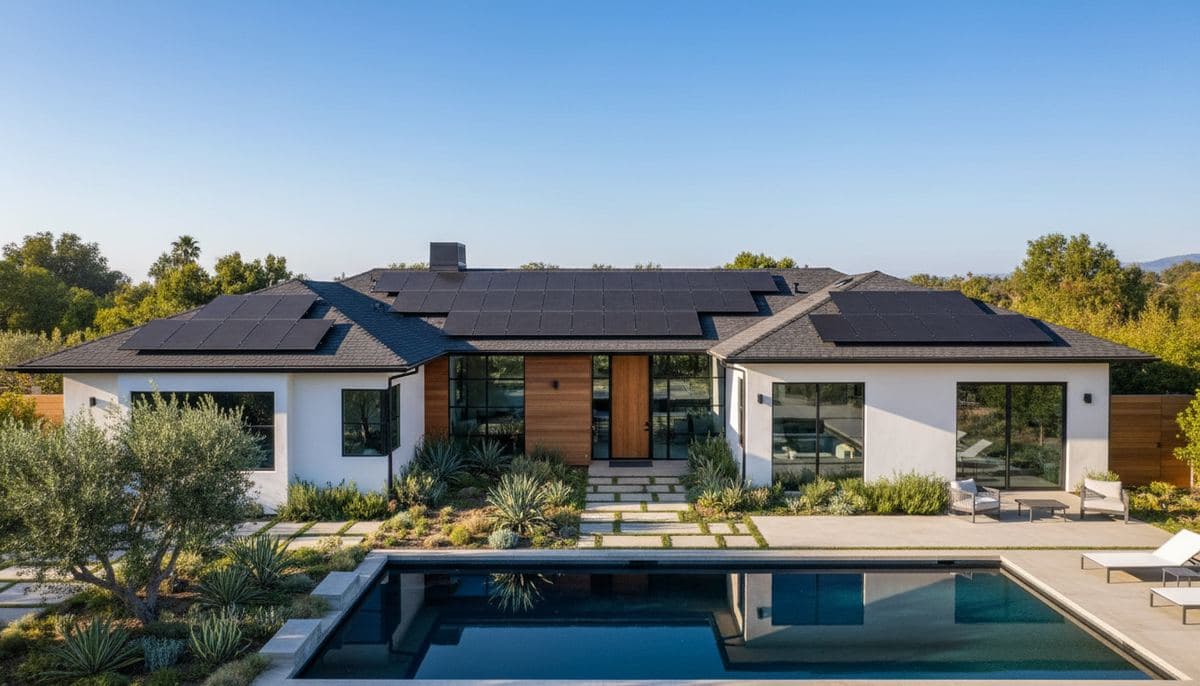
Tesla's Solar Roof — the glass-tile roof with solar cells built into some of the tiles — is gone. If you were waiting on a quote, or you liked the idea of a roof that is the solar system, the good news is that the alternatives are cheaper per watt, produce more, and are installed by the same certified network Tesla itself now relies on. Here is what actually happened and what to do about it.
Last verified: September 2026 by Helios Energy Global.
What Tesla changed in 2026
Three moves, all reported in Electrek's August 26, 2026 overview of how Tesla's solar business works now:
- Solar Roof discontinued earlier in August 2026. The product never reached scale — roughly 3,000 tile roofs installed in the US by the end of 2022, about 0.17% of residential installs that year — because it was a full re-roof with a premium price and a slow, specialized install.
- Tesla stepped back from installing itself. Outside a handful of direct-service territories, Tesla now routes residential solar and Powerwall sales through third-party Certified Installers; it lists "more than 7,000 installers in 35-plus countries." Helios Energy Global is a Tesla Certified Installer for Southern California.
- A Tesla-made panel. In January 2026 Tesla launched a 420 W solar panel assembled at its Buffalo, New York factory — the first panel it fully designed and manufactured, all-black, with integrated mounting. Per the datasheet, the TSP-420 measures 71.1 × 44.7 × 1.57 in, weighs 49 lb, and is rated at 20.5% efficiency or better. Electrek reports Tesla's base cash price at roughly $2.30 per watt before installation and incentives.
So the "Tesla look" — an all-black roof with no visible hardware — is still available. It is just a panel product now, installed by installers like us, rather than a roof product installed by Tesla.
Alternative 1: a new roof plus conventional solar panels
If your roof needs replacing anyway, this is the closest substitute for what the Solar Roof promised — a new roof and a solar system in one project — at a fraction of the price.
- Roof: a composition-shingle re-roof on a typical Southern California home runs well under what a Solar Roof did; our roof replacement cost page has the current ranges by roof type and county.
- Solar: about $2.50–$3.50 per watt installed for a conventional array, per our solar panel cost guide. A 7 kW system therefore lands around $17,500–$24,500 before financing.
- Coordination: Helios pairs vetted, licensed roofing partners with our solar install so the flashing, penetrations and warranties line up — that is the solar plus new roof package. The roofer is the licensed roofing contractor; we sell, design and coordinate the combined job.
Two cautions. First, the 30% homeowner tax credit expired December 31, 2025, so a cash purchase of either the roof or the panels gets no federal credit; roughly 30% off the top is still available on the solar through a prepaid lease, where the financier owns the system for five years and ownership transfers to you at the start of year six at essentially no cost. Second, the roof itself never qualified for the solar credit even when the Solar Roof existed — only the solar-generating portion did.
Alternative 2: Tesla panels + Powerwall 3 through a Certified Installer
This is the direct replacement if what you wanted was a Tesla system. The 420 W Tesla panel is a standard-format module — it goes on your existing roof with Tesla's integrated mounting — and pairs with the Powerwall 3, which has its own solar inverter (six MPPT inputs, up to 20 kW of panels, 11.5 kW continuous output, 13.5 kWh storage per the Powerwall 3 datasheet).
What it looks like on a real quote:
| Component | Typical installed range (Helios, SoCal) |
|---|---|
| 7 kW of Tesla 420 W panels (17 modules) | $17,500–$24,500 (at $2.50–$3.50/W) |
| One Powerwall 3 (inverter included) | $14,500–$18,500 |
| Two Powerwall 3 | $24,000–$30,000 |
| Powerwall 3 Expansion (storage only) | ~$8,000–$11,500 each |
Full pricing is on our Powerwall 3 cost page, and the Expansion pack guide covers when a storage-only unit beats a second Powerwall. Under NEM 3.0 for SCE, PG&E and SDG&E customers, the battery is what makes the system pay, because exports are credited at avoided cost; LADWP customers on retail net metering can often skip it. See NEM 3.0 explained.
Alternative 3: an all-black, low-profile array on your existing roof
If the appeal of the Solar Roof was mostly aesthetic — no silver frames, no visible rails — a conventional all-black module on low-profile racking with hidden conduit gets you 90% of the look for the standard price. Qcells, REC, Silfab and Canadian Solar all sell all-black residential modules in the 405–470 W range; dimensions and weights are in our solar panel size guide, and our best solar panels for 2026 ranks them. On a tile roof, the tile-roof solar guide covers the mounting that keeps the array flush and the tiles intact.
If you already own a Solar Roof
Your warranty is a contract with Tesla, and a product being discontinued does not void it. What changes is who shows up: with Tesla shifting installation and service toward Certified Installers, expect service tickets to route through Tesla support to a local certified company. Practical steps:
- Keep the Tesla app monitoring active and note the date of any production drop; that timestamp is what a warranty claim turns on.
- Solar Roof tiles are proprietary — a certified installer can service the Powerwall, inverter and electrical side, but replacement tiles come only from Tesla. Ask Tesla support directly about tile inventory before you need it.
- If the system is under-producing and Tesla is slow, a certified installer can diagnose the electrical side and document the fault for the claim. Our solar repair service does this for any brand, including Tesla systems.
How to decide
- Roof has under 10 years left → Alternative 1 (new roof plus panels), financed as one project. Our guide on how old a roof can be for solar explains the threshold.
- Roof is fine, you want Tesla hardware and backup → Alternative 2 (Tesla panels plus Powerwall 3).
- Roof is fine, aesthetics were the point, backup is optional → Alternative 3, and add a battery later if NEM 3.0 economics push you there — adding a battery to existing solar covers the retrofit.
Frequently asked questions about the Tesla Solar Roof
Did Tesla discontinue the Solar Roof?
Yes. Electrek's August 26, 2026 report on Tesla's solar business states the Solar Roof was discontinued earlier in August 2026. Tesla now focuses on its 420 W panel and Powerwall 3, sold largely through Certified Installers.
Can I still get Tesla solar panels in California?
Yes. Tesla's US-made 420 W panel, launched in January 2026, is available through Tesla and its Certified Installer network. Helios is a Tesla Certified Installer serving Southern California and installing statewide.
What is the cheapest alternative to a Tesla Solar Roof?
Conventional panels on your existing roof, at about $2.50–$3.50 per watt installed in California. If the roof needs replacing, a composition re-roof plus panels is still far less than a Solar Roof was, because you pay for solar only on the panel area rather than across the whole roof.
Does a discontinued Solar Roof still have a warranty?
Yes. Tesla's warranty is a contract that survives the product line. Service is likely to route through Tesla support to Certified Installers for the electrical and Powerwall side; proprietary tiles come from Tesla.
Is a Powerwall 3 worth it with new panels?
For SCE, PG&E and SDG&E customers under NEM 3.0, usually yes — the battery shifts midday solar into the 4–9 PM peak, which is where the savings are. For LADWP customers on retail net metering, it is mainly a backup purchase.
Can I get the 30% tax credit on a Tesla system in 2026?
Not on a cash purchase — the homeowner credit expired December 31, 2025. A prepaid solar lease still captures roughly 30% through the financier's commercial credit; details in our lease tax-credit deadline guide.
Next steps
- Book a free consultation and custom design — we quote Tesla panels plus Powerwall 3, a conventional all-black array, and the roof-plus-solar package side by side.
- See real numbers on the Powerwall 3 cost page and the solar panel cost page.
- Roof first? Start with roof replacement cost and the solar plus roof package.
Sources
- Electrek — Tesla's solar business in 2026: how it works now (Solar Roof discontinued, Certified Installer model, 420 W panel) — August 26, 2026
- Tesla Solar Panel datasheet, TSP-415 / TSP-420 — 2025
- Tesla Powerwall 3 Datasheet (US) — 2025
- IRS — Residential Clean Energy Credit (25D expired for property placed in service after Dec 31, 2025) — July 4, 2026
More guides
The 10 Best Solar Companies in Altadena, CA (2026) — Rebuild-Ready, Battery-First
Altadena is now one of the most complex solar markets in Southern California — active Eaton Fire rebuild territory, Title 24 solar mandates on new construction, and real PSPS exposure along the San Gabriels. This guide ranks the 10 best solar installers serving Altadena in 2026 and explains what makes a good design here.
ReadHow many watts does a hot tub use? (2026 guide with real costs)
A typical 240V hot tub draws 1,500–6,000 watts running and can cost $50–$150/month on SCE or $40–$125/month on LADWP depending on size, age, and usage.
ReadBest Solar Companies in Pismo Beach, CA (2026): Honest Rankings for Coastal Homeowners
A straight-talking, numbers-first guide to the best solar installers serving Pismo Beach in 2026 — covering real costs, PG&E net metering, battery tradeoffs, and what to ask before you sign.
ReadGet a free consultation and custom design.
No pressure, no obligation — the owner reviews every design we send.