Does California require solar on new homes? The 2026 mandate explained
Yes — California's Title 24 Energy Code has required solar on most new single-family homes since 2020, with battery backup added for many homes under the 2023 code update.
By Taylor Crouse — Founder, Helios Energy GlobalUpdated
Quick answer
- Yes — California's Title 24 Energy Code has required solar on virtually all new single-family homes and low-rise multifamily buildings since January 1, 2020.
- The 2023 code update (effective January 1, 2023) added a battery requirement for many new homes — typically a 10 kWh minimum storage system.
- Mandatory system size is calculated by a state formula tied to conditioned floor area, climate zone, and efficiency features — often landing between 2 kW and 5 kW for a typical Southern California tract home.
- New-home buyers should verify whether the builder's system is owned outright or buried in a PPA/lease, and whether it is correctly sized — builder-grade installs are frequently at the code minimum floor, not optimized for the home's actual load.
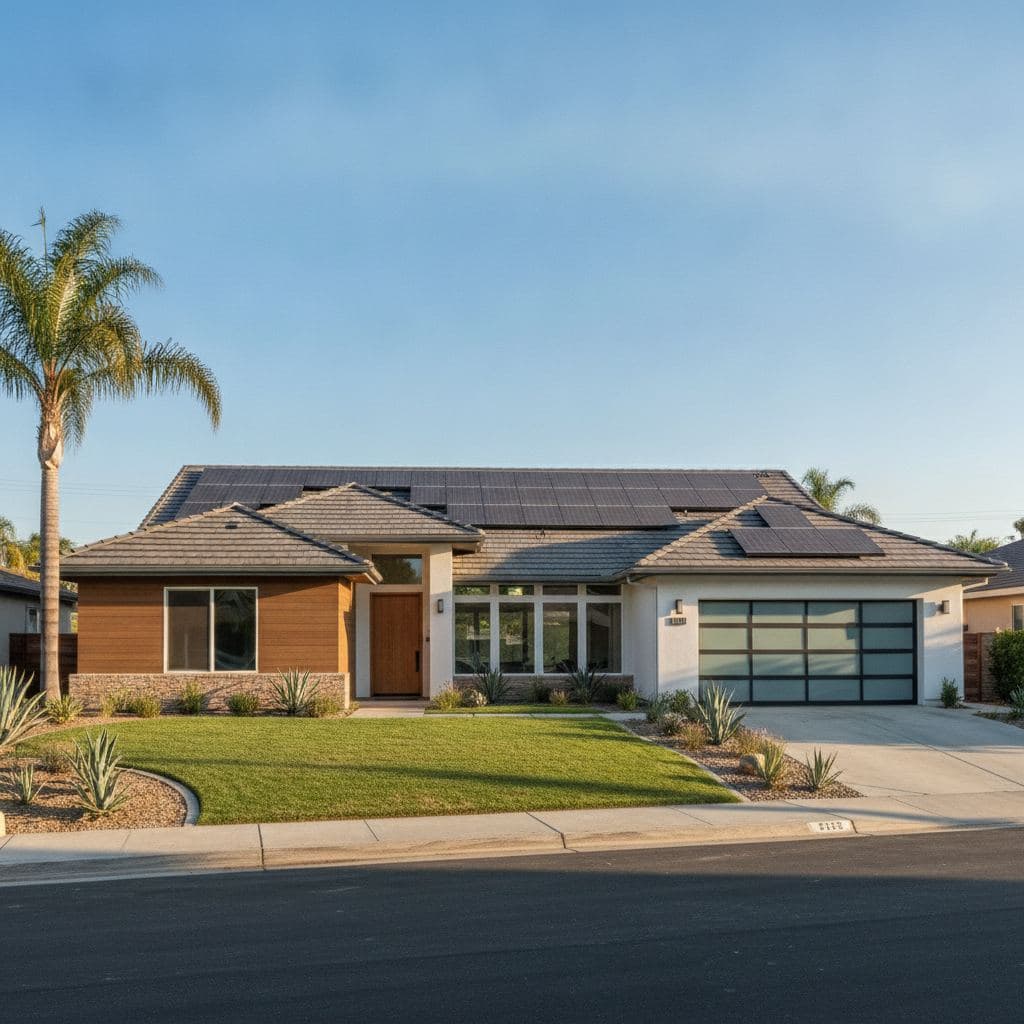
California's Title 24 Energy Code has required solar photovoltaic systems on new single-family homes since January 1, 2020, making it the first statewide mandate of its kind in the U.S. The 2023 code update — now in effect — extended that requirement and added battery storage for a large share of new homes, with minimum storage capacity of roughly 10 kWh.
Last verified: September 2026 by Helios Energy Global.
What the California solar mandate actually requires
The mandate lives inside California's Building Energy Efficiency Standards, commonly called Title 24. It covers:
- New single-family homes (detached)
- New low-rise multifamily buildings up to three stories
- Additions and alterations that trigger a full permit in certain cases
High-rise multifamily (four stories and up) is covered by a separate compliance pathway and is not discussed here.
The sizing formula
The California Energy Commission (CEC) does not pick a flat system size. Instead, builders use a formula that accounts for:
- Conditioned floor area (square footage of heated/cooled space)
- Climate zone (Southern California spans CEC zones 6–15)
- Efficiency features already in the home (better insulation, windows, or HVAC can reduce the required solar size)
In practice, the formula typically produces a minimum system between 2 kW and 5 kW for a new 1,800–2,800 sq ft Southern California tract home. That is a code floor, not a recommendation — it is often not enough to cover a household's full electricity use, especially if you add an EV or run central air conditioning heavily.
When batteries are required under the 2023 code
The 2023 Title 24 update requires battery storage on new homes in two main situations:
- Homes with a time-of-use (TOU) rate obligation — which is essentially every new SCE customer, since SCE's default residential rate is TOU with a 4–9 PM peak window.
- Homes that cannot meet the energy budget with solar alone due to shading, roof orientation, or other constraints.
The minimum battery size under the 2023 code is 10 kWh of usable capacity. Builders commonly install a single entry-level battery unit to hit that threshold. One unit at 10–13 kWh usable capacity is enough to satisfy code but may not carry a household through a full overnight outage, particularly if HVAC is running.
Key numbers at a glance
| Item | Typical range / value | Notes |
|---|---|---|
| Mandate effective date | January 1, 2020 | Single-family and low-rise multifamily |
| 2023 code battery minimum | ~10 kWh usable | Required for most new SCE-served homes |
| Builder-installed system size | 2 kW – 5 kW (estimate) | Code minimum; often not load-optimized |
| Aftermarket solar cost (2026) | ~$2.50–$3.50 per watt installed | Before any incentives |
| Battery cost (2026, installed) | ~$14,000 – $18,500 per unit | Single battery; larger homes may need two |
| SCE average residential rate | ~34 – 35¢/kWh | TOU peak 4–9 PM daily |
| LADWP average residential rate | ~28¢/kWh | Retail-rate net metering still in effect |
| Federal solar tax credit (2026) | $0 | 30% credit expired December 31, 2025 |
| SGIP battery rebate (2026) | Waitlisted | Residential SGIP budget on waitlist |
How utility rules affect new-home solar in Southern California
This is where localization matters most, and where generic California articles get it wrong.
SCE-served new homes (most of LA County, Orange County, Inland Empire)
New homes connected to Southern California Edison are on NEM 3.0, officially the Net Billing Tariff. Under NEM 3.0, excess solar exported to the grid is compensated at avoided-cost rates — roughly 5–8¢/kWh during most hours — rather than the retail rate you pay to import power. That gap makes a battery far more valuable: instead of exporting cheap, you store and self-consume.
If your builder installed a code-minimum battery, it may not be large enough to capture all the midday solar production your system generates. This is one of the most common upgrade conversations we have with new-home buyers. See our NEM 3.0 explainer and solar vs. battery under NEM 3.0 for the full picture.
LADWP-served new homes (City of Los Angeles)
LADWP is a municipal utility and is not on NEM 3.0. LADWP still offers retail-rate net metering, meaning excess solar exported to the grid is credited at close to the full retail rate (~28¢/kWh). That changes the math significantly: a battery is less urgently needed for bill savings, though it still provides backup power value. New homes in the City of Los Angeles should confirm their utility at permit — the city boundary does not perfectly match the LADWP service territory.
Other Southern California municipal utilities
Pasadena Water and Power, Burbank Water and Power, Glendale Water and Power, Anaheim Public Utilities, and Riverside Public Utilities all run their own net metering programs and are not on NEM 3.0. Rates and export credit structures vary. If your new home is served by one of these utilities, ask us to run the numbers for your specific tariff — the free consultation covers this.
What new-home buyers need to verify before closing
Builder-installed solar is not automatically a good deal. Here are the four things to check:
1. Ownership structure: owned, leased, or PPA?
Many production homebuilders partner with a solar company and offer the system as a Power Purchase Agreement (PPA) or lease, sometimes bundled into the home price in a way that obscures the arrangement. With a PPA:
- You do not own the panels — the solar company does.
- You pay a per-kWh rate for the power the panels produce, which may escalate annually.
- Selling the home requires either buying out the contract (often $15,000–$30,000+) or transferring it to the buyer — which some buyers will reject.
- You cannot claim any incentives because you do not own the equipment.
Ask for the solar contract before you sign anything on the home. If it is a PPA or lease, understand the buyout terms and escalator clauses in full.
2. Is the system actually sized for your load?
The code minimum is not the same as "right-sized for your family." A 2.5 kW system on a 2,400 sq ft home with an EV charger, a pool pump, and two adults working from home will not come close to covering your usage. Run your expected annual consumption against the system's estimated annual production — NREL's PVWatts tool is a free public resource for this.
We offer a custom design and savings estimate that models your actual load and utility tariff.
3. Panel brand, warranty, and inverter type
Builder-grade installs frequently use tier-2 panels and string inverters to hit the lowest possible cost. That is not automatically bad, but you should know:
- Panel warranty: look for 25-year product and performance warranty from a manufacturer with a track record.
- Inverter type: microinverters or DC optimizers perform better on roofs with partial shading or complex angles. String inverters are fine on clean south-facing roofs.
- Monitoring: confirm you have app-based production monitoring so you can see if the system underperforms.
4. Battery capacity vs. your actual backup needs
A single 10 kWh battery will run essential loads (lights, refrigerator, phone charging, some fans) for roughly 12–24 hours. It will not run central AC through a summer night. If you are in a wildfire-risk area or want whole-home backup, you likely need two battery units or a larger system. Our batteries page walks through sizing for different backup scenarios.
Frequently asked questions about the California solar mandate
Does the mandate apply to existing homes?
No — the Title 24 solar requirement applies only to new construction permits. Existing homes are not required to add solar. Retrofitting solar is voluntary, and the economics depend on your utility, roof, and usage. See our solar overview for retrofit considerations.
Can a builder get an exemption from the solar requirement?
Yes, but it is narrow. Exemptions are available when shading reduces expected production by more than a defined threshold (typically when a south-facing roof would receive less than 80% of the unshaded solar resource). In practice, most Southern California lots qualify — the region has excellent solar access.
Does the 30% federal tax credit apply to my builder-installed solar?
No. The 30% federal residential solar tax credit expired on December 31, 2025. There is no federal credit for solar installed in 2026, whether on a new home or a retrofit. Anyone telling you otherwise is working with outdated information.
Is SGIP available for my new-home battery?
SGIP (Self-Generation Incentive Program) residential battery rebates are currently on a waitlist in 2026 — the budget is not actively disbursing for standard residential applicants. Equity-tier applicants (low-income, medical baseline, high fire-threat district) may have a shorter wait. Do not factor SGIP into your budget unless you have a confirmed reservation number.
What if my new home is in the City of Los Angeles — does NEM 3.0 apply?
No. The City of Los Angeles is served by LADWP, a municipal utility not subject to the CPUC's NEM 3.0 (Net Billing Tariff). LADWP still offers retail-rate net metering, which is substantially more favorable for solar economics than NEM 3.0. Confirm your utility at permit — some LA addresses are served by SCE, not LADWP.
Can I add more solar or a larger battery after closing?
Yes, and for many new-home buyers it makes sense to do so within the first year once you have real utility bills to work from. Adding panels or a second battery after move-in is a standard retrofit project. The cost is roughly $2.50–$3.50 per watt for additional panels and $14,000–$18,500 installed for an additional battery unit.
Does the mandate cover condos and townhomes?
Low-rise multifamily (three stories and under) is covered, but solar is typically installed as a shared system on the building, not per unit. Individual condo buyers generally do not have control over the building's solar setup. High-rise multifamily uses a different compliance pathway. If you are buying a condo, ask the developer for the building's energy compliance documentation.
Next steps
- Book a free consultation and custom design — we review your builder's contract, size the right system for your load, and explain your utility's net metering rules in plain English.
- See what a custom solar design looks like — estimated production, bill savings, and payback period for your specific home.
- Understand NEM 3.0 and how it affects your solar value — essential reading for SCE customers.
- Solar vs. battery under NEM 3.0: which matters more? — the tradeoff explained with numbers.
- Battery storage options and sizing — how many kWh you actually need for backup.
- Solar panel cost in Southern California — current installed price ranges and what drives the variation.
- Our Southern California service locations — we serve Santa Monica, the Westside, LA, and surrounding communities.
More guides
Best Solar Companies in Menifee, CA (2026): An Honest Homeowner's Guide
Menifee is one of the fastest-growing cities in Riverside County — and one of the best places in Southern California to go solar. Here's an honest, numbers-first look at the top installers serving the area in 2026.
ReadBest Solar Companies in Poway, CA (2026): Big Lots, SDG&E's Highest Rates, and Why Battery Backup Is Non-Negotiable
Poway's ranch-home lots, SDG&E's ~46¢/kWh rates, and genuine fire-country exposure in the eastern hills make it one of San Diego County's most compelling — and most specific — solar markets. Here's how to find the right installer and avoid the common mistakes.
ReadHow do I lower my electric bill in California? (2026 guide)
California homeowners can cut their electric bill by 20–60% through rate-plan switching, load-shifting, and solar+battery — here's exactly how, with SCE and LADWP numbers.
ReadGet a free consultation and custom design.
No pressure, no obligation — the owner reviews every design we send.