Tesla Powerwall 3 Expansion Pack: capacity, limits, and what it adds (2026)
A Tesla Powerwall 3 Expansion adds 13.5 kWh of storage and zero extra inverter power, with a hard limit of 3 Expansion units per system, all wired to the leader Powerwall 3.
By Taylor Crouse — Founder, Helios Energy GlobalPublished
Quick answer
- A Powerwall 3 Expansion adds 13.5 kWh of storage and 0 kW of extra power; the Powerwall 3 inverter still sets the ceiling at 11.5 kW continuous / 185 A LRA (Tesla Powerwall 3 datasheet).
- Tesla allows up to 3 Expansion units per system, all wired to the leader Powerwall 3, for a maximum of 7 units (4 Powerwall 3 + 3 Expansion) and 94.5 kWh.
- It is only compatible with Powerwall 3; Powerwall 2 and Powerwall+ cannot use it.
- Our installed estimate in Southern California: $8,000–$11,500 per Expansion, versus $14,500–$18,500 for a full Powerwall 3 (see Powerwall 3 cost).
- The 30% federal residential credit expired December 31, 2025; SGIP general-market residential storage is waitlisted.
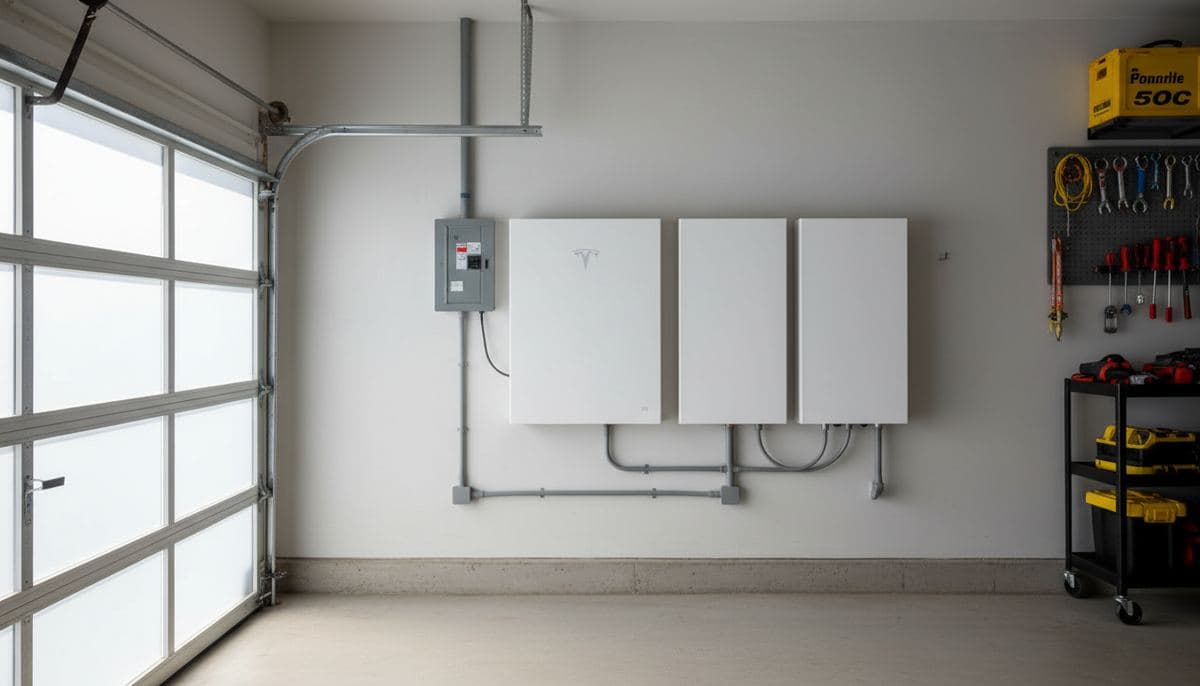
The Tesla Powerwall 3 Expansion is a 13.5 kWh battery-only unit that plugs into a Powerwall 3 and roughly doubles how long your home can run, without adding a single watt of output. Because it has no inverter, it installs for a good deal less than a second Powerwall 3, typically $8,000–$11,500 in our service area, and you can add up to three per system.
Last verified: September 2026 by Helios Energy Global.
What the Powerwall 3 Expansion is, and what it is not
Tesla's system design documentation says it plainly: "An Expansion unit does not include an inverter; it is only additional storage (kWh)." That one sentence answers most of the confusion around this product.
What it is, per Tesla's Powerwall 3 datasheet and Expansion specifications page:
- A DC battery pack with the same 13.5 kWh nominal energy as a Powerwall 3 (model number 1807000-xx-y).
- Slightly slimmer than a Powerwall 3: 43.5 x 24 x 6.6 inches versus 43.5 x 24 x 7.6 inches.
- 242.5 lb bare, 261.2 lb with glass cover and wall bracket. A Powerwall 3 is 291.2 lb installed.
- Indoor and outdoor rated (NEMA 3R, IP67 pack), –4°F to 122°F, same as the Powerwall 3.
- Floor-mounted stacked behind the Powerwall 3 (up to three deep) or wall-mounted on its own bracket.
- Covered by the same 10-year limited warranty: 70% energy retention at year 10 and unlimited cycles for solar self-consumption and backup (Tesla Powerwall Limited Warranty Rev. 2.6, effective May 6, 2026).
What it is not:
- Not a second inverter. Backup power, motor starts, and how many air conditioners you can run at once are set by the Powerwall 3 it connects to.
- Not compatible with Powerwall 2 or Powerwall+. Tesla's spec sheet reads "Only compatible with Powerwall 3," and it requires a Powerwall 3 with part number 1707000-xx-J or later.
- Not standalone. It has no grid connection and cannot be installed without a Powerwall 3 leader.
Still deciding on the platform? Start with our Powerwall 2 vs Powerwall 3 comparison for California.
Capacity and power math: what 13.5 kWh more actually buys you
Two numbers matter for any battery: how much it stores (kWh) and how fast it can deliver it (kW). The Expansion only changes the first.
A Powerwall 3 alone gives you 13.5 kWh at up to 11.5 kW continuous on-grid and, per Tesla's US specifications, up to 15.4 kW during an outage in the 11.5 kW configuration with an 80 A breaker. Add one Expansion: 27 kWh at the same 11.5 kW. Add three: 54 kWh, still 11.5 kW.
There is one power-side benefit, and it is on charging, not discharge. Tesla's specifications list maximum charge power at 5 kW for a Powerwall 3 alone, rising to 8 kW with Expansion units installed. A larger solar array can refill a bigger bank faster, which matters on day two of a PSPS event.
Here is what one Expansion's 13.5 kWh translates to for common loads. These are Helios estimates using typical appliance draws; your numbers depend on the appliance and the weather.
| Load | Typical draw | Hours from one 13.5 kWh Expansion |
|---|---|---|
| Refrigerator (averaged over the cycle) | 150 W | ~90 hours |
| Internet, router, phone charging | 20 W | ~675 hours |
| Essentials bundle: fridge, freezer, lights, Wi-Fi, TV | 800 W | ~17 hours |
| Window or mini-split AC (one room) | 1,000 W | ~13.5 hours |
| Whole-home average, typical SoCal household (30 kWh/day) | 1,250 W | ~11 hours |
| 3-ton central AC while running | 3,500 W | ~3.9 hours |
| Electric water heater element | 4,500 W | ~3 hours |
| Level 2 EV charging | 7,200 W | ~1.9 hours (roughly 40 miles) |
The pattern: an Expansion turns a one-night backup into a two-day backup for essentials, but does nothing for a home that overloads the inverter when the AC compressor and dryer start together. That is a power problem, and the answer is a second Powerwall 3.
Not sure which problem you have? Our battery runtime calculator sizes against your actual loads, and what size battery to back up a house walks through the method.
How many Expansions can a Powerwall 3 have, and when a second Powerwall 3 is the better buy
The rule, from Tesla's Powerwall 3 Expansion design page: "Up to (3) Expansion units can be connected to the Leader Powerwall 3," and "The total maximum system size is (7) units – up to (4) Powerwall 3 units with up to (3) Expansion units."
The detail most articles miss is the word "Leader." A system has exactly one leader (the unit wired to the Backup Gateway 2, Backup Switch, or Gateway 3), and Tesla states that Expansions connected to a Follower Powerwall 3 "will not function." So the limit is three Expansions per system, not three per Powerwall. Whether you own one Powerwall 3 or four, the ceiling is the same.
| Configuration | Storage | Continuous power | Notes |
|---|---|---|---|
| 1 Powerwall 3 | 13.5 kWh | 11.5 kW | Baseline |
| 1 Powerwall 3 + 1 Expansion | 27 kWh | 11.5 kW | Most common Expansion build |
| 1 Powerwall 3 + 3 Expansions | 54 kWh | 11.5 kW | Maximum energy on one inverter |
| 2 Powerwall 3 | 27 kWh | 23 kW | Same energy as row 2, double the power |
| 2 Powerwall 3 + 1 Expansion | 40.5 kWh | 23 kW | Headroom plus runtime |
| 4 Powerwall 3 + 3 Expansions | 94.5 kWh | 46 kW | Tesla's stated maximum |
Choose an Expansion when your Powerwall 3 has never tripped on overload, you want longer outage coverage or more 4–9 PM shifting, and you have space beside the existing unit.
Choose a second Powerwall 3 when you have central AC over 3 tons, a well pump, an EV charger, or a pool pump you want on backup, or you are planning whole-home backup for a home over roughly 3,000 square feet. Two Powerwall 3 units installed run $24,000–$30,000, and you get 23 kW to spend.
Installed cost: what an Expansion actually costs in 2026
Tesla does not publish an installed price, but its hardware price is straightforward. Pricing guides tracking Tesla's online configurator through August 2026 put the Expansion at about $5,900, with Tesla's one-Powerwall-3-plus-one-Expansion bundle listed at $20,459 before tax, delivery, and installation.
Our installed estimate for Southern California is $8,000–$11,500 per Expansion, built from these components:
- Hardware: roughly $5,900 for the Expansion, plus the harness and bracket or stacking kit.
- Sales tax: 9.5%–10.25% across most of our Los Angeles and Orange County footprint, about $560–$610.
- Labor and mounting: $1,300–$1,800 when installed alongside the Powerwall 3, because the crew and commissioning are already on site; $2,500–$4,000 as a later retrofit, since it becomes its own site visit and commissioning.
- Permit and inspection: $250–$800 depending on the city. Some cities treat an Expansion as a revision to the existing battery permit; others want a new application.
- Occasional extras: a pad for a stacked floor mount, or relocating the Powerwall 3 to make wall space.
Compare that to $14,500–$18,500 installed for one full Powerwall 3, which carries its own inverter, six solar MPPT inputs, conduit run, and breaker. The Expansion typically lands at 50%–65% of a full unit for the same 13.5 kWh, and that gap is the entire reason the product exists. For bundle pricing and what moves the number, see our canonical Powerwall 3 pricing page. For context, home batteries generally run $14,000–$18,500 installed per unit across brands.
Already own a Powerwall 2 or Powerwall+? The retrofit path
Tesla's Expansion specifications list the unit as "Only compatible with Powerwall 3." No adapter, firmware update, or gateway trick changes that. Powerwall 2 and Powerwall+ are AC-coupled batteries with their own inverters; the Expansion is a DC pack that speaks only to a Powerwall 3's battery management system.
If you have a Powerwall 2 and want more storage, your options are:
- Add a Powerwall 3 to the existing system. Tesla supports mixed systems in specific configurations, and the new Powerwall 3 becomes the leader eligible for Expansions of its own. Usually the right call if you also want more solar, since the Powerwall 3 accepts up to 20 kW of panels directly.
- Add another Powerwall 2 while inventory lasts. Simpler on paper, but it locks you into a product line that no longer gets new accessories.
- Replace rather than add. Rarely worth it for a healthy Powerwall 2, but it comes up when a homeowner wants to consolidate an aging string inverter and battery into one unit.
We cover gateway compatibility and how existing solar interconnects in adding a Powerwall to existing solar in California.
Southern California specifics: SCE arbitrage, LADWP, and PSPS
SCE, PG&E, and SDG&E customers (NEM 3.0). Since April 15, 2023, new solar customers of the three investor-owned utilities take service on the Net Billing Tariff, per the CPUC, with exports credited at a rate "reflecting the value of this generation to the grid," far below what you pay to buy power back. SCE's default TOU-D-4-9PM plan averages roughly 34–35¢/kWh, with summer on-peak from 4 to 9 PM at about 48–52¢/kWh. A single Powerwall 3 often empties before 9 PM in a summer household running AC. An Expansion carries midday solar all the way through the peak window, which is where the money is under NEM 3.0.
A quick illustration: shifting an extra 10 kWh per day out of the 4–9 PM window at a 20¢ spread is about $2 a day, roughly $600–$700 a year. On its own that is a slow payback on a $8,000–$11,500 Expansion; combined with backup value and rising rates, it becomes a reasonable one.
LADWP customers. LADWP is a municipal utility and is not on NEM 3.0. It still runs retail net metering, and its effective rate averages about 28¢/kWh, so exported solar is worth roughly what imported power costs. For LADWP homes, an Expansion is a backup and resilience purchase, not a bill-reduction purchase. Be honest with yourself about that before you buy.
PSPS and outage backup. Public Safety Power Shutoffs in SCE's foothill and canyon communities can last 24–72 hours. One Powerwall 3 runs essentials for roughly a day; one Expansion pushes that past two, and with solar refilling the bank at up to 8 kW during the day, a Powerwall 3 plus one Expansion can ride out most multi-day events for essential loads. In a high-fire-threat district, the Expansion is usually the better-value purchase compared to a second Powerwall 3.
As a Tesla Certified Installer, we design for the utility you are actually on, not a generic SoCal average.
Incentives in 2026: what is left
- Federal 25D credit: expired. The IRS states the Residential Clean Energy Credit "is not available for any property placed in service after December 31, 2025," so a 2026 cash purchase of an Expansion gets no federal credit. Roughly 30% off the top is still available through a prepaid lease: the financier owns the system for the first 5 years and claims the commercial credit, and ownership transfers to you at the start of year 6 at essentially no cost.
- SGIP general-market residential storage: waitlisted. The program's step tracker shows the Small Residential Storage budget closed at Step 7 for SCE, PG&E, SDG&E/CSE, and SoCalGas as of September 1, 2026; new applications sit on a waitlist. Do not build an Expansion budget around SGIP unless you qualify for the Residential Solar and Storage Equity budget, which has separate income and location rules.
- Utility programs. SCE and LADWP periodically run demand-response or virtual power plant programs that pay for battery participation. These change often; we will tell you what is live at design time.
Frequently asked questions about the Powerwall 3 Expansion
How many kWh is a Powerwall 3 Expansion pack?
Each Expansion has a nominal energy of 13.5 kWh, identical to the Powerwall 3 itself, per Tesla's Powerwall 3 datasheet. One Powerwall 3 plus one Expansion is 27 kWh; one plus three is 54 kWh.
How many expansion packs can a Powerwall 3 have?
Tesla allows up to 3 Expansion units per system, and all must connect to the leader Powerwall 3; Expansions on a follower unit will not function. The largest supported system is 4 Powerwall 3 units plus 3 Expansions: 7 units and 94.5 kWh.
Does the Powerwall 3 Expansion add more power?
No. The Expansion has no inverter, so output stays at the Powerwall 3's rating of up to 11.5 kW continuous on-grid (15.4 kW backup in the 11.5 kW configuration) and 185 A locked-rotor amps for motor starts. The one change is on charging: maximum charge power rises from 5 kW to 8 kW with Expansions installed, per Tesla's US specifications.
How much does a Powerwall 3 Expansion cost installed?
Our Southern California estimate is $8,000–$11,500 per Expansion: roughly $5,900 in hardware, sales tax, $1,300–$4,000 in labor depending on whether it goes in with the Powerwall 3 or later, and a permit. A second full Powerwall 3 costs more because it includes its own inverter; two Powerwall 3 units installed run $24,000–$30,000.
Can I add an Expansion to a Powerwall 2 or Powerwall+?
No. Tesla lists the Expansion as "Only compatible with Powerwall 3," and it requires a Powerwall 3 with part number 1707000-xx-J or later. Powerwall 2 owners who want more storage add another Powerwall or a Powerwall 3.
Can I add a Powerwall 3 Expansion later?
Yes, as long as your Powerwall 3 is the leader and has a compatible part number. Expect higher labor than installing both at once, typically $2,500–$4,000 versus $1,300–$1,800, because it is a separate site visit, commissioning, and often a separate permit. It also needs space: stacked behind a floor-mounted Powerwall 3 or on a wall bracket beside it.
Is the Powerwall 3 Expansion worth it under NEM 3.0?
For SCE, PG&E, and SDG&E customers, usually yes if your Powerwall 3 empties before 9 PM in summer, because every extra kWh you hold back from export and use during the 4–9 PM peak is worth roughly 48–52¢ instead of a much smaller export credit. For LADWP customers on retail net metering, it is a backup purchase with little bill impact.
Next steps
- Book a free consultation and custom design. We pull your utility interval data, model a Powerwall 3 with and without Expansions against your 4–9 PM usage, and tell you which configuration actually pencils.
- Run your own numbers first with the battery runtime calculator.
- See the canonical Powerwall 3 pricing page for current bundle pricing.
- Backing up the entire house? Whole-home backup covers the load-management and panel considerations that decide between an Expansion and a second Powerwall 3.
Sources
- Tesla Powerwall 3 Datasheet (US) — 2025
- Tesla Energy Library: Powerwall 3 Expansion Units (System Design) — September 11, 2025
- Tesla Energy Library: Powerwall 3 Specifications (Backup Switch install manual, US) — April 3, 2026
- Tesla Powerwall Limited Warranty (USA), Rev. 2.6 — May 6, 2026
- IRS: Residential Clean Energy Credit — July 4, 2026
- SGIP Program Metrics (step tracker) — September 1, 2026
More guides
What is the average LADWP electric bill in 2026?
The typical LADWP residential customer pays roughly $140–$230/month in mid-2026, based on tiered rates that work out to an effective 26–31¢/kWh — still below what SCE customers pay, though the gap has narrowed.
ReadCan You Finance a New Roof With Your Solar Project in 2026?
Most solar-specific loans can be scoped to include a roof replacement costing $12,000–$16,000, but the structures differ sharply from a HELOC or unsecured loan — and leases keep roof work entirely separate.
ReadHow many watts does a refrigerator use? (2026 numbers by type and age)
Most full-size refrigerators run at 100–400 watts and use 1–2 kWh per day — here's the full breakdown by type, age, and what it costs on SCE vs. LADWP.
ReadGet a free consultation and custom design.
No pressure, no obligation — the owner reviews every design we send.