Removal & reinstallation
Solar panel removal and reinstallation, done by solar people
New roof coming? We detach, store, and reinstall your array — any brand, any original installer — then recommission it and verify production. Your solar investment comes through the roof project intact.
Quick answer
Solar panel removal and reinstallation costs $250–$350 per panel in Southern California — about $5,000–$7,000 for a typical 20-panel system — including labeled storage, new flashing and hardware at every attachment, reinstall, recommissioning and production verification. The detach typically takes one day and the reinstall one to two days once your roofer is finished. It's for any homeowner replacing or repairing a roof under an existing array, whoever installed it.
The most expensive mistake in a Southern California roof replacement is letting the roofing crew handle the solar. Roofers are excellent at roofs — but panels detached without documentation, stored flat under foot traffic, and re-mounted through reused flashing are how arrays come back producing less than they did, leaking within a year, or out of warranty entirely. Helios does removal and reinstallation as a core service, not a favor: solar technicians handle the array, your roofer (or our licensed roofing partners) handles the roof, and the two schedules interlock so your system is down for days, not weeks. If the roof and solar decisions are happening together, start with our one-project roof + solar page.
Why homeowners hand us the array.
Secure handling, labeled storage
Every panel, optimizer, and fastener is photographed, labeled, and stored padded on site (or off-site on request). Your array goes back exactly where it came from — same string order, same layout.
Coordinated around your roofer
We schedule the detach the day before roofing starts and the reinstall as soon as your roofer signs off — with any roofing contractor, or with our own licensed roofing partners if you’d rather have one contract.
Recommissioned and verified
Reinstallation ends with new flashing at every penetration, torque-checked connections, utility notification where required, and a production check against your system’s baseline before we call it done.
The removal & reinstallation process.
Eight steps, documented start to finish. The roofing window in the middle belongs to your roofer — everything on either side of it belongs to us.
- 1
System assessment & photo documentation
We map the array, string layout, and attachment points, photograph everything, and pull the original permit records where available. If your system was installed by a company that’s gone out of business, this is where we reconstruct what they left behind.
- 2
Shutdown & safe detach
The system is de-energized in the correct order — AC disconnect, inverter, rapid shutdown — then panels, rails, and wiring are removed by solar technicians, not laborers. Roof penetrations are sealed temporarily so the house stays weather-tight until roofing begins.
- 3
Labeled, padded storage
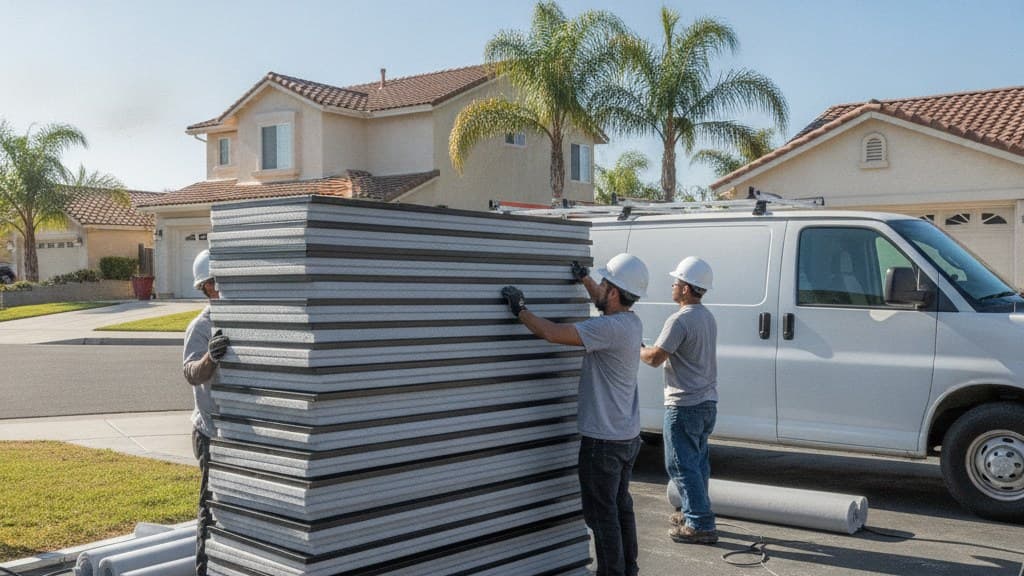
Panels are stacked on edge protection with foam between each unit, hardware is bagged and labeled by roof plane, and everything is staged out of the roofer’s way — on site for most jobs, or off-site if the project runs long.
- 4
Your roof work happens
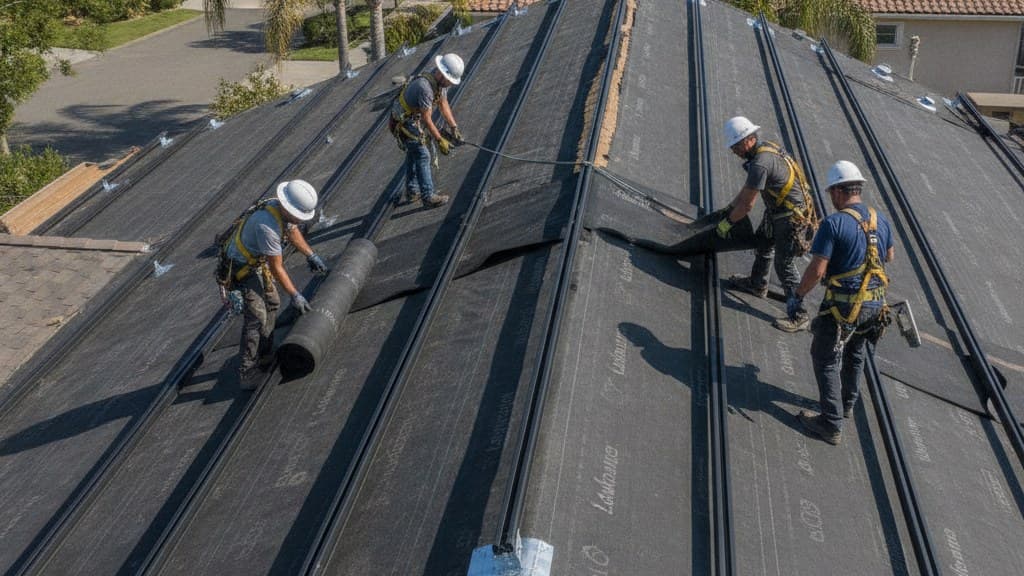
Your roofing contractor replaces the roof on their normal schedule with a clean deck — no working around panels, no broken glass, no liability questions. Don’t have a roofer yet? Our licensed roofing partners can handle the roof under the same project.
- 5
New mounts & flashing — never reused
When we reinstall, every roof attachment gets new flashing and sealing rated for the new roofing material. Reusing old flashing on a new roof is the #1 cause of leaks on remove-and-reinstall jobs done cheap — we don’t do it.
- 6
Reinstallation & torque check
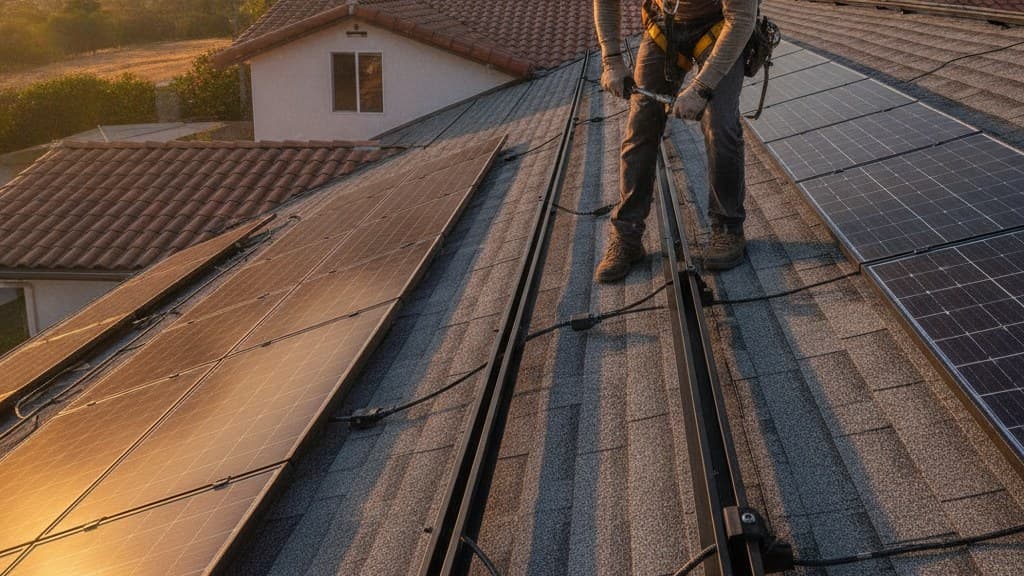
The array goes back in its documented layout, connectors are re-seated, and every structural and electrical connection is torqued to spec. Damaged or end-of-life parts found along the way are flagged with a price before we replace anything.
- 7
Recommission & utility notification
We re-energize in sequence, verify rapid shutdown, restore your monitoring, and handle utility or AHJ notification where the jurisdiction requires it — so your interconnection and NEM status stay intact.
- 8
Production verification
Before we leave, we confirm the system is producing at its expected baseline and your monitoring app is reporting every panel. You get the photo record of the finished work.
What removal and reinstallation costs.
Detach-and-reset runs $250–$350 per panel in Southern California. That number covers the whole job — not a teaser rate with the flashing added back later: labeled storage on site, new flashing and mounting hardware at every attachment, reinstallation in the documented layout, recommissioning, and a production check against your system's baseline. Roof pitch, roof material, racking age, and how well the original install was documented move a job within the range; the roofing itself is priced separately by your roofer or our licensed roofing partners.
| System size | Typical fit | Detach + reinstall |
|---|---|---|
| 20 panels | Typical 6–8 kW system on a single-story home | $5,000 – $7,000 |
| 25 panels | Larger 8–10 kW system, often two roof planes | $6,250 – $8,750 |
| 30 panels | Big two-story or multi-plane array | $7,500 – $10,500 |
Roofing not included. Prices are $250–$350 per panel; your quote is set after we see the array.
What the per-panel price includes
- Labeled, padded storage on site
- New flashing and mounting hardware at every attachment
- Reinstallation in the documented layout
- Recommissioning and production verification
What moves a job to the top of the range
- Tile or steep-pitch roofs (slower, more careful detach and reset)
- Ground-level storage off site instead of staged on the property
- Systems with damaged racking or undocumented wiring that must be reconstructed
Quoted separately
- Off-site storage beyond 30 days
- Replacement of failed components found during the detach (flagged with a price first)
- The roofing itself — performed by your roofer or our licensed roofing partners
How to read a competing quote: the ones that come in suspiciously low almost always get there by reusing old flashing on your brand-new roof — which converts a cheap shortcut today into a leak repair that costs more than the entire R&R did. Ask any bidder, in writing, whether new flashing at every attachment is included.
Sources & method: the $250–$350 per panel range is Helios job pricing for detach-and-reset work in Southern California, not an estimate. For market context only: OC Solar publishes $250–$350 per panel for removal and reinstallation, and LA Solar Group lists $4,200–$7,800 per job depending on module tier. Those are their published figures, not our price. Updated September 2026.
Removal & reinstallation questions, answered.
- How much does solar panel removal and reinstallation cost?
- Solar panel removal and reinstallation costs $250–$350 per panel in Southern California — roughly $5,000–$7,000 for a 20-panel system and $7,500–$10,500 for 30 — including labeled storage, new flashing and hardware, reinstall, recommissioning and production verification. Within that range, system size, roof pitch, racking condition, and storage time move the number. We quote every job clearly and completely — detach, storage, new flashing and hardware, reinstall, recommissioning — after seeing the array, so you’re never paying a padded flat rate. A flat number quoted over the phone without anyone looking at the array is a red flag anywhere in this industry.
- How long does the process take?
- The detach is typically one day for most residential systems, and the reinstall one to two days once your roofer is done. The total calendar time is set by the roofing work in the middle — we schedule around it so the system is down for the minimum possible window.
- Can you remove and reinstall panels another company installed?
- Yes — that’s most of this work. We handle Tesla, Enphase, SolarEdge, and the other common residential platforms regardless of who installed them, including systems from installers that have gone out of business. We document the existing layout first so manufacturer warranties stay intact.
- Will removal and reinstallation void my warranties or my NEM status?
- Done properly, no. Panel and inverter warranties are with the manufacturers and survive a professional R&R; we keep the photo record that proves correct handling. Your net metering agreement stays with the system — we handle any required utility notification so your interconnection isn’t disturbed.
- Can you replace the roof too, or do I need my own roofer?
- Either works. We coordinate with any roofing contractor you’ve hired, or our licensed roofing partners can replace the roof as part of one project with one point of contact — often the cheaper path, since the crews share scheduling and the panels come off and go on exactly on time.
- What happens if a panel breaks or something fails during the job?
- Our workmanship guarantee covers every connection we make, and our handling process — edge protection, foam interleaving, labeled hardware — exists to prevent breakage in the first place. If we find already-failing equipment during the detach (common on 10+ year systems), you get the finding and a price, never a surprise on the final invoice.
Removal & reinstallation by city.
Roof stock, permitting office, and the utility whose interconnection has to survive the reroof all change by city. Pick yours for the local specifics.
Roofer already scheduled? Get the solar side locked in.
Send us the roofing start date and a photo of your array — we'll quote the R&R as one clear number and slot the detach the day before your crew shows up.