How Many Solar Panels Does a 1,500 Sq Ft Home Need in Southern California? (With 1,000 and 2,500 Sq Ft)
A typical 1,500 sq ft Southern California home needs roughly 9–13 solar panels (a 3.5–5.0 kW system) to cover its annual electricity use—here's the math, utility-by-utility.
By Taylor Crouse — Founder, Helios Energy GlobalPublished
Quick answer
- A 1,500 sq ft Southern California home typically uses 5,500–7,500 kWh/year and needs a 3.5–5.0 kW solar system.
- At 420 W per panel, that works out to roughly 9–13 panels on a south-facing roof.
- NREL PVWatts puts Los Angeles at ~1,677 kWh per kW per year and Riverside at ~1,694 kWh per kW per year (south-facing, 20° tilt, 14% system losses, October 2026 run).
- The 30% federal residential solar tax credit expired December 31, 2025—there is no federal credit for a 2026 purchase.
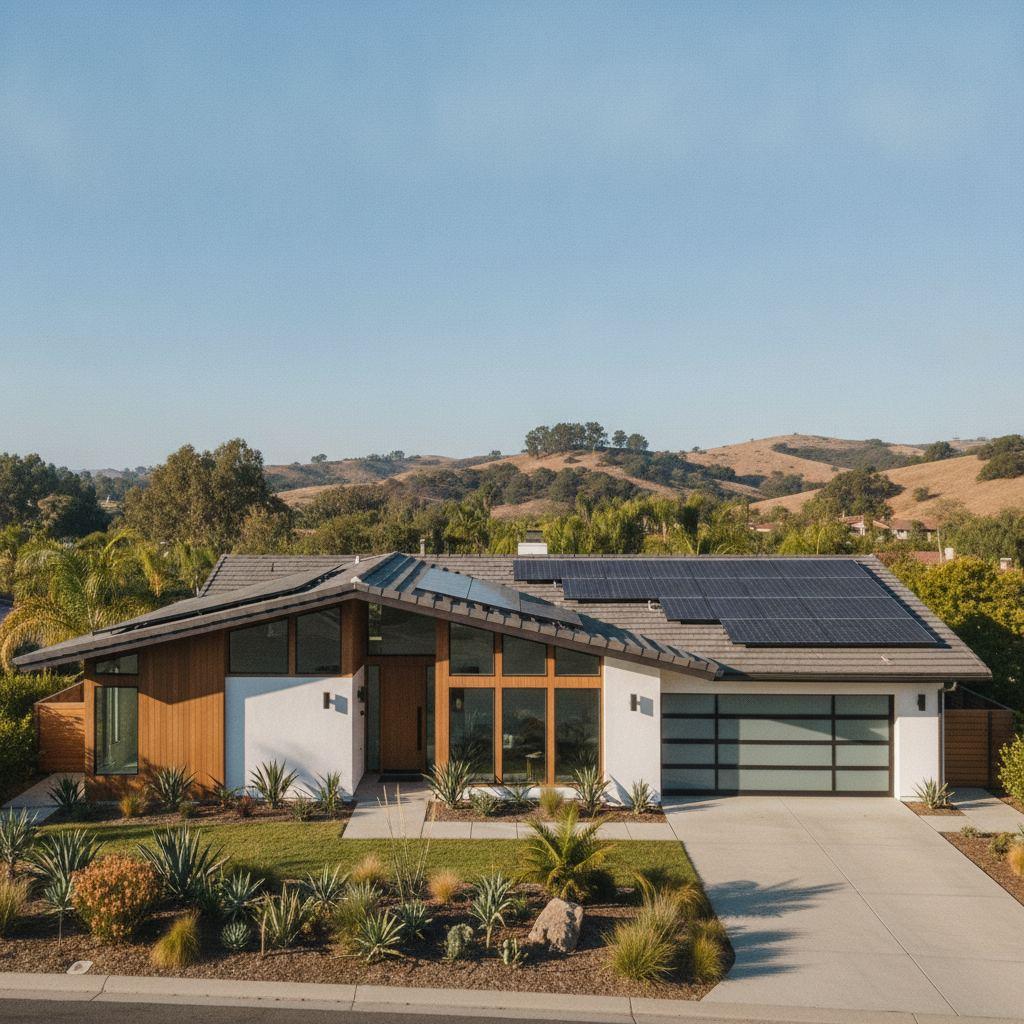
A 1,500 sq ft Southern California home typically needs 9–13 solar panels—a system in the 3.5–5.0 kW range—to cover its annual electricity use. That number is driven by how much electricity the home actually consumes, not by its square footage, so the right starting point is your annual kWh, not a ruler.
Last verified: November 2026 by Helios Energy Global.
How the panel count is calculated
Square footage alone doesn't size a solar system. The correct sequence is: annual kWh → system size in kW → panel count. Here's how each step works for a 1,500 sq ft Southern California home.
Step 1 — Establish annual electricity use
EIA's 2024 Average Monthly Bill (Table 5A) puts the California residential average at 503 kWh per month across 14.2 million customers. That's roughly 6,040 kWh per year statewide—but that average includes apartments and mild coastal homes that use very little air conditioning.
A 1,500 sq ft single-family home in Southern California—with central AC running through a warm summer—realistically lands somewhat above that statewide average. A reasonable planning range is 5,500–7,500 kWh per year, depending on whether the home uses gas or electric appliances, has an EV charger, or runs a pool pump. Homes at the lower end are gas-heated with moderate AC use; homes at the upper end have electric resistance heat, heavy AC, or an EV charging nightly. Use your own 12-month bill total wherever possible; if you don't have it, 6,500 kWh/year is a defensible midpoint for this home size in the LA basin.
Step 2 — Convert kWh to system size
NREL's PVWatts model (version 8, NSRDB TMY weather data, standard module, fixed roof mount, 20° tilt, south-facing azimuth, 14% system losses, run October 2026) shows Los Angeles at 1,677 kWh per kW per year and Riverside at 1,694 kWh per kW per year.
Divide your annual usage by your city's production factor:
- Los Angeles (SCE / LADWP territory): 6,500 kWh ÷ 1,677 = 3.88 kW → round up to ~4.0 kW
- Riverside (IE / SCE territory): 6,500 kWh ÷ 1,694 = 3.84 kW → also ~4.0 kW
- At the upper end of usage (7,500 kWh): 7,500 ÷ 1,677 = 4.47 kW → ~4.5–5.0 kW
The practical range for a 1,500 sq ft SoCal home is 3.5–5.0 kW.
Step 3 — Convert kW to panel count
Residential panels average 400–450 watts in 2026; the 60-cell residential middle—430 to 470 W modules—is where most installs land. Using 420 W as a planning benchmark (verify the exact model on any written proposal):
- 3,500 W ÷ 420 W = 8.3 panels → 9 panels
- 5,000 W ÷ 420 W = 11.9 panels → 12 panels
Result: 9–13 panels for a 1,500 sq ft Southern California home, assuming a south-facing roof with no significant shading. An east-west split, partial shade, or steeper tilt will push the count higher.
Solar panels for a 1,000 sq ft home
A 1,000 sq ft Southern California home—typically a condo, small bungalow, or older tract house—uses less electricity, but the per-kWh cost savings math is identical. For most California single-family homes, 400–900 kWh a month is normal; above 1,000 kWh usually means heavy AC, an EV, or a pool. A 1,000 sq ft home with gas heat and modest AC typically lands in the 4,000–5,000 kWh/year range.
Sizing at the midpoint (4,500 kWh/year, Los Angeles):
- System size: 4,500 ÷ 1,677 = 2.68 kW → round to ~3.0 kW
- Panel count at 420 W: 3,000 ÷ 420 = 7.1 → 7–9 panels
For the smallest homes, a 2.5–3.5 kW system is typically sufficient. At Helios's installed price range of $2.50–$3.50 per watt, that's roughly $6,250–$12,250 before any applicable incentives—see solar panel cost in California for the full picture. If you're curious how your smaller home compares to a 2,000 sq ft home, our guide for 2,000 sq ft homes walks through that sizing in the same step-by-step format.
Solar panels for a 2,500 sq ft home
A 2,500 sq ft Southern California home is more likely to have central AC running hard through summer, a larger refrigerator, and potentially an EV or pool. A realistic usage range is 8,000–11,000 kWh/year.
Sizing at the midpoint (9,000 kWh/year, Los Angeles):
- System size: 9,000 ÷ 1,677 = 5.37 kW → round to ~5.5–6.0 kW
- Panel count at 420 W: 6,000 ÷ 420 = 14.3 → 13–18 panels
A 5.0–7.0 kW system covers most 2,500 sq ft homes in Southern California. Homes with pools, EVs, or all-electric appliances can push past 7 kW. Our guide for 3,000 sq ft homes covers the next size tier, where usage and system sizing shift meaningfully upward.
Summary table: panel count by home size (estimates)
| Home size | Typical annual kWh (SoCal estimate) | System size (kW) | Panel count (420 W panels) | Usable roof area needed |
|---|---|---|---|---|
| 1,000 sq ft | 4,000–5,000 kWh | 2.5–3.5 kW | 7–9 panels | ~175–260 sq ft |
| 1,500 sq ft | 5,500–7,500 kWh | 3.5–5.0 kW | 9–13 panels | ~265–395 sq ft |
| 2,500 sq ft | 8,000–11,000 kWh | 5.0–7.0 kW | 13–18 panels | ~395–545 sq ft |
All figures are estimates. Annual kWh assumes a Southern California single-family home with central AC and gas heat. System size uses NREL PVWatts v8 production for Los Angeles (1,677 kWh/kW/year), south-facing roof, 20° tilt, 14% system losses, October 2026 run. Panel count uses 420 W as a planning benchmark—verify the exact model wattage on any written proposal. Usable roof area is panel footprint (~21 sq ft per panel) plus fire-code clearances, estimated at a 75% usable factor on the south-facing plane.
Why two homes of the same size can need very different systems
Square footage is a rough proxy for electricity use, not a reliable one. The real drivers are:
- Air conditioning load. A 1,500 sq ft home in Riverside with a single-stage AC unit running June–October can easily use 40–50% more electricity than a 1,500 sq ft home in Santa Monica with a marine layer and no AC.
- Pool pump. A variable-speed pool pump adds roughly 1,200–2,500 kWh/year; an older single-speed pump can add 3,000–4,500 kWh/year.
- EV charging. Air conditioning, pool pumps, and EV charging are the three loads that push a California home above 30 kWh per day. A Level 2 home charger used nightly adds roughly 3,000–5,000 kWh/year depending on the vehicle and miles driven.
- Electric vs. gas appliances. A home with a gas range, gas water heater, and gas dryer uses far less electricity than an all-electric home of the same size. According to EIA's 2020 Residential Energy Consumption Survey, 64% of California homes heat with natural gas and only 20% heat with electricity. If you're electrifying—switching to a heat pump water heater, induction range, or heat pump HVAC—size your solar system for your future load, not today's bill.
- Household size. Four people in a 1,500 sq ft house use more electricity than one person in a 2,500 sq ft house.
The right approach: pull your last 12 months of bills, add up the kWh column, and use that number. If you're planning to add an EV or switch appliances, estimate the added load and include it. Our solar sizing calculator guide and how many solar panels do I need in California walk through the arithmetic in detail.
Does your roof have room?
Most 1,500 sq ft Southern California homes have enough roof for a 3.5–5.0 kW system—but the usable area after fire-code setbacks is always smaller than the total roof footprint.
The rule homeowners find most surprising is that the fire code reserves part of your roof for firefighters. The California Residential Code, Section R324, requires access pathways and ridge setbacks on one- and two-family homes so a crew can reach the roof and ventilate it in a fire. In practice:
Two pathways, each at least 36 inches wide, run from the lowest roof edge to the ridge, on separate roof planes. An 18-inch clear setback on both sides of the ridge applies where the array covers 33% or less of the total roof area; go beyond 33% and the setback grows to 36 inches.
Hips, valleys, and roof obstructions such as vents and skylights all eat into what is left. This is why the "usable" roof area an installer quotes is often well below the area you measured yourself, and why a south-facing plane that looks big enough for twenty panels may legally hold fourteen.
A useful rule of thumb for 2026: about 1 kW of solar per 70 square feet of total roof area, or roughly 28 sq ft of total roof per modern 400 W panel after fire-code setbacks.
For a 3.5–5.0 kW system, you need approximately 265–395 sq ft of usable, unobstructed south-facing roof (see table above). Most 1,500 sq ft homes in Southern California have a south-facing plane of 600–900 sq ft total, leaving plenty of room after setbacks—but complex hip roofs, heavy shading from trees, or skylights can tighten that margin quickly.
For panel dimensions and physical footprint details, see our solar panel dimensions, size, and weight guide. Tile and metal roofs affect mounting hardware and labor cost but not the panel count calculation; roofing work, when needed, is coordinated through Helios's vetted, licensed roofing partners.
What does a system this size cost?
For a 1,500 sq ft Southern California home, a 3.5–5.0 kW system runs approximately $8,750–$17,500 at Helios's current installed price range of $2.50–$3.50 per watt before incentives. The spread is wide because equipment choices, roof complexity, and whether a main-panel upgrade is needed ($3,000–$5,000 when required) all move the final number.
Important for 2026 buyers: The 30% federal residential solar tax credit expired December 31, 2025. There is no federal credit available for a residential solar purchase made in 2026. California's SGIP battery incentive has residential budget funds that are currently waitlisted, not openly available. State and local incentives vary by utility—get a written quote that shows the gross price and the cost per watt so you can compare offers fairly. For a full breakdown of California solar pricing, see solar panel cost in California.
When Helios quotes your system, you receive one all-in written price with the equipment named by model—so you know exactly what you're getting and can compare it apples-to-apples with any other offer. You can also explore your estimated savings with our design tool.
Battery pairing: SCE and SDG&E vs. LADWP
Whether a battery makes sense depends heavily on which utility you're on.
SCE and SDG&E customers on NEM 3.0 (Net Billing Tariff): Solar-only systems export surplus power at wholesale rates—as low as 5–8¢/kWh in the middle of the day—while you pay 48–58¢/kWh during SCE's 4–9 PM peak. A battery that stores midday solar and dispatches it during the evening peak dramatically improves the economics. For a 3.5–5.0 kW solar system, one Tesla Powerwall 3 (installed $14,500–$18,500) or an Enphase IQ Battery 10C (installed $13,000–$15,500) is a natural pairing. See batteries and our NEM 3.0 explainer for the full rate arbitrage math, and solar vs. battery under NEM 3.0 for a side-by-side comparison.
LADWP customers: LADWP is a municipal utility and is not on NEM 3.0. LADWP still offers retail-rate net metering—meaning your surplus solar exports at the same rate you pay to import (~28¢/kWh effective). That changes the battery math: you're not losing money on exports, so a battery's value shifts toward backup power and time-of-use optimization rather than rate arbitrage. A battery still makes sense for outage protection, but it's less financially urgent than it is for SCE or SDG&E customers. Pasadena, Burbank, Glendale, Riverside RPU, and Anaheim APU are also municipal utilities with their own net metering programs—check your specific tariff before assuming NEM 3.0 applies.
Frequently asked questions about solar panels for a 1,500 sq ft home
How many solar panels does a 1,500 sq ft house need in California?
Most 1,500 sq ft Southern California homes need 9–13 solar panels, sized to a 3.5–5.0 kW system. The exact count depends on your annual kWh use, roof orientation, and panel wattage—square footage alone doesn't determine it. Pull your last 12 months of utility bills and use the annual kWh total as your starting point.
Is 10 solar panels enough for a 1,500 sq ft home?
For many 1,500 sq ft Southern California homes, yes—10 panels at 420 W each gives you a 4.2 kW system, which produces roughly 7,000–7,100 kWh/year in Los Angeles (using NREL PVWatts). If your home uses around 6,000–7,000 kWh/year, 10 panels will cover most or all of your load. Homes with EVs, pools, or all-electric appliances may need 12–14 panels.
How many kWh does a 1,500 sq ft house use per year in California?
The average California home uses about 503 kWh per month—about 6,000 kWh a year—according to EIA's 2024 data for the state's 14.2 million residential customers. A 1,500 sq ft single-family home in Southern California with central AC typically runs somewhat above that statewide average, in the range of 5,500–7,500 kWh/year. Homes with pools, EVs, or electric heat can exceed 9,000 kWh/year.
What size solar system do I need for a 1,500 sq ft home?
A 3.5–5.0 kW system covers most 1,500 sq ft Southern California homes. Use your actual annual kWh and divide by your city's production factor: NREL PVWatts (October 2026 run) gives Los Angeles ~1,677 kWh per kW per year and Riverside ~1,694 kWh per kW per year for a south-facing roof at 20° tilt with 14% system losses. For the full sizing methodology, see how to calculate your solar system size.
Does roof size matter more than home size for solar?
Roof size matters for whether the panels fit, but home size matters for how much electricity you use—and it's usage that drives the system size. Most residential systems need 300–500 square feet of unobstructed roof space after fire code pathways are removed; chimneys, vents, skylights, and other obstructions mean that what looks like a large roof can yield surprisingly limited usable panel area. A 1,500 sq ft home with a complex hip roof may have less usable panel area than a 1,000 sq ft home with a simple gable.
Is there still a federal tax credit for solar in 2026?
No. The 30% federal residential solar tax credit (Section 25D) expired December 31, 2025. There is no federal credit for a residential solar system purchased or installed in 2026. Some commercial and utility-scale credits remain under different tax code sections, but those do not apply to homeowners buying a rooftop system. Check with a tax professional for your specific situation.
How do I compare solar quotes for a 1,500 sq ft home?
Get the gross price (before any incentives) and the cost per watt in writing for every quote. Make sure each quote names the specific panel model and inverter so you're comparing equivalent equipment. Be cautious of quotes that show a dramatically lower "after-incentive" price without clearly stating which incentives they're applying—especially in 2026, when the federal tax credit no longer applies to residential purchases. For guidance on what to look for, see our solar panel cost guide and locations we serve.
Next steps
- Book a free consultation and custom design — Helios sizes your system from your actual bills and a satellite roof analysis, at no cost and no obligation.
- Explore your estimated savings — see projected production, bill offset, and payback for your specific address.
- Learn about battery options — compare the Powerwall 3, Enphase IQ Battery 10C, and FranklinWH aPower 2 for your utility and usage.
- Understand NEM 3.0 and how it affects your solar value — essential reading for SCE and SDG&E customers.
- See all Southern California locations Helios serves
- Read about solar panel cost in California — the full installed price breakdown, per watt and by system size.
- Solar panel dimensions, size, and weight guide — understand how many panels physically fit on your roof.
- How many solar panels do I need in California? — the general sizing guide, with a calculator by city.
Sources
- EIA 2024 Average Monthly Bill, Residential (Table 5A) — January 2025
- EIA Electric Power Monthly, Table 5.6.A (August 2026 data) — October 2026
- SunSupp PV — Solar panel wattage benchmarks by manufacturer 2026 — July 2026
- California Solar Permits — Roof fire setbacks and pathways for residential solar PV — June 2018
More guides
How many watts does a TV use? (2026 guide with real numbers)
A modern 55-inch LED TV uses roughly 60–100 watts while running — here's what that costs at SCE and LADWP rates and how it factors into solar sizing.
ReadBuying a House With Solar in California (2026): What Happens to the NEM Agreement?
Good news first: the seller's net metering agreement transfers with the home — the AB 942 provision that would have ended it at sale was defeated. Here's the due-diligence checklist that actually matters: owned vs. leased, the PTO date, system health, and roof condition.
ReadHow Much Does a 7 kW Solar System Cost in California? (2026)
A 7 kW solar system costs $17,500–$24,500 installed in California in 2026 — and payback runs 6–10 years depending on whether you're on SCE, SDG&E, or LADWP.
ReadGet a free consultation and custom design.
No pressure, no obligation — the owner reviews every design we send.