How Many Solar Panels Do You Need for a 3,000 Sq Ft Home in Southern California? (2026)
A 3,000 sq ft SoCal home with a pool, EV, and dual AC typically needs 24–35 panels (10–14 kW) to cover 1,200–1,600 kWh/month — size by your bill, not your square footage.
By Taylor Crouse — Founder, Helios Energy GlobalPublished
Quick answer
- A 3,000 sq ft Southern California home with typical loads (pool, EV, dual AC) uses roughly 1,200–1,600 kWh/month and needs a 10–14 kW solar system.
- That translates to 24–35 panels at today's standard 400–430 W panel sizes.
- Installed cost before any incentives: approximately $25,000–$49,000 depending on system size and equipment (see cost table below).
- The 30% federal residential solar tax credit expired December 31, 2025 — factor that into your 2026 payback math.
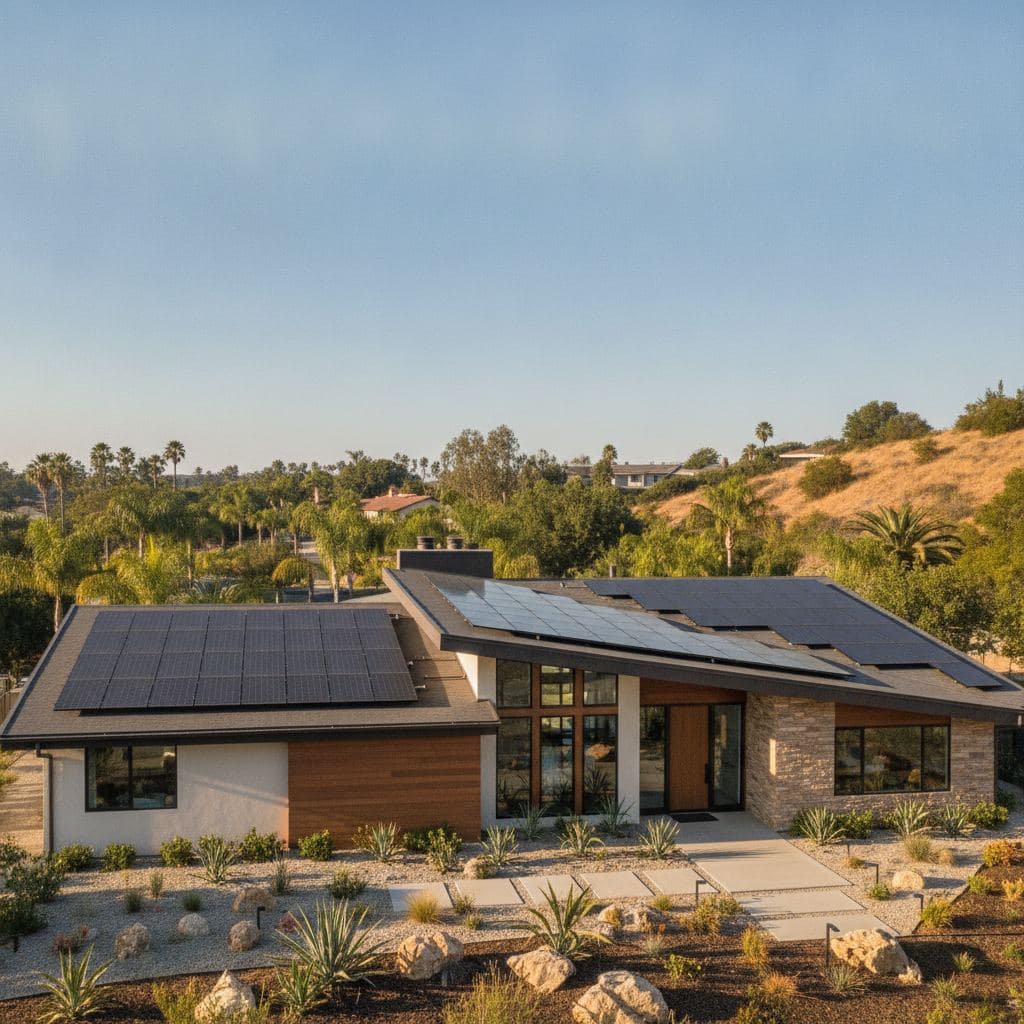
A fully loaded 3,000 sq ft home in Southern California typically needs between 10 and 14 kW of solar — that's roughly 24 to 35 panels at 400–430 watts each. The right number isn't determined by square footage; it's determined by how many kilowatt-hours you actually consume each month, which for a home this size with a pool, EV charger, and dual-zone AC commonly runs 1,200–1,600 kWh/month — two to three times the statewide average.
Last verified: September 2026 by Helios Energy Global.
Why square footage is the wrong starting point
Square footage tells you how much space you're heating and cooling, but it says nothing about your actual electricity load. Per EIA Form EIA-861 data, California residential customers averaged just 503 kWh/month in 2024 — but that average includes small apartments, mild coastal homes, and households with gas appliances. A 3,000 sq ft home in the San Fernando Valley or Inland Empire with dual AC, a pool pump running 6–8 hours a day, and a Level 2 EV charger can easily use three times that.
The usage-first rule: Pull your last 12 months of electric bills, add up the kWh, and divide by 12. That monthly average is your sizing target — not your address, not your square footage.
What drives usage in a large SoCal home
- Dual-zone HVAC: Two AC systems in a hot inland climate can add 600–900 kWh/month in summer alone
- Pool + spa pump: A variable-speed pump running 8 hrs/day adds roughly 100–200 kWh/month; a gas heater with electric ignition adds less, but an electric heat pump pool heater can add 300–500 kWh/month
- Level 2 EV charging: A typical EV driver adds 250–400 kWh/month depending on miles driven
- Electric appliances: All-electric cooking, water heating, and dryer add 150–300 kWh/month vs. gas equivalents
Put those loads together and 1,200–1,600 kWh/month is a realistic — not pessimistic — profile for a 3,000 sq ft home with all three.
How system size is calculated
The formula is straightforward:
System size (kW) = Monthly kWh ÷ (Peak Sun Hours/day × 30 days × 0.80 derate)
According to NREL's PVWatts database, Southern California coastal areas average roughly 5.0–5.5 peak sun hours per day, while inland and desert cities reach 5.5–6.5+ peak sun hours. Using a conservative 5.3 PSH for a mid-SoCal location and a standard 0.80 system derate factor (accounting for inverter losses, wiring, soiling, and temperature):
- 1,200 kWh/month: 1,200 ÷ (5.3 × 30 × 0.80) ≈ 9.4 kW → round to 10 kW
- 1,400 kWh/month: 1,400 ÷ (5.3 × 30 × 0.80) ≈ 11.0 kW → round to 11–12 kW
- 1,600 kWh/month: 1,600 ÷ (5.3 × 30 × 0.80) ≈ 12.6 kW → round to 13–14 kW
At 400–430 W per panel, a 10 kW system needs 23–25 panels; a 14 kW system needs 33–35 panels.
Sizing table: 3,000 sq ft SoCal home scenarios
| Monthly usage (kWh) | System size | Panel count (400–430 W) | Est. installed cost (2026) | Typical profile |
|---|---|---|---|---|
| ~900–1,100 | 8–10 kW | 19–25 panels | $20,000–$35,000 (est.) | Modest loads, gas pool/water heat |
| ~1,200–1,400 | 10–12 kW | 24–30 panels | $25,000–$42,000 (est.) | Pool pump + 1 EV, 2 AC zones |
| ~1,400–1,600 | 12–14 kW | 30–35 panels | $30,000–$49,000 (est.) | Pool + EV + electric heat pump |
| ~1,600–2,000+ | 14–16 kW | 35–40 panels | $37,500–$56,000 (est.) | Full electrification, large EV fleet |
All cost figures are rough estimates at Helios's 2026 installed rate of ~$2.50–$3.50/W before any incentives. See solar panel cost details for the full breakdown.
How your utility changes the math
The number of panels needed to hit "net zero" depends heavily on which utility you're on — because the value of each kWh your system produces varies dramatically.
SCE customers (NEM 3.0 / Net Billing Tariff)
Rate figures sourced from SCE's CPUC-approved TOU-D tariff schedules effective January 2026 put SCE's average all-in residential rate at about 35¢/kWh.
The TOU-D-4-9PM plan features a summer weekday on-peak rate of 58¢/kWh. Under NEM 3.0 (the CPUC Net Billing Tariff), however, midday solar exports earn only about 5–8¢/kWh — a fraction of what you pay to buy power back at night. This fundamentally changes sizing strategy:
- Sizing to your full annual usage no longer maximizes savings the way it did under NEM 2.0
- A correctly sized system should focus on self-consumption — matching panel output to daytime loads (pool pump, EV charging, appliances)
- Battery storage becomes nearly essential to capture midday solar and deploy it during the 4–9 PM peak window, when you'd otherwise buy power at 48–58¢/kWh
- Read our NEM 3.0 explainer and the solar vs. battery tradeoff guide before finalizing your design
For a 3,000 sq ft SCE home, a 10–13 kW system paired with one or two batteries is a common Helios recommendation — sized to self-consume aggressively rather than export.
LADWP customers (retail-rate net metering)
LADWP keeps full retail-rate net metering — a meaningful difference from SCE's Net Billing Tariff.
In July–September 2026, LADWP's Tier 1 rate is 26.41¢/kWh, Tier 2 is 32.27¢/kWh, and Tier 3 is 40.97¢/kWh.
Because exports and imports net at the same retail pricing, LADWP customers can size their system to cover 100% of annual usage without worrying that oversizing will hurt them. Solar production offsets your most expensive kilowatt-hours first, so a system that erases Tier 3 and Tier 2 usage is saving you 32–41¢/kWh in summer, not the headline Tier 1 number.
For a 3,000 sq ft LADWP home using 1,400 kWh/month, a 12–14 kW system that targets full annual offset is reasonable. A battery is primarily a resilience purchase on LADWP — valuable for backup power (especially in fire-adjacent neighborhoods) but not required for the solar economics to work.
SDG&E customers
EIA's 2024 utility-level data shows SDG&E's residential bundled retail rate averaged 43.63¢/kWh — the highest of any major California utility. SDG&E is also under NEM 3.0. The high rate makes solar payback faster in absolute dollar terms, but the same NEM 3.0 export-value problem applies. Battery pairing is strongly recommended.
Panel count vs. roof space
Each 400–430 W panel occupies roughly 18–20 sq ft of usable roof area. A 3,000 sq ft home typically has 1,200–1,800 sq ft of roof area, but usable, unshaded, south/west-facing space is usually 600–1,000 sq ft after accounting for setbacks, vents, and obstructions.
| System size | Approx. panels needed | Approx. roof area required |
|---|---|---|
| 10 kW | 24–25 panels | ~450–500 sq ft |
| 12 kW | 28–30 panels | ~540–600 sq ft |
| 14 kW | 33–35 panels | ~630–700 sq ft |
Most 3,000 sq ft homes have enough roof for a 10–14 kW system. Tile or steep-pitch roofs don't reduce panel count, but they do increase installation cost — see roof types and solar compatibility for details. If your roof is near end-of-life, coordinate a replacement before panels go on; Helios works with vetted, licensed roofing partners and can coordinate that job.
What a 10–14 kW system costs in 2026
Helios's installed rate runs approximately $2.50–$3.50 per watt before incentives — the same range across Southern California. System-level estimates:
| System size | Estimated installed cost (2026, before incentives) |
|---|---|
| 10 kW | $25,000–$35,000 |
| 12 kW | $30,000–$42,000 |
| 14 kW | $35,000–$49,000 |
Important 2026 note: The 30% federal residential solar tax credit expired December 31, 2025. There is no federal incentive for a residential solar purchase made in 2026. California's SGIP battery rebate program is also waitlisted for residential customers in 2026. Factor these into your payback projections — there is no current statewide rebate to stack on top of your system price.
For a complete cost breakdown, see our solar panel cost guide.
Adding battery storage under NEM 3.0
For SCE customers especially, one or two batteries paired with a 10–14 kW system is the configuration that actually maximizes bill savings. Helios's 2026 installed battery pricing:
| Battery | Installed cost (est.) |
|---|---|
| Tesla Powerwall 3 (1 unit) | $14,500–$18,500 |
| Tesla Powerwall 3 (2 units) | $24,000–$30,000 |
| Enphase IQ Battery 10C | $13,000–$15,500 |
| FranklinWH aPower 2 + aGate | $16,000–$21,000 |
See our full battery storage page for a side-by-side comparison.
The 140 kWh/day target: what it means in practice
If your 3,000 sq ft home uses 1,400 kWh/month, that's roughly 47 kWh/day on average — not 140. (The "140" referenced in some sizing conversations refers to 140 kWh/day in peak summer, which is an extreme outlier reserved for large estates with multiple EV chargers, pool heaters, and year-round heavy AC. Most 3,000 sq ft homes land at 40–55 kWh/day average, spiking to 60–80 kWh/day in August.)
The right number is always your actual 12-month average, not a rule-of-thumb daily figure. Pull your utility bills, add up the kWh column, divide by 12.
How to get a quote you can actually compare
When you get proposals from any installer, ask for two numbers in writing:
- The gross system price (before any incentives — because in 2026 there are no federal credits to subtract)
- The cost per watt (gross price ÷ system size in watts)
Helios provides one all-in written price with the equipment named by model — so you know exactly what you're buying. Get the gross price and cost per watt from every installer you talk to, and compare those numbers directly. For a deeper look at what goes into a proposal, see our solar design and savings tool.
A free consultation and custom design will show you the exact system size, panel count, and estimated annual production for your specific roof and utility — using real interval data from your bills, not square footage rules of thumb.
Frequently asked questions about solar panel count for large homes
How many solar panels does a 3,000 sq ft house need?
Most 3,000 sq ft homes in Southern California need 24–35 panels (10–14 kW), but the actual number depends on your monthly kWh usage, not your square footage. Pull your last 12 months of bills, find your average monthly kWh, and use that as your sizing target.
Is 10 kW of solar enough for a 3,000 sq ft home?
It depends on your loads. If your home uses 900–1,100 kWh/month — no EV, gas pool heater, gas water heater — a 10 kW system can cover most of your usage. Add an EV and a pool pump and you're likely looking at 12–14 kW to hit full offset.
How many panels fit on a 3,000 sq ft roof?
A 3,000 sq ft home typically has 600–1,000 sq ft of usable, south- or west-facing roof space after setbacks and obstructions. That's enough for 30–55 panels — more than enough for a 10–14 kW system. Shading, roof pitch, and obstructions matter more than raw square footage.
Does NEM 3.0 change how many panels I should install?
Yes, for SCE, PG&E, and SDG&E customers. Under NEM 3.0, midday solar exports earn only about 5–8¢/kWh, so oversizing to export aggressively doesn't pay. The focus shifts to self-consumption and battery storage. LADWP customers are not on NEM 3.0 and can still size for full annual offset. See our NEM 3.0 guide.
What is the cost per watt for a 10–14 kW system in Southern California?
Helios's 2026 installed rate is approximately $2.50–$3.50 per watt before incentives, putting a 10 kW system at roughly $25,000–$35,000 and a 14 kW system at roughly $35,000–$49,000. The 30% federal tax credit expired December 31, 2025 and does not apply to 2026 purchases.
How does a 3,000 sq ft home compare to a 2,000 sq ft home for solar sizing?
A 2,000 sq ft home with similar loads typically needs 7–10 kW (17–25 panels). The 3,000 sq ft home adds roughly 2–4 kW of additional capacity primarily because of larger HVAC loads, not just because it's bigger. See our 2,000 sq ft solar sizing guide for the smaller-home comparison.
Should I add a battery to a 10–14 kW system?
On SCE and SDG&E (NEM 3.0 utilities), a battery is strongly recommended — it captures cheap midday solar and deploys it during the 4–9 PM peak when grid power costs 48–58¢/kWh. On LADWP, a battery is primarily a resilience purchase; the solar economics work without one, though backup power is increasingly valuable in fire-adjacent LA neighborhoods.
Next steps
- Book a free consultation and custom design — we'll size your system from your actual bills, not a rule of thumb
- Explore battery storage options — Powerwall 3, Enphase IQ, and FranklinWH compared
- See full solar panel cost details — the $2.50–$3.50/W range explained
- Understand NEM 3.0 and what it means for SCE customers
- Solar vs. battery tradeoffs under NEM 3.0
- Find your Helios service area
Sources
- EIA Form EIA-861 Table 5A — 2024 Average Monthly Bill, Residential — October 7, 2025
- EIA Form EIA-861 Table 6 — 2024 Utility Bundled Retail Sales, Residential — October 7, 2025
- LADWP Residential Electric Rates — official rate schedule page — September 2026
- ElectricChoice — LADWP Tier Rates & Utility Info (2026), citing LADWP July–September 2026 rate tables — September 14, 2026
- ElectricityCostComparison.com — SCE Rates 2026, sourced from SCE CPUC-approved TOU-D tariff schedules effective January 2026, verified July 2026 — July 25, 2026
More guides
Best Solar Companies in Riverside, CA (2026): An Honest Homeowner's Guide
A straight-talking, numbers-first ranking of the top solar installers serving Riverside, CA in 2026 — covering local utility rules, real price ranges, battery guidance, and exactly what to ask before you sign.
ReadBest Solar Companies in Poway, CA (2026): Big Lots, SDG&E's Highest Rates, and Why Battery Backup Is Non-Negotiable
Poway's ranch-home lots, SDG&E's ~46¢/kWh rates, and genuine fire-country exposure in the eastern hills make it one of San Diego County's most compelling — and most specific — solar markets. Here's how to find the right installer and avoid the common mistakes.
ReadIs there a California solar tax credit in 2026? What homeowners actually get
California has no state solar tax credit, and the federal 30% credit expired December 31, 2025 — but a prepaid lease still delivers roughly 30% off in 2026.
ReadGet a free consultation and custom design.
No pressure, no obligation — the owner reviews every design we send.