Guide
Solar vs. battery under NEM 3.0: do you need storage?
Solar vs. battery under NEM 3.0 is the question almost every SoCal homeowner now faces. The short version: storage is usually where the savings are on the big utilities — but not always. Here's the both-sides math, so you can decide for your home.
Guides / Solar vs. battery
By Taylor Crouse, Founder · Updated
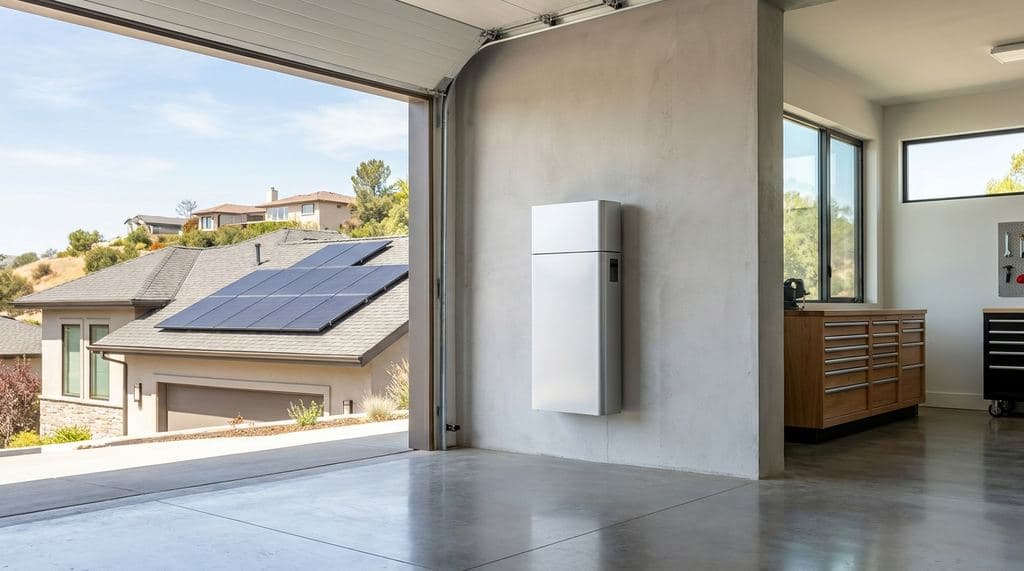
The core tradeoff: export vs. self-consumption.
Every solar kilowatt-hour you produce does one of two things: you use it in the moment, or you send it to the grid. Under the old NEM 2.0 rules, those were worth nearly the same, so it didn't much matter. Under NEM 3.0, it matters a lot — exported power is credited at a small fraction of the retail rate, while power you use yourself offsets the full retail price you'd otherwise pay.
That single change is the whole solar-vs-battery question. A battery shifts your midday surplus — which would otherwise export for pennies — into the evening, when you're cooking, running the AC, and grid power is most expensive (the 4–9 PM peak). Without storage, that surplus just leaves at a discount.
Solar-only vs. solar + battery.
Both can be the right answer. Here's the honest comparison for a typical home on an investor-owned utility.
Solar only
- Lower upfront cost — solar without the battery cost.
- Longer payback under NEM 3.0 — roughly 10–14 years on SCE, SDG&E, and PG&E, since surplus exports earn little.
- No backup power — the system shuts off during an outage.
- Still strong on municipal utilities, whose net metering wasn't changed by NEM 3.0.
Solar + battery
- Higher upfront cost — a Powerwall 3 adds about $14,500–$18,500.
- Shorter payback — roughly 6–9 years for most SoCal homes, by using stored power during the peak instead of exporting cheap.
- Keeps your home powered during outages and PSPS events — the resilience solar-only can't offer.
- The default choice for most investor-owned-utility homes.
The value a spreadsheet misses: resilience.
If your home sits in a High Fire Threat District, you've likely lived through an SCE Public Safety Power Shutoff — the utility cuts power during high-wind, high-fire-risk conditions, sometimes for a day or more. Grid-tied solar alone goes dark right along with the grid; it's designed to shut off so it can't backfeed lines while crews work. A battery is the only thing that keeps your refrigerator, lights, and internet running through it.
For many of our High Fire Threat District clients, backup is the real reason they add storage — the faster payback is a bonus on top.
Battery sizing, in plain terms.
The right size comes down to what you want the battery to do during an outage or peak. There's no universal answer.
Critical-loads backup
Covers the essentials — fridge, lights, internet, a few outlets, medical equipment — through an evening peak or a short outage. A single battery often handles this comfortably.
Whole-home backup
Keeps heavier loads running — central AC, an EV charger — through a longer outage. This usually calls for more than one battery, and the right count depends on your real usage.
The key variable is runtime: how long the stored energy lasts depends on how much you're drawing. Rather than guess, we model your actual consumption to estimate how long a given battery will carry your home — because two houses with identical panels can need very different storage.
When solar-only is still the smart call.
We don't push batteries on everyone — that wouldn't be honest. Two situations make solar-only a genuinely good choice. If you're on a municipal utility like LADWP, Pasadena Water & Power, or Riverside Public Utilities, your net metering wasn't touched by NEM 3.0 and stays favorable, so solar-only can pencil out well on its own.
And if budget is the priority and backup isn't a pressing concern, solar-only is the lower upfront cost. Because we design every system to be battery-ready, you can start with panels and add storage later without re-permitting headaches — a reasonable path when the timing or budget isn't right today.
One thing worth knowing before you rule storage out on price alone. The 30% federal residential tax credit expired on December 31, 2025, so a 2026 cash or loan purchase pays the full sticker. But the federal commercial credit survived, and a prepaid lease routes it to the party allowed to claim it: the financier owns the system for the first five years and takes the credit, roughly 30% of that value comes back to you as an up-front reduction, and ownership transfers to you at the start of year 6 at essentially no additional cost. Applied to the $14,500–$18,500 a Powerwall 3 adds, that is often the difference between storage penciling and not. We offer it through Propel (via Concert Finance) and through Participate Energy. We're not tax advisors — we put the structure in writing and suggest you confirm it with yours.
Common questions.
- Do I need a battery under NEM 3.0?
- If you're on an investor-owned utility (SCE, SDG&E, or PG&E), a battery is usually what makes solar pay off well, but it isn't strictly required. Under NEM 3.0, exported power is credited at a small fraction of the retail rate, so the savings come from using your own solar rather than selling it. A battery captures that self-consumption value and brings payback into roughly the 6–9 year range, versus about 10–14 years for solar-only. On municipal utilities with better net metering, solar-only is more often worth it on its own.
- How much does it cost to add a battery?
- A Tesla Powerwall 3, the unit we most often install, typically adds about $14,500–$18,500 to a project, depending on how many you need and the electrical work involved. That's on top of a typical 6–10 kW solar system at roughly $15,000–$35,000 before incentives. The SGIP battery rebate that used to offset storage broadly is now limited to income-qualified and fire-zone tiers, so most homeowners shouldn't count on it. We'll tell you whether you qualify. On financing: the 30% federal residential tax credit ended December 31, 2025, so a cash or loan purchase pays full sticker in 2026 — but a prepaid lease still routes roughly 30% back to you through the surviving commercial credit, with the financier owning the system for five years and title transferring to you at the start of year 6. We offer it through Propel (via Concert Finance) and Participate Energy. We're not tax advisors, so we put the structure in writing and suggest you confirm it with yours.
- What size battery do I need?
- It depends on your goal. If you want to cover critical loads — refrigerator, lights, internet, a few outlets, maybe medical equipment — through an evening peak or a short outage, a single battery often does the job. If you want whole-home backup that runs air conditioning or an EV charger for an extended outage, you'll likely need more capacity. We model your actual usage to estimate runtime rather than guessing, since two homes with the same panels can have very different battery needs.
- Does a battery keep my house powered during an outage?
- Yes — and this is the part economics alone can't capture. Grid-tied solar without storage shuts off when the grid goes down, by design, for utility-worker safety. Only a battery keeps your home running during an outage or a Public Safety Power Shutoff (PSPS). For homes in a High Fire Threat District facing SCE PSPS events, that resilience is often the deciding factor regardless of the payback math.
- When does solar-only still make sense?
- Solar-only can still be the right call in two situations. First, if you're served by a municipal utility — LADWP, Pasadena Water & Power, Riverside Public Utilities and others — whose net metering wasn't changed by NEM 3.0 and remains more favorable. Second, if budget is the priority and backup power isn't a concern: solar-only is the lower upfront cost, and because we design every system to be battery-ready, you can add storage later without re-permitting headaches.
Compare both options for your home.
We'll model solar-only and solar+battery side by side — payback, backup runtime, and the complete pricing — so the choice is yours, not ours.
Prefer to talk it through? Call (310) 564-8817.