How to Calculate What Size Solar System You Need (2026)
Most Southern California homes need a 6–12 kW solar system — find yours in three steps using your annual kWh, a local production factor of 1,500–1,700 kWh/kW, and a derate for roof orientation and shade.
By Taylor Crouse — Founder, Helios Energy GlobalPublished
Quick answer
- The formula: Annual kWh ÷ production factor (1,500–1,700 kWh/kW in Southern California) ÷ derate (0.75–1.0 for orientation/shade) = system size in kW.
- Typical SoCal range: 6–12 kW covers most homes; 500 kWh/month users land near 4–5 kW, while homes with EVs or pools often need 10–15 kW.
- Panel count: Divide system kW by panel wattage (0.40–0.46 kW per panel in 2026) — a 10 kW system is roughly 22–25 panels.
- SCE vs. LADWP matters: SCE's NEM 3.0 export penalty often makes a slightly larger system smarter; LADWP's retail-rate net metering lets you size purely to your usage.
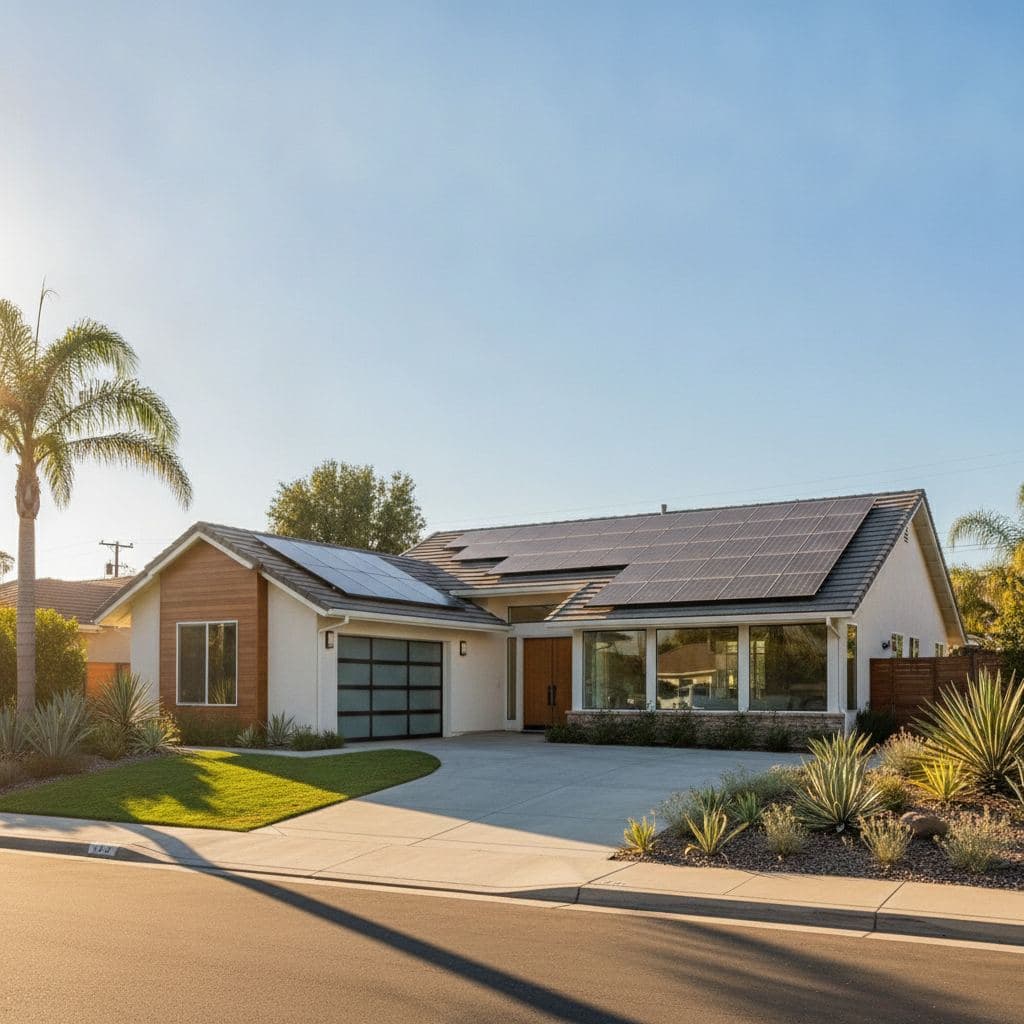
Most Southern California homes need between 6 and 12 kW of solar to cover their annual electricity use. You can calculate your own number in three steps using nothing more than your last 12 utility bills and the production data for your roof's orientation.
Last verified: September 2026 by Helios Energy Global.
The three-step formula
Step 1 — Pull your annual kWh from a real bill
Log into your utility account (SCE, LADWP, SDG&E, or your muni) and download 12 months of usage. Add up the total kilowatt-hours consumed. Do not average a single month — seasonal swings are large, and one summer month on SCE can be 3× a winter month.
The average California home uses about 503 kWh per month — roughly 42% less than the U.S. average of 863 kWh, thanks to the mild climate and decades of efficiency standards. That's roughly 6,000 kWh/year statewide, but the average Southern California home lands between 7,000 and 18,000 kWh/year depending on square footage, whether you have a pool or EV, and how aggressively you run air conditioning.
Where to find it on your SCE bill: Look for the "Usage History" section or the 12-month bar chart on the back of any paper bill. The number labeled "kWh used this period" is what you need — add all 12.
Step 2 — Divide by your production factor (and derate for your roof)
A production factor (also called specific yield) tells you how many kilowatt-hours each installed kilowatt of panels will produce in a year at your location. Inland desert areas of Southern California yield roughly 1,870 kWh/kW/year; the LA coast comes in around 1,572 kWh/kW/year , per physics-based pvlib modeling using Open-Meteo ERA5 historical weather data. For most Southern California planning purposes, 1,500–1,700 kWh/kW is a solid range.
Next, apply a derate factor for anything that reduces your roof's real-world output versus a perfect south-facing, unshaded installation:
| Roof condition | Derate factor | Effect on system size |
|---|---|---|
| South-facing, 15–30° tilt, no shade | 1.00 | No adjustment needed |
| West- or east-facing (±45° of south) | 0.85–0.95 | Size up ~5–15% |
| Significant morning or afternoon shade | 0.75–0.85 | Size up ~15–25% |
| Flat roof (ballasted, adjustable tilt) | 0.95–1.00 | Minimal adjustment |
| Steep tile roof (>35°) | 0.90–0.95 | Slight reduction in production |
Coastal areas in Southern California also experience June Gloom — marine layer that reduces June production by 8–15% compared to inland locations at the same latitude. If you're in Santa Monica, Malibu, or Manhattan Beach, use the lower end of the production factor range.
The formula in plain math:
Sources
- CPUC Public Advocates Office Q2 2026 Electric Rates Report (via Helios tracker) — July 2026
- Solar Benchmark — California Solar Panel Performance Benchmarks — April 6, 2026
- EnergySage — How Many Solar Panels Do I Need? 2026 Guide — July 1, 2026
- U.S. DOE FOTW #1307 — EV Charging Energy Consumption (2020 RECS) — September 11, 2023
More guides
What is the average LADWP electric bill in 2026?
The typical LADWP residential customer pays roughly $140–$230/month in mid-2026, based on tiered rates that work out to an effective 26–31¢/kWh — still below what SCE customers pay, though the gap has narrowed.
ReadPowerwall 3 vs FranklinWH aPower 2 vs Enphase IQ 10C for SCE TOU Rates (2026)
On SCE TOU-D-PRIME, a 7 kW battery system can shift roughly $57–$76/month in summer peak-hour charges — here's which of the three leading batteries does it best.
ReadWhat should you set your Tesla Powerwall reserve to in 2026?
Most Southern California homeowners get the best results setting their Powerwall reserve between 10–30%, depending on whether their priority is TOU bill savings, wildfire backup, or NEM 3.0 self-consumption.
ReadGet a free consultation and custom design.
No pressure, no obligation — the owner reviews every design we send.