How Do Solar Panels Work? From Sunlight to the Outlet, Step by Step
Sunlight knocks electrons loose in silicon cells (the photovoltaic effect), an inverter converts DC to AC, and a Southern California home on SCE can expect roughly 1,677 kWh of output per kW of panels installed each year.
By Taylor Crouse — Founder, Helios Energy GlobalPublished
Quick answer
- Sunlight knocks electrons loose inside silicon cells — this is called the photovoltaic effect — and produces direct current (DC) electricity.
- An inverter converts that DC into the 120/240 V alternating current (AC) your home appliances use.
- A south-facing Los Angeles roof produces roughly 1,677 kWh per kW of panels per year (NREL PVWatts v8, standard module, 20° tilt, 14% system losses, October 2026 run).
- Power your home doesn't use in the moment either charges a battery or flows back through the meter — how much you're credited depends on whether you're on SCE/SDG&E net billing or LADWP net metering.
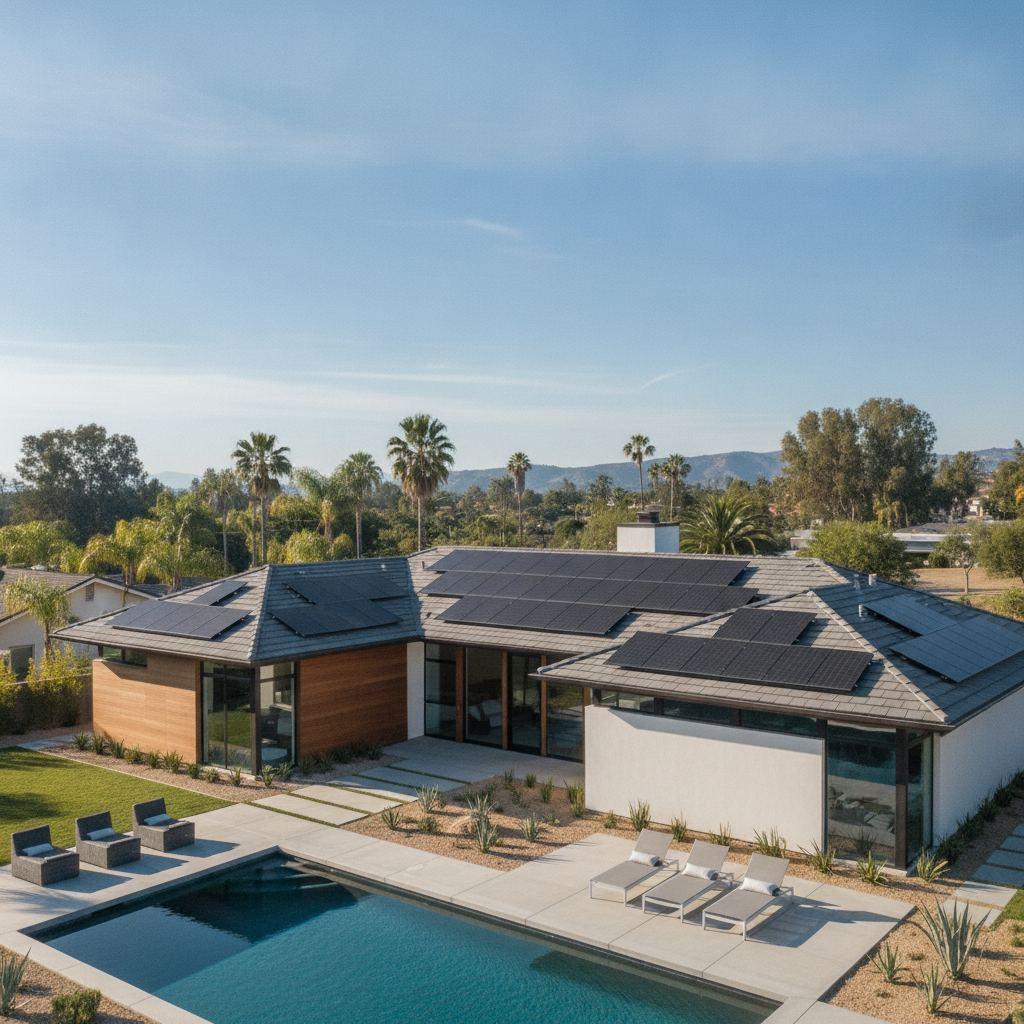
A solar panel system converts sunlight into household electricity through three linked steps: the photovoltaic effect inside each silicon cell creates DC power, an inverter turns that into AC, and the grid or a battery absorbs whatever your home doesn't use right away. For a typical Southern California home, that process runs silently on the roof every day — and per NREL PVWatts v8 modeling for Los Angeles (south-facing, 20° tilt, 14% system losses, October 2026 run), each installed kilowatt of panels produces about 1,677 kWh per year, meaning an 8 kW system yields roughly 13,400 kWh annually. Understanding each step helps you ask better questions, read your monitoring app, and compare quotes with confidence.
Last verified: November 2026 by Helios Energy Global.
Step 1 — The cell and the panel: where electricity is born
Photovoltaic materials and devices convert sunlight into electrical energy. A single PV device is known as a cell. An individual PV cell is usually small, typically producing about 1 or 2 watts of power. These cells are made of different semiconductor materials and are often less than the thickness of four human hairs. Cells are sandwiched between protective materials such as glass and/or plastic to withstand the outdoors for many years.
The physics behind this is called the photovoltaic effect. Photovoltaics gets its name from the process of converting light (photons) to electricity (voltage), which is called the photovoltaic effect. This phenomenon was first exploited in 1954 by scientists at Bell Laboratories who created a working solar cell made from silicon that generated an electric current when exposed to sunlight.
Here is what happens inside a cell when sunlight hits it: when the sun shines onto a solar panel, energy from the sunlight is absorbed by the PV cells in the panel. This energy creates electrical charges that move in response to an internal electrical field in the cell, causing electricity to flow. That flow of charge is direct current — DC — which moves in one direction only.
From cells to panels to arrays: to boost the power output of PV cells, they are connected in chains to form larger units known as modules or panels. Modules can be used individually, or several can be connected to form arrays. One or more arrays are then connected to the electrical grid as part of a complete PV system. Because of this modular structure, PV systems can be built to meet almost any electric power need, small or large. A typical residential roof in Southern California holds 20–30 panels wired together, producing enough DC power to feed an inverter.
Want the production numbers? See our guide to how much power a solar panel produces in Southern California — it covers per-panel output by city, season, and roof direction using the same NREL PVWatts model.
Step 2 — The inverter: DC becomes AC
Your home runs on AC. Every outlet, appliance, and light fixture expects 120 V or 240 V alternating current. The inverter is the device that bridges the gap between the DC your panels generate and the AC your house needs.
Three inverter types you'll see on quotes:
- String inverter — one central box converts DC from all panels at once. Lower upfront cost; if one panel is shaded, the whole string's output can drop.
- Microinverters — one small inverter per panel, mounted on the roof. Each panel operates independently, so shade on one doesn't drag down the others. Enphase IQ8 microinverters are the most common in Southern California.
- Hybrid inverter (with battery) — manages both solar input and a battery simultaneously. The Tesla Powerwall 3 has a hybrid inverter built in, which is one reason it installs faster on new solar systems.
For a deeper look at the trade-offs, see our guides to solar inverters explained and microinverters vs. string inverters.
Step 3 — The main panel and the meter: what happens next
AC power from the inverter flows into your home's main electrical panel and is distributed to circuits exactly like power from the grid. Your home draws from solar first; anything left over goes one of two places:
- Into a battery — stored for evening use or a grid outage.
- Out through the meter to the grid — and here is where your utility matters.
SCE and SDG&E (NEM 3.0 / Net Billing Tariff): Excess power exported to the grid is credited at a wholesale-adjacent rate, not retail. At SCE's average of ~34–35¢/kWh for power you consume but export credits that are a fraction of that, a battery becomes much more financially important under NEM 3.0. For a full breakdown, see our NEM 3.0 explained guide.
LADWP: LADWP is a municipal utility and is not subject to the CPUC's NEM 3.0 rules. LADWP still offers retail-rate net metering — meaning excess solar exported to the grid earns you a credit at roughly the same rate (~28¢/kWh effective) as power you buy. That makes solar-only systems (no battery) more financially straightforward for LADWP customers than for SCE or SDG&E customers.
Step 4 — The battery: storing midday sun for evening use
Solar panels peak around solar noon and taper off by late afternoon. But in Southern California, the most expensive electricity hours — and the hours when you use the most power — are in the evening. A home battery bridges that gap.
During the day, surplus DC power from the panels charges the battery. After sunset, the battery discharges to run the house. For SCE customers, whose TOU-D-PRIME peak runs roughly 4–9 PM at ~48–58¢/kWh, a battery can shift nearly all evening consumption off the grid. For LADWP customers on retail net metering, the financial case is softer — but the backup-power value is the same for everyone.
Explore battery options, specs, and installed costs on our batteries page.
Why a solar-only system shuts off in a blackout: anti-islanding
This surprises many homeowners: a grid-tied solar system with no battery shuts itself off automatically when the grid goes down. The reason is a safety rule called anti-islanding protection. Inverters are required by code to detect a grid outage and stop exporting power within milliseconds — otherwise utility workers repairing lines could be electrocuted by power flowing from your roof.
A battery with a transfer switch (or a hybrid inverter like the Powerwall 3) solves this. It isolates your home from the grid, allows the solar panels to keep running, and lets the battery power your critical loads. Without a battery, your panels sit idle during the outage even if the sun is shining.
See our full guide: Do solar panels work during a power outage?
What changes your output through the day and the year
Four factors move the needle on how much electricity your system produces at any given moment:
- Sun angle — output peaks when the sun is highest (roughly 10 AM–2 PM). Early morning and late afternoon angles are shallower, so cells absorb less energy per square foot.
- Shade — even a shadow from a chimney or a neighbor's tree on one panel can reduce output. Microinverters limit this to the shaded panel only; a string inverter spreads the penalty across the string.
- Heat — silicon cells are less efficient as temperature rises. This is counter-intuitive: a clear, cool January day in Pasadena can produce more power per hour than a sweltering August afternoon. The effect is real but modest in most Southern California climates.
- Clouds and seasons — output drops on overcast days and in winter when days are shorter and the sun angle is lower. For Los Angeles, the best month is August (~69 kWh per 400 W panel) and the worst month is December (~40 kWh per 400 W panel), per NREL PVWatts v8. That is about 58% of summer output in winter — meaningful, but not zero. See our guide on solar panels on cloudy days and in winter in Southern California.
A concrete Southern California example: NREL PVWatts v8 (NSRDB TMY weather data, standard module, fixed roof mount, 20° tilt, south-facing, 14% system losses, October 2026 run) puts Los Angeles at 1,677 kWh per kW of installed capacity per year, or about 671 kWh per 400 W panel per year — roughly 1.84 kWh per panel per day on average. An 8 kW system on a south-facing Los Angeles roof therefore produces approximately 13,400 kWh/year under those assumptions. Your actual number will vary with tilt, shading, and roof direction — which is exactly what a custom design from Helios calculates.
What your monitoring app is showing: Most systems — whether using Enphase Enlighten, Tesla's app, or SolarEdge mySolarEdge — display real-time watts being produced, kilowatt-hours generated today, and cumulative production over the system's life. If you see a sharp dip at a consistent time each day, that is usually shade. A flat zero during daylight hours points to an inverter or communication issue worth investigating. If you are not sure what a kilowatt-hour actually means, that guide explains the difference between kW (rate of production) and kWh (total energy produced).
Component lifespans at a glance
| Component | What it does | Warranted life |
|---|---|---|
| Solar panels (silicon) | Convert sunlight to DC electricity | 25-year product + performance warranty (typical) |
| String inverter | Converts DC to AC for whole system | 10–12 years standard (extendable to 25 years) |
| Microinverter (e.g., Enphase IQ8) | Converts DC to AC per panel | 25 years |
| Hybrid inverter / battery system (e.g., Powerwall 3) | Converts DC/AC, manages battery | 10 years, ≥70% capacity at year 10 |
| Home battery (e.g., Tesla Powerwall 3) | Stores surplus solar, powers home in outages | 10-year warranty, ≥70% capacity at year 10 |
| Main panel (if upgraded) | Distributes AC to home circuits | No standard solar warranty; typical service life 30–40 years |
Warranted life figures are estimates based on manufacturer warranty documents and 2026 industry comparisons. Actual lifespan may exceed warranted life.
Solar panels carry two warranties: a product warranty (manufacturing defects, typically 25–30 years) and a performance warranty (guaranteed output, typically 87% at year 25). Inverters are warranted separately (12–25 years).
Maxeon solar panels carry a 40-year warranty, the longest standard term in residential solar for 2026. Enphase microinverters back their hardware for 25 years; SolarEdge's base inverter term runs 12 years.
The Tesla Powerwall is backed by a 10-year warranty that guarantees that the battery will retain at least 70% of its capacity by the end of the warranty period.
For a deeper look at how long panels last in Southern California conditions, see our guide on how long solar panels last.
Frequently asked questions about how solar panels work
What exactly is the photovoltaic effect?
Photovoltaics gets its name from the process of converting light (photons) to electricity (voltage), which is called the photovoltaic effect. Inside a silicon cell, incoming photons knock electrons loose from their atoms. Those free electrons are swept in one direction by an internal electric field built into the cell, creating a flow of direct current. No moving parts, no combustion — just light and physics.
Does it matter which direction my roof faces in Southern California?
Direction matters significantly. NREL PVWatts v8 puts a south-facing Los Angeles roof at 1,677 kWh per kW per year. East- and west-facing roofs produce roughly 10–15% less annually, though west-facing panels can better match SCE's 4–9 PM peak pricing window. Our custom design tool models your specific roof orientation.
What happens to my solar system during a power outage if I have no battery?
Without a battery, your inverter's anti-islanding protection kicks in and shuts the system down within milliseconds of detecting a grid outage — even if the sun is shining. This is a safety code requirement, not a malfunction. A battery with a transfer switch allows the system to island safely and keep running. See do solar panels work during a power outage? for the full explanation.
How does the billing difference between SCE and LADWP affect how I use my solar?
SCE and SDG&E customers are on NEM 3.0 (the CPUC Net Billing Tariff), which credits exported solar at a wholesale-adjacent rate rather than retail. That makes it financially important to consume solar power directly or store it in a battery rather than export it. LADWP customers still receive retail-rate net metering at an effective rate of roughly 28¢/kWh, so solar-only systems (without a battery) still offset the full retail rate on every exported kilowatt-hour. See our NEM 3.0 explained guide for numbers.
Why does my monitoring app show lower output on hot summer afternoons than on cool spring days?
Silicon cells are less efficient at high temperatures — a physical property called the temperature coefficient. On a 100°F August afternoon in the San Fernando Valley, panel surface temperatures can reach 140–160°F, noticeably reducing output compared to a clear 65°F March day with the same irradiance. This is one reason NREL PVWatts models include a temperature-derate factor in its system losses.
How many panels does a typical Southern California home need?
The number depends on your annual electricity use, your roof's orientation, and how much of your bill you want to offset. At roughly 1,677 kWh per kW per year for a south-facing Los Angeles roof (NREL PVWatts v8, October 2026), a home using 12,000 kWh per year would need approximately 7–8 kW of panels — around 18–20 panels at 400 W each. Our production guide has the city-by-city breakdown.
Do I need a permit to install solar panels in Southern California?
Yes. Every jurisdiction — Los Angeles, Santa Monica, Pasadena, Torrance, and others — requires a building permit and utility interconnection approval before a system can be energized. Helios handles all permitting and interconnection paperwork as part of every installation. The timeline varies by city but typically runs 2–8 weeks from permit submission to Permission to Operate.
Next steps
- Book a free consultation and custom design — we model your roof, utility, and usage before quoting anything.
- Explore our locations across Southern California — we serve Santa Monica, Los Angeles, Pasadena, Long Beach, and beyond.
- See how much a solar system produces for your home — personalized output and savings estimates.
- Learn about adding a battery — Powerwall 3, Enphase IQ Battery 10C, and FranklinWH aPower 2 options.
- Understand NEM 3.0 vs. LADWP net metering — the billing rules that determine how much your exported solar is worth.
- Read our solar overview — system types, financing, and what to expect from the installation process.
Sources
- DOE SETO Solar Photovoltaic Technology Basics (updated July 22, 2026) — July 22, 2026
- DOE SETO How Does Solar Work — September 2, 2026
- NREL Solar Photovoltaic Technology Basics — November 1, 2022
- Solar Equipment Warranty Comparison 2026 — SunSup PV — August 12, 2026
More guides
Best Solar Companies in West Covina, CA (2026): Honest Rankings for SGV Homeowners
A straight-talking, numbers-first guide to the top solar installers serving West Covina in 2026 — covering SCE's NEM 3.0 rules, real pricing ranges, battery strategy, and how to compare quotes without getting burned.
ReadDo Solar Panels Work on a North-Facing Roof in Southern California? (2026)
A north-facing roof in Southern California cuts solar output by roughly 30–40% versus south-facing — but west-facing panels on the same home, microinverters, and battery storage can still make the numbers work under NEM 3.0 and SCE's 4–9 PM peak.
ReadThe 9 Best Solar Companies in Encinitas, CA (2026): SDG&E Rates, NEM 3.0, and What the Marine Layer Actually Does to Your Bill
Encinitas pays some of the highest electricity rates in the country under SDG&E, and NEM 3.0 changed the math on exports entirely. Here's an honest, numbers-first guide to the best solar installers in Encinitas for 2026 — and exactly what to ask before you sign.
ReadGet a free consultation and custom design.
No pressure, no obligation — the owner reviews every design we send.