Best Solar Companies in Rancho Palos Verdes, CA (2026): Honest Rankings for Peninsula Homeowners
A straight-talking, numbers-first ranking of the best solar installers serving Rancho Palos Verdes in 2026, with honest guidance on SCE's Net Billing Tariff, HOA approvals, coastal roof considerations, and what a real quote should include.
By Taylor Crouse — Founder, Helios Energy GlobalUpdated
Quick answer
- Your utility is Southern California Edison (SCE), and NEM 3.0 applies. Export credits are significantly lower than they were under legacy net metering, which changes the math on system sizing and makes battery storage far more valuable than it was even two years ago.
- Average peak sun hours run about 5.5 per day on the Palos Verdes Peninsula — solid for Southern California and enhanced by cooler marine air that keeps panels operating closer to their rated efficiency.
- Typical system sizes on the Peninsula range from roughly 8 kW to 15 kW, reflecting the larger, high-energy homes common here. Expect installed costs in the $2.50–$3.50 per watt range before any incentives.
- The 30% federal residential solar tax credit expired December 31, 2025. There is no federal credit for systems installed in 2026. Any installer quoting you a "30% federal credit" on a 2026 install is giving you outdated information.
- HOA design review is the rule, not the exception in RPV. Many communities require architectural committee approval before a permit is even submitted — choosing an installer who handles that workflow matters.
- Battery storage is worth serious consideration here. Under NEM 3.0's low daytime export rates, a battery lets you consume your own solar production at full retail value rather than exporting it for pennies.
Rancho Palos Verdes occupies the southern tip of the Palos Verdes Peninsula in Los Angeles County, a community of large-lot homes, ocean views, and active homeowners associations — served for electricity by Southern California Edison. That combination of premium housing stock, HOA governance, and SCE's current Net Billing Tariff creates a solar market with its own distinct set of rules, and generic installer advice often misses the details that matter most here.
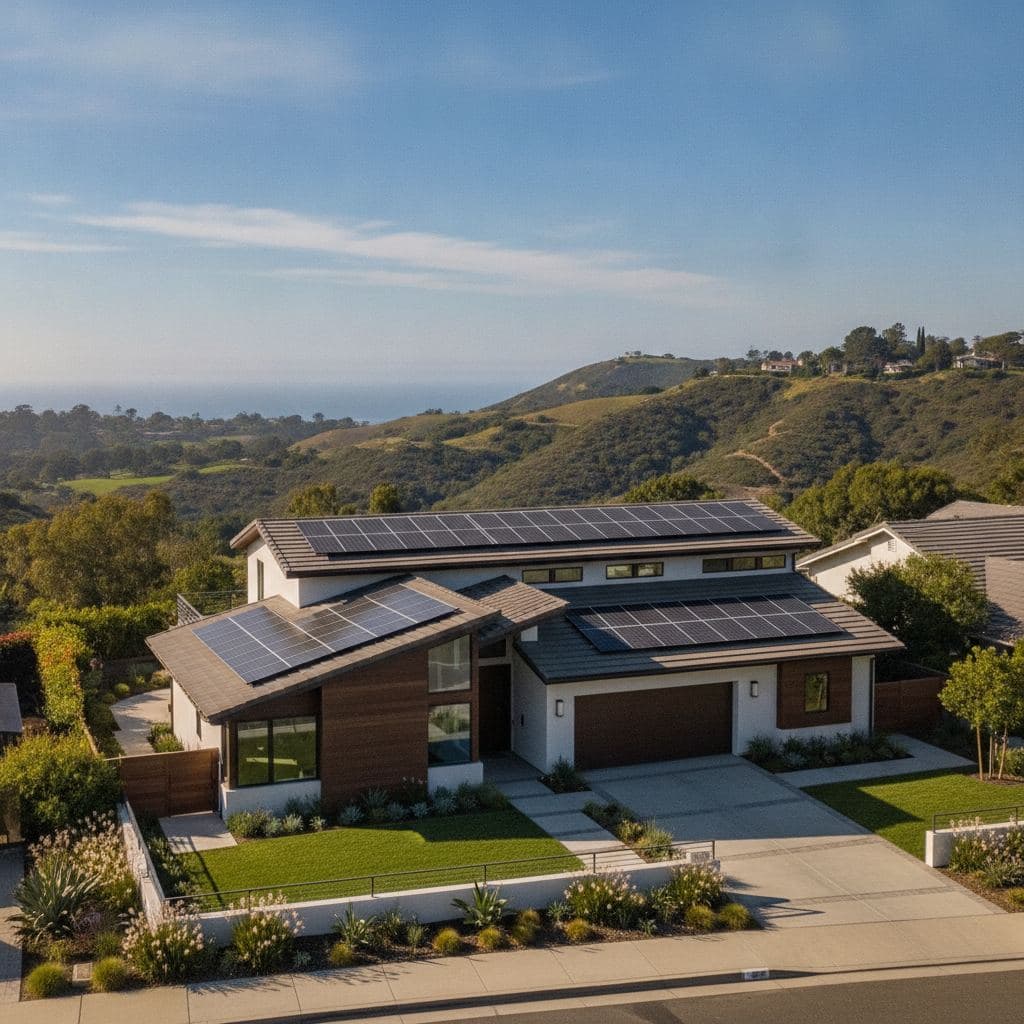
Last verified: September 2026 by Helios Energy Global.
Top 8 best solar companies in Rancho Palos Verdes (2026)
A 2026 note on who is still standing. Residential solar has been through a brutal consolidation, and several companies that appear on older "best of" lists no longer exist. SunPower filed Chapter 11 in August 2024 and the brand now belongs to a different legal entity; Sunnova filed in June 2025; Freedom Forever filed in April 2026. Companies that have shut down or are in restructuring have been removed from the ranking below — a workmanship warranty is only worth the company standing behind it. Full detail in our statewide ranking of California solar companies.
At-a-glance ranking
- Helios Energy Global — Best for: Peninsula-specific HOA workflow + SCE NEM 3.0 design
- Sunrun — Best for: Homeowners who want a lease or PPA with a national warranty
- Tesla Energy — Best for: Integrated Powerwall + solar aesthetics
- Palmetto Solar — Best for: Tech-forward monitoring and transparent online quoting
- SunPower Inc. — Best for: Premium high-efficiency panels on space-constrained roofs
- Baker Electric Solar — Best for: Southern California regional track record
- Semper Solaris — Best for: Veteran-owned, roofing-and-solar bundled projects
- Momentum Solar — Best for: Homeowners exploring financing options across a national platform
This ranking reflects Helios Energy Global's own editorial opinion and is not paid placement. Verify each company's active California Contractors State License Board (CSLB) license and confirm they currently serve Rancho Palos Verdes before signing any agreement.
#1 — Helios Energy Global
Rancho Palos Verdes is one of the more demanding installation markets in Southern California, and Helios Energy Global was built for exactly this kind of complexity. Every system design is reviewed by the owner before it goes to a customer — meaning you get a design calibrated to your specific roof geometry, your HOA's architectural guidelines, your SCE rate schedule, and the NEM 3.0 export structure, not a template pulled from a CRM.
We handle the HOA approval workflow from start to finish, which on the Peninsula can involve submitting renderings, attending architectural committee meetings, and revising panel placement to satisfy aesthetic requirements — steps that trip up installers who don't work here regularly.
Our coastal experience also means we spec equipment with salt-air corrosion resistance in mind, and we size batteries to maximize self-consumption under NEM 3.0 rather than just adding storage as an upsell. No high-pressure tactics, no invented discounts — just a free consultation, a custom design, and a quote you can actually compare against any other bid.
Learn more about solar installation in Rancho Palos Verdes and what makes the Peninsula market unique.
#2 — Sunrun
Best for: Homeowners who prefer a lease or power purchase agreement (PPA) rather than owning the system outright. Why it fits: Sunrun is one of the largest residential solar companies in the country, with a broad California footprint and established SCE interconnection processes. Their lease and PPA products transfer equipment responsibility to Sunrun for the contract term. What to ask: What happens to the system if I sell my home? What are the escalator clauses on my monthly payment over 20+ years?
#3 — Tesla Energy
Best for: Homeowners drawn to the aesthetic of Tesla Solar Roof or who want Powerwall batteries tightly integrated with their solar array. Why it fits: Tesla's Powerwall is one of the most recognized battery products in California, and their app-based monitoring is genuinely strong. Their all-in-one approach suits homeowners who want a single brand managing generation and storage. What to ask: What is the current lead time for Solar Roof installation in my zip code? Who handles service calls — Tesla directly or a subcontractor?
#4 — Palmetto Solar
Best for: Homeowners who want to start the quoting process digitally and value real-time system monitoring. Why it fits: Palmetto's platform lets you see preliminary estimates online before a site visit, and their Palmetto Protect monitoring subscription gives ongoing performance visibility. They work with a network of local installers in Southern California. What to ask: Which local subcontractor will physically install my system, and what is their CSLB license number?
#5 — SunPower Inc.
Best for: Roofs where space is constrained and you need the highest watts per square foot available. Why it fits: Maxeon-cell panels consistently rank among the highest efficiency options on the market, which matters on smaller or partially shaded roof sections. Their 25-year comprehensive warranty has historically been among the stronger product guarantees in the industry. What to ask: Confirm current California dealer availability and warranty service terms under the post-restructuring entity.
#6 — Baker Electric Solar
Best for: Homeowners who want a well-established Southern California regional installer with a long local track record. Why it fits: Baker Electric has been operating in SoCal for decades and has completed a large volume of SCE-territory installs. Their familiarity with local permit offices and utility interconnection is a genuine operational advantage. What to ask: Do you have experience with HOA architectural review in gated Peninsula communities specifically?
#7 — Semper Solaris
Best for: Homeowners who need roofing work done alongside solar, or who prefer a veteran-owned business. Why it fits: Semper Solaris holds both roofing and solar contractor licenses, which simplifies projects where the roof needs attention before panels go up — a real consideration on older Peninsula homes with aging tile or composition roofs. What to ask: Are both the roofing and solar scopes covered under a single warranty, and for how long?
#8 — Momentum Solar
Best for: Homeowners who want to explore multiple financing structures and compare options across a national installer's product suite. Why it fits: Momentum operates in California and offers loan, lease, and PPA structures. Their sales process is typically phone- and digital-first before a site visit. What to ask: Who installs locally, and what is the process if I need service after the install team has moved on?
This is Helios Energy Global's own editorial opinion — not paid placement and not a guarantee of quality. Verify each company's active CSLB license at cslb.ca.gov and confirm current service availability in Rancho Palos Verdes before signing any contract.
Why Rancho Palos Verdes solar is different from a generic install
SCE and NEM 3.0 change the economics fundamentally
Rancho Palos Verdes is SCE territory, which means your system falls under California's Net Billing Tariff — commonly called NEM 3.0. Under this structure, the credit you receive for electricity exported to the grid during the day is set at the avoided-cost rate, which is a fraction of what you pay to import power in the evening. The practical implication: a solar-only system that was a strong financial performer under legacy net metering now requires more careful sizing and, in most cases, battery storage to achieve similar payback periods.
Exporting excess midday solar production earns you relatively little; consuming that production directly — or storing it in a battery for evening use — is where the value lives under NEM 3.0.
For a deeper explanation of how the tariff works, see our NEM 3.0 guide.
Batteries aren't optional anymore — they're the strategy
Under legacy net metering, a battery was a nice-to-have for backup power. Under NEM 3.0, a battery is a core financial tool. By storing solar energy during peak production hours and discharging it when SCE's time-of-use rates are highest (typically late afternoon through evening), a battery meaningfully improves the economics of a Peninsula solar install.
The question isn't really "do I need a battery?" — it's "what size battery makes sense for my usage profile?" A properly designed system pairs battery capacity to your evening load, not just to a round number that looks good on a proposal.
Read more in our solar vs. battery under NEM 3.0 guide and our battery storage page.
HOA design review is a real project phase, not a formality
A significant portion of Rancho Palos Verdes falls within communities governed by homeowners associations with active architectural review committees. California's Solar Rights Act limits HOAs from outright banning solar installations, but it does allow reasonable aesthetic conditions — panel placement, color matching, visibility from the street. On the Peninsula, that can mean submitting detailed renderings, providing equipment spec sheets, and sometimes attending a committee meeting before a permit application is even filed.
Installers who don't regularly work in HOA-governed communities often underestimate this phase, which can delay projects by weeks. Choosing an installer who treats HOA approval as a managed workflow — not an afterthought — is one of the most practical decisions you can make in this market.
Coastal conditions affect equipment selection
The marine influence on the Palos Verdes Peninsula is a double-edged factor. On the positive side, cooler ambient temperatures keep solar panels operating closer to their rated efficiency — panels lose output as they heat up, and RPV's ocean breezes reduce that thermal penalty compared to inland valleys. On the less favorable side, salt-laden coastal air accelerates corrosion on mounting hardware, connectors, and inverter enclosures if the wrong equipment is specified.
Racking systems rated for coastal or C4/C5 corrosion environments, stainless or hot-dip galvanized hardware, and inverters with appropriate ingress protection ratings are not upsells — they're baseline specifications for a system expected to last 25+ years on the Peninsula.
Lot size, view corridors, and roof geometry vary dramatically by neighborhood
RPV is not a uniform housing stock. The Miraleste Hills, Lunada Bay, Portuguese Bend, and Rancho Palos Verdes Estates neighborhoods each have distinct lot configurations, roof pitches, and orientation profiles. Homes in Lunada Bay often have ocean-facing rear elevations that may be architecturally restricted from panel placement. Portuguese Bend properties sometimes have complex roof geometry from additions and remodels. Miraleste Hills homes tend to have favorable south-facing roof sections but may sit on slopes that complicate racking.
A system design that doesn't account for your specific address — not just your zip code — will produce less than projected and may face HOA objections. Satellite-based shading analysis is a minimum; an in-person roof assessment is the standard for a credible quote in this market.
Real prices: what solar costs in Rancho Palos Verdes
Per-watt benchmark
Installed solar in Rancho Palos Verdes generally runs in the $2.50–$3.50 per watt range before any incentives, depending on system size, equipment tier, roof complexity, and whether battery storage is included. Larger systems tend to land toward the lower end of the per-watt range; smaller systems or those with complex installs (tile roofs, steep pitches, HOA-required custom racking) trend higher. These figures reflect the installed cost — panels, inverter, racking, wiring, permits, interconnection, and labor.
Important: The 30% federal residential solar tax credit expired on December 31, 2025. It is not available for systems installed in 2026. Do not let any quote assume that credit in your payback calculation.
Illustrative pre-incentive price ranges (2026 estimates)
| System Size | Low Estimate | High Estimate | Typical Use Case |
|---|---|---|---|
| 6 kW | ~$14,400 | ~$19,500 | Smaller home, moderate usage |
| 8 kW | ~$19,200 | ~$26,000 | Mid-size home, average SCE bill |
| 10 kW | ~$24,000 | ~$32,500 | Larger home, EV charging |
| 12 kW | ~$28,800 | ~$39,000 | High-usage home, pool equipment |
| 15 kW | ~$36,000 | ~$48,750 | Large estate, whole-home offset goal |
These are illustrative ranges, not quotes. Your actual price depends on your roof, your equipment choices, and current labor and material costs. Use the estimate your Rancho Palos Verdes solar savings tool for a starting point, then get a full site assessment.
What pushes a quote higher in RPV
- Tile roof installation — Spanish or concrete tile requires specialized removal, reinstallation, and flashing; adds labor cost
- Steep pitch or complex geometry — multi-plane roofs with hips, valleys, or dormers increase install time
- HOA-required custom racking or panel positioning — non-standard layouts can add material and design cost
- Battery storage — a single battery unit adds meaningfully to the project cost; multiple units more so
- Main panel upgrade — older homes may need a 200A service upgrade to accommodate the solar interconnection
- Coastal-rated hardware — appropriate for RPV, but carries a modest premium over standard-grade racking
Solar-only or solar + battery in Rancho Palos Verdes?
When solar-only still makes sense
If your primary goal is reducing your SCE bill and your usage is heavily daytime-weighted — a home office, a pool that runs midday, or significant daytime HVAC — a well-sized solar-only system can still perform meaningfully under NEM 3.0. The key is sizing to consumption, not to "offset 100% of your annual kWh," because annual offset math ignores the timing mismatch that NEM 3.0 penalizes. Solar-only also has a lower upfront cost, which matters if you're planning to sell within five to seven years and want the simplest possible payback calculation.
When battery storage materially improves the math
For the typical RPV household — larger home, evening-heavy usage, pool, EV, or some combination — a battery transforms the system's financial profile under NEM 3.0. Storing midday solar production and discharging it during SCE's peak rate hours (when import costs are highest) is the mechanism that makes the economics work. Beyond the financial case, battery backup is genuinely valuable on the Peninsula, where grid outages — while not frequent — can be complicated by the area's topology and limited access routes.
Battery proposal mistakes to avoid
- Undersized battery for your evening load — a single small battery paired with a 12 kW system may cycle out before your evening usage is covered
- Ignoring the battery's usable capacity vs. nameplate capacity — some batteries derate significantly in cold or hot conditions
- Assuming the battery qualifies for a federal tax credit — the residential federal credit expired; verify any incentive claims in writing
- Accepting a battery proposal that doesn't show you the charge/discharge schedule — if the installer can't show you when the battery charges and when it deploys, the design isn't complete
For a full breakdown, visit our battery storage page.
How to choose the right solar company in Rancho Palos Verdes
Start with license verification
Every solar installer in California must hold a valid CSLB license — typically a C-46 (Solar) or C-10 (Electrical). Look up any company you're considering at cslb.ca.gov before you agree to a site visit. Confirm the license is active, bonded, and insured. This takes three minutes and eliminates a meaningful category of risk.
Ask specifically about SCE NEM 3.0 experience
NEM 3.0 changes how system sizing decisions should be made. An installer who is still pitching "100% offset" as the universal goal without discussing time-of-use alignment and battery dispatch is working from an outdated playbook. Ask: "How do you size a system under NEM 3.0 for a home like mine?" A good answer involves your specific rate schedule, your usage timing, and an honest discussion of battery economics.
Ask about their HOA workflow
If your property is in an HOA-governed community — and many RPV properties are — ask the installer directly: "Have you submitted to this HOA's architectural committee before? What does your process look like?" An experienced installer will have a defined workflow, sample submittal packages, and realistic timelines. Vague answers here are a warning sign.
Evaluate the design, not just the price
A quote is a number. A design is a document that shows panel placement, shading analysis, production estimates by month, battery sizing rationale, and the SCE rate schedule the system is optimized for. If you're comparing two quotes and one comes with a detailed design document and one comes with a price on a napkin, they are not comparable. Ask for the design.
How to compare quotes without getting tricked
- Compare price per watt, not total system price — a cheaper total might just be a smaller system
- Check the panel wattage and count — two 10 kW quotes may use very different panel quality
- Verify the production estimate methodology — ask if it uses PVWatts or similar modeling, and whether shading was measured on site
- Confirm what's included — ask whether the quoted price covers permits, the interconnection application, HOA submittal, and monitoring, and get the answer in writing
- Read the warranty terms carefully — separate warranties often apply to panels (manufacturer), inverter (manufacturer), and workmanship (installer); know who handles each
- Get the NEM 3.0 export credit assumption in writing — the export rate used in your payback projection should be disclosed explicitly, not buried
See our full solar guide for more on evaluating proposals.
Rancho Palos Verdes quote checklist
Before signing any solar contract in RPV, get clear answers to these questions:
- License: What is your CSLB license number, and can I verify it right now?
- Insurance: What are your general liability and workers' comp coverage limits?
- HOA: Have you worked with my specific HOA's architectural committee? What does your submittal package include?
- NEM 3.0: What export rate are you assuming in my payback calculation, and where does that number come from?
- System sizing: Why did you choose this system size for my usage profile and rate schedule?
- Battery: If you're recommending a battery, what is the usable capacity, the warranty, and the projected dispatch schedule?
- Equipment: What panel brand, inverter brand, and racking system are you specifying, and why are they appropriate for a coastal environment?
- Production estimate: What tool did you use to model production, and was shading measured on site?
- Timeline: What is the realistic timeline from signed contract to Permission to Operate (PTO) from SCE?
- Permits: Who pulls the permit — your company or a subcontractor? Is permit cost included in the quote?
- Financing: If I'm financing, what is the APR, the loan term, and who is the lending partner?
- Federal credit: Are you assuming any federal tax credit in this proposal? (Correct answer for 2026: no.)
- Workmanship warranty: What does your workmanship warranty cover, and for how long?
- After-sale service: Who do I call if there's a problem two years from now — you, the manufacturer, or a third party?
Final verdict
Rancho Palos Verdes is a market where the details determine whether a solar investment performs as promised or underdelivers for 25 years. SCE's NEM 3.0 tariff requires a fundamentally different sizing approach than the legacy net metering most homeowners have heard about. The Peninsula's HOA landscape adds an approval layer that many installers aren't equipped to navigate efficiently. Coastal conditions demand equipment specifications that aren't always standard. And the homes here — large, architecturally varied, often with complex roof geometry — require genuine design work, not template proposals.
Helios Energy Global ranks #1 in this guide because we operate specifically in this environment. Every design is owner-reviewed, every HOA submittal is managed as a defined workflow, and every system is sized for NEM 3.0 self-consumption — not for a metric that made sense under a tariff that no longer applies.
We don't invent discounts, we don't use high-pressure tactics, and we give you a design document you can actually evaluate, not just a price. If you're comparing installers, we welcome the comparison — and we'll show you exactly how our design differs from any other quote you have on the table.
Frequently asked questions about solar in Rancho Palos Verdes
How much does solar cost in Rancho Palos Verdes in 2026?
Installed solar in RPV typically runs in the $2.50–$3.50 per watt range before incentives, depending on system size, roof complexity, equipment tier, and whether battery storage is included. A commonly sized 10 kW system might run roughly $25,000–$35,000 before any applicable incentives. Get a site-specific quote rather than relying on national averages, which often underestimate Peninsula installation complexity.
Does NEM 3.0 apply to my home in Rancho Palos Verdes?
Yes. Rancho Palos Verdes is served by Southern California Edison, an investor-owned utility regulated by the CPUC. NEM 3.0 (the Net Billing Tariff) applies to new solar installations on SCE. This means export credits for excess solar sent to the grid are set at avoided-cost rates — significantly lower than what you pay to import power — making battery storage and time-of-use alignment central to a well-designed system.
Is the 30% federal solar tax credit available in 2026?
No. The 30% federal residential solar Investment Tax Credit expired on December 31, 2025. There is no federal tax credit available for residential solar systems installed in 2026. Any installer or proposal that references a 30% federal credit for a 2026 installation is giving you incorrect information. Verify any incentive claims in writing before signing.
Do I need a battery with solar in Rancho Palos Verdes?
You don't legally need one, but under NEM 3.0, a battery substantially improves the financial performance of most RPV solar installs. By storing midday solar production and discharging it during SCE's high-rate evening hours, a battery lets you consume your own solar at full retail value rather than exporting it for a fraction of that. For larger homes with significant evening loads — common on the Peninsula — the battery case is strong. A well-designed system will model your specific usage timing before recommending a battery size.
How long does it take to get Permission to Operate (PTO) from SCE in Rancho Palos Verdes?
The full timeline from signed contract to SCE's Permission to Operate typically runs 10–16 weeks in this market, though it varies. That includes HOA architectural review (which can add several weeks in RPV), city permit processing through the Rancho Palos Verdes Building and Safety Division, installation, inspection, and SCE's interconnection review. Installers experienced in this specific workflow can often compress the timeline; those who aren't will frequently hit avoidable delays.
How do I verify that a solar installer is licensed in California?
Visit the California Contractors State License Board at cslb.ca.gov and search by company name or license number. Confirm the license is active, that the classification covers solar or electrical work (C-46 or C-10), and that the bond and insurance are current. Do this before agreeing to a site visit — it takes less than five minutes and is one of the most important steps in vetting any contractor.
What size solar system does a typical Rancho Palos Verdes home need?
RPV homes tend to be larger than the Southern California average, and many have pools, EV chargers, or high HVAC loads that push annual consumption well above 15,000–20,000 kWh per year. System sizes in the 8–15 kW range are common on the Peninsula. The right size depends on your actual usage history (pull 12 months of SCE bills), your time-of-use rate schedule, whether you're adding a battery, and your roof's available south- or west-facing area. A credible installer will show you the sizing rationale, not just a number.
Can my HOA block me from installing solar panels in Rancho Palos Verdes?
No — California's Solar Rights Act prohibits HOAs from outright banning solar installations. However, HOAs can impose reasonable aesthetic conditions, such as panel placement requirements, color specifications, or restrictions on street-facing visibility. In practice, this means an HOA architectural review process is typically required before you can pull a permit. The process is manageable with the right documentation, but it adds time and requires an installer who knows how to prepare a compliant submittal package.
Next steps
- Book a free consultation and custom design — no pressure, no obligation
- Learn about solar installation in Rancho Palos Verdes — Peninsula-specific details
- Estimate your Rancho Palos Verdes solar savings — city-prefilled savings calculator
- Understand how NEM 3.0 affects your SCE system
- Compare solar-only vs. solar + battery under NEM 3.0
- Explore battery storage options
- See what a 10 kW system costs in California
- Browse all solar guides
More guides
How long do PSPS power shutoffs last in 2026?
PSPS shutoffs typically last 1–5 days, though some SCE customers went without power for up to 7 days during the January 2025 windstorm events.
ReadHow Much Does a Roof Replacement with Solar Panels Cost in 2026?
A combined roof-replacement-plus-new-solar project in Southern California typically runs $30,000–$65,000 depending on roofing material and system size — less than doing both projects separately. If you already have solar, Helios's detach-and-reset adds $250–$350 per panel.
ReadDo I need HOA approval for solar in California? (2026 guide)
California Civil Code 714 limits HOA conditions to a $1,000 cost cap and 10% output reduction—your HOA cannot ban solar outright.
ReadGet a free consultation and custom design.
No pressure, no obligation — the owner reviews every design we send.