Solar inverters explained: types, costs, and which one you need in 2026
Solar inverters convert panel DC power to usable AC electricity — expect to pay $1,000–$3,500 for a string inverter or $1,500–$5,000+ for microinverters on a typical Southern California home system.
By Taylor Crouse — Founder, Helios Energy GlobalUpdated
Quick answer
- A solar inverter converts your panels' DC electricity into the AC power your home uses — without it, nothing works.
- String inverters cost roughly $1,000–$3,500 installed; microinverters run $1,500–$5,000+ on a typical 6–10 kW Southern California home system.
- Inverters typically need replacement after 10–15 years — a $1,500–$4,000 expense most homeowners don't budget for upfront.
- If you're on SCE's NEM 3.0 net billing tariff, a hybrid (battery-ready) inverter is almost always the smarter long-term choice.
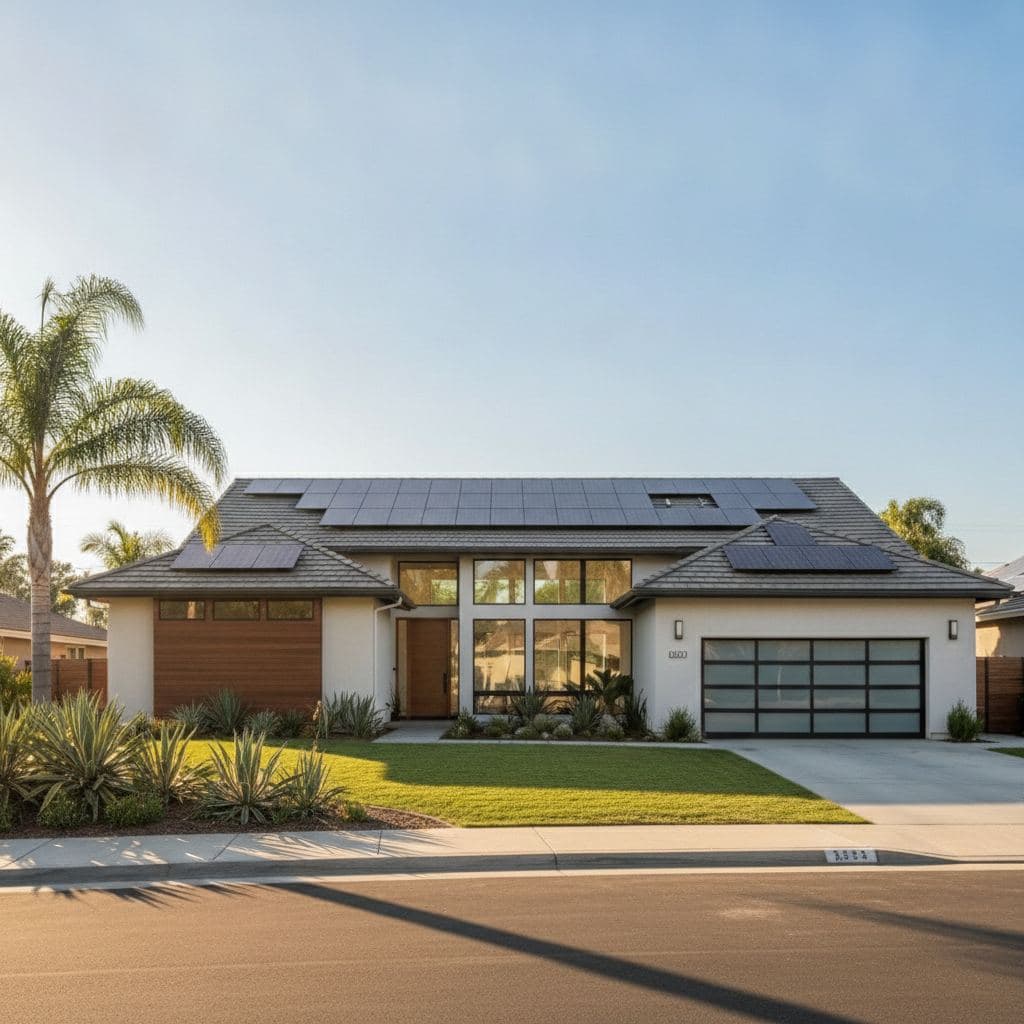
A solar inverter is the single most critical piece of hardware in your system after the panels themselves — and on a typical 8 kW Southern California rooftop, the inverter hardware alone runs $800–$4,000 depending on type, before installation labor. Choose the wrong type for your roof layout or utility tariff and you'll either leave meaningful production on the table or pay thousands more than necessary.
Last verified: August 2026 by Helios Energy Global.
What a solar inverter actually does
Your solar panels produce direct current (DC) electricity. Your home runs on alternating current (AC). The inverter bridges that gap — it's the box (or set of small boxes) that converts panel output into usable power and, in grid-tied systems, synchronizes with the utility grid.
Beyond basic conversion, modern inverters also:
- Monitor production at the system or panel level
- Apply maximum power point tracking (MPPT) to squeeze the most watts out of varying sunlight conditions
- Communicate with the utility for grid interconnection compliance
- Manage battery charging and discharging (hybrid models only)
If the inverter fails, your entire system stops producing — even on a sunny day. That's why brand, warranty, and replacement cost deserve as much attention as the panels themselves.
The four inverter types: a plain-English breakdown
String inverters
One central box (or occasionally two) handles the entire array. All your panels are wired together in series "strings" that feed into it.
Best for: Simple rooftops with one or two unshaded south- or west-facing planes. Common on newer tract homes in the Inland Empire, San Fernando Valley, and South Bay.
Watch out for: If one panel is shaded — a vent pipe, a neighbor's tree, afternoon shadow from a parapet — the entire string underperforms. String inverters also require a separate battery inverter if you add storage later, unless you choose a hybrid model from the start.
Microinverters
A small inverter mounts directly behind each individual panel. Each panel operates independently.
Best for: Complex rooflines, partial shading, east-west split arrays, or any homeowner who wants panel-level monitoring. Very common in coastal and hillside neighborhoods where roofs face multiple directions.
Watch out for: Higher upfront cost and more components on the roof. If one microinverter fails, only that panel goes offline — but you may not notice for weeks without monitoring alerts set up.
Power optimizers + string inverter (DC optimizers)
A small optimizer mounts behind each panel (like microinverters) but still feeds a central string inverter. The optimizer conditions DC power at the panel level before sending it to the inverter.
Best for: Homeowners who want panel-level performance tuning and monitoring but prefer a single central inverter for serviceability. SolarEdge is the dominant brand in this category.
Watch out for: You still have a central inverter that will need replacement. You also have per-panel hardware on the roof.
Hybrid inverters (battery-ready)
A hybrid inverter handles both solar conversion and battery charge/discharge in one unit. Brands like SolarEdge, SMA, and Tesla (Powerwall 3) integrate these functions.
Best for: Anyone adding or planning to add a battery — which in 2026 means virtually every SCE customer on NEM 3.0, where stored energy used during the 4–9 PM peak is far more valuable than energy exported to the grid at low avoided-cost rates. Learn how NEM 3.0 changes the math →
Watch out for: Higher upfront cost. If you're on LADWP's retail-rate net metering (still available to LADWP customers as of 2026), a battery is less financially urgent — though still valuable for outage resilience.
Inverter cost by type: 2026 estimates
| Inverter Type | Hardware Cost (estimate) | Installed Cost — 6–8 kW System (estimate) | Typical Warranty |
|---|---|---|---|
| String inverter (no optimizer) | $800–$2,000 | $1,000–$3,500 | 10–12 years |
| String inverter + DC optimizers | $1,500–$3,500 | $2,500–$5,500 | 12–25 years (optimizer), 12 yr (inverter) |
| Microinverters (e.g., Enphase IQ8) | $1,800–$4,500 | $2,500–$6,000+ | 25 years |
| Hybrid inverter (solar + battery-ready) | $2,000–$5,000 | $3,000–$7,000+ | 10–12 years |
All figures are approximate 2026 installed ranges for Southern California residential systems. Final pricing depends on system size, roof complexity, permit fees, and labor. Request a custom design and quote for your specific home.
The year-10–15 replacement nobody budgets for
String inverters and hybrid inverters carry 10–12 year warranties from most manufacturers. Microinverters (Enphase in particular) typically carry 25-year warranties matching the panels.
Here's the math most installers don't walk you through at signing:
- A typical 8 kW system installed in 2026 will likely need a string inverter replacement around 2036–2041.
- Replacement cost in today's dollars: roughly $1,500–$4,000 including labor and any updated interconnection paperwork.
- Microinverter replacements are per-unit (one failed unit ≈ $250–$450 installed) and covered by warranty for 25 years if you use a warranted brand.
What this means for your payback math: If you're comparing a lower-cost string inverter system to a microinverter system, factor in one likely string inverter replacement over a 25-year panel life. The gap in total cost of ownership narrows considerably.
Brand landscape in 2026: who Helios installs and why
We're not going to rank brands with made-up scores. Here's an honest summary of the major players you'll encounter in Southern California:
Enphase (microinverters) The dominant microinverter brand in the US. The IQ8 series is "grid-agnostic" — it can form a microgrid during an outage even without a battery (limited power). Strong monitoring app, 25-year warranty, large local installer network for warranty service. Higher upfront cost.
SolarEdge (optimizers + string inverter, hybrid) The leading optimizer-plus-string-inverter system. Their HD-Wave inverter is compact and efficient. SolarEdge also makes a well-regarded hybrid inverter for battery integration. 12-year inverter warranty (extendable), 25-year optimizer warranty.
SMA (string, hybrid) German-engineered, long track record, popular in commercial and premium residential. Their Sunny Boy and Sunny Tripower lines are workhorses. Less consumer-facing marketing than Enphase or SolarEdge but respected among installers for reliability.
Tesla (Powerwall 3 integrated inverter) The Powerwall 3 includes a built-in solar inverter — it's a hybrid system by design. Compelling if you're buying solar and battery together, though it locks you into Tesla's ecosystem. Works well with SCE's NEM 3.0 time-of-use structure.
What Helios installs: We specify based on your roof, your utility, and your goals — not on which brand gives us the best margin. For shaded or complex roofs we lean toward Enphase. For straightforward roofs where a battery is planned, SolarEdge hybrid or Tesla Powerwall 3 are frequent choices. We'll show you the comparison in your custom design.
SCE vs. LADWP: does your utility change the inverter decision?
Yes — meaningfully.
SCE customers (NEM 3.0 / Net Billing Tariff): Export rates for excess solar sent to the grid are low (often under 10¢/kWh at midday). But electricity you use yourself — especially during the 4–9 PM peak at ~34–35¢/kWh — is worth far more. This makes a hybrid inverter with battery storage the highest-ROI configuration for most SCE customers. See how solar + battery works under NEM 3.0 →
LADWP customers: LADWP still offers retail-rate net metering as of 2026, meaning excess solar exported to the grid is credited at roughly the retail rate (~28¢/kWh average). A standard string or microinverter system without a battery can still pencil out well. A hybrid inverter remains a good choice for outage resilience and future-proofing, but it's less financially urgent than on SCE.
Other Southern California municipal utilities (Pasadena Water & Power, Burbank, Glendale, Anaheim, Riverside): Each runs its own net metering program, not NEM 3.0. Terms vary — we'll check your specific utility during your consultation.
What about SGIP battery rebates?
California's Self-Generation Incentive Program (SGIP) offered rebates on paired battery storage. As of 2026, residential SGIP funds are waitlisted — not closed, but new applicants are queued. We'll add you to the waitlist as part of your project if applicable. Learn more about batteries and storage →
Also worth noting: the 30% federal residential solar tax credit expired December 31, 2025. There is no federal income tax credit for a solar system installed in 2026. Any installer or website still advertising "30% federal tax credit" for a 2026 purchase is giving you outdated information.
Frequently asked questions about solar inverters
How long do solar inverters last?
String inverters and hybrid inverters typically last 10–15 years in real-world conditions, with manufacturer warranties of 10–12 years. Microinverters (Enphase IQ8 and similar) carry 25-year warranties and often outlast the warranty period. Budget for at least one string inverter replacement over the 25-year life of your panels.
What does a solar inverter replacement cost in Southern California?
A string inverter replacement runs roughly $1,500–$4,000 installed in 2026 dollars, depending on inverter size and any updated interconnection or permit requirements. Individual microinverter replacements are typically $250–$450 per unit installed, and are covered by warranty for 25 years with brands like Enphase.
Do I need a special inverter to add a battery?
Yes. A standard string or microinverter system cannot directly charge a DC-coupled battery — you'd need a separate battery inverter/charger, or to replace your existing inverter with a hybrid model. If there's any chance you'll add a battery in the next 5–10 years, starting with a hybrid inverter saves money long-term. This is especially true for SCE customers on NEM 3.0.
Are microinverters better than string inverters?
It depends on your roof. On a simple, unshaded south-facing roof, a quality string inverter performs nearly as well as microinverters and costs less upfront. On a shaded, multi-plane, or east-west roof, microinverters typically produce 5–25% more electricity by letting each panel operate independently. Our microinverters vs. string inverters deep-dive walks through the scenarios in detail.
What inverter brands are most reliable?
Enphase, SolarEdge, SMA, and Tesla (Powerwall 3) are the established brands with meaningful US market presence and local service networks in Southern California. Reliability data across brands is broadly comparable among tier-one manufacturers — warranty terms, local serviceability, and ecosystem fit (battery compatibility, monitoring) matter more than brand loyalty alone.
Can I replace just the inverter, or do I need new panels too?
In most cases, yes — you can replace just the inverter without replacing your panels. The panels and inverter are separate components. The exception is if your panels use a proprietary connector or voltage range incompatible with modern inverters, which is rare but possible on very old (pre-2010) systems.
Does my inverter affect my utility interconnection or NEM agreement?
Your inverter must be on the utility's approved equipment list and meet UL 1741 / IEEE 1547 standards — virtually all major brand inverters sold in the US meet this. When you replace an inverter, you typically need to notify your utility and may need an updated interconnection agreement. We handle all of this paperwork as part of our installation and replacement service.
Next steps
- Book a free consultation and custom design — we'll spec the right inverter for your roof, utility, and goals, with no obligation.
- See full solar system costs for Southern California — inverter cost in context of a complete system.
- Explore battery storage options — especially relevant if you're on SCE's NEM 3.0 tariff.
- Read our NEM 3.0 guide — understand how your export rate affects the inverter + battery decision.
- Solar vs. battery under NEM 3.0 — the numbers behind pairing storage with your inverter choice.
- See our service locations across Southern California — we serve Santa Monica, the Westside, South Bay, San Fernando Valley, and beyond.
- Learn about roof types and solar compatibility — roof complexity is a primary driver of the string-vs-micro decision.
More guides
What direction should solar panels face in California in 2026?
South-facing panels produce roughly 10-20% more annual energy than west-facing, but west-facing arrays can cut more off your bill under NEM 3.0 and SCE's 4-9 PM peak rates.
ReadCan you really get free solar panels from the government in 2026?
No — the government does not give away free solar panels in 2026; the federal tax credit expired Dec 31, 2025, and 'free solar' pitches are almost always $0-down leases with 20-25 year contracts.
ReadIs Tesla Solar Worth It in California in 2026?
Tesla panels and Powerwall 3 are genuinely competitive—but the direct-install service record is the real wildcard. Here's an honest take from a Tesla Certified Installer.
ReadGet a free consultation and custom design.
No pressure, no obligation — the owner reviews every design we send.