Microinverters vs string inverters: which is better in 2026?
On a typical 8 kW SoCal roof with two azimuths, microinverters cost roughly $800–$1,600 more than a plain string inverter but recover most of that gap through better shade and split-orientation production.
By Taylor Crouse — Founder, Helios Energy GlobalUpdated
Quick answer
- On an 8 kW two-azimuth SoCal roof, microinverters (e.g., Enphase IQ8) typically add $800–$1,600 over a plain string inverter, or $400–$900 over a string-with-optimizers (SolarEdge) system.
- Microinverters eliminate single-point-of-failure risk: one bad unit costs you 1 panel's output (~350–400 W), not the whole array.
- String inverters with power optimizers close ~80–90% of the production gap vs. microinverters on shaded or multi-azimuth roofs, at a lower upfront cost.
- All three topologies meet California's NEC 2020 rapid-shutdown requirement — the difference is how, not whether.
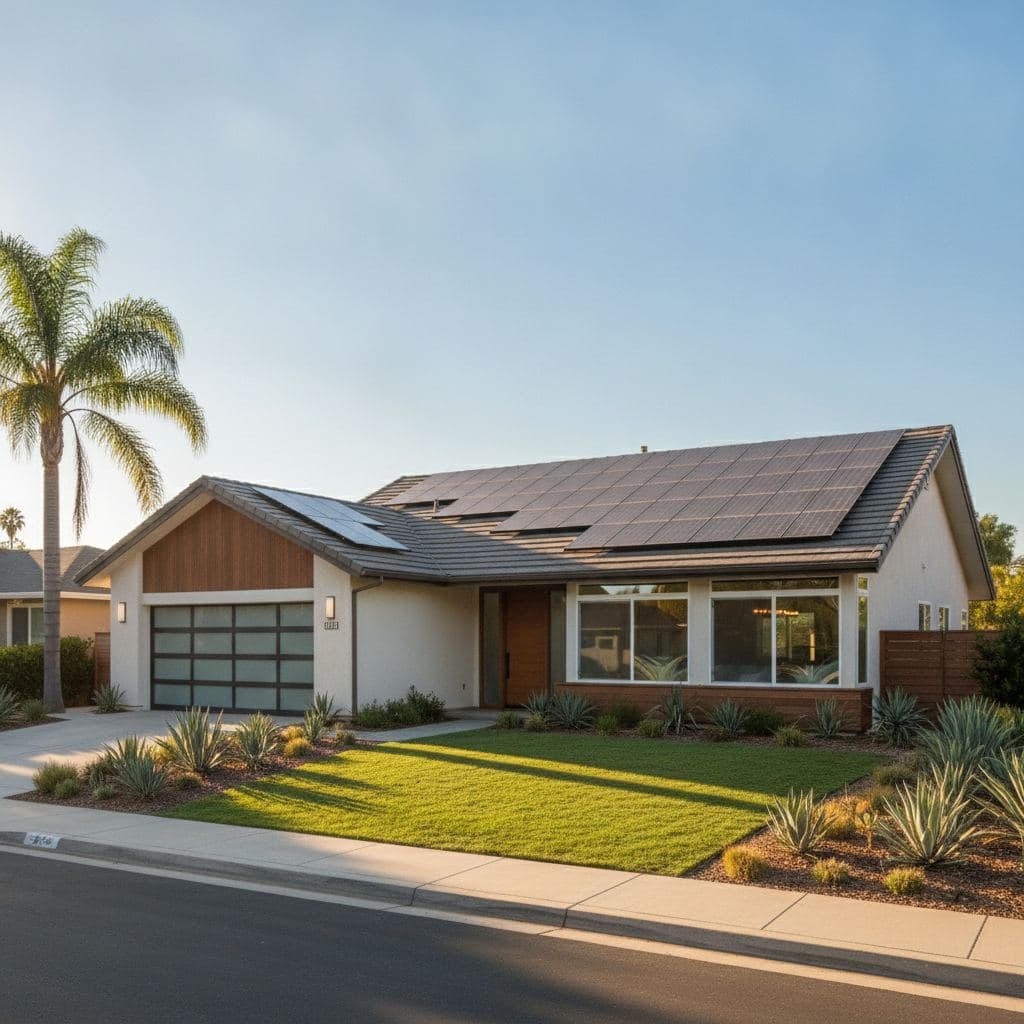
On an 8 kW Southern California roof split across two orientations, microinverters typically outproduce a plain string inverter by 5–12% annually when one face is partially shaded or misaligned — that's roughly 400–1,000 kWh/year at SCE's ~34–35¢/kWh peak rates, or $136–$350 in extra bill savings per year. Whether that production gain justifies the $800–$1,600 upfront premium depends on your roof geometry, shading situation, and how long you plan to stay in the home.
Last verified: August 2026 by Helios Energy Global.
The three inverter topologies you'll actually see quoted in SoCal
Before getting to the numbers, it helps to know exactly what each product does.
Plain string inverter — All panels wire in series into one central box (typically 5–10 kW for residential). Simple, proven, lowest cost. The whole string performs at the level of its weakest panel.
String inverter + power optimizers (e.g., SolarEdge) — Each panel gets a small DC optimizer that tracks its own maximum power point. The optimized DC still feeds a central string inverter. You get panel-level monitoring and shade mitigation without going fully distributed.
Microinverters (e.g., Enphase IQ8 series) — Each panel gets its own AC inverter mounted on the racking. No central box at all. Fully distributed, fully independent, panel-level everything.
| Feature | Plain String | String + Optimizers | Microinverters |
|---|---|---|---|
| Typical installed cost delta vs. plain string (8 kW) | Baseline | +$400–$900 (estimate) | +$800–$1,600 (estimate) |
| Shade/mismatch mitigation | Minimal | Strong (~80–90% of micro gains) | Best |
| Single-point-of-failure risk | High — full array down | Partial — inverter still a SPOF | Very low — 1 panel affected |
| Panel-level monitoring | No | Yes | Yes |
| Rapid shutdown compliance method | Requires add-on module | Built-in via optimizer | Built-in at panel level |
| Typical product warranty | 10–12 years | 12 years (optimizer) / 12 yr (inverter) | 25 years |
| Best for | Simple, unshaded, single-pitch | Partial shade, 1–2 azimuths | Heavy shade, 3+ azimuths, complex roofs |
All cost figures are estimates for a typical 8 kW SoCal install as of mid-2026. Labor and equipment pricing vary by contractor.
Shade and split azimuths: the real battleground
Most Santa Monica–area homes have at least two roof faces, and many have a tree, chimney, or neighbor's structure throwing shade for part of the day. This is where inverter topology matters most.
Why string inverters struggle with two azimuths: If you wire a south-facing string and a west-facing string into the same inverter, the west panels are still producing when the south panels have peaked and are declining. In a pure series string, the lower-voltage panels drag down the whole string's output — a phenomenon called mismatch loss. NREL research puts mismatch losses in real-world multi-azimuth residential systems at 3–8% annually on a plain string, and higher when shade is involved.
What optimizers fix: A SolarEdge or similar optimizer on each panel lets every panel independently track its maximum power point. The string inverter still converts DC to AC centrally, but the mismatch problem is largely solved. For most two-azimuth SoCal roofs, this closes the production gap to within a few percentage points of microinverters — at a lower cost premium.
What microinverters add on top: Because each panel converts to AC independently, there is zero electrical coupling between panels. A cloud shadow, a bird dropping, or a failing cell on panel 14 has zero effect on panel 15. On roofs with three or more distinct orientations, significant tree shade, or dormer interruptions — common in older Santa Monica and Culver City bungalows — microinverters' full independence can be worth the extra cost.
The single-point-of-failure question
This is the argument that resonates most with homeowners, and it's legitimate.
With a plain string inverter, the inverter box is the single point of failure for your entire system. String inverters typically carry 10–12 year warranties. If yours fails at year 11, you're looking at a $1,500–$2,500 replacement cost, and your entire array is offline until it's swapped — no solar production, no battery charging if you have one.
With SolarEdge, the central inverter is still a single point of failure for AC output, though the optimizers keep monitoring and the system can often limp along in a degraded state. The inverter warranty is typically 12 years.
With Enphase microinverters, a failed unit takes down exactly one panel — roughly 350–400 W out of your 8 kW system, or about 4–5% of capacity. The rest of the array keeps producing normally. Enphase IQ8 microinverters carry a 25-year warranty, which is the longest standard product warranty in the residential solar industry and aligns with the typical 25-year panel warranty. That warranty alignment matters: you're not replacing a central inverter mid-system-life.
Rapid shutdown: all three comply, but differently
California adopted NEC 2020, which requires rapid shutdown — the ability to de-energize rooftop conductors to below 30V within 30 seconds for firefighter safety. This is a non-negotiable compliance item, not a differentiator.
- Plain string inverters require a separate rapid-shutdown device (module-level power electronics or a dedicated transmitter/receiver system). This adds cost and a component.
- SolarEdge optimizers handle rapid shutdown natively — optimizers de-energize on command from the inverter.
- Enphase microinverters handle rapid shutdown natively at each panel — no additional hardware needed.
The practical upshot: if you're quoting a plain string system, make sure rapid-shutdown compliance hardware is named in the proposal. With optimizers or micros, it's built in.
When string inverters still win
Microinverters are not always the right answer. A plain string — or a string with optimizers — is the smarter choice in these situations:
- Unobstructed, single-pitch south-facing roof with no shading from 9 AM to 3 PM. Mismatch losses are minimal, and the cost savings are real.
- Tight budget with a straightforward payback goal. Saving $800–$1,600 upfront shortens payback by roughly 1–2 years at SCE rates, which matters if you're not planning to stay 10+ years.
- Large commercial-scale residential systems (15+ kW) where string inverters offer simpler string-level monitoring and lower per-watt cost.
- LADWP customers still on retail-rate net metering: because LADWP (~28¢/kWh average) pays less per exported kWh than SCE (~34–35¢/kWh), the dollar value of incremental production gains from microinverters is lower, which shifts the math toward the cheaper option. See how your utility affects solar savings →
How this plays out on a real 8 kW SoCal roof
Here's a simplified scenario to make the numbers concrete.
A Santa Monica home installs an 8 kW system (roughly 20 × 400 W panels). The roof has a south face and a southwest face. There's a neighbor's tree that shades two southwest panels from about 2–4 PM in winter.
- Plain string, no optimizers: Estimated annual production ~9,800–10,200 kWh. Shading and mismatch drag the whole string down during affected hours.
- String + optimizers: Estimated annual production ~10,400–10,800 kWh. Mismatch mostly eliminated; shaded panels isolated.
- Microinverters: Estimated annual production ~10,600–11,000 kWh. Fully independent; shaded panels have zero effect on others.
At SCE's ~34–35¢/kWh blended rate (higher during 4–9 PM TOU peak), the production difference between optimizers and microinverters is roughly $68–$140/year. At that gap, the $400–$700 extra cost of microinverters over optimizers has a 3–6 year payback on the premium — reasonable over a 25-year system life, but not dramatic. The bigger gap is plain string vs. either optimized option.
See how system size and design affect your savings →
Frequently asked questions about microinverters vs string inverters
Are Enphase microinverters worth the extra cost in 2026?
For most Southern California roofs with two or more orientations, partial shade, or complex geometry, yes — the 25-year warranty alignment with panels and the elimination of single-point-of-failure risk justify the $800–$1,600 premium over a 25-year system life. On a clean, single-pitch, unshaded south roof, the math is closer and a string-plus-optimizer system often makes more financial sense.
Does NEM 3.0 change which inverter is better for SCE customers?
Under NEM 3.0 (the Net Billing Tariff that applies to SCE, PG&E, and SDG&E customers), maximizing self-consumption is more important than maximizing export, because export rates are much lower than retail. This actually slightly favors microinverters paired with a battery — panel-level optimization helps you harvest more energy during the day to store and use at peak. Learn more about NEM 3.0 →
Do LADWP customers need to think about this differently?
Yes. LADWP is a municipal utility not subject to NEM 3.0 and still offers retail-rate net metering at roughly 28¢/kWh. Because the per-kWh value of extra production is lower at LADWP than at SCE, the financial case for microinverters' production premium is smaller. The warranty and reliability arguments still apply, but the payback math is less compelling for the premium.
Can I add microinverters to an existing string inverter system?
Not directly — microinverters replace the string inverter entirely and require re-wiring each panel. If you have an aging string inverter and want to upgrade, a full re-power to microinverters is possible but involves significant labor cost. It's worth evaluating against simply replacing the string inverter with a new unit.
What happens if one Enphase microinverter fails?
That panel stops producing — roughly 350–400 W out of your total array. Your other panels continue operating normally. Enphase's monitoring app (Enlighten) will flag the failed unit within 24–48 hours. Under the 25-year warranty, Enphase covers replacement; you pay for labor, which is typically $150–$300 per unit.
Do power optimizers (SolarEdge) give me the same monitoring as microinverters?
Yes — SolarEdge's monitoring portal gives you panel-level production data, similar to Enphase Enlighten. The key difference is that SolarEdge still routes everything through a central inverter, so if that inverter fails, the whole system goes down even though you can still see panel-level data. Enphase's fully distributed architecture means monitoring and production continue independently per panel.
Is there a battery compatibility difference between the two?
Yes, and it matters. Enphase IQ batteries integrate natively with Enphase microinverter systems. SolarEdge has its own battery (SolarEdge Energy Bank) designed for its ecosystem. Both are solid options, but mixing brands (e.g., Enphase micros with a non-Enphase battery) can add complexity. A plain string inverter gives you the most battery-brand flexibility. Compare battery options for SoCal →
Next steps
- Book a free consultation and custom design — we'll model your specific roof geometry, shading, and utility (SCE vs. LADWP vs. other muni) to show you exactly which inverter topology pencils out best.
- See full solar system pricing for Southern California →
- Understand how NEM 3.0 affects your SCE solar economics →
- Explore battery storage options to pair with your inverter →
- Check if your roof type affects inverter choice →
- Learn how we design systems for maximum savings →
Sources
- Enphase IQ8 datasheet
- SolarEdge HD-Wave inverter specs
- NEC 2020 Rapid Shutdown requirements (NFPA)
- CPUC Net Billing Tariff (NEM 3.0) overview
- California Energy Commission – Inverter Eligibility
- EIA – California residential electricity rates
- NREL – Distributed PV shading losses
- DSIRE – California solar incentives
More guides
Adding a Tesla Powerwall to an existing solar system: how it works in California (2026)
Yes — a Powerwall 3 retrofits onto almost any existing solar system via AC coupling, keeps your NEM status, and runs $14,500-$18,500 installed for one unit.
ReadHow many solar panels do I need in California? (2026)
Most Southern California homes need 14–32 panels (6–12 kW), depending on usage and whether you're on SCE or LADWP rates.
ReadCan You Add a Battery to a Leased Solar System (Sunrun, Tesla, Sunnova) in California?
Yes — a battery you own can be AC-coupled to leased Sunrun, Tesla, or Sunnova panels for roughly $14,500–$18,500 installed (one Powerwall 3), without touching the lease or requiring lessor sign-off.
ReadGet a free consultation and custom design.
No pressure, no obligation — the owner reviews every design we send.