Best Time of Year to Install Solar Panels in Southern California: Winter Installs, the December 4 Tariff Date and the 2027 Lease Deadline
In Southern California there is no bad season to install solar — but December 4, 2026 is a real supply-chain date: a 15% tariff and $0.38/W minimum import price on solar modules take effect that day, and leased systems must be placed in service by December 31, 2027 to qualify for the Section 48E credit.
By Taylor Crouse — Founder, Helios Energy GlobalPublished
Quick answer
- There is no bad season to install solar in Southern California — the calendar that matters is contractual, not meteorological.
- A 15% federal tariff and a $0.38/W minimum import price on imported solar modules take effect December 4, 2026, under Proclamation 11052 signed August 6, 2026.
- Antidumping and countervailing duty orders on solar cells and modules from India, Indonesia, and Laos were published in the Federal Register on November 9, 2026 (documents 2026-22825 and 2026-22824).
- If you are considering a solar lease or prepaid lease, the Section 48E credit that passes through to your pricing requires the system to be placed in service by December 31, 2027 for projects that did not begin construction by July 4, 2026.
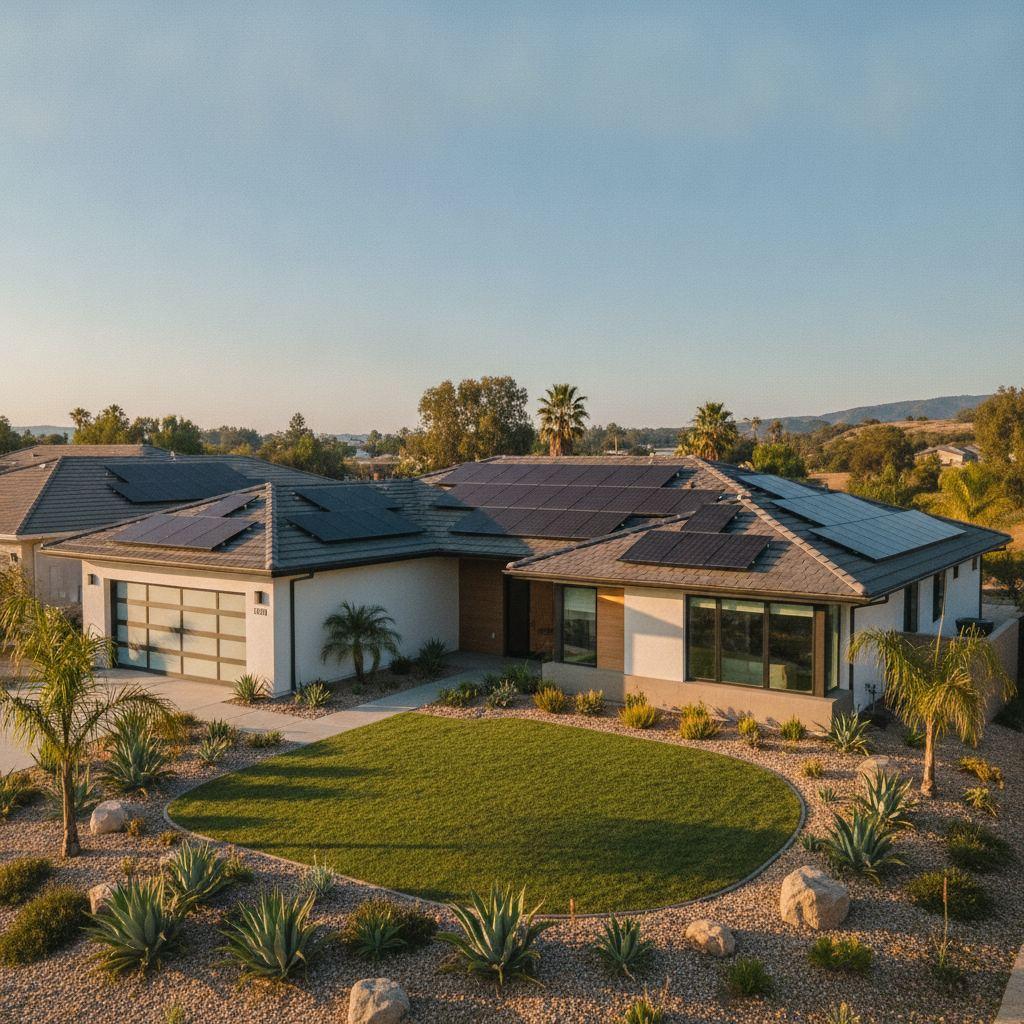
Southern California gets roughly 1,690 kWh per installed kW per year on a south-facing roof — and that annual yield is what pays your system back, regardless of which month crews show up. The calendar dates that actually move your economics in 2026–2027 are a federal tariff effective date (December 4), two sets of trade-duty orders already published (November 9), and a lease tax-credit placed-in-service deadline (December 31, 2027).
Last verified: November 2026 by Helios Energy Global.
Why Southern California Has No "Bad Season" for Solar
Southern California does not have a meaningful installation season the way the Pacific Northwest or the Northeast does. Panels go on roofs every month of the year here. Rain is rare enough that it rarely delays a job by more than a day, and there is no snow to contend with. The practical advantage of a winter install is operational, not meteorological:
- Permit offices and installation crews are less backlogged from roughly November through February. Shorter queues can mean a faster path from signed contract to permission to operate (PTO).
- December is the yearly production low. For Los Angeles, NREL PVWatts v8 shows a best month (August) of about 69 kWh per 400 W panel and a worst month (December) of about 40 kWh — December is roughly 58% of August's output. A system installed in December or January reaches its first high-production summer at full output, rather than missing part of the spring ramp-up.
- Winter rain washes panels naturally, so a new system starts the spring season clean.
For a deeper look at month-by-month production numbers across LA, Orange County, the Inland Empire, and San Diego, see our guide: Do Solar Panels Work on Cloudy Days and in Winter in Southern California?
The Two Trade-Policy Dates That Actually Affect Your Quote
December 4, 2026: Section 232 Minimum Import Price and 15% Tariff
On August 6, 2026, President Trump issued a Section 232 proclamation imposing new trade measures on imports of polysilicon and certain derivative products, including silicon wafers, solar cells, and solar modules. The measures take effect on December 4, 2026.
Although the proclamation imposes additional Section 232 tariffs on covered imports, its most significant feature is a new Minimum Import Price ("MIP") program. The MIP floors are: $0.22/W for solar cells and $0.38/W for solar modules.
These new trade measures are established under Proclamation 11052 released by President Trump on August 6, 2026.
The new measures replace the expired solar safeguard tariff under Section 201 of the Trade Act of 1974 that lapsed in February 2026.
What this means for a homeowner: panels are roughly 25–35% of an installed system's all-in price. The tariff's pass-through to your total quote is smaller than the headline rates suggest, but installers who pre-purchased inventory before December 4 may be able to hold current pricing longer than those who did not. Ask any installer you speak with when their panel inventory was imported. See our full analysis at /solar-panel-cost.
November 9, 2026: Antidumping and Countervailing Duty Orders on India, Indonesia, and Laos
A separate set of trade actions compounds the December 4 picture. Commerce issued antidumping duty orders on crystalline silicon photovoltaic cells, whether or not assembled into modules, from India, Indonesia, and Laos. On November 2, 2026, the ITC notified Commerce of its final affirmative determinations that an industry in the United States is materially injured by reason of less-than-fair-value imports of solar cells from India, Indonesia, and Laos.
The antidumping order (document 2026-22825) was published in the Federal Register on November 9, 2026.
Commerce simultaneously issued countervailing duty orders (document 2026-22824) on crystalline silicon photovoltaic cells from India, Indonesia, and Laos.
There are now AD/CVD orders placed on solar imports from a range of countries: China, Taiwan, Cambodia, Malaysia, Thailand, Vietnam, India, Indonesia, and Laos.
The 2027 Lease Deadline: Section 48E and What It Means for You
The 30% federal residential solar tax credit (Section 25D) expired December 31, 2025. There is no federal tax credit for a homeowner who buys a system outright in 2026. However, a separate commercial credit — Section 48E — still applies to third-party-owned systems (leases and prepaid leases), and it passes through to homeowners in the form of lower lease pricing.
A wind or solar facility that begins construction after July 4, 2026 must be placed in service by December 31, 2027 to get the Section 48E credit.
The July 4, 2026 and December 31, 2027 dates are in the statute. The court ruling vacated the IRS notice about how to show that construction began; it did not change the dates Congress set.
In plain terms: if you sign a solar lease or prepaid lease today and the installer's fleet did not safe-harbor equipment before July 4, 2026, the system generally must be fully installed and receive permission to operate before January 1, 2028 — or the lessor loses the credit that makes the lease pricing competitive.
Our page /guides/solar-lease-tax-credit-2027-deadline walks through the full statutory analysis, including what "began construction" means and how equipment safe harbors work. We do not restate that analysis here. For Helios's own prepaid-lease option, see /financing.
Key Dates and Numbers at a Glance
| Event | Date | What it affects |
|---|---|---|
| Section 232 Proclamation 11052 signed | August 6, 2026 | Sets $0.38/W module MIP and 15% tariff |
| AD/CVD orders published (docs 2026-22825 & 2026-22824) | November 9, 2026 | Duties on cells/modules from India, Indonesia, Laos |
| Section 232 tariff and MIP effective | December 4, 2026 | New cost floor for imported modules |
| Section 48E placed-in-service cutoff (new starts) | December 31, 2027 | Lease/PPA credit eligibility deadline |
| Typical SoCal December output (estimate) | ~100 kWh/kW | Yearly low; ~58% of August peak |
| Typical SoCal August output (estimate) | ~174 kWh/kW | Yearly high (NREL PVWatts, LA) |
| Installed solar cost range (SoCal, all-in) | ~$2.50–$3.50/W | Before any incentives; see /solar-panel-cost |
Output figures are estimates based on NREL PVWatts v8 modeling for a south-facing 20° roof in the Los Angeles area. Actual production varies by roof angle, shading, and location.
Permits, Installation, and PTO: What Takes Time
The three steps between "signed contract" and "system producing" are the permit, the installation, and permission to operate (PTO). Each is covered in detail by its own Helios guide:
- Permits: Los Angeles permitting timelines vary significantly by jurisdiction and current queue depth — see /guides/how-long-do-solar-permits-take-los-angeles for current averages by city.
- Installation: The physical installation of a residential system typically takes one to three days once permits are in hand — see /guides/how-long-does-solar-installation-take-california.
- PTO: After installation, the utility must inspect and grant permission to operate before you can export power — see /guides/solar-pto-permission-to-operate-california for what to expect from SCE, LADWP, and other Southern California utilities.
The aggregate timeline matters for the December 31, 2027 lease deadline above: a system signed in late 2027 with permitting delays could miss the window. For purchase customers, the timeline affects when production starts, not a tax-credit deadline.
How Your Utility Affects the Math — SCE vs. LADWP and Other Munis
The season you install does not change your utility rate structure, but your utility determines how much each kilowatt-hour of solar is worth — and that number has a bigger effect on payback than the installation month.
SCE customers (NEM 3.0 / Net Billing Tariff): SCE is an investor-owned utility subject to CPUC's NEM 3.0. Per SCE's current TOU-D-PRIME tariff, the average bill rate runs approximately 34–35¢/kWh, with peak charges of roughly 48–58¢/kWh from 4–9 PM. Under NEM 3.0, exported solar is credited at a wholesale-adjacent rate rather than retail, which means a battery paired with your panels captures significantly more value than export alone. Rate changes that take effect January 1 can shift your payback calculation — see /guides/sce-rate-changes-2026 and /guides/sce-time-of-use-rates-explained for the current structure.
LADWP customers: LADWP is a municipal utility and is not on NEM 3.0. LADWP still offers retail-rate net metering, with an effective rate of approximately 28¢/kWh (ranging roughly 26–31¢ depending on tier and season). Retail-rate export makes the economics of solar-only systems more straightforward than under SCE's net billing tariff, though the lower base rate means the absolute dollar savings per kWh are smaller than in SCE territory.
SDG&E customers: SDG&E is an investor-owned utility on NEM 3.0. Its average rate is approximately 46¢/kWh — the highest in Southern California — which means solar offsets are more valuable per kWh even under net billing.
Other municipal utilities (Pasadena Water and Power, Riverside RPU, Anaheim Public Utilities, Burbank Water and Power, Glendale Water and Power) each run their own net metering programs and are not subject to NEM 3.0. Rules and rates vary; ask Helios for the current terms for your specific utility when you get a quote.
For a full comparison of how NEM 3.0 and municipal net metering affect the value of your solar production, see /guides/nem-3-explained and /guides/solar-vs-battery-nem-3.
Should You Wait for Prices to Drop in 2027?
This is a fair question and deserves a straight answer: we don't predict module prices, and neither should any installer. What the public record shows is:
The new Section 232 remedies take effect December 4, 2026, giving developers, manufacturers, importers, and financiers approximately 120 days to evaluate their exposure.
From December 4, a covered crystalline-silicon module will also face a $0.38-per-watt minimum import price and the applicable Section 232 percentage duty.
- AD/CVD orders on cells and modules from India, Indonesia, and Laos are now in force as of November 9, 2026, adding a separate layer of duties on top of Section 232.
Whether installers pass those costs through immediately, absorb them partially, or offset them with other supply-chain moves is not something we or anyone else can predict with certainty. What we can say is that the structural cost floor on imported modules is higher after December 4 than before it, and that no announced policy change is scheduled to lower it in 2027. Waiting for a price drop that may not materialize also consumes months of production and — for lease customers — narrows the window before the December 31, 2027 placed-in-service deadline.
The installed cost range for a Southern California home solar system runs approximately $2.50–$3.50 per watt before incentives; full system-size estimates are at /solar-panel-cost.
Frequently Asked Questions About the Best Time to Install Solar
Is winter a bad time to install solar panels in Southern California?
No. Southern California's mild winters mean installation crews work year-round without meaningful weather delays. A south-facing 10 kW system in Los Angeles makes roughly 1,000–1,100 kWh in December versus 1,700–1,800 kWh in July — production is lower in winter, but installing in December means the system reaches its first high-output summer at full capacity. Permit offices and crews are also typically less backlogged in winter months.
What exactly happens on December 4, 2026?
On August 6, 2026, President Trump signed a proclamation imposing a 15% ad valorem tariff and minimum import prices on polysilicon and its derivatives under Section 232 of the Trade Expansion Act of 1962, effective December 4, 2026. The minimum import price for solar modules is $0.38 per watt. Installers who have pre-purchased inventory before that date may be insulated from the immediate cost increase; those sourcing panels after December 4 will face the new price floor.
What are the AD/CVD orders published November 9, 2026, and do they affect me?
Commerce issued antidumping duty orders on crystalline silicon photovoltaic cells, whether or not assembled into modules, from India, Indonesia, and Laos.
Commerce simultaneously issued countervailing duty orders on the same products from those three countries. These duties apply at the import level and affect panel pricing for modules sourced from those countries. Ask your installer which country their panels are manufactured in and whether those panels are subject to any of the current AD/CVD orders.
Does the Section 48E credit apply to me as a homeowner who buys a system outright?
No. The homeowner credit under §25D does not apply to expenditures after December 31, 2025. Section 48E is a commercial credit that applies to the third-party owner of a leased or PPA system. It passes through to homeowners indirectly as lower lease pricing. If you purchase a system outright in 2026, there is no federal solar tax credit available to you.
What is the December 31, 2027 deadline for solar leases?
Any project begun after July 4, 2026 must be fully installed, interconnected, and placed in service by December 31, 2027 or it receives no Section 48E ITC at all. The full statutory analysis — including what "began construction" means, how equipment safe harbors work, and what it means if a lessor's fleet was safe-harbored before July 4 — is at /guides/solar-lease-tax-credit-2027-deadline.
Does my utility (LADWP vs. SCE) change the best time to install?
Your utility does not change the best season to install, but it significantly changes the economics of solar. LADWP offers retail-rate net metering at roughly 28¢/kWh effective, while SCE operates under NEM 3.0 (net billing) at roughly 34–35¢/kWh average with 48–58¢/kWh peaks. The value of exported solar versus self-consumed solar differs substantially between these two utilities, which affects whether a battery makes sense alongside your panels. See /guides/nem-3-explained for a full breakdown.
Will solar panel prices drop in 2027 if I wait?
We don't make price predictions. The publicly documented fact is that a $0.38/W minimum import price and a 15% tariff on covered modules take effect December 4, 2026, and antidumping and countervailing duties on modules from India, Indonesia, and Laos are already in force. No announced policy is scheduled to reduce those floors in 2027. Waiting also uses up months of potential production and, for lease customers, reduces the buffer before the December 31, 2027 placed-in-service deadline.
Next Steps
- Book a free consultation and custom design — Helios gives one all-in written price with the equipment named by model. Ask for the gross price and cost per watt in writing.
- See system sizes and all-in cost ranges for Southern California
- Explore solar financing options including prepaid leases
- Learn how NEM 3.0 affects SCE and SDG&E customers
- Understand how solar and batteries work together under NEM 3.0
- Get a solar quote for your home
- Find your Helios service area
Sources
- Presidential Proclamation 11052 — Section 232 Polysilicon & Solar Tariffs (Hunton Andrews Kurth analysis of Aug 6, 2026 proclamation) — August 6, 2026
- Federal Register Doc. 2026-22825 — AD Orders on Solar Cells from India, Indonesia, Laos (Nov 9, 2026) — November 9, 2026
- Federal Register Doc. 2026-22824 — CVD Orders on Solar Cells from India, Indonesia, Laos (Nov 9, 2026) — November 9, 2026
- Tax Field Guide — Section 48E Solar ITC: July 4, 2026 & Dec 31, 2027 Deadlines — October 26, 2026
- NREL PVWatts v8 — Monthly Solar Production, Los Angeles / Santa Monica (via Helios Energy Global winter production guide) — November 4, 2026
More guides
Best Solar Companies in Palos Verdes Estates, CA (2026): Honest Rankings for a Coastal Clifftop Community
A straight-talking, numbers-first guide to the best solar installers in Palos Verdes Estates — covering SCE's Net Billing Tariff, HOA design review, coastal efficiency gains, and what a real 2026 quote should look like.
ReadDo Solar Panels Work on a North-Facing Roof in Southern California? (2026)
A north-facing roof in Southern California cuts solar output by roughly 30–40% versus south-facing — but west-facing panels on the same home, microinverters, and battery storage can still make the numbers work under NEM 3.0 and SCE's 4–9 PM peak.
ReadBest Solar Companies in Vista, CA (2026): Honest Rankings for SDG&E Homeowners
Vista's ~46¢/kWh SDG&E rates and same-day SolarAPP+ permits make it one of SoCal's most compelling solar markets — if you pick the right installer. Here are the 10 best solar companies serving Vista in 2026, ranked honestly.
ReadGet a free consultation and custom design.
No pressure, no obligation — the owner reviews every design we send.