Do Solar Panels Work on a North-Facing Roof in Southern California? (2026)
A north-facing roof in Southern California cuts solar output by roughly 30–40% versus south-facing — but west-facing panels on the same home, microinverters, and battery storage can still make the numbers work under NEM 3.0 and SCE's 4–9 PM peak.
By Taylor Crouse — Founder, Helios Energy GlobalPublished
Quick answer
- A north-facing roof in Southern California produces roughly 30–40% fewer kWh per year than the same system on a south-facing roof — at a typical 25–30° pitch.
- A flat or low-slope north-facing roof loses far less: closer to 12–17% versus south at a 10° tilt.
- West-facing panels on the same structure can still pencil under SCE's 4–9 PM peak rate of 59¢/kWh (summer weekdays) — the evening bias rewards afternoon and west-facing production.
- Pure north-only roofs with steep pitches (≥30°) are the most common walk-away scenario — the system simply needs too many extra panels to break even.
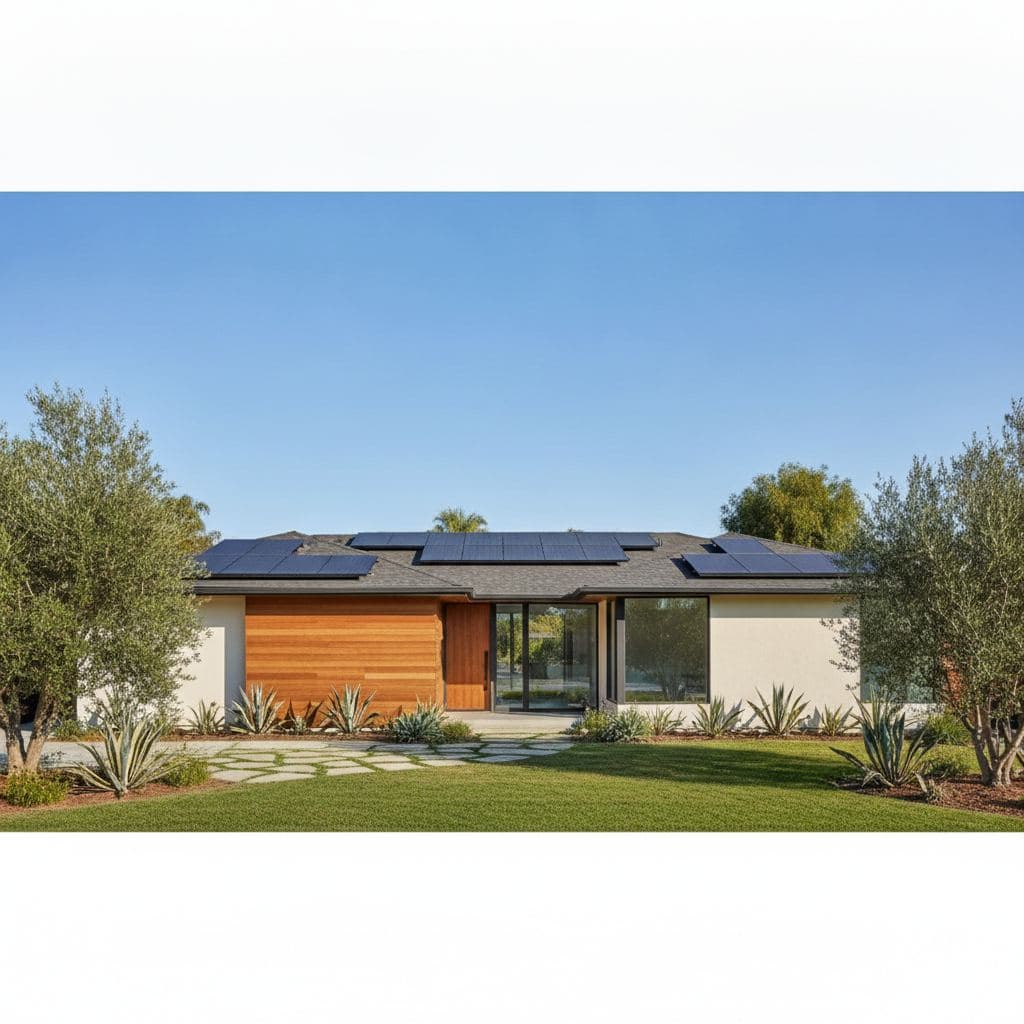
A north-facing roof in Southern California will produce roughly 30–40% fewer kilowatt-hours per year than an equivalent south-facing array at the same tilt — meaning a 10 kW south-facing system that generates around 16,000 kWh/year might yield only 9,600–11,200 kWh facing north. Whether that gap kills the economics depends entirely on your utility, your roof's pitch, whether you have any west-facing surface, and whether you're pairing panels with a battery.
Last verified: October 2026 by Helios Energy Global.
Why north-facing roofs underperform in the Northern Hemisphere
The sun arcs across the southern sky from sunrise to sunset at Southern California's latitude (~34°N). At a 30° tilt, a north-facing array produces only about 60% of what an equivalent south-facing array generates — meaning you'd need roughly 67% more panels to hit the same annual kWh output. At a steeper 45° tilt, production can fall to around 50% of the south-facing baseline.
The tilt angle matters a lot here. A near-flat roof is far more forgiving than a steep one: a north-facing array keeps roughly 83% of south-facing output at a 10° tilt, but only around 47% at a 40° pitch. So a gently sloped north-facing roof is a very different conversation from a steep, sharply north-pitched one.
The production penalty by tilt — north-facing vs. south-facing (Southern California estimate):
| Roof pitch (approx.) | North-facing output vs. south | Practical verdict |
|---|---|---|
| Flat / ~10° | ~83–88% | Workable; size up modestly |
| ~15–20° (low slope) | ~70–80% | Acceptable with microinverters |
| ~25–30° (typical tract home) | ~60–70% | Needs ~40–65% more panels; run the numbers carefully |
| ~35–40° (steep pitch) | ~50–60% | Marginal; usually a walk-away |
| True steep north (≥40°, no west face) | ~47–55% | Walk away in most cases |
Estimates derived from NREL PVWatts v8 (NSRDB) reference runs for Los Angeles County at ~34°N latitude, via TheGreenWatt's orientation calculator (July 2026) and SolarCalculatorHQ's PVWatts v6-calibrated model. Actual output varies by shading, panel efficiency, and microclimate.
When a north-facing roof can still make sense
You also have a west-facing surface
This is the most important nuance for Southern California homeowners on SCE's Net Billing Tariff (NEM 3.0). SCE's TOU-D-4-9PM plan charges 59¢ per kWh on summer weekdays from 4–9 PM , per SCE's published rate schedule. West-facing panels keep producing into that 4–9 PM window — which is exactly when the grid is most expensive and, under NEM 3.0, when exported energy earns its highest avoided-cost credit.
The practical play: put panels on the west-facing slope to capture that late-afternoon peak, and accept that the north-facing slope simply doesn't get panels. You don't have to cover every surface. A well-designed west-only or southwest + west array on a home with a north-facing primary pitch will typically outperform a north-heavy design on a bill-savings basis.
LADWP customers have a different calculus. LADWP still offers retail-rate net metering — not NEM 3.0 — so a north-facing array that generates kWh at any hour of the day earns the same ~28¢/kWh credit (26–31¢ effective). The evening-bias advantage of west-facing panels matters less here. That makes north-facing arrays relatively more viable for LADWP customers than for SCE, PG&E, or SDG&E customers, because every kWh exported earns the same rate. Municipal utility customers in Pasadena (PWP), Riverside (RPU), Anaheim (APU), Burbank, and Glendale should check their own net metering terms — none of them are on NEM 3.0.
Your roof pitch is low
A north-facing roof at a 10° tilt retains roughly 83% of south-facing production — a penalty you can often close by sizing the system up by 15–20%. If you're on a flat or near-flat roof (common in older Santa Monica bungalows and commercial-adjacent residential buildings), a rack-mounted array tilted toward south at 10–15° can sidestep the north-facing penalty almost entirely. That's a different product conversation than a steep north-pitch Victorian.
You're adding a battery
Under SCE's NEM 3.0 (Net Billing Tariff), the export credit for midday solar is only around 5–8¢/kWh — far below the retail rate. A battery changes the equation: you store what your north-facing panels generate during the day and discharge it during the 4–9 PM peak, avoiding the 59¢/kWh on-peak charge rather than exporting at a low credit. SCE's average residential rate is 34.5¢/kWh as of October 1, 2026 , per SCE's Rate Advisory — but peak avoidance is worth nearly double that per kWh. A battery makes a lower-production north-facing system more viable by capturing the value of every kWh generated, rather than relying on favorable export credits that NEM 3.0 doesn't offer.
See our battery storage guide and NEM 3.0 explained for the full math.
Microinverters close part of the gap
Installing microinverters instead of a string inverter optimizes each panel individually, meaning one shaded or low-performing panel won't drag down the entire system — and the efficiency gain from switching to microinverters can reach 10–20% on challenging roof planes. On a north-facing roof, where every panel is already fighting diffuse-light conditions and potential shading from chimneys or trees, that 10–20% recovery matters. It won't close the full 30–40% north-vs.-south gap, but it can meaningfully close the gap between a marginal system and a viable one.
The honest walk-away scenarios
Not every roof should get solar. Here are the situations where we'll tell you directly that north-facing panels don't make financial sense:
Steep north pitch (≥30°), no west or south surface at all. A 30°-tilted north-facing array produces only about 60% of an equivalent south-facing one — you'd need roughly 67% more panels to hit the same kWh. That means a system that would otherwise be 8 kW needs to become 13 kW+ to deliver the same energy — and the installed cost scales accordingly. The payback math rarely works.
Heavy shading on the north face. If trees, chimneys, or nearby buildings cast shadows on a north-facing roof, solar production drops even further than the orientation penalty alone. A north-facing roof that's also shaded in the morning and afternoon is almost never viable.
SCE or SDG&E customer, no battery, no west surface. Under NEM 3.0, a north-facing-only system exports at low avoided-cost rates all day and never captures the peak-hour value. The bill offset is small, the payback is long. A battery would help, but then you're paying for both the extra panels and the battery — the system cost rises significantly before the economics improve.
Short remaining roof life. If your roof needs replacement in the next 3–5 years, installing panels now means paying for solar panel removal and reinstallation later — typically $250–$350 per panel (roughly $5,000–$7,000 for a 20-panel system, $7,500–$10,500 for 30 panels, with tile or steep roofs at the top of that range). On a north-facing system that's already marginal, that future cost can push the project into negative territory.
How to think about system sizing on a north-facing roof
If the numbers do work — low pitch, LADWP territory, battery included, or a mix of north and west surfaces — you'll need to size up to compensate. The standard rule: divide your target annual kWh output by the north-facing production factor to get the required system size.
Example: A home using 12,000 kWh/year wants to offset 90% (~10,800 kWh). A south-facing 8 kW system in Los Angeles might generate ~13,000 kWh/year. A north-facing system at a 25° pitch producing ~65% of that per watt would need roughly 12–13 kW to hit the same target — pushing installed cost from a typical 8 kW range of $20,000–$28,000 to a 12–13 kW range of $30,000–$45,500 before any incentives.
For a precise, address-specific number, get a custom design from Helios — we model every roof plane in your design software, not just the primary pitch.
Utility-by-utility summary for Southern California
| Utility | Net metering type | North-facing viability | Key reason |
|---|---|---|---|
| SCE | NEM 3.0 (Net Billing) | Low without battery | Exports earn ~5–8¢/kWh; peak is 4–9 PM |
| LADWP | Retail-rate net metering | Moderate | Every kWh offsets at ~28¢ regardless of time |
| SDG&E | NEM 3.0 (Net Billing) | Low without battery | Highest retail rate (~46¢/kWh) but same low export credit |
| PG&E | NEM 3.0 (Net Billing) | Low without battery | ~40–41¢/kWh average; export credit still ~5–8¢ |
| Pasadena PWP / Burbank / Glendale / Anaheim APU / Riverside RPU | Own net metering programs (not NEM 3.0) | Varies by tariff | Check each utility's current net metering rate |
SCE peak hours and rates per SCE's published TOU rate schedule, read October 2026.
Frequently asked questions about solar panels on a north-facing roof
How much less power do north-facing solar panels produce in Los Angeles?
At typical US latitudes (30–45°N), a north-facing roof at a 30° tilt produces roughly 60% of what an equivalent south-facing array generates — figures derived from NREL PVWatts v8 reference runs. In Los Angeles specifically (~34°N), the penalty is in the same range: expect roughly 30–40% less annual output at a typical residential roof pitch of 20–30°.
Can microinverters fix a north-facing roof's production problem?
Partially. Microinverters optimize each panel individually so one shaded or low-performing panel won't drag down the whole system, with efficiency gains of up to 10–20% on difficult orientations. That's meaningful, but it won't close the full 30–40% orientation gap. Microinverters are the right choice for a north-facing install, but they're a partial solution, not a complete fix.
Does NEM 3.0 make north-facing solar worse for SCE customers?
Yes, significantly. Under NEM 3.0, the export credit for solar sent to the grid is only about 5–8¢/kWh — far below SCE's average retail rate of 34.5¢/kWh. A north-facing system produces most of its energy during midday hours when it's exported at that low credit. A south- or west-facing system produces more energy during the late afternoon, closer to the 4–9 PM peak window. Adding a battery is the primary way to restore the economics for a north-facing SCE customer.
Is a north-facing roof better for LADWP solar customers?
Relatively, yes. LADWP still offers retail-rate net metering at roughly 28¢/kWh (26–31¢ effective range), so every kWh a north-facing system generates earns the same credit regardless of time of day. The production penalty still applies — you'll still generate 30–40% less energy than a south-facing system — but you're not also losing the time-of-use value that SCE customers depend on. For LADWP customers with a low-pitched north-facing roof, the numbers can work with a modest size-up. See our locations page for LADWP-specific details.
What's the minimum roof pitch where north-facing panels make sense?
At a 10° tilt, a north-facing roof retains roughly 83% of south-facing production — a gap you can often close by sizing the system up 15–20%. Below about 15° pitch, north-facing becomes viable in most scenarios, especially for LADWP customers or SCE/SDG&E customers with a battery. Above 30° pitch, the economics get difficult without additional west-facing surface area.
Should I put panels on my north-facing roof if I also have a west-facing slope?
In most cases, no — put the panels on the west-facing slope and leave the north face alone. West-facing panels in SCE territory generate power into the 4–9 PM peak window, when electricity costs 59¢/kWh on summer weekdays. SCE's TOU-D-4-9PM plan charges 59¢ per kWh on summer weekdays from 4 PM to 9 PM — and west-facing panels are still producing during the early part of that window. A well-sized west-only system will typically outperform a north-heavy design on bill savings, even if the west roof has less total square footage.
Will solar panels on a north-facing roof damage my roof or void my warranty?
Orientation doesn't affect roof warranty or structural risk — those depend on the mounting system, the roofer's work, and your existing roof condition. If your roof is in good shape, a north-facing installation is mechanically identical to any other. If your roof needs work first, Helios coordinates with vetted, licensed roofing partners — we're never the roofing contractor, but we manage the sequencing so your solar install follows a sound roof. See roof types and solar compatibility for more.
Next steps
- Book a free consultation and custom design — we'll model every roof plane at your address, including north-facing surfaces, and show you exactly what each produces before you commit.
- See what solar costs in Southern California — installed price ranges by system size, before any incentives.
- Explore battery storage options — the piece that makes a lower-production north-facing system viable under NEM 3.0.
- Understand NEM 3.0 and what it means for your export credits — especially relevant if you're on SCE, SDG&E, or PG&E.
- Solar vs. battery under NEM 3.0 — how to think about the tradeoff when your roof orientation limits raw production.
- See all Southern California service areas — LADWP, SCE, and municipal utility territories explained.
Sources
- SCE Time-of-Use Residential Rate Plans — sce.com — October 2026
- SCE Rate Advisory, October 1, 2026 — sce.com — October 1, 2026
- Solar Panel Orientation Calculator — calibrated against NREL PVWatts v6 — SolarCalculatorHQ — April 2026
- Solar Panel Direction Calculator — NREL PVWatts v8 (NSRDB) — TheGreenWatt — July 2026
More guides
Best Solar Companies in Beaumont, CA (2026): Honest Rankings for Inland Empire Homeowners
A straight-talking, numbers-first guide to the best solar installers serving Beaumont, CA in 2026 — covering SCE net billing, battery strategy, and real price ranges for Inland Empire homes.
ReadBest Solar Companies in Newport Beach, CA (2026): Aesthetics-First Installs from Balboa Island to Newport Coast
Newport Beach homes range from Balboa Island cottages to Newport Coast estates — and every one of them demands a custom solar design. Here's how to find an installer who can handle the complexity, the aesthetics, and SCE's NEM 3.0 economics.
ReadDo solar panels damage your roof? What 1,000+ installs taught us for 2026
No — properly flashed, rafter-mounted panels don't damage roofs; problems trace to bad sealing, missed rafters, or installing over a roof already near end-of-life.
ReadGet a free consultation and custom design.
No pressure, no obligation — the owner reviews every design we send.