Can you add an Enphase or Tesla battery to solar another company installed? (California, 2026)
Yes — Tesla Powerwall 3 and, since August 2026, Enphase's IQ Battery 10C both AC-couple to solar systems installed by other companies, including orphaned Freedom Forever, SunPower and Titan systems; expect $14,500–$18,500 installed for one Powerwall 3 and no change to your NEM 2.0 status if you don't add panels.
By Taylor Crouse — Founder, Helios Energy GlobalPublished
Quick answer
- Yes. A battery does not care who installed your panels. Both mainstream retrofit routes — Tesla Powerwall 3 and Enphase IQ Battery 10C — connect to existing solar on the AC side, so the original installer, inverter brand and even the installer's bankruptcy do not block it.
- New in August 2026: Enphase announced that the IQ Battery 10C (10 kWh, 7.08 kW continuous) plus the IQ Combiner 6C and IQ Meter Collar now work with existing non-Enphase solar systems, integrating up to 15.4 kVA of third-party solar and enabling whole-home backup without a separate subpanel.
- Cost: one Powerwall 3 installed runs $14,500–$18,500; home batteries generally $14,000–$18,500 per unit; a retrofit adds roughly $500–$2,000 over installing with new solar, and a main-panel upgrade, if needed, $3,000–$5,000.
- Your NEM 2.0 stays intact as long as you do not add solar capacity; adding a battery alone does not trigger NEM 3.0 on SCE, PG&E or SDG&E.
- No federal credit on a 2026 cash purchase (25D expired Dec 31, 2025); roughly 30% off the top is still available through a prepaid lease. SGIP general-market residential storage is waitlisted.
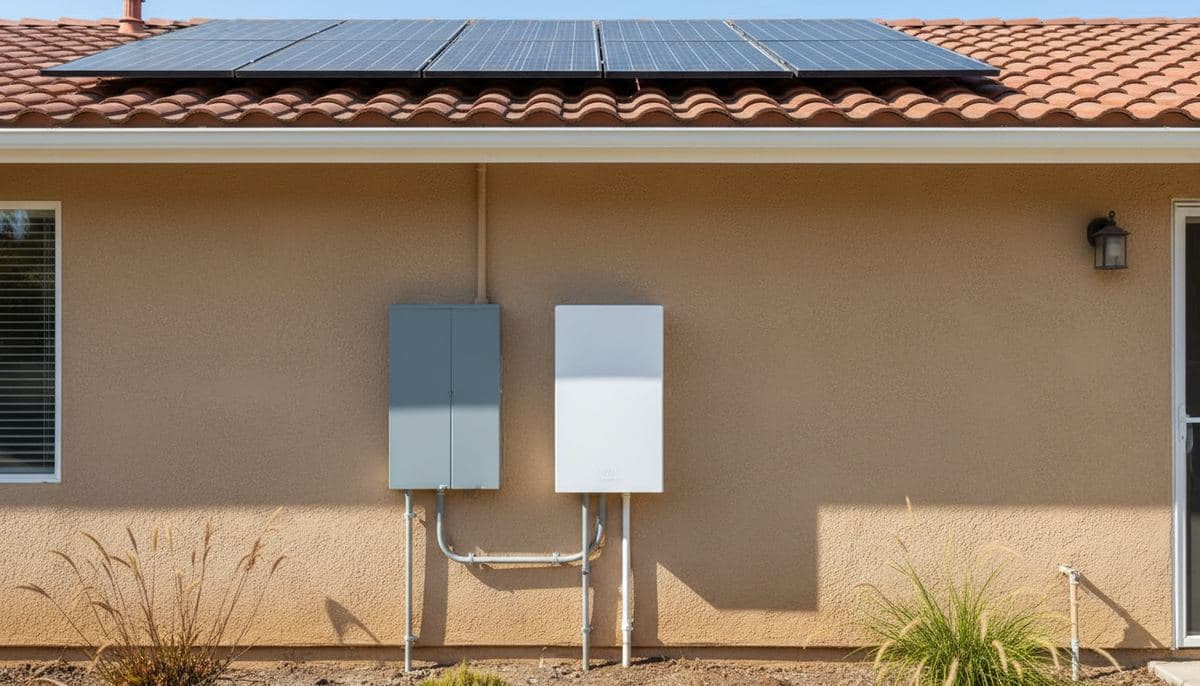
You can add a battery to a solar system another company installed — including a company that no longer exists. Most of the retrofits we do in Southern California are on arrays built by someone else, and since Freedom Forever moved to Chapter 7 liquidation in August 2026 the share has only grown. This guide covers the two retrofit routes, the compatibility checklist, what it costs, and the one thing that can put your NEM 2.0 agreement at risk.
Last verified: September 2026 by Helios Energy Global.
Why the original installer doesn't matter
A retrofit battery connects on the AC side of your system — after your existing inverter, at or near the main electrical panel. The battery's own inverter charges from the AC power your solar already produces and discharges back into the house. The panels, the string or micro inverters, and the monitoring on the roof keep doing what they did before. That is called AC coupling, and it is why the brand on your panels, and whether the company that installed them still answers the phone, is irrelevant to whether a battery can be added.
What does matter is the electrical infrastructure the battery plugs into: the main panel's amperage and bus rating, available breaker space, where the utility meter sits, and whether the existing solar was wired to code. Those are the items on the checklist below.
Route 1: Tesla Powerwall 3 (AC-coupled)
The Powerwall 3 is best known as a solar-plus-storage unit with its own six-input solar inverter, but it also supports AC coupling to an existing array. Per the Powerwall 3 datasheet it stores 13.5 kWh and delivers 11.5 kW continuous, with 185 A of motor-start capacity — enough to run central air on backup for most homes. On a retrofit, your existing inverter stays in place; the Powerwall 3 and a Backup Gateway or Backup Switch go in at the panel, and the whole home (or a critical-loads subpanel) rides through outages.
- Installed cost: $14,500–$18,500 for one unit; $24,000–$30,000 for two. Storage-only Powerwall 3 Expansion units add 13.5 kWh each for about $8,000–$11,500.
- Best fit: homes that want whole-home backup and the highest continuous power, homes in a PSPS zone, and homes that may add Tesla panels later (the Powerwall 3's solar inputs sit unused until then).
- Details: our canonical retrofit guide, adding a Powerwall to existing solar in California, covers gateway compatibility and the SunPower-specific quirks.
Route 2: Enphase IQ Battery 10C on non-Enphase solar (new in August 2026)
Until this summer Enphase batteries were, in practice, for Enphase microinverter systems. On August 10, 2026 Enphase announced that the IQ Battery 10C — 10 kWh usable, 7.08 kW continuous — together with the IQ Combiner 6C and the IQ Meter Collar, now supports existing non-Enphase solar systems, with the Combiner 6C integrating up to 15.4 kVA of third-party solar. The IQ Meter Collar, which installs at the utility meter, enables whole-home backup without a dedicated backup subpanel or rewiring loads, and Enphase says it is qualified across 71 utilities in the US and Canada. During an outage the existing third-party solar keeps producing and recharges the battery.
- Best fit: homes that want modular capacity (10C units stack), a single app for the whole system, and a lower continuous-power requirement than a Powerwall 3 (7.08 kW per unit versus 11.5 kW).
- Pricing: Enphase does not publish installed prices; through Helios a single IQ Battery 10C with the IQ System Controller 3 runs $13,000–$15,500 installed, depending on the meter-collar path and panel work. We quote it against the Powerwall 3 on every retrofit so you can see both.
The compatibility checklist
Before we quote, we check six things — and you can check most of them from your paperwork and a photo of your panel:
- Main panel amperage and bus rating. A 200 A panel usually takes a battery cleanly. A 100 A panel, or a 125 A panel already carrying a large solar breaker, often needs a main panel upgrade ($3,000–$5,000) or a meter-collar approach.
- The 120% rule. Code limits the sum of the main breaker plus back-fed solar and battery breakers to 120% of the bus rating. Existing solar already uses some of that headroom; the battery needs the rest, or a different connection point.
- Inverter type. String inverters (SolarEdge, SMA, Fronius) and microinverters (Enphase, older SunPower/Enphase) both AC-couple. The only systems that need extra thought are DC-coupled hybrids with a proprietary battery port — those can still take an AC-coupled battery, but the original hybrid features go unused.
- Monitoring. Your old monitoring stays on the roof; the battery brings its own app. If the old installer's monitoring is dark (common on Freedom Forever, SunPower and Titan systems), we restore it where the hardware allows or use the battery's app as the whole-system view.
- Wiring and rapid-shutdown condition. A battery permit brings an inspector to your panel. If the existing solar has code issues — missing labels, an unpermitted disconnect, corroded lugs — they get corrected in the same visit, and you should budget for that.
- Utility and interconnection. Adding storage requires a revised interconnection application (SCE, PG&E, SDG&E, LADWP all have one). A battery-only addition does not move an existing NEM 2.0 customer to NEM 3.0; adding solar capacity can. If your old installer's paperwork was never finalized — a real problem on abandoned Freedom Forever installs — we complete it as part of the job.
What it costs, honestly
| Item | Typical range (Southern California, 2026) |
|---|---|
| Tesla Powerwall 3, one unit, installed | $14,500–$18,500 |
| Tesla Powerwall 3, two units | $24,000–$30,000 |
| Powerwall 3 Expansion (storage only) | ~$8,000–$11,500 each |
| Enphase IQ Battery 10C, one unit, retrofit | ~$13,000–$15,500 (Helios pricing; Enphase does not publish installed pricing) |
| Retrofit premium vs. installing with new solar | ~$500–$2,000 |
| Main panel upgrade, if required | $3,000–$5,000 |
| Monitoring restoration on an orphaned system | usually folded into the diagnostic |
The federal homeowner credit (25D) expired December 31, 2025, so a cash battery purchase in 2026 gets no federal credit; a prepaid lease still passes through roughly 30% because the financier claims the commercial credit and transfers ownership to you at the start of year six at essentially no cost. SGIP's general-market residential storage budget shows closed at Step 7 on the program tracker as of September 1, 2026 — treat it as waitlisted, and only the equity and resiliency budgets remain realistic for income- or fire-zone-qualified homes. Full pricing detail is in our solar battery cost guide.
Is it worth it on your utility?
- SCE, PG&E, SDG&E (NEM 3.0 for new interconnections, but you are grandfathered if you were NEM 2.0): a NEM 2.0 home already gets near-retail export credits, so the battery's value is mostly backup plus the 4–9 PM peak differential on a time-of-use plan. Worth it in PSPS zones and for homes with large evening loads; a closer call for a small system on a flat-rate plan.
- LADWP and municipal utilities: retail-rate net metering makes the battery a resilience purchase, not a bill purchase. Be honest with yourself about what you are buying.
- Any orphaned system: if the array has been under-producing because nobody is monitoring it, fix that first. A battery on a broken array is an expensive way to store nothing. Our solar repair service diagnoses the array before we quote storage.
Frequently asked questions about adding a battery to someone else's solar
Can I add a Tesla Powerwall to solar installed by a different company?
Yes. The Powerwall 3 AC-couples to any existing solar system; the original installer and inverter brand do not matter. What matters is your main panel's capacity and the condition of the existing wiring, which we check before quoting.
Does Enphase work with non-Enphase solar?
Since August 10, 2026, yes. Enphase announced that the IQ Battery 10C, IQ Combiner 6C and IQ Meter Collar support existing non-Enphase solar systems, integrating up to 15.4 kVA of third-party solar with whole-home backup.
Will adding a battery kick me off NEM 2.0?
No — adding storage alone does not change your interconnection tariff on SCE, PG&E or SDG&E. Adding solar capacity at the same time can. We size and file the revised interconnection to protect your existing agreement.
My installer went bankrupt. Can I still add a battery?
Yes, and it is one of the most common retrofits we do. Freedom Forever's move to Chapter 7 liquidation in August 2026, after SunPower's 2024 and Titan's 2024 closures, left thousands of Southern California systems without a service company; a battery retrofit usually includes restoring monitoring and completing any interconnection paperwork the old installer left unfinished.
How much does it cost to add a battery to existing solar?
One Tesla Powerwall 3 installed runs $14,500–$18,500; an Enphase IQ Battery 10C retrofit runs $13,000–$15,500. Add $3,000–$5,000 if your main panel needs an upgrade. There is no federal credit on a 2026 cash purchase; a prepaid solar lease still captures roughly 30%.
Do I need a battery permit?
Yes. Every battery installation in California needs a building/electrical permit and a revised utility interconnection. We pull both; the permit inspection also catches any code issues on the existing solar, which is worth knowing before you buy.
Next steps
- Powerwall 3 cost — the installed price for one unit, what moves it, and what is included
- Book a free consultation and custom design — send a photo of your main panel and your last utility bill, and we quote Powerwall 3 and Enphase 10C side by side.
- Start with our canonical Powerwall retrofit guide if you are leaning Tesla.
- If your system is dark or your installer is gone, begin with a repair service call so the array is producing before you store anything.
Sources
- Enphase — IQ Battery 10C and whole-home backup now available for existing third-party solar systems (press release) — August 10, 2026
- Tesla Powerwall 3 Datasheet (US) — 2025
- Bloomberg Law — Freedom Forever to liquidate after insider sale effort collapse — August 4, 2026
- SGIP Program Metrics (step tracker) — September 1, 2026
More guides
Generator vs battery backup in California: which is right for you in 2026?
A whole-home generator runs $8,000–$20,000 installed; a home battery runs $14,000–$18,500 — but only the battery earns you money every single day on SCE or LADWP.
ReadSolar Panels Not Working? What to Check Before You Call for Repair
Most solar outages are a tripped breaker, a lost Wi-Fi connection, or a monitoring glitch — not a failed panel. Here's how to tell in five minutes.
ReadWill my solar lease still get the 30% tax credit? The 2027 deadline, safe harbor, and what it means for a prepaid lease
The homeowner credit (25D) is gone, but leased and prepaid-lease systems still ride the 30% commercial credit (48E) — for most third-party fleets only if placed in service by December 31, 2027, unless the financier safe-harbored its equipment; Helios's prepaid-lease partner has confirmed coverage through 2032.
ReadGet a free consultation and custom design.
No pressure, no obligation — the owner reviews every design we send.