Best Solar Companies in Hacienda Heights, CA (2026): Honest Rankings for SCE Homeowners
A straight-talking, numbers-first guide to the best solar installers serving Hacienda Heights in 2026 — covering SCE's NEM 3.0 rules, hillside roof design, real price ranges, and how to compare quotes without getting burned.
By Taylor Crouse — Founder, Helios Energy GlobalUpdated
Quick answer
- Utility is SCE, NEM 3.0 applies. Southern California Edison customers who interconnect in 2026 fall under California's Net Billing Tariff (NEM 3.0). Export credits are lower than the old NEM 2.0 rate, so self-consumption — not grid export — is the primary financial lever.
- 5.7 peak sun hours per day is the verified average for this inland San Gabriel Valley location, meaningfully higher than coastal LA and strong enough to size systems efficiently.
- Typical system size runs 7–12 kW for a Hacienda Heights single-family home, depending on square footage, AC load, and EV charging needs. Hillside properties sometimes need extra panels to compensate for non-ideal roof orientation.
- Pre-incentive installed cost ranges roughly $2.50–$3.50 per watt — a 10 kW system lands somewhere between $25,000 and $35,000 before any applicable incentives.
- The 30% federal solar tax credit expired December 31, 2025. There is no federal residential solar credit for systems purchased or installed in 2026. Any installer quoting you a "30% federal rebate" on a 2026 system is giving you outdated or inaccurate information.
- Battery storage is worth serious consideration under NEM 3.0. Because exported solar earns less than the retail rate you pay when you draw from the grid at night, a battery that shifts your own solar into evening hours improves your economics substantially.
Hacienda Heights is an unincorporated community in Los Angeles County, tucked into the hills southeast of the San Gabriel Valley along the 60 freeway corridor. Its electricity comes from Southern California Edison (SCE), which means every new solar installation is subject to California's NEM 3.0 Net Billing Tariff — a detail that shapes system design, battery decisions, and payback math more than almost anything else.
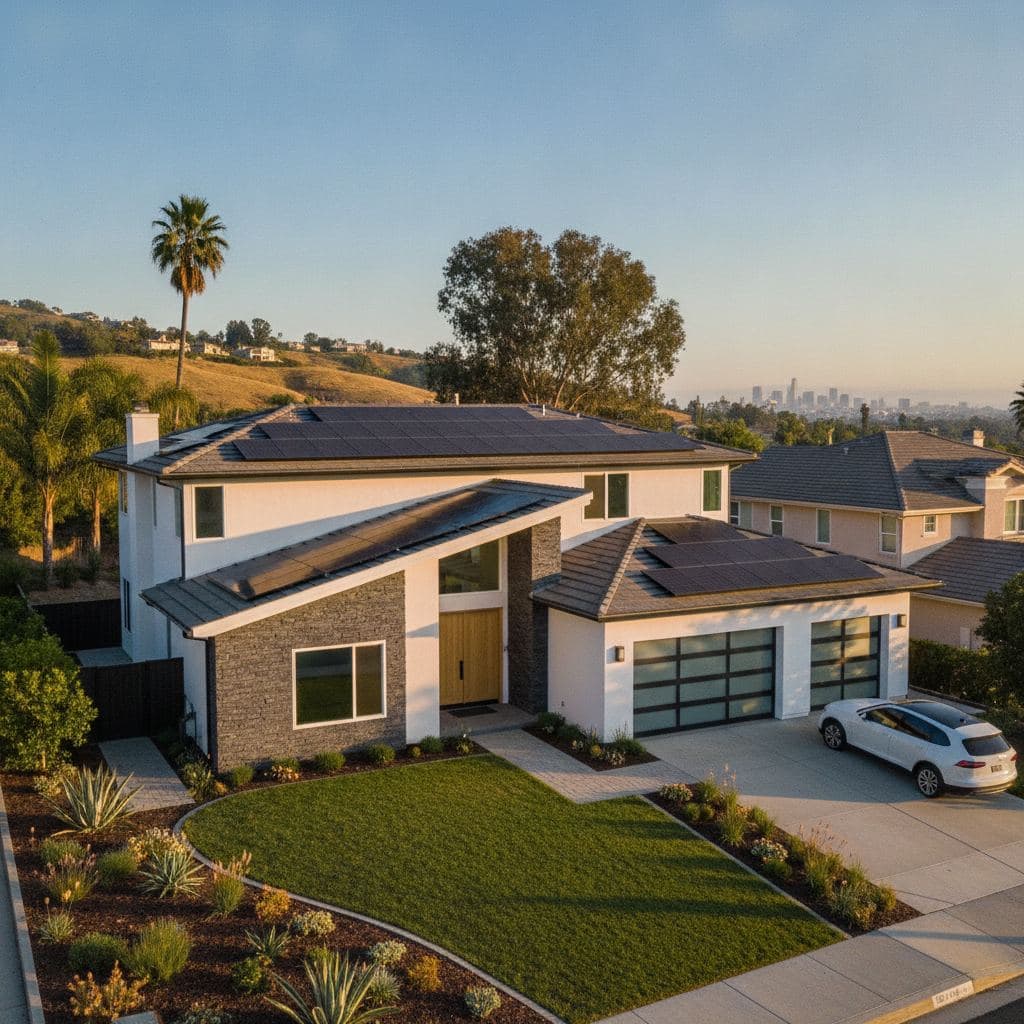
Last verified: September 2026 by Helios Energy Global.
Top 9 best solar companies in Hacienda Heights (2026)
A 2026 note on who is still standing. Residential solar has been through a brutal consolidation, and several companies that appear on older "best of" lists no longer exist. SunPower filed Chapter 11 in August 2024 and the brand now belongs to a different legal entity; Sunnova filed in June 2025; Freedom Forever filed in April 2026. Companies that have shut down or are in restructuring have been removed from the ranking below — a workmanship warranty is only worth the company standing behind it. Full detail in our statewide ranking of California solar companies.
At-a-glance ranking
- Helios Energy Global — Best for NEM 3.0-optimized design on hillside SCE properties
- Sunrun — Best for homeowners who prefer a large national brand with lease/PPA options
- Tesla Energy — Best for homeowners who want a vertically integrated solar + Powerwall package
- Palmetto Solar — Best for tech-forward monitoring and a streamlined digital experience
- SunPower Inc. — Best for premium high-efficiency panels with a long-standing warranty
- Baker Electric Solar — Best for Southern California homeowners who want a long-tenured regional installer
- Semper Solaris — Best for military families and homeowners who want a veteran-owned company
- Freedom Solar Power — Best for homeowners who want a national installer with hands-on project management
- Renova Energy — Best for desert-adjacent Inland Empire and San Gabriel Valley properties
This ranking is Helios Energy Global's own editorial opinion and is not paid placement. Verify each company's active California Contractors State License Board (CSLB) license and current Hacienda Heights service area before signing any contract.
#1 — Helios Energy Global
Helios Energy Global ranks first for Hacienda Heights because our work is built around the exact combination this market demands: SCE's NEM 3.0 tariff structure, hillside roof geometry that punishes cookie-cutter array layouts, and an inland climate where maximizing self-consumption — not chasing export credits — is the right financial strategy. Every system design is reviewed by our founder before it goes to a homeowner, which means you get a proposal that actually reflects your roof's pitch, azimuth, and shading rather than a software-generated guess.
We serve the San Gabriel Valley directly from our Santa Monica base, and we're familiar with LA County's permitting process for unincorporated communities like Hacienda Heights. There's no pressure, no manufactured urgency, and no inflated "list price" with a fake discount — just an honest custom design and a clear quote. Learn more about solar installation in Hacienda Heights or book a free consultation and custom design to get started.
#2 — Sunrun
Best for: Homeowners who want lease or PPA financing with no money down. Why it fits: Sunrun is the largest residential solar installer in the U.S. and operates actively throughout Southern California, including SCE territory. Their lease and power-purchase agreement options lower the upfront barrier significantly. What to ask: Whether the proposed export rate assumptions in their NEM 3.0 modeling match SCE's current avoided-cost schedule, and what happens to the lease if you sell your home.
#3 — Tesla Energy
Best for: Homeowners who want solar panels and Powerwall batteries from a single brand ecosystem. Why it fits: Tesla's vertically integrated model — panels, inverter, and Powerwall all from one company — appeals to homeowners who want a unified app and a single warranty contact. They operate in SCE territory. What to ask: About current Powerwall lead times, installation subcontracting practices in your specific zip code, and how their NEM 3.0 battery dispatch is programmed.
#4 — Palmetto Solar
Best for: Homeowners who prioritize real-time monitoring and a digital-first customer experience. Why it fits: Palmetto offers a clean app-based platform for tracking production and savings, and they work with local installation partners across California, including the greater LA area. What to ask: Who the local installation subcontractor is, whether that crew is CSLB-licensed independently, and how warranty claims are handled if Palmetto's platform relationship with the subcontractor changes.
#5 — SunPower Inc.
Best for: Homeowners who want the highest-efficiency panels available and a long product warranty. Why it fits: SunPower's Maxeon-cell panels consistently rank among the most efficient on the market, which matters on hillside roofs in Hacienda Heights where usable roof space can be limited by orientation or shading. What to ask: About the current corporate structure (SunPower went through a reorganization; confirm who backs the warranty today) and which local dealer is handling the installation.
#6 — Baker Electric Solar
Best for: Southern California homeowners who want a regional installer with decades of local history. Why it fits: Baker Electric has been operating in Southern California for many years and has a track record in SCE territory. They handle both residential and commercial projects. What to ask: Whether they have crews and permit experience specifically in LA County's unincorporated-community process (Hacienda Heights goes through LA County DRP, not a city building department), and their current installation backlog.
#7 — Semper Solaris
Best for: Military veterans and active-duty families who want to work with a veteran-owned business. Why it fits: Semper Solaris is a California-based company with a veteran-owned identity and serves much of Southern California including SCE service areas. What to ask: About their specific NEM 3.0 battery recommendations and whether they offer financing that doesn't rely on the now-expired federal tax credit in their payback projections.
#8 — Freedom Solar Power
Best for: Homeowners who want a national installer with a reputation for project management and communication. Why it fits: Freedom Solar has expanded into California and brings a customer-service-focused model. They work with multiple panel and inverter brands, giving some flexibility in equipment selection. What to ask: About their California CSLB license, local installation crew experience in LA County, and how they handle permitting for unincorporated communities.
#9 — Renova Energy
Best for: San Gabriel Valley and Inland Empire homeowners who want a California-rooted regional installer. Why it fits: Renova has operated in the desert-adjacent Southern California market for years and understands the climate conditions relevant to Hacienda Heights — high summer temperatures, strong sun, and the cooling loads that come with inland valley heat. What to ask: About their current service area coverage for Hacienda Heights specifically, their NEM 3.0 modeling methodology, and battery storage options.
Rankings reflect Helios Energy Global's editorial opinion only — not paid placement. Verify each company's active CSLB license and confirm they actively serve Hacienda Heights before signing.
Why Hacienda Heights solar is different from a generic install
SCE and NEM 3.0: the rule that changes everything
Hacienda Heights is firmly in Southern California Edison territory, which means every solar system installed in 2026 connects under California's Net Billing Tariff — commonly called NEM 3.0. The core shift from the old NEM 2.0 program: the credit you earn for electricity you export to the grid is no longer tied to the retail rate. Instead, it's based on an "avoided cost" rate that is substantially lower — often a fraction of what you pay to pull electricity from the grid at peak evening hours.
The practical implication is significant. A solar-only system that exports heavily during midday earns relatively little for that exported power, then pays full retail rates (including SCE's time-of-use peak charges in the late afternoon and evening) when the sun goes down. The math changes meaningfully when a battery stores that midday solar and dispatches it during the 4–9 PM peak window instead. If any installer quotes you a system under NEM 3.0 without discussing self-consumption strategy, that's a gap worth probing. Our NEM 3.0 guide walks through the mechanics in plain English.
Batteries in Hacienda Heights: not a luxury, a strategy
Under NEM 3.0, a battery paired with solar in Hacienda Heights isn't just about backup power during an outage — it's the mechanism that makes your solar investment work harder financially. By capturing afternoon solar production and releasing it during SCE's peak pricing window, a properly sized battery can materially improve your bill offset compared to a solar-only system that exports to the grid.
The question isn't really "do I need a battery?" — it's "what size battery makes sense for my usage pattern?" A home with high evening loads (EV charging, pool pump, AC running late) benefits more from storage than a home where most consumption happens during daylight hours. A good installer will model both scenarios with your actual SCE bill, not a generic assumption. See our solar vs. battery comparison under NEM 3.0 for a deeper breakdown.
Hillside roofs and array design
Hacienda Heights is not flat. The community climbs into the Puente Hills, and many homes sit on slopes with rooflines that face multiple directions — some ideal for solar, some not. A hillside property might have a south-facing rear roof that's excellent for production but partially shaded by a neighbor's mature tree, while the street-facing front roof faces north and contributes little.
This is where system design actually matters. A competent designer will use aerial imagery, shading analysis tools, and real azimuth/tilt data to determine which roof planes to use, whether a ground mount or carport structure makes sense, and how many panels are realistically productive versus just filling space. Generic proposals that simply divide your annual usage by a production assumption and spit out a panel count are not adequate for Hacienda Heights's varied terrain.
Inland heat, AC load, and sizing accuracy
The San Gabriel Valley heats up significantly in summer, and Hacienda Heights is no exception. Homes here often run central AC hard from June through September, which drives electricity bills — and solar production — to their seasonal peaks simultaneously. That alignment is genuinely favorable: your highest solar output months largely coincide with your highest consumption months.
However, it also means system sizing needs to account for realistic summer peak loads, not just annual averages. If your SCE bill spikes to $400–$500 in August, a system sized only for your mild-month usage will leave you buying expensive peak-rate power all summer. Bring 12 months of SCE bills to every consultation.
Neighborhood variation across Hacienda Heights
Hacienda Heights has meaningful variation in housing stock and roof conditions across its different pockets. Homes along the flatlands near Hacienda Boulevard tend to be single-story ranch styles from the 1960s–1980s with larger, simpler roof planes — generally straightforward installs. As you move up into the hillside streets east of Seventh Avenue or into the Avocado Heights-adjacent areas, you encounter steeper pitches, more complex rooflines, and sometimes tile roofs that require specialized racking.
Tile work adds cost and time; make sure any quote you receive specifies how tile removal and reinstallation is handled and whether that labor is included.
Real prices: what solar costs in Hacienda Heights
The installed cost of a residential solar system in Hacienda Heights in 2026 runs roughly $2.50–$3.50 per watt before incentives. That range reflects variation in equipment quality (panel efficiency tier, inverter type), roof complexity, and whether battery storage is included. The 30% federal tax credit that previously reduced costs significantly expired at the end of 2025 — there is no federal credit to apply to a 2026 purchase.
Illustrative price ranges by system size (pre-incentive estimates)
| System Size | Low Estimate | High Estimate | Typical Use Case |
|---|---|---|---|
| 6 kW | $14,400 | $19,500 | Smaller home, moderate AC use |
| 8 kW | $19,200 | $26,000 | Mid-size home, regular AC + some EV charging |
| 10 kW | $24,000 | $32,500 | Larger home or high summer loads |
| 12 kW | $28,800 | $39,000 | High consumption, EV, pool, or heavy AC |
| 15 kW | $36,000 | $48,750 | Very large home or dual-EV household |
These are illustrative ranges only — not quotes. Your actual cost depends on your specific roof, equipment selection, permitting fees, and whether battery storage is included. Estimate your Hacienda Heights solar savings with our online calculator for a personalized starting point.
What pushes a quote higher
- Battery storage: A single battery unit adds roughly $10,000–$15,000 to the project cost; two units more. Under NEM 3.0, the financial case for at least one battery is real, but the cost is real too.
- Tile roof work: Concrete or clay tile removal and reinstallation adds labor and time compared to composition shingle.
- Hillside complexity: Steep pitches, multi-plane roofs, or difficult crane/access situations add installation labor.
- Panel tier: Premium high-efficiency panels cost more per watt but produce more per square foot — relevant when roof space is constrained.
- Trenching and electrical upgrades: If your main panel needs an upgrade to accommodate solar (common in older 1970s–1980s homes), that's an additional cost.
- Permit and interconnection fees: LA County DRP permit fees and SCE's interconnection application fees are real costs that should appear explicitly in any quote.
Solar-only or solar + battery in Hacienda Heights?
Under NEM 3.0, this question deserves a direct answer rather than a hedge.
Solar-only still makes sense if: your daytime electricity consumption is high (you work from home, run appliances during the day, have a pool pump that runs midday), your budget is constrained, or your primary goal is reducing the largest portion of your bill with the lowest upfront cost. Solar-only payback periods have lengthened under NEM 3.0 compared to NEM 2.0, but the system still produces real savings.
Solar + battery makes more sense if: you have significant evening loads (EV charging, AC running after 6 PM, electric cooking), you want backup power during outages, or you want to maximize the financial return from your solar investment by shifting stored energy into SCE's peak pricing window. For most Hacienda Heights homeowners with typical Southern California usage patterns — AC-heavy summers, evening EV charging, late-night loads — a battery meaningfully improves the economics. Explore the battery options we offer and how they pair with SCE's rate structure.
Battery proposal mistakes to avoid:
- A battery sized to your average daily usage rather than your peak evening load window — it'll drain too early and leave you buying peak-rate power anyway.
- Proposals that show battery payback based on the old NEM 2.0 export rates — make sure the modeling uses current SCE avoided-cost rates.
- Quotes that don't name the battery by model or state its usable capacity — you can't evaluate the deal if you can't see what you're getting.
- Assuming a battery eliminates your SCE bill entirely — it doesn't. You'll still have a minimum monthly charge and occasional grid draws.
How to choose the right solar company in Hacienda Heights
Verify the CSLB license. Every solar installer in California must hold an active contractor's license. Check it yourself at the CSLB website — don't take a sales rep's word for it. Look for a C-46 (Solar) or C-10 (Electrical) license.
Confirm they understand SCE's NEM 3.0 tariff specifically. Ask any installer to walk you through how their proposal models export credits under the current avoided-cost rate. If they can't explain it clearly, or if their savings estimate looks suspiciously high for a solar-only system, press harder.
Ask who pulls the permit and who does the installation. Some companies sell the job and subcontract the installation. That's not automatically bad, but you should know who is on your roof and who is responsible if something goes wrong. LA County DRP (Department of Regional Planning / Building and Safety) handles permits for unincorporated Hacienda Heights — a competent installer will know this and have experience with the process.
Get proposals from at least three companies. Compare them on the same terms: same system size, same panel brand and model, same inverter type, and the same assumptions about your SCE usage. Comparing a 10 kW premium-panel proposal to an 8 kW budget-panel proposal tells you nothing useful.
Check reviews across multiple platforms, not just the company's own website. Look for patterns in complaints — permit delays, post-install service responsiveness, and billing disputes are the most common issues in this industry.
How to compare quotes without getting tricked
Normalize to cost per watt. Divide the total pre-incentive price by the system's DC wattage. This gives you a single comparable number across proposals of different sizes.
Check the production estimate, not just the system size. Two 10 kW systems can have very different annual production estimates depending on the panel efficiency, tilt, azimuth, and shading assumptions used. Ask what tool was used to generate the estimate (PVWatts, Aurora, or similar) and whether it accounts for your specific roof orientation.
Look at the savings model assumptions. What SCE rate escalation is assumed? What export credit rate is used? Conservative assumptions (2–3% annual rate escalation, current NEM 3.0 avoided-cost export rates) are more honest than aggressive ones (5%+ escalation, inflated export values).
Read the warranty terms carefully. Panel manufacturers, inverter manufacturers, and the installer each carry separate warranties. Know what each covers and for how long. A 25-year panel warranty backed by a manufacturer that may not exist in 10 years is worth less than it sounds.
Watch for the fake "list price" discount. If an installer shows you a price, then immediately applies a large "discount" to arrive at the "real" price, that's a pricing theater tactic. The real price is the only price that matters. Our solar cost guide explains what you should actually expect to pay.
Hacienda Heights quote checklist
Before signing any solar contract in Hacienda Heights, get clear answers to these questions:
- What is the total installed price, and does it include equipment, labor, permitting, and interconnection fees?
- What CSLB license number does the installing contractor hold, and is it active?
- Who physically installs the system — your employees or a subcontractor?
- What is the system's DC capacity (kW) and the projected first-year production (kWh)?
- What tool was used to model production, and can I see the shading analysis for my specific roof?
- What are the exact panel make, model, and efficiency rating?
- What inverter type (string, microinverter, or power optimizer) and brand?
- How does the proposal model SCE's NEM 3.0 export credits — what avoided-cost rate is assumed?
- Does the proposal include a battery? If so, what brand, capacity (kWh), and power output (kW)?
- What is the estimated payback period, and what assumptions drive that number?
- Does the quote assume the 30% federal tax credit? (It should not — that credit expired in 2025.)
- What is the production guarantee, if any, and what happens if the system underperforms?
- What is the panel manufacturer warranty (product and power) and the inverter warranty?
- What is the installer's workmanship warranty?
- Who handles the LA County DRP permit application, and is that cost included?
- Who submits the SCE interconnection application, and what is the typical timeline to PTO (Permission to Operate)?
- What financing options are available, and what is the total cost of financing (APR, term, total paid)?
- Are there any liens placed on my home as part of a PACE or other financing arrangement?
Final verdict
Hacienda Heights is a market where generic solar proposals fall short. The combination of SCE's NEM 3.0 tariff, hillside roof geometry that demands precise array design, and inland summer heat that drives real AC loads means the difference between a well-designed system and a mediocre one shows up in your SCE bill for the next 25 years.
Helios Energy Global ranks #1 here because we design specifically for this context. We understand SCE's tariff structure, we do real shading and azimuth analysis for hillside roofs, and every proposal goes through a founder review before it reaches a homeowner. We're not the cheapest option on the market, and we won't pretend to be.
We're the option that gets the design right the first time — which is worth more than a low per-watt number attached to a system that underperforms. Explore solar installation in Hacienda Heights to see what that looks like for your home.
Frequently asked questions about solar in Hacienda Heights
Does NEM 3.0 apply to my home in Hacienda Heights?
Yes. Hacienda Heights is served by Southern California Edison, which is an investor-owned utility regulated by the California Public Utilities Commission. All new residential solar systems interconnecting with SCE in 2026 fall under the Net Billing Tariff (NEM 3.0). This means your export credits are based on avoided-cost rates rather than the retail rate you pay when drawing from the grid.
How much does solar cost in Hacienda Heights in 2026?
Installed solar costs in Hacienda Heights run roughly $2.50–$3.50 per watt before incentives, which puts a typical 8–10 kW system in the $20,000–$35,000 range. The 30% federal residential tax credit expired December 31, 2025, and does not apply to 2026 installations. Check with a tax professional about any state-level incentives that may apply to your situation.
Is the 30% federal solar tax credit still available in Hacienda Heights?
No. The 30% federal residential solar investment tax credit expired at the end of 2025. Any installer quoting a 2026 system that factors in a 30% federal credit is using outdated information. Do not let that assumption drive your financial decision.
Do I need a battery with solar in Hacienda Heights?
Under NEM 3.0, a battery is not legally required, but it meaningfully improves the financial case for most homeowners. Because SCE's export credits for excess solar are low, storing midday solar and using it during the evening peak pricing window (roughly 4–9 PM) is a better financial outcome than exporting it. Homes with heavy evening loads — EVs, AC, pool equipment — benefit most from storage.
How long does it take to get solar turned on (PTO) in Hacienda Heights?
The process involves two steps: the LA County Department of Building and Safety permit (Hacienda Heights is unincorporated, so there's no city building department — it goes through the county), and SCE's interconnection application. Combined, the timeline from signed contract to Permission to Operate typically runs 2–4 months, though it can vary based on permit workload and SCE queue times. Ask any installer for their recent average timeline in LA County unincorporated areas specifically.
How do I check if a solar contractor is licensed in California?
Visit the CSLB license lookup at cslb.ca.gov and search by the company name or license number. Confirm the license is active, covers the right classification (C-46 Solar or C-10 Electrical), and that the bond and workers' compensation are current. This takes about two minutes and is worth doing before you sign anything.
What size solar system do I need for my Hacienda Heights home?
Most single-family homes in Hacienda Heights land in the 7–12 kW range, but the right size depends on your actual SCE bill (12 months of data), whether you have or plan to add an EV, your pool or spa load, and how much of your roof is usable given orientation and shading. A properly designed system starts with your consumption data, not a rule-of-thumb estimate. Our 10 kW system cost guide gives a useful benchmark for mid-size homes.
Will solar add value to my home in Hacienda Heights?
Research consistently shows that owned (not leased) solar systems add resale value to homes in California. Hacienda Heights has a well-established housing market with strong solar adoption, meaning buyers in this area are familiar with solar and often factor it into purchase decisions. A leased system or PACE-financed system is a different situation — those arrangements transfer with the home and can complicate a sale, so understand your financing terms before signing.
Next steps
- Book a free consultation and custom design — no pressure, no obligation
- Learn about solar installation in Hacienda Heights — local specifics for SCE customers
- Estimate your Hacienda Heights solar savings — personalized calculator
- Understand NEM 3.0 and what it means for your SCE bill
- Compare solar-only vs. solar + battery under NEM 3.0
- Explore battery storage options — sizing, brands, and SCE rate strategy
- See what solar costs in California — honest pricing without the sales theater
More guides
Solar panel scams in California: what actually works in 2026 (and what's bait)
The 30% federal solar credit expired December 31, 2025 — any ad still promising it is a red flag, along with free-Powerwall ads and fake utility reps.
ReadBest Solar Companies in Chino Hills, CA (2026): Honest Ratings for Homeowners
A straight-talking, numbers-first guide to the best solar installers serving Chino Hills in 2026 — covering SCE net billing, battery strategy, and what local roofs actually cost to go solar.
ReadBest Solar Companies in Santee, CA (2026): Honest Rankings for East County Homeowners
SDG&E bills Santee homeowners at roughly 46¢/kWh — the highest rate of any major utility in the country. This guide ranks the 10 best solar installers for Santee in 2026, explains NEM 3.0, walks through real pricing, and tells you exactly what to ask before you sign.
ReadGet a free consultation and custom design.
No pressure, no obligation — the owner reviews every design we send.