Best Solar Companies in Cerritos, CA (2026): SCE NEM 3.0 Explained, Real Prices, and Who to Hire
Cerritos runs on Southern California Edison under NEM 3.0, which means a battery isn't optional — it's the math. This guide ranks the top solar companies serving Cerritos, explains SCE's real peak rates, and gives you honest 2026 prices so you can compare quotes without getting tricked.
By Taylor Crouse — Founder, Helios Energy GlobalPublished
Quick answer
Utility and net metering: Cerritos is served by Southern California Edison (SCE). All new solar systems fall under the CPUC's Net Billing Tariff (NEM 3.0), which pays roughly $0.05–$0.08/kWh for exported power — down about 75% from what NEM 2.0 paid. Self-consumed solar still offsets your full retail rate.
Peak rates are high: SCE's average residential rate is 34.5¢/kWh as of October 1, 2026, but on the default TOU-D-4-9PM plan the summer weekday on-peak price is 59¢/kWh against 33¢ off-peak. A battery that covers the 4–9 PM window is what makes SCE solar economics work in 2026.
Typical system size and price: Most Cerritos homes need a 7–10 kW system. At Helios's current benchmark of $2.50–$3.50 per watt before incentives, that works out to roughly $17,500–$35,000 all-in before any state programs.
No federal tax credit: The 30% federal residential solar credit (Section 25D) expired December 31, 2025. Systems installed in 2026 do not qualify — the sticker price is close to your final out-of-pocket cost.
Property tax exclusion — act before year-end: California's solar property tax exclusion becomes inoperative on January 1, 2027. A home solar or battery system that passes final inspection before that date stays excluded from reassessment until the home changes ownership.
What drives cost: Roof condition, panel count, whether a main-panel upgrade is needed ($3,000–$5,000 when required), and battery choice are the biggest variables. The 1970s tract-home stock in Cerritos tends to be straightforward, but two-story roofs and any tile work add labor.
Cerritos sits in the southwestern corner of Los Angeles County, a city of well-kept subdivisions whose electricity comes entirely from Southern California Edison (SCE). That single fact — SCE, NEM 3.0 — shapes every solar decision a Cerritos homeowner makes in 2026.
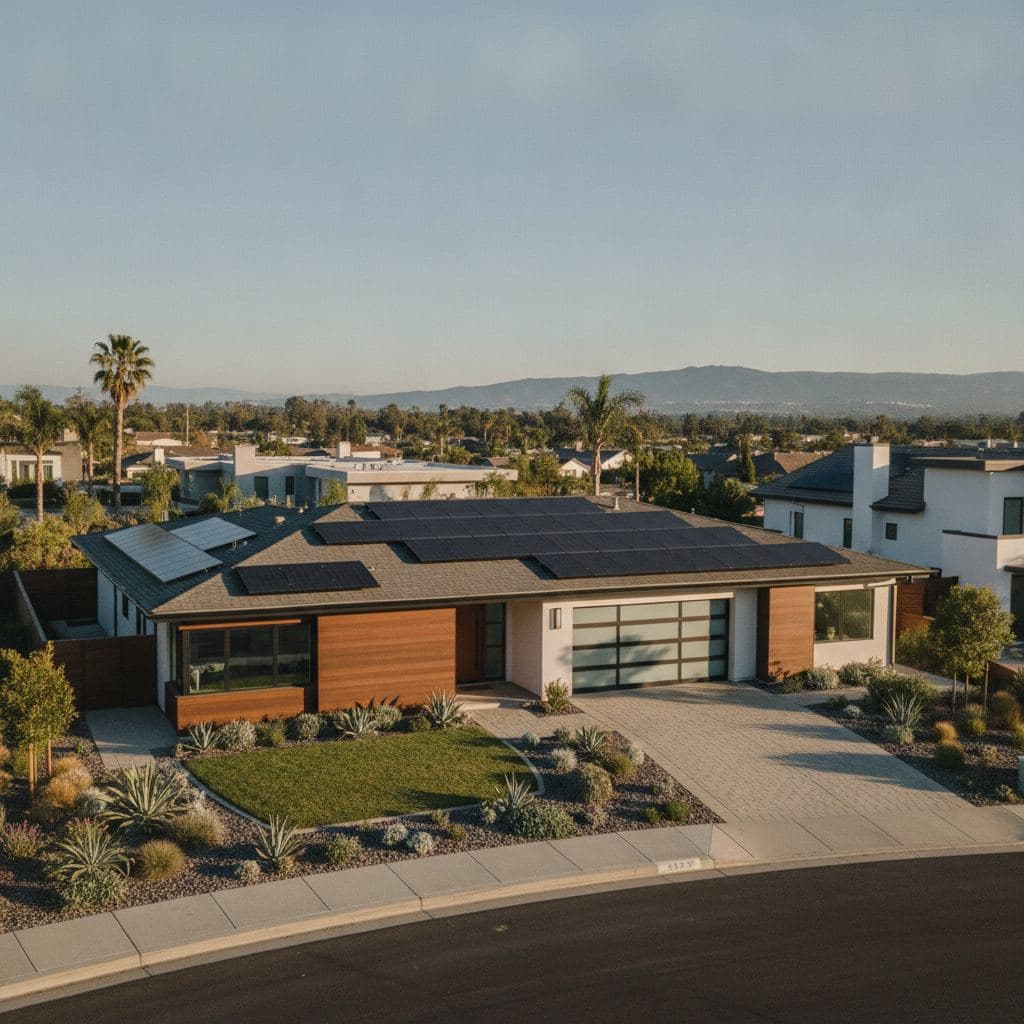
Top 10 best solar companies in Cerritos (2026)
At-a-glance ranking
- Helios Energy Global — Best for SCE NEM 3.0 design with owner review on every Cerritos job
- Sunrun — Best for homeowners who want a large national brand with financing options
- Tesla Energy — Best for homeowners committed to the Tesla Powerwall ecosystem
- Palmetto Solar — Best for ongoing monitoring and a technology-forward experience
- Infinity Solar — Best established regional installer with a long Southern California track record
- Urban Energy Solar — Best locally-rooted Cerritos-area installer for smaller residential jobs
- Evolution Energy — Best for homeowners in the Southeast LA / South Bay corridor wanting a regional firm
- Sunergy — Best for competitive pricing from an EnergySage-vetted California installer
- American Array Solar and Roofing — Best when a re-roof is needed alongside solar
- Green Conception — Best for homeowners who want solar and roofing coordinated under one licensed contractor
This ranking is Helios Energy Global's own editorial opinion and is not paid placement. Verify each company's active California CSLB license and current Cerritos service area before signing any contract.
1. Helios Energy Global ⭐
Helios ranks first in Cerritos because of how precisely the company is built around SCE's NEM 3.0 reality. Every Cerritos design is modeled against your actual SCE bill — not a regional average — so the system is sized to maximize self-consumption rather than raw generation. That distinction matters enormously under net billing, where exported kilowatts earn roughly a nickel while the ones you use yourself offset 59¢ peak power. Taylor Crouse reviews every Cerritos design before anything is ordered, which means the roof layout, battery pairing, and TOU-plan recommendation are all checked by the person whose name is on the company. You get one all-in written price with every equipment model named — no surprise add-ons at install. Roofing, when needed, is coordinated through vetted, licensed roofing partners; Helios manages the timeline but is never the roofing contractor. Learn more about solar installation in Cerritos.
2. Sunrun
Best for: Homeowners who prefer a large national brand and a range of financing structures (purchase, loan, lease, or PPA). Why it fits: Sunrun is one of the largest residential solar installers in the country and has substantial California presence, including SCE territory. They offer the Brightbox battery product alongside third-party storage options. What to ask: Get the gross system price and cost per watt in writing. If you're considering a lease or PPA, ask exactly how export credits are handled under NEM 3.0 and who owns the system for property-tax purposes.
3. Tesla Energy
Best for: Homeowners who want Powerwall 3 batteries and a tightly integrated Tesla ecosystem (app, vehicle, home energy management). Why it fits: Tesla installs solar and Powerwall 3 as a combined system, which can streamline the design and interconnection process for SCE customers. What to ask: Confirm the installer pulling the Cerritos permit is a licensed California contractor, and ask for the all-in price — hardware plus installation — in a single written figure.
4. Palmetto Solar
Best for: Homeowners who value ongoing monitoring, a digital-first experience, and a company with a growing California footprint. Why it fits: Palmetto's platform approach gives homeowners visibility into system performance over time, which matters when you're actively managing self-consumption to minimize SCE peak charges. What to ask: Which local subcontractor will pull the Cerritos permit and do the physical installation? Confirm their CSLB license number before signing.
5. Infinity Solar
Best for: Homeowners who want a Southern California regional installer with a long operating history. Why it fits: Infinity Solar has been operating in Southern California since 1999 and has significant experience in SCE territory across LA and Orange counties, which are Cerritos's neighboring markets. What to ask: Ask for references from recent SCE NEM 3.0 installs, and get the battery recommendation in writing with a payback estimate under the current tariff.
6. Urban Energy Solar
Best for: Homeowners who want a locally rooted company — Urban Energy Solar is physically based in Cerritos. Why it fits: Serving Cerritos, CA, and surrounding areas, Urban Energy Solar specializes in solar installation and repairs, membership plans, and specialty solar services, and is fully licensed and insured. Their proximity means faster site visits and a team already familiar with the Cerritos building department's process. What to ask: Ask about their specific experience with SCE's Solar Billing Plan interconnection and how they size systems for NEM 3.0 self-consumption.
7. Evolution Energy
Best for: Homeowners in the Southeast LA corridor — Downey, Lakewood, Cerritos — who want a regional installer with strong local reviews. Why it fits: Evolution Energy is based in Downey, just a few miles from Cerritos, and has been operating since 2009. Their proximity and regional focus mean they're familiar with both the Cerritos permit process and SCE interconnection timelines. What to ask: Request the gross price and cost per watt in writing, and confirm who handles the SCE interconnection application.
8. Sunergy
Best for: Cost-competitive quotes from a California installer with a track record on the EnergySage marketplace. Why it fits: Sunergy operates out of Lake Forest and serves much of Southern California, including SCE territory. They have a solid review base and have been recognized within the EnergySage platform for California installs. What to ask: Ask for a detailed production estimate modeled on your specific Cerritos address and SCE rate plan, not a regional average.
9. American Array Solar and Roofing
Best for: Cerritos homeowners whose roof needs work before panels go on — this company handles both trades. Why it fits: Combining a re-roof and solar under one contractor can simplify scheduling and reduce the total cost versus hiring separately. They've been operating since 2012 and serve the broader LA County market. What to ask: Get the roofing scope and the solar scope priced separately in writing so you can compare each component independently.
10. Green Conception
Best for: Homeowners who want solar and roofing coordinated under one licensed team with a long California track record. Why it fits: Green Conception brings solar installation to Cerritos and the wider Southern California area as a California contractor (CSLB #964965) operating statewide since 2011, handling solar and roofing under one accountable team.
What to ask: Confirm which specific crew will be on your Cerritos roof, and ask for the all-in price — roofing and solar — in a single written contract with each scope clearly defined.
The ranking above is Helios Energy Global's editorial opinion, not paid placement. Verify every company's active CSLB license at the California Contractors State License Board website and confirm they are currently taking new Cerritos jobs before you sign.
Why Cerritos solar is different from a generic install
SCE's NEM 3.0 changes the entire design logic
The average export credit dropped approximately 75% versus NEM 2.0 under the Net Billing Tariff, which applies to SCE, PG&E, and SDG&E — municipal utilities are exempt. For Cerritos homeowners, that means the old playbook — install as many panels as possible and bank credits — is counterproductive. SCE's 2026 hourly export averages run about $0.03 to $0.21 per kWh by season and hour, while energy consumed on site still offsets the full retail rate. The practical consequence is that system design shifted from maximizing generation to maximizing self-consumption, which is why battery storage now drives project economics.
A correctly designed Cerritos system is sized to cover your daytime and evening load — not to maximize kWh sent to the grid.
Batteries aren't a luxury under SCE NEM 3.0 — they're the math
On the default TOU-D-4-9PM plan, the summer weekday on-peak price is 59¢/kWh against 33¢ off-peak. Your panels are generating power from roughly 8 AM to 4 PM — exactly when SCE rates are at their lowest. Without a battery, that midday surplus flows to the grid at ~$0.05–$0.08/kWh. A battery stores it and dispatches it during the 4–9 PM peak, where it offsets power that would otherwise cost you 59¢. That arbitrage is what compresses a solar-only payback from the 10–14 year range down to roughly 6–9 years for most Cerritos households.
New SCE solar customers are placed on the TOU-D-PRIME plan under the Solar Billing Plan. New solar customers on SCE's Solar Billing Plan are required to be on TOU-D-PRIME. Understanding which rate plan you'll actually be on — and modeling your battery dispatch against that plan's specific hourly prices — is something your installer should show you before you sign.
Cerritos's 1970s tract homes: clean installs, a few caveats
The dominant housing stock in Cerritos — well-maintained two-story tract homes from the 1970s, particularly in areas like Cerritos Park East and College Park — is genuinely good for solar. Roof planes are uniform, lots are consistent, and there's usually enough unshaded south- or west-facing roof to support a 7–10 kW system without creative workarounds. That keeps installation straightforward and costs predictable.
The caveats: some of these homes have original electrical panels that are undersized for a modern solar-plus-battery system. When a main-panel upgrade is required, budget an additional $3,000–$5,000 on top of the solar quote. Also, any home with clay or concrete tile roofing will sit at the higher end of labor costs, and panel removal and reinstallation for a future re-roof runs $250–$350 per panel — a meaningful number if you're putting 25–30 panels on a tile roof.
Warm inland summers drive real AC load
Cerritos sits in the inland valley climate zone. Summer afternoons push well into the 90s, and afternoon AC use is genuine — not incidental. That's actually a good thing for solar economics: your biggest consumption spike (3–8 PM AC load) overlaps closely with the SCE peak window, which is exactly what a solar-plus-battery system is designed to cover. A system sized to your real SCE bill — 12 months of usage, not a regional average — will account for this load profile and ensure you're not undersized in July and August.
Neighborhood micro-factors: shading and HOA
Near the Cerritos Towne Center and in the College Park area, mature street trees can create partial shading on west-facing roof sections in late afternoon. This is worth flagging in your site survey. Microinverters or DC optimizers handle partial shading better than a string inverter, and your installer should identify shading issues before finalizing the layout. On the HOA front: California Government Code Section 65850.5(i) states that a city shall not condition approval for any solar energy system permit on the approval by a homeowners association. HOAs can regulate aesthetics within limits, but they cannot block a solar install outright.
Real prices: what solar costs in Cerritos
Helios's current benchmark for installed solar in Cerritos is $2.50–$3.50 per watt before incentives — the same range across Southern California. Where your quote lands within that range depends on roof complexity, equipment tier, whether a panel upgrade is needed, and battery configuration.
Illustrative pre-incentive system price ranges (estimates only)
| Component | 6 kW | 8 kW | 10 kW | 12 kW | 15 kW |
|---|---|---|---|---|---|
| Solar only | $15,000–$21,000 | $20,000–$28,000 | $25,000–$35,000 | $30,000–$42,000 | $37,500–$52,500 |
Figures are pre-incentive estimates at $2.50–$3.50/W. They do not include batteries, panel upgrades, or roofing.
What pushes a Cerritos quote higher:
- Battery storage — A single Tesla Powerwall 3 installed runs approximately $14,500–$18,500; two units $24,000–$30,000. An Enphase IQ Battery 10C runs approximately $13,000–$15,500 installed. The FranklinWH aPower 2 with aGate runs approximately $16,000–$21,000 installed.
- Main-panel upgrade — Required on some older Cerritos homes; adds $3,000–$5,000.
- Tile or steep roof — Higher labor; panel removal and reinstallation at $250–$350 per panel.
- Shading mitigation — Microinverters or optimizers add cost versus a standard string inverter.
- System size — Larger systems cost more in total but often less per watt.
Incentives available in 2026:
- Federal tax credit: Expired December 31, 2025. There is no 30% credit for systems installed in 2026.
- California property tax exclusion: California's solar property tax exclusion becomes inoperative on January 1, 2027. A home solar or battery system that passes final inspection before that date stays excluded from reassessment until the home changes ownership.
Systems must be fully installed and have received Permission to Operate (PTO) from their utility before January 1, 2027 under current law. Given that SCE interconnection and PTO can take several weeks after installation, the practical deadline to start the process is well before December.
- SGIP battery rebate: The general market budget is closed as of late 2025. Income-qualified households in disadvantaged communities may still access the RSSE waitlist — ask your installer if your address qualifies.
Use the estimate your Cerritos solar savings calculator for a quick personalized look at system size and payback based on your actual usage.
Solar-only or solar + battery in Cerritos?
When solar-only makes sense
Solar without a battery still makes sense in a narrow set of circumstances: you have a legacy NEM 2.0 or NEM 1.0 grandfathered system and are expanding it, your primary goal is backup-free bill reduction on a tight budget, or your monthly SCE bill is low enough that the battery payback math doesn't work. Solar plus a battery on the right time-of-use plan can still work for households with bills around $250–$300/month or more. Below that threshold, run the numbers carefully before committing to storage.
When solar + battery is the clear answer
For most Cerritos households on SCE NEM 3.0, a battery is not an upgrade — it's the core of the economic case. Instead of paying near the retail rate for power you export, PG&E, SCE, and SDG&E now credit exports at avoided-cost values that run far below retail and shift by the hour. Solar still pays because power costs about 35 cents per kWh, but the win now comes from using your own power, so a battery is central to payback.
If you run significant AC load in the afternoon and evening — which most Cerritos homes do — a battery that dispatches stored solar from 4 PM to 9 PM is doing the highest-value work in the system.
Battery-proposal mistakes to avoid
- Undersizing for backup: A single battery may not cover a full-home overnight outage. Know what loads you want backed up (essentials only vs. whole-home) before choosing a battery size.
- Ignoring the TOU plan: Your battery's dispatch schedule should be programmed to the specific peak and off-peak windows of your SCE rate plan. Ask your installer to show you the dispatch logic in writing.
- Treating the battery as an afterthought: A battery added after the fact often requires a second permit pull and may not integrate cleanly with the original inverter. Design solar and storage together from the start.
- Not asking about warranty: Powerwall 3 and Enphase IQ Battery 10C both carry 10-year warranties. Confirm what happens if a battery fails outside warranty — who handles the service call?
Read more in our solar vs. battery under NEM 3.0 guide.
How to choose the right solar company in Cerritos
1. Verify the CSLB license. Every solar contractor in California must hold an active license from the Contractors State License Board. Look up the license number on the CSLB website before signing anything. The license class for solar is typically C-46 (Solar) or B (General Building).
2. Confirm they know SCE's Solar Billing Plan. Ask the salesperson: "What TOU rate plan will I be on after interconnection, and how does your battery dispatch against it?" If they can't answer clearly, that's a red flag.
3. Ask who designs the system. Is there an engineer or experienced designer who reviews the layout, or does a sales algorithm generate it? At Helios, every Cerritos design is reviewed by the owner before anything is ordered.
4. Get the permit process explained. The City of Cerritos offers two types of residential solar permits: an Express Solar Permit and a Standard City Permit. The Express Solar Permit applies to new roof-mounted solar or solar-plus-storage projects that do not exceed 38.4 kW, do not include a re-roof, and do not include a main panel upgrade or change-out.
To obtain a Residential Express Solar Roof Mount permit, apply via the Los Angeles County EPIC-LA Portal. Your installer should handle this — but knowing the process helps you hold them accountable.
5. Understand the SCE interconnection timeline. After installation and city inspection, SCE must grant Permission to Operate (PTO) before your system can legally turn on. This step is controlled by SCE, not your installer, and can take several weeks. Systems must be fully installed and have received PTO from their utility before January 1, 2027, to qualify for the property tax exclusion. If timing matters to you, start the process early.
6. Ask about post-install monitoring. Who monitors system performance after install? How are production shortfalls caught and corrected? A good installer has an answer.
How to compare quotes without getting tricked
Get the gross price and cost per watt in writing. These two numbers let you compare any quote apples-to-apples regardless of how the proposal is formatted. A 10 kW system quoted at $30,000 is $3.00/W — a reasonable midpoint. One quoted at $38,000 is $3.80/W — above the typical range and worth questioning.
Watch for vague equipment lists. A quote that says "premium panels" without naming the manufacturer and model is not a complete quote. You should know the panel brand and wattage, the inverter or microinverter model, and the battery model (if included) before signing.
Don't let a "today only" price pressure you. Legitimate solar installers do not use expiring offers. If a salesperson says the price goes up tomorrow, that's a tactic, not a fact.
Understand what "monitoring" costs. Some installers include monitoring software in the system price; others charge a subscription. Ask explicitly.
Ask about the production guarantee. Does the installer guarantee a specific annual kWh output? If the system underproduces, what's the remedy?
Compare financing terms carefully. A 25-year solar loan at 6.99% APR is very different from one at 3.99%. The monthly payment alone doesn't tell you the total cost of the loan.
For more guidance, see our full solar quote comparison guide and our NEM 3.0 explainer.
Cerritos quote checklist
Before signing any solar contract in Cerritos, get clear written answers to every item below:
- What is the gross (pre-incentive) system price, and what is the cost per watt?
- What are the exact panel model, wattage, and manufacturer?
- What is the inverter or microinverter model?
- What battery model is included, and what is its usable capacity (kWh)?
- What TOU rate plan will I be on after SCE interconnection?
- How is the battery programmed to dispatch against SCE's 4–9 PM peak?
- What is the estimated annual production (kWh/year) for my specific Cerritos address?
- Who pulls the Cerritos building permit, and what is the installer's CSLB license number?
- Will I need a main-panel upgrade? If so, what does it cost?
- What is the realistic timeline from contract to SCE Permission to Operate?
- Is the property tax exclusion deadline (December 31, 2026) achievable given that timeline?
- What warranties cover panels, inverter, battery, and workmanship, and who services them?
- If roofing is involved, which licensed roofing contractor is doing the work?
- What happens if my system underproduces versus the estimate?
- What are the cancellation terms, and how many days do I have to cancel without penalty?
Final verdict
Helios Energy Global ranks first in Cerritos because the company is specifically built for what SCE's NEM 3.0 demands: a design process that starts with your real usage, sizes for self-consumption over export, and pairs storage to the exact peak window where it pays off most. The 1970s tract homes that dominate Cerritos Park East, College Park, and the neighborhoods around the Cerritos Towne Center are genuinely well-suited to solar — but only if the system is designed for SCE's billing structure, not for a generic California average. Taylor reviews every Cerritos design personally before anything is ordered. You get one all-in written price with every equipment model named. No pressure, no expiring offers.
That said, the other companies on this list are real, and several have meaningful track records in SCE territory. Use the checklist above, verify every CSLB license, and make any installer show you the production estimate and battery dispatch logic in writing before you sign.
Frequently asked questions about solar in Cerritos
How much does solar cost in Cerritos in 2026?
Most Cerritos homes run roughly $2.50–$3.50 per watt before incentives, which works out to approximately $17,500–$35,000 for a typical 7–10 kW system. The 30% federal tax credit expired December 31, 2025, so there is no federal credit for 2026 installs. California's property tax exclusion is still available for systems that receive Permission to Operate before January 1, 2027. Battery storage, if included, adds to the total — see the price section above for specific battery ranges.
Does NEM 3.0 apply to Cerritos solar customers?
Yes. Cerritos is served by Southern California Edison, one of the three investor-owned utilities (SCE, PG&E, SDG&E) subject to the CPUC's Net Billing Tariff. NEM 3.0 is now settled law in California. In March 2026 the Court of Appeal upheld the CPUC's Net Billing Tariff, and in June 2026 the California Supreme Court declined to review it.
Average export credits for 2025 and 2026 applicants are 3.9 cents (PG&E), 4.6 cents (SCE), and 3.7 cents (SDG&E) per kWh. There is no path back to retail-rate export credits for new customers.
Is a battery worth it for a Cerritos home under NEM 3.0?
For most Cerritos homes, yes — and the math is straightforward. Your panels produce power at midday when SCE export credits are lowest (roughly $0.05–$0.08/kWh). A battery stores that power and dispatches it during the 4–9 PM peak, where it offsets electricity that would otherwise cost you 59¢/kWh on the default SCE plan. That spread is what makes the battery pay for itself and compresses overall system payback. See our battery guide for more detail.
What SCE rate plan will I be on after going solar in Cerritos?
New solar customers on SCE's Solar Billing Plan are required to be on TOU-D-PRIME. This plan has a 4–9 PM peak window year-round, with summer weekday peak prices around 59–61¢/kWh and off-peak prices around 23–26¢/kWh. Your battery dispatch and system design should be optimized specifically for TOU-D-PRIME's pricing structure, not for the general TOU-D-4-9PM plan that non-solar customers use.
How do I get a solar permit in Cerritos?
The City of Cerritos offers two types of residential solar permits: an Express Solar Permit and a Standard City Permit. Projects that qualify for an Express Solar Permit — new roof-mounted solar or solar-plus-storage, not exceeding 38.4 kW, without a re-roof or main-panel upgrade — may be processed via the Los Angeles County EPIC-LA Portal at epicla.lacounty.gov. Your installer should handle the permit application, but knowing the process helps you ask the right questions and understand the timeline.
How long does it take to go solar in Cerritos, from contract to Permission to Operate?
The full timeline — site survey, design, permitting, installation, city inspection, and SCE Permission to Operate — typically runs 8–16 weeks for a straightforward Cerritos install. The building permit and SCE interconnection steps are controlled by outside agencies and are the most variable parts. If you're trying to qualify for the property tax exclusion before December 31, 2026, the practical deadline to start the permitting process is no later than early November.
How do I verify a solar contractor's license in Cerritos?
Look up the company's CSLB license number on the California Contractors State License Board website (cslb.ca.gov). Confirm the license is active, the classification covers solar (C-46 or B), and there are no disciplinary actions. Never rely on the company's own website for this — go directly to the CSLB lookup tool.
Will solar cover my summer air conditioning bills in Cerritos?
Cerritos's warm inland summers push real afternoon AC load, and that load lands almost exactly in the SCE peak window. A system sized to your actual 12-month SCE usage — not a regional average — will account for summer AC demand. Paired with a battery, your own stored solar can cover most of the costly 4–9 PM AC hours, which is where the biggest bill reduction comes from. The key is accurate sizing: a system designed for a mild coastal climate will underperform in Cerritos's summer heat.
Next steps
- Book a free consultation and custom design — no pressure, no obligation
- Solar installation in Cerritos — see how Helios approaches SCE NEM 3.0 installs in your city
- Estimate your Cerritos solar savings — get a personalized size and payback estimate
- Understand NEM 3.0 and what it means for your design
- Solar vs. battery under NEM 3.0 — when storage changes the math
- What a 10 kW solar system costs in California
- Everything about home batteries
Sources
More guides
AB 942 Explained: What Actually Passed — and the Scary Parts That Didn't (2026)
California's AB 942 generated a year of terrifying headlines about solar owners losing net metering. Most of what scared people was amended out before it became law. Here's the final scorecard, with sources.
ReadTesla Solar Panel Removal and Reinstallation in California: Who Does It and What It Costs in 2026
Helios charges $250–$350 per panel to remove and reinstall Tesla solar panels in California, with the roofing quoted separately. Tesla's own R&R process takes 4–12+ weeks, and a Powerwall system needs a certified installer if you want to keep the battery warranty intact.
ReadEV Charger Installation Cost in Los Angeles (2026)
A Level 2 EV charger installation in Los Angeles typically runs $800–$2,500 installed, or $3,000–$6,500+ if your panel needs an upgrade.
ReadGet a free consultation and custom design.
No pressure, no obligation — the owner reviews every design we send.