How Many Watts Does a Heat Pump Use? Sizing Solar and a Battery for an All-Electric Home (2026)
A 3-ton ducted heat pump runs at roughly 2,500–3,500 watts in heating mode — here's how that translates to daily kWh, what it costs at LADWP, SCE, and SDG&E rates, and how many solar panels and battery capacity cover it.
By Taylor Crouse — Founder, Helios Energy GlobalPublished
Quick answer
- A 3-ton ducted heat pump draws ~2,500–3,500 watts running in heating mode at typical Southern California winter temperatures (40–55°F outdoor).
- Startup (compressor surge) hits ~10,000–18,000 watts for under 2 seconds on older single-stage units; variable-speed inverter compressors surge far less.
- A 3-ton system running 6–8 hours per day in winter uses roughly 10–15 kWh/day, costing $2.80–$5.40/day at SCE rates or $2.80–$4.20/day at LADWP.
- To offset that added load, most SoCal homeowners need 3–6 additional 400W panels and at least one home battery (10 kWh usable) for evening coverage.
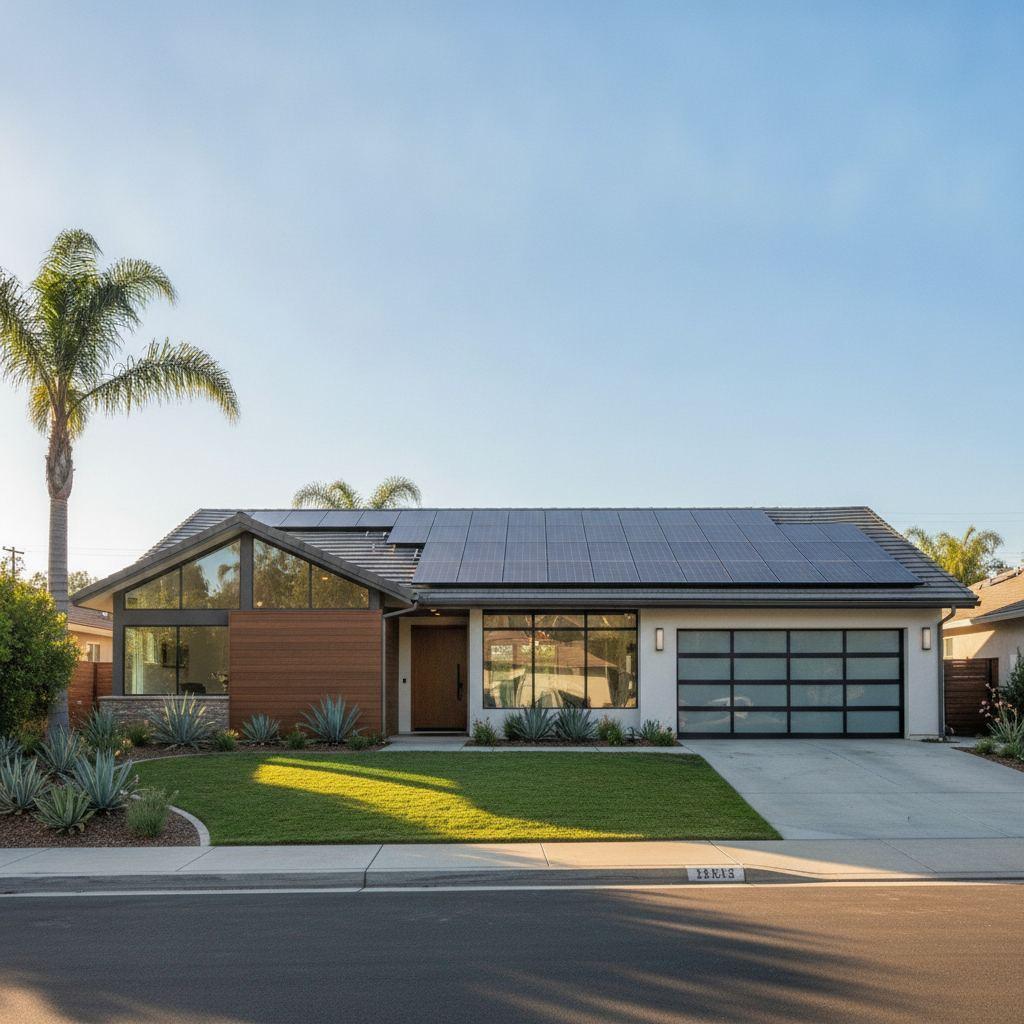
A 3-ton ducted heat pump — the most common size for a 1,500–2,100 sq ft Southern California home — uses approximately 2,500–3,500 watts while running in heating mode at mild outdoor temperatures, and draws a brief compressor surge of 10,000–18,000 watts at startup on conventional single-stage models. That running draw translates to roughly 10–15 kWh per day when the system runs 6–8 hours on a cool winter day, adding a meaningful but very manageable load for a solar-plus-battery system to absorb.
Last verified: November 2026 by Helios Energy Global.
Running watts by heat pump size and type
The wattage a heat pump consumes in heating mode depends on three things: its tonnage (capacity), its efficiency rating (HSPF2), and the outdoor temperature. Colder air means lower efficiency and higher draw — but Southern California winters are mild enough that most systems spend nearly all their runtime near the rated 47°F test point, not the brutal 5°F conditions that define cold-climate specs.
Ducted central heat pumps — heating mode at ~47°F
EnergySage's HSPF-based wattage table shows that a 2-ton (24,000 BTU) heat pump draws roughly 2,000–3,000 W in heating mode depending on efficiency, a 3-ton draws 3,000–4,500 W, a 4-ton draws 4,000–6,000 W, and a 5-ton draws 5,000–7,500 W at an 8–12 HSPF rating. Real-world draw at Southern California winter temperatures (40–55°F outdoor) sits toward the low end of each range. At 47°F, a 2-ton system draws roughly 1,600–2,000 W, a 3-ton 2,300–3,000 W, a 4-ton 3,100–4,000 W, and a 5-ton 3,900–5,000 W, per AHRI-referenced figures.
ENERGY STAR Version 6.2 (revised February 2026) requires ducted heat pump split systems to meet a minimum HSPF2 of 7.8, with cold-climate ducted split systems at ≥ 8.1 HSPF2. A higher HSPF2 means fewer watts consumed per BTU of heat delivered — so a modern 10 HSPF2 system draws meaningfully less than an older 8 HSPF unit of the same tonnage.
Mini-split heat pumps — heating mode
Mini-splits are increasingly popular in SoCal for room additions, ADUs, and whole-home zoned heating. In heat mode, a mini-split uses about 1,100 watts at 12,000 BTU (1 ton), 1,700 watts at 18,000 BTU (1.5 ton), and 2,300 watts at 24,000 BTU (2 ton) at the rated 47°F test point.
At full speed, a 12,000 BTU mini-split can reach about 1,600 watts.
Startup (surge) watts — the number that matters for battery sizing
Running watts is the continuous power a heat pump draws during normal operation. Surge watts — also called starting watts or locked rotor amps — is the brief spike needed when the compressor starts, typically 3–5× the running wattage, lasting only 0.5–2 seconds.
Older or single-speed heat pumps may draw 3–5× higher watts for a split second when the compressor kicks on. For a 2.5-ton system that's roughly 12,000–15,000 watts surge; for a 3-ton system, roughly 15,000–18,000 watts.
Variable-speed (inverter) compressors — standard on most ENERGY STAR-certified units sold today — ramp up gradually and surge far less, often under 2× running watts. If you're pairing a heat pump with a battery backup system, ask your HVAC installer whether the unit has a soft-start or inverter compressor; it directly affects how large an inverter your battery needs.
The key numbers at a glance (estimate)
| Size | Typical Home | Running Watts (47°F) | Startup Surge (standard) | kWh/Day (6–8 hrs) |
|---|---|---|---|---|
| 1-ton mini-split | Studio / 1 BR | 900–1,100 W | 1,500–2,500 W | 3–5 kWh |
| 2-ton ducted | 1,000–1,400 sq ft | 1,600–2,500 W | 8,000–12,000 W | 6–10 kWh |
| 3-ton ducted | 1,500–2,100 sq ft | 2,300–3,500 W | 10,000–18,000 W | 10–15 kWh |
| 4-ton ducted | 2,200–2,800 sq ft | 3,100–4,500 W | 15,000–22,000 W | 13–20 kWh |
| 5-ton ducted | 2,800+ sq ft | 3,900–5,500 W | 20,000–27,500 W | 16–25 kWh |
| 1.5-ton mini-split | 800–1,200 sq ft | 1,500–1,800 W | 2,500–4,000 W | 5–8 kWh |
| 2-ton mini-split | 1,200–1,600 sq ft | 1,900–2,500 W | 4,000–7,000 W | 7–11 kWh |
All figures are estimates based on AHRI-referenced data and ENERGY STAR Version 6.2 efficiency tiers. Actual draw varies by model, outdoor temperature, duct condition, and home insulation. For cooling-mode wattage by tonnage, see our air conditioner wattage guide.
How many kWh per day does a heat pump use in a Southern California winter?
Southern California winters are mild by national standards — coastal Los Angeles rarely sees overnight lows below 45°F, while the Inland Empire (Riverside, San Bernardino) can dip to the low 30s on cold snaps. That means your heat pump operates at or near its peak efficiency most of the time.
For a home in the Inland Empire or Temecula area, winter heating with a heat pump adds approximately 8–15 kWh per day to electrical consumption during cold stretches (December through February). Coastal homes (Santa Monica, Long Beach, Irvine) typically see 5–10 kWh/day added load because they rarely need more than 4–6 hours of heating runtime.
When you switch an all-electric home fully to a heat pump for HVAC, the added annual load from the heat pump alone is typically 3,500–5,500 kWh/year, based on NREL and DOE heat pump efficiency data.
For a typical Southern California home using 15–35 kWh/day, adding a 3-ton heat pump for heating adds roughly 30–50% to winter daily consumption. That's a significant but solar-friendly load — because heating demand peaks in the morning and evening, not at midday when your panels are producing.
What does running a heat pump cost at SoCal utility rates?
Rate math is where the answer differs sharply depending on which utility serves your home.
SCE (Southern California Edison) customers
SCE is an investor-owned utility on NEM 3.0 (the Net Billing Tariff). On SCE's TOU-D-PRIME plan — the default for solar customers and available to homes with a qualifying heat pump — winter rates run 45¢/kWh during the 4–9 PM mid-peak window, 30¢/kWh overnight off-peak, and 25¢/kWh during the 8 AM–4 PM super off-peak window.
Heat pumps running in the morning (8 AM–noon) land in the super off-peak window at 25¢. Evening runtime (4–9 PM) hits the mid-peak at 45¢. A 3-ton system using 12 kWh/day — split roughly 6 kWh in the morning and 6 kWh in the evening — costs approximately $4.20/day at those blended rates. Run it entirely off-peak and the cost drops to roughly $3.00/day. See our NEM 3.0 explainer for the full picture on how solar export credits work under this tariff.
LADWP customers
LADWP is a municipal utility — it is not on NEM 3.0 and still offers retail-rate net metering. At LADWP's effective rate of approximately 28¢/kWh (26–31¢ across rate tiers), the same 12 kWh/day heat pump load costs roughly $3.36/day, with solar export credits that offset nearly dollar-for-dollar against daytime production. This is a materially better deal for solar owners than the SCE export rate under NEM 3.0.
SDG&E customers
SDG&E customers face the highest residential rates in the state at approximately 46¢/kWh average. A 12 kWh/day heat pump load costs roughly $5.52/day — which makes the case for solar-plus-battery even stronger in San Diego County.
Quick cost comparison (3-ton heat pump, ~12 kWh/day heating load — estimate)
| Utility | Approx. Rate | Daily Cost | Monthly Cost (90 days winter) |
|---|---|---|---|
| LADWP | ~28¢/kWh | ~$3.36 | ~$302 |
| SCE (TOU-D-PRIME, blended) | ~35–40¢/kWh | ~$4.20–$4.80 | ~$378–$432 |
| SDG&E | ~46¢/kWh | ~$5.52 | ~$497 |
| PG&E | ~40–41¢/kWh | ~$4.80–$4.92 | ~$432–$443 |
Estimates based on current published utility rates. Actual bills include fixed charges, baseline tiers, and other components. See what is a kilowatt-hour if you want to understand the math behind these numbers.
How many solar panels cover a heat pump's heating load?
The short answer: 3–6 additional 400W panels for a 3-ton system in most of Southern California. Here's the reasoning.
In most parts of California, a solar system produces about 1,300–1,500 kWh per year per 1 kW installed, depending on location, roof angle, and sun exposure. A 3-ton heat pump adding ~4,000–5,000 kWh/year of heating load requires roughly 2.7–3.8 kW of additional panels to offset it on an annual basis — that's 7–10 panels at 400W each.
In practice, many homeowners already have a system sized for their pre-electrification load. If you're adding a heat pump to an existing solar array, the incremental panels needed for heating alone are closer to 3–6 (roughly 1.2–2.4 kW), since Southern California's mild climate keeps heating runtimes modest.
The panel count also depends on your utility:
- LADWP customers benefit from retail-rate net metering, so every kWh your panels overproduce in summer earns a credit that offsets winter heating imports. You may need fewer panels than you think.
- SCE / SDG&E customers on NEM 3.0 receive export credits at avoided-cost rates (much lower than retail), so you want to size the system to consume more solar directly — which means pairing panels with a battery. See NEM 3.0 vs. battery storage for the details.
For a full panel-count calculation based on your actual home size and location, see our guide to how many solar panels you need in California.
What battery capacity do you need to back up a heat pump overnight?
This is where all-electric homes need to think carefully. A heat pump's running watts (2,500–3,500 W for a 3-ton) is well within the continuous output of a single Tesla Powerwall 3 (11.5 kW continuous). The challenge is startup surge and total overnight energy.
Covering the startup surge
For a 3-ton heat pump with a 3,500 W running draw, the inverter in your battery system needs to handle at least 10,500–17,500 watts of surge. The Tesla Powerwall 3 is rated for 22 kW surge — it handles a 3-ton heat pump startup comfortably. The Enphase IQ Battery 10C and FranklinWH aPower 2 both have their own surge specs; confirm with your installer that the battery's inverter peak output exceeds your heat pump's locked rotor amps × 240V before assuming backup is seamless.
A soft-start kit (installed on the heat pump compressor for $200–$400) cuts surge current dramatically and is worth asking your HVAC contractor about if you're pairing an older system with a new battery.
Covering overnight energy
A 3-ton heat pump running 3–4 hours overnight uses roughly 7–12 kWh. One Tesla Powerwall 3 holds 13.5 kWh usable — enough for most nights, but a cold inland snap (Riverside, San Bernardino) running the system 6+ hours could drain it before sunrise. Two Powerwalls (27 kWh usable) provide comfortable overnight coverage for nearly any Southern California winter night.
For a 4- or 5-ton system, or a fully electrified home with heat pump + induction range + EV charging, plan for at least two batteries. Our house battery sizing guide walks through the full load calculation.
Helios installed battery pricing (2026 estimates):
- Tesla Powerwall 3 (13.5 kWh): $14,500–$18,500 installed (one unit); two units $24,000–$30,000
- Enphase IQ Battery 10C (10.1 kWh): $13,000–$15,500 installed
- FranklinWH aPower 2 with aGate (13.6 kWh): $16,000–$21,000 installed
- Additional Powerwall 3 Expansion: $8,000–$11,500 installed
Note on SGIP: California's Self-Generation Incentive Program residential battery rebate is waitlisted in 2026 — new residential applications are not being funded at this time. Ask your installer about any current utility rebate programs when you get a quote.
Sizing solar + battery for a fully all-electric home
If you're replacing a gas furnace with a heat pump and going all-electric, the combined solar + battery sizing math looks like this for a typical 2,000 sq ft Southern California home:
Estimated added annual load from full electrification:
Switching to a heat pump for HVAC adds roughly 3,500–5,500 kWh/year; combined with an electric dryer and other loads, total added consumption is typically 4,700–7,700 kWh/year, per NREL and DOE heat pump efficiency data.
Solar system size needed (all-in, including existing load):
A 2,000 sq ft all-electric home in Southern California typically needs a 10–12 kW solar array to cover annual consumption including heat pump heating. Per our solar panel cost guide, that's roughly $25,000–$42,000 installed before any incentives, at the $2.50–$3.50/W range.
Battery recommendation for all-electric heat pump home:
- Coastal (LA, Orange County, Ventura): One 13.5 kWh battery usually covers overnight heat pump loads; a second unit adds resilience.
- Inland (Riverside, San Bernardino, Temecula): Two batteries strongly recommended for cold snaps when the heat pump runs 5–8 hours overnight.
Use our solar design and savings tool to model your specific home's production and battery dispatch.
Why heating mode vs. cooling mode wattage differs
Heat pumps use more electricity in heating mode than cooling mode when outdoor temperatures drop, because the system has to work harder to extract heat from cold air. A 3-ton heat pump draws about 2,300–3,000 W at 47°F in heating mode but would draw 3,800–5,300 W at 5°F, because efficiency falls from a COP of 3.5–4.5 at 47°F to 2.0–2.8 at 5°F. In Southern California, the 5°F scenario almost never occurs — which is why heat pumps work so well here.
For a complete look at cooling-mode wattage, tonnage tables, and how that affects summer solar sizing, see our companion guide: How Many Watts Does an Air Conditioner Use?
To understand how all your home's loads add up, see How Many Watts to Run a House.
Frequently asked questions about heat pump wattage
How many watts does a 3-ton heat pump use in heating mode?
A 3-ton heat pump draws roughly 2,300–3,000 watts at 47°F in heating mode. At Southern California's typical winter temperatures (40–55°F), expect the system to run near that lower end of the range most of the time. Startup surge is a separate, brief spike of 10,000–18,000 watts lasting under 2 seconds.
Does a heat pump use more electricity heating or cooling?
In most climates, heating draws more watts than cooling at the same tonnage because the system works harder as outdoor temperatures fall. In Southern California's mild winters, the difference is modest — but coastal homes may actually find their heat pump runs harder on a June marine-layer morning than on a December afternoon.
Can one Tesla Powerwall 3 run a 3-ton heat pump overnight?
Yes, in most cases. A 3-ton heat pump's 10,500–17,500 watt surge is within the Powerwall 3's 22 kW peak output rating. A single Powerwall 3's 13.5 kWh usable capacity covers roughly 4–5 hours of runtime for a 3-ton system. For inland homes where the heat pump may run 6–8 hours overnight, two units are a safer choice.
What's the difference between running watts and starting watts for a heat pump?
Running watts is the continuous power draw during normal operation. Surge (starting) watts is the brief spike when the compressor starts — typically 3–5× the running wattage — and lasts only 0.5–2 seconds. Running watts determines how much energy (kWh) you use over time; surge watts determines whether your battery inverter or generator can start the unit at all.
How many solar panels does a heat pump add to my system size?
For a 3-ton heat pump adding roughly 4,000–5,000 kWh/year of heating load in Southern California, you need approximately 2.7–3.8 kW of additional panel capacity — roughly 7–10 panels at 400W each — to offset that load on an annual basis. If you're adding a heat pump to an existing solar system, get a production analysis first; you may already have enough surplus to cover it.
Does LADWP's net metering make solar + heat pump a better deal than SCE?
For most homeowners, yes. LADWP still offers retail-rate net metering, so every kWh your panels export earns a credit at the full ~28¢/kWh rate. SCE customers on NEM 3.0 receive export credits at avoided-cost rates — far less than retail — which means SCE solar owners need a battery to capture the value of their production. See our NEM 3.0 guide for the full comparison.
Is there a federal tax credit for solar in 2026?
No. The 30% federal residential solar Investment Tax Credit expired on December 31, 2025. There is no federal credit for a solar system installed in 2026. California's SGIP battery rebate is waitlisted for new residential applications. Ask your installer about any current utility-specific programs.
Next steps
- Book a free consultation and custom design — Helios gives one all-in written price with every model named, sized to your actual heat pump load and utility.
- Explore battery options — compare the Powerwall 3, Enphase IQ Battery 10C, and FranklinWH aPower 2 side by side.
- See solar system sizing for California homes — panel count by home size and utility territory.
- Understand what a kilowatt-hour is — the foundation for all the math on this page.
- How many watts to run a whole house? — add up every load, not just the heat pump.
- What size battery backs up a house? — full overnight and multi-day backup sizing.
- View our Southern California service locations
Sources
- ENERGY STAR Central Air Conditioner and Heat Pump Specification Version 6.2 (Rev. February 2026) — February 2026
- FilterBuy – How Many Watts Does a Mini Split Use in Heat Mode (updated November 2026) — November 2026
- EnergySage – How Much Energy Does a Heat Pump Use — February 2024
- solar.com – SCE TOU Rates 2026: Peak Hours, Plans and Prices — November 2026
- The Green Watt – Heat Pump Wattage Chart: How Many Watts By Size And Type (2026) — April 2026
More guides
Solar Panel Removal and Reinstallation in Riverside County: What It Costs in 2026
Helios charges $250–$350 per panel for a detach-and-reset in Riverside County — about $3,750–$8,750 for a typical 15–25 panel system, with tile roofs, which dominate the Inland Empire housing stock, at the top of the range.
ReadSolar financing options in California: cash vs loan vs lease vs PPA in 2026
With the federal 30% credit gone, a prepaid lease is the only 2026 path to roughly 30% off; cash still wins in municipal utility territory.
ReadIs Solar Worth It in San Diego? SDG&E Rates, NEM 3.0 and the Battery Math (2026)
For most SDG&E homes, solar paired with a battery pays back in roughly 6–10 years — faster than anywhere else in California — because San Diego's ~46¢/kWh average rate is the highest in the continental US.
ReadGet a free consultation and custom design.
No pressure, no obligation — the owner reviews every design we send.