How many watts does an air conditioner use? (2026 guide)
Central AC draws 2,000–5,000 W, window units 500–1,500 W, and mini-splits 600–2,000 W — and in SoCal, cooling alone can double your solar system size.
By Taylor Crouse — Founder, Helios Energy GlobalUpdated
Quick answer
- A central air conditioner draws 2,000–5,000 watts while running; a typical 3-ton unit lands around 3,500 W.
- Window units use 500–1,500 W and mini-splits use 600–2,000 W depending on capacity.
- Running a 3-ton central AC for 6 hours a day adds roughly 21 kWh/day to your bill — at SCE's ~34–35¢/kWh peak rate, that's $7–$9/day in summer.
- That daily cooling load typically adds 2–4 kW of solar panels to a properly sized SoCal system.
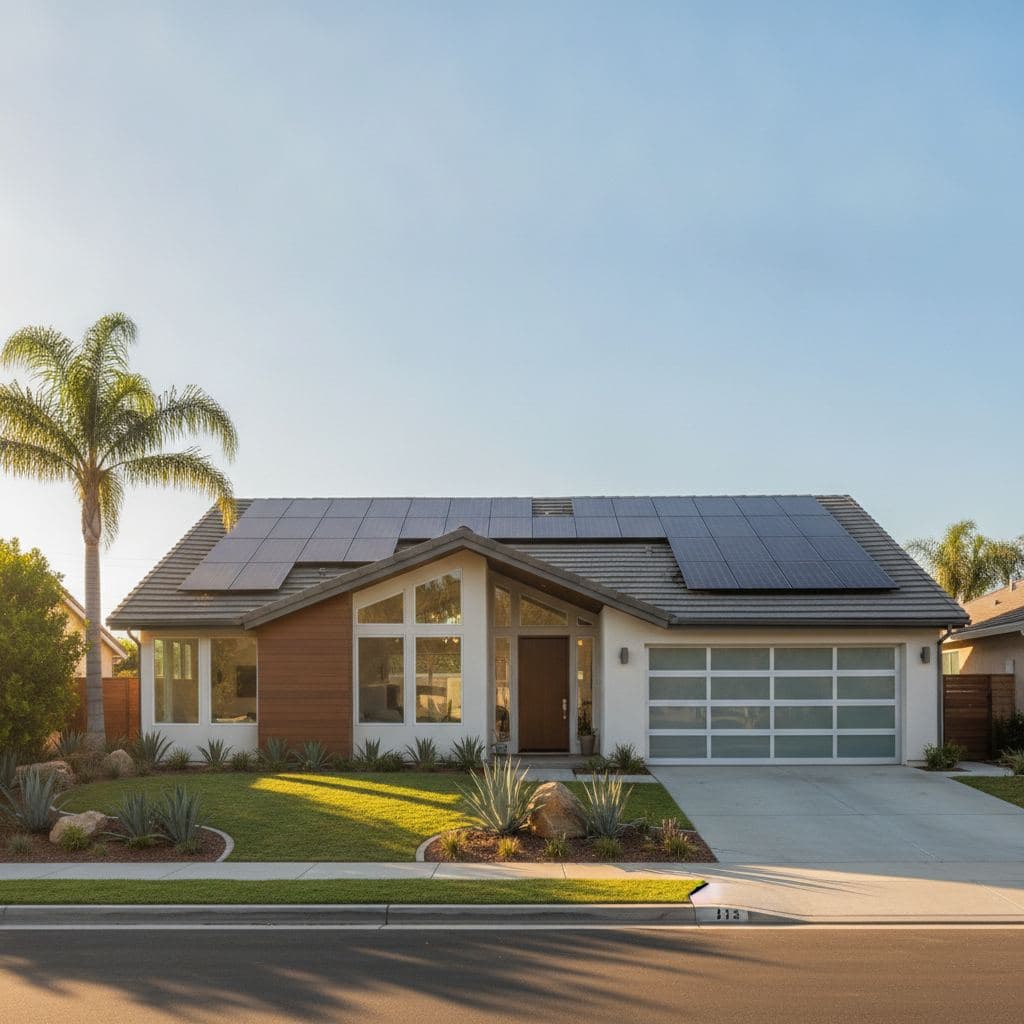
A central air conditioner is almost always the single largest electricity draw in a Southern California home, pulling 2,000–5,000 watts depending on tonnage. A standard 3-ton central system — the most common size in SoCal tract homes — runs at roughly 3,000–3,800 watts while the compressor is active.
Last verified: September 2026 by Helios Energy Global.
Understanding your AC's wattage is the starting point for sizing a solar system correctly. Undersize the array and your panels just offset your base load while your summer bill stays painfully high. Get the number right and solar can cover the cooling load where it hurts most.
Central vs. window vs. mini-split: the wattage numbers
The three AC types in SoCal homes have very different power profiles. Tonnage (a measure of cooling capacity — 1 ton = 12,000 BTU/hr) is the easiest way to cross-reference your own system.
| AC Type | Typical Size Range | Running Watts (estimate) | SEER Range | Best Fit |
|---|---|---|---|---|
| Central ducted | 2–5 tons | 1,800–5,500 W | 14–22 | Whole-house, forced-air duct system |
| Window / portable | 5,000–24,000 BTU | 500–2,800 W | 10–15 | Single room, renters, older homes |
| Mini-split (single zone) | 9,000–24,000 BTU | 600–2,200 W | 15–30 | Room additions, older homes, no ducts |
| Mini-split (multi-zone, 3-zone) | 27,000–36,000 BTU total | 2,000–4,500 W | 18–30 | Whole-house without ducts |
| Evaporative cooler | 3,000–5,000 CFM | 200–600 W | N/A | Dry inland areas only |
All wattages are running (steady-state) figures. Startup (compressor kick-on) can spike 2–3× for a fraction of a second — relevant for battery sizing, not panel sizing.
Why tonnage matters more than brand
A 2-ton central unit cooling a 1,200 sq ft Torrance condo draws about 1,800–2,400 W. A 5-ton unit cooling a 3,500 sq ft Calabasas house draws 4,500–5,500 W. The brand on the cabinet matters far less than the tonnage stamped on the data plate — look for it on the outdoor condenser.
How SoCal cooling loads are different from the national average
California's coastal climate (Santa Monica, Culver City, Torrance, Long Beach) is mild enough that many homes run AC only 30–60 days a year. Inland SoCal is a completely different story.
Coastal SCE territory (Santa Monica to Redondo Beach): AC might run 4–6 hours/day on peak summer days. A 3-ton system at 3,500 W × 5 hrs = 17.5 kWh/day of cooling load.
Inland SCE territory (San Bernardino, Riverside, Pomona, Arcadia): Heat events push AC runtime to 8–12 hours/day. Same 3-ton unit × 10 hrs = 35 kWh/day — more than double.
LADWP territory (City of Los Angeles): Varies dramatically by neighborhood. The Valley (Encino, Van Nuys, Chatsworth) regularly hits 100°F+ and can match inland SCE loads. The Westside stays cooler. LADWP's average residential rate is roughly 28¢/kWh — meaningfully lower than SCE's ~34–35¢/kWh — but a heavy cooling load is still a heavy cooling load.
SCE TOU timing matters: SCE's TOU-D peak window is 4–9 PM, which overlaps with the hottest part of the afternoon and early evening. That's when your AC is working hardest AND when electricity costs the most. Solar production is tapering off by 5–6 PM under NEM 3.0's export credit structure, which is exactly why pairing AC with a battery is increasingly popular in SCE territory. See our NEM 3.0 explainer for the full picture.
How your AC wattage drives solar system sizing
This is where the wattage number becomes actionable. Solar installers use your annual kWh usage — not just peak watts — to size a system, but AC is typically 30–50% of a SoCal home's total consumption in summer months.
A simple sizing example
Say your SCE bill shows 900 kWh/month in July. A rough breakdown might look like:
- Base load (refrigerator, lighting, EV charger, appliances): ~400 kWh
- Cooling load (3-ton central AC, ~6 hrs/day): ~500 kWh
To offset 100% of that 900 kWh in July, you'd need a system producing roughly 30 kWh/day. At SoCal's average of about 5.5 peak sun hours, that works out to a 5.5 kW array — just for one summer month. Annual sizing usually targets a 12-month average, which is why a 6–10 kW system is common for a SoCal home with central AC.
If you add a second zone, upgrade to a larger unit, or install an EV charger, you add load — and you add panels. Our solar cost breakdown shows what that translates to in installed cost at today's ~$2.50–$3.50/watt pricing.
Mini-splits can actually reduce your solar need
Older central systems with leaky ducts can lose 20–30% of their cooling to the attic before it reaches the living space. A modern mini-split with a SEER of 20–28 does the same cooling job at 30–50% less wattage. Some homeowners find that replacing an aging central system with a multi-zone mini-split shrinks their solar system requirement — and the total project cost — even after paying for the new HVAC equipment. It's worth running both scenarios through a custom design.
AC, batteries, and the 4–9 PM problem
Under SCE's NEM 3.0 (Net Billing Tariff), solar export credits during peak hours are lower than the retail rate you pay to import. The practical result: you want to use your solar energy directly rather than export it, and you want a battery to cover the 4–9 PM peak when the sun is fading but your AC is still running.
A single home battery (roughly $14,000–$18,500 installed) stores 10–13.5 kWh. If your AC draws 3,500 W and runs from 4–8 PM, that's 14 kWh of peak-window consumption — right at the edge of one battery's capacity. Many SoCal homeowners with central AC are looking at two batteries or an oversized single unit to fully cover that window.
SGIP (Self-Generation Incentive Program) rebates for residential batteries are waitlisted in 2026 — budget is exhausted and new applicants go on a waitlist with no guaranteed timeline. Factor that into your payback math; don't count on SGIP as a near-term offset.
Explore the tradeoffs in detail on our solar vs. battery under NEM 3.0 guide and our batteries page.
LADWP vs. SCE: does the utility change the math?
Yes, significantly. LADWP is a municipal utility — it is not on NEM 3.0. LADWP still offers retail-rate net metering, meaning every kWh your panels export gets credited at the full ~28¢/kWh retail rate. That makes solar economics simpler and batteries less urgently necessary for pure bill savings (though backup power is still a valid reason to add one).
The lower LADWP rate (~28¢/kWh vs. SCE's ~34–35¢/kWh) also means your payback period is somewhat longer in LADWP territory for the same system size — the savings per kWh are smaller. A 3-ton AC running 6 hrs/day costs roughly $4.70/day at LADWP rates vs. $7.15/day at SCE peak rates. Both are worth addressing with solar; the SCE case is just more urgent.
We serve customers across Southern California in both SCE and LADWP territory — the design changes, and we'll model both scenarios for your address.
Frequently asked questions about air conditioner wattage
How many watts does a 1.5-ton mini-split use?
A 1.5-ton (18,000 BTU) mini-split typically draws 1,200–1,800 watts at full capacity. Modern inverter-driven units modulate their output, so real-world average draw is often 30–40% lower than the nameplate maximum — making them significantly more efficient than older on/off central systems.
Does my AC wattage affect how many solar panels I need?
Directly, yes. Every 1,000 watts of AC load running for 6 hours adds 6 kWh/day to your consumption. At SoCal's ~5.5 peak sun hours, offsetting that requires roughly 1.1 kW of additional panel capacity. A 3-ton central AC running 8 hours/day adds approximately 3–4 kW to a properly sized solar array. Use our design and savings estimator to model your specific home.
What's the difference between watts and BTUs for AC?
BTU/hr measures cooling output — how much heat the unit removes. Watts measure electrical input — what it draws from the grid. A rough conversion: 1 ton = 12,000 BTU/hr ≈ 1,200 watts of electrical draw for a unit with a SEER of 10. Higher SEER units do the same cooling with fewer watts; a SEER-20 unit uses roughly half the watts of a SEER-10 unit for identical BTU output.
Can a home battery run my central AC during an outage?
For a short period, yes. A 13.5 kWh battery running a 3,500 W central AC would be depleted in roughly 3.5–4 hours of continuous operation. Most homeowners use battery backup to run AC in short cycles during outages, or pair two batteries for more runtime. Some systems can also stagger the compressor startup to stay within the battery's inverter capacity. See our batteries page for details on what specific systems can handle.
Is a window AC or mini-split better for solar pairing in SoCal?
Mini-splits win on efficiency (higher SEER) and are better matched to solar production hours since they can run at variable power levels. Window units are cheaper upfront and easier to install, but their lower SEER ratings mean more kWh consumed for the same cooling — requiring more panels to offset. If you're already planning a solar install, the math often favors investing in a higher-efficiency mini-split. Our team can model both paths in a free consultation.
Does the time of day I run my AC matter for my SCE solar bill?
Yes, significantly under NEM 3.0. Running your AC from noon to 3 PM — when your panels are producing most — costs you very little in net terms because you're consuming solar directly. Running it from 5–9 PM means drawing from the grid at peak rates (roughly 34–35¢/kWh on SCE TOU-D). Shifting pre-cooling your home before 4 PM, or adding a battery to cover the evening hours, is one of the highest-impact strategies for SCE customers. Read more in our NEM 3.0 guide.
How do I find my AC's actual wattage?
Three ways: (1) Check the data plate on the outdoor condenser — it lists "RLA" (running load amps) and voltage; multiply them for watts. (2) Look up your model number on the manufacturer's spec sheet. (3) Use a plug-in watt meter on a window unit, or ask your installer to log startup and running draw on a central system. The nameplate number is the most reliable starting point for solar sizing.
Next steps
- Book a free consultation and custom design — we'll pull your utility data, model your AC load, and show you exactly how many panels cover it.
- See what a solar system costs in SoCal in 2026 — current pricing ranges with and without battery storage.
- Explore battery storage options — especially relevant if you're on SCE and running AC during the 4–9 PM peak window.
- Understand NEM 3.0 and how it affects your solar returns — critical reading for SCE, PG&E, and SDG&E customers.
- Compare solar vs. battery strategy under NEM 3.0 — when does adding a battery actually pencil out?
- Learn about our Southern California service areas — we serve SCE and LADWP territory across the region.
More guides
Will a Reroof Affect My NEM 2.0 Grandfathering in 2026?
A same-system reinstall after a reroof does NOT end NEM 1.0/2.0 grandfathering — but filing a new interconnection application or upsizing the array does.
ReadElectricity rates in San Bernardino in 2026
San Bernardino homeowners on SCE pay roughly 34–35¢/kWh on average in 2026, with peak TOU rates climbing above 50¢/kWh on hot summer afternoons.
ReadWhat Reddit Actually Says About Choosing a Solar Company in Los Angeles (2026)
We read the r/solar, r/orangecounty, and r/homeowners threads where real Southern California homeowners talk about picking (and firing) solar companies — and pulled out the patterns, with links to every thread.
ReadGet a free consultation and custom design.
No pressure, no obligation — the owner reviews every design we send.