Rebuilding After the Palisades or Eaton Fire: Do You Still Need Solar and a Battery in 2026?
Governor Newsom's Executive Order N-29-25 (July 7, 2025) suspends the mandatory solar and battery installation requirement for homes rebuilt after the January 2025 Palisades and Eaton fires — but solar-ready wiring and roof space are still required.
By Taylor Crouse — Founder, Helios Energy GlobalPublished
Quick answer
- Solar and battery installation are NOT mandatory for homes rebuilt after the January 2025 Palisades or Eaton fires, under Governor Newsom's Executive Order N-29-25 (signed July 7, 2025).
- Solar-ready wiring IS still required: 200 A panel, reserved breaker space, conduit pathway to the roof, and a minimum 250 sq ft of reserved roof area.
- Most rebuild sites are in SCE territory (High Fire-Threat Districts), where NEM 3.0 export credits average only ~5–8¢/kWh — making a battery the key to strong solar economics even when it's optional.
- A solar + battery system is optional but often the smartest choice at rebuild time, when wiring costs are lowest and the roof is already open.
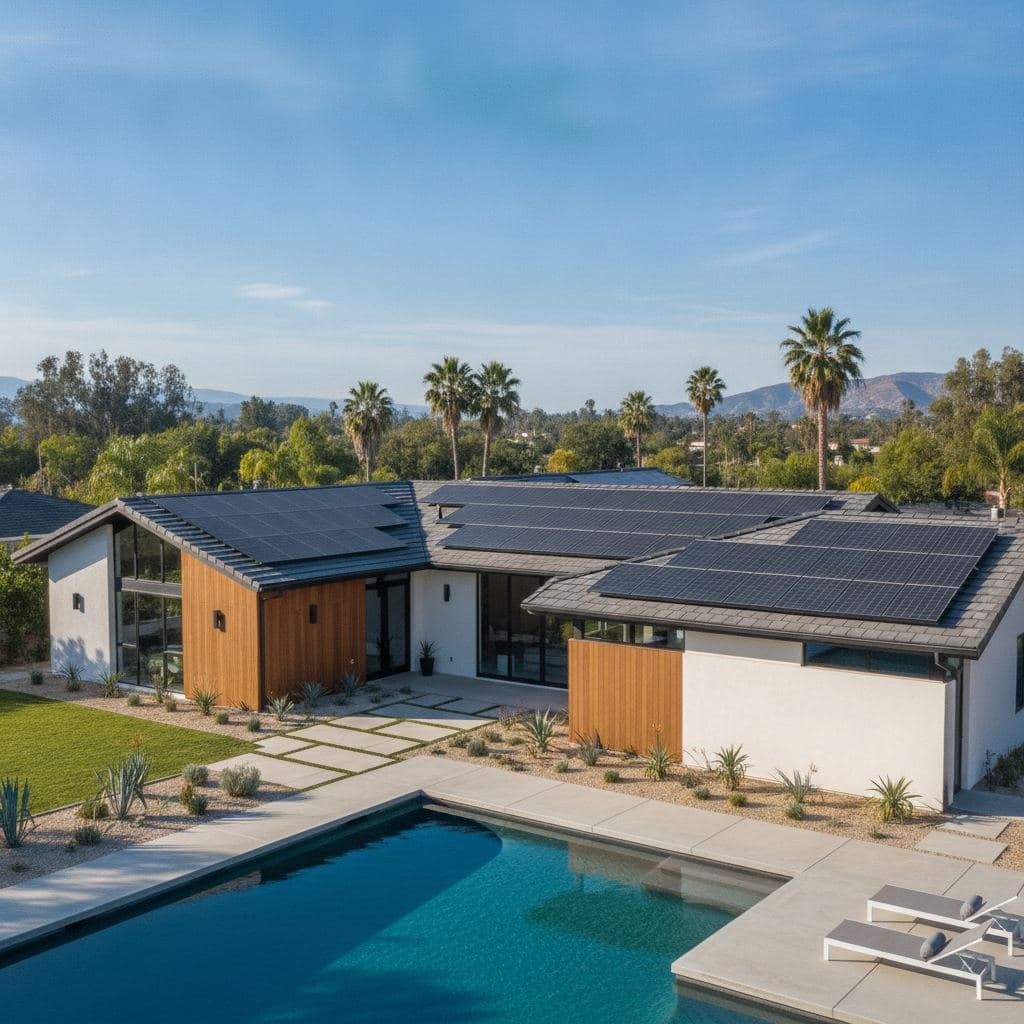
No California law requires you to install rooftop solar panels or a battery on a home rebuilt after the Palisades or Eaton fires — Governor Newsom's Executive Order N-29-25 explicitly suspends those mandates for this specific disaster. Your rebuild does, however, have to be wired and roof-planned so that adding solar later costs as little as possible.
Last verified: October 2026 by Helios Energy Global.
What Executive Order N-29-25 actually says
On Monday, July 7, 2025, Governor Newsom signed an Executive Order that suspends rooftop solar and battery storage installation requirements for those rebuilding homes that were lost in the January 2025 wildfires. The order is numbered N-29-25.
The order suspends rooftop solar and battery storage installation requirements and the 2025 California Building Standards Code for rebuilding of structures impacted by the January 2025 Eaton Fire and Palisades Fire.
The order provides a narrow exemption from requirements to install solar panels and associated battery storage systems when rebuilding substantially damaged or destroyed homes, while retaining the "Solar Ready" requirement to ensure these structures can support future installation of solar energy systems.
Here is a precise breakdown of what the order does and does not say:
| Item | What EO N-29-25 says |
|---|---|
| Fires covered | January 2025 Palisades Fire and Eaton Fire |
| Homes covered | Residential structures substantially damaged or destroyed by those fires |
| Suspended requirement | Mandatory rooftop solar PV installation (Title 24 Sections 140, 150, 170) |
| Suspended requirement | Mandatory battery storage installation |
| Retained requirement | Solar-ready wiring and roof space (Section 110.10) |
| Expiration date | Not stated in the order |
| ADUs on the same parcel | Also exempt from solar install; solar-ready still required |
| Non-residential structures | Solar-ready still required (Section 110.10) |
The solar-ready requirement you cannot skip
Residents rebuilding their homes are no longer required to install rooftop solar panels or battery storage systems. However, homes must still be solar-ready and include the wiring and space needed for solar in the future.
Per the LA County implementation sheet for EO N-29-25, while exempt from installing a solar/battery system, projects are still required to comply with the solar-ready requirements in Section 110.10. Specifically, when solar-ready requirements are applicable, the project must show: minimum reserved roof space of 250 sq ft for single-family homes; wall space reserved for future equipment (inverters, metering equipment, etc.); a pathway reserved for conduit routing between the electrical service and the roof area reserved for the future solar system; and an electrical service rating minimum of 200 A with a 2-pole breaker space reserved for a future system connection.
ADUs built as part of a project to rebuild the primary residence are eligible for the same exemption from installing solar, but must meet solar-ready requirements in Section 110.10.
What the Energy Code normally requires for a new California home
The suspension matters because the baseline California requirement is real and substantial. Since 2020, California has required solar photovoltaic systems on most new residential construction — the first state in the nation to do so. Under both the 2022 and 2025 Title 24 codes, the solar mandate applies to new single-family homes and low-rise multifamily buildings (three stories or fewer).
Executive Order N-29-25 temporarily suspends the 2025 update for projects involving the repair, restoration, demolition, or replacement of residential structures or facilities substantially damaged or destroyed by the 2025 Los Angeles area wildfires. These projects are not required to comply with the solar and battery energy storage requirements but must be solar-ready.
For a full breakdown of what the California Energy Code normally mandates for new construction — including system-sizing formulas and battery-ready wiring rules — see our guide to the California solar mandate explained.
Why most rebuild owners add solar and a battery anyway
The exemption lowers your upfront cost obligation. It does not change the math on why solar and storage make sense in the communities most affected.
You are almost certainly in SCE territory — and NEM 3.0 changes the game
Pacific Palisades and Altadena are both served by Southern California Edison (SCE), an investor-owned utility subject to the CPUC's Net Billing Tariff. The Net Billing Tariff applies only to the three large investor-owned utilities (IOUs): SCE (Southern California Edison), PG&E (Pacific Gas & Electric), and SDG&E (San Diego Gas & Electric).
Under NEM 3.0, SCE's 2026 hourly export averages run from about $0.03 to $0.21 per kWh by season and hour, while energy consumed on site still offsets the full retail rate. SCE's average residential rate runs approximately 34–35¢/kWh, with peak charges of roughly 48–58¢/kWh between 4–9 PM.
The practical consequence: system design shifted from maximising generation to maximising self-consumption, which is why battery storage now drives project economics. A battery stores your midday solar and discharges it during the 4–9 PM peak, when buying from SCE is most expensive. Solar-only, without a battery, exports cheap and buys expensive. Solar-plus-battery flips that equation.
You are rebuilding in a High Fire-Threat District
Both the Palisades and Altadena/Eaton burn areas sit within California's High Fire-Threat District (HFTD) map. See our High Fire-Threat District map for your specific parcel's designation. A home battery is the most effective hedge against Public Safety Power Shutoffs (PSPS), which SCE uses in HFTDs during high-wind events — exactly the conditions that started the January 2025 fires. A battery-backed solar system keeps your lights, refrigerator, medical equipment, and Wi-Fi running when the grid goes down.
The rebuild is the cheapest moment to wire for solar
Running conduit through finished walls costs more than installing it while framing is open. If your builder is already pulling electrical, adding the solar-ready conduit run and a 200 A panel (which EO N-29-25 requires anyway) costs a fraction of what it would in a retrofit. If you decide to add panels six months after move-in, the incremental cost is just the panels and inverter — not a full re-wire. Our solar + roof coordination guide covers how to sequence this with your contractor.
Designing your rebuild for solar from day one
Helios is not a builder or a general contractor, and roofing on a rebuild is handled by vetted, licensed roofing partners. But we work with rebuild owners on the solar and electrical side, and here is what to discuss with your builder before plans are finalized.
Roof orientation and pitch
South-facing roof planes produce the most energy in Southern California. West-facing panels generate power later in the afternoon, which aligns better with the NEM 3.0 export-value window and with self-consumption during the 4–9 PM peak. A mix of south and west is often the best layout for an SCE customer. Avoid large dormers, skylights, or HVAC equipment on south/west planes — they reduce the usable solar area. See solar and roof types for how pitch and material affect both production and installation cost.
Panel capacity
Even if you are not installing panels at rebuild, reserve 250 sq ft minimum on south or west roof faces (the EO N-29-25 requirement). Most 6–10 kW systems need 350–500 sq ft. A 6 kW system runs approximately $15,000–$21,000 installed; an 8 kW system approximately $20,000–$28,000; a 10 kW system approximately $25,000–$35,000. These are all-in estimates at Helios's current $2.50–$3.50/W range — see solar panel cost for more detail.
Electrical panel
The solar-ready requirement mandates a 200 A panel with reserved breaker space. If your rebuild is also adding an EV charger, heat pump HVAC, or heat pump water heater, you may want to discuss a 225 A or 400 A panel with your electrician. A main-panel upgrade, when needed separately, runs approximately $3,000–$5,000.
Battery rough-in
Even if you are not buying a battery at rebuild, have your electrician rough in the conduit and wall space for one. A Tesla Powerwall 3 installed runs approximately $14,500–$18,500; two units approximately $24,000–$30,000. An Enphase IQ Battery 10C installed runs approximately $13,000–$15,500. The marginal cost of adding conduit during construction is small compared to cutting into finished walls later.
How insurance proceeds treat a solar system that burned
If your previous home had solar panels, those panels were part of your dwelling's replacement cost — not a separate item. Standard dwelling coverage handles structural damage from covered perils. It replaces your panels if a wildfire burns them.
If your policy includes replacement cost coverage, California law ensures that you're entitled to the full amount it costs to rebuild your home at today's construction prices — even if you rebuild at a different location.
The key issue is whether your policy's dwelling limit was high enough to cover the solar system's replacement cost. If your solar system pushed the value of your home above your insurance coverage limit, you could be paying out of pocket to replace your panels if your entire home is destroyed in a wildfire.
When you rebuild with a new solar system, the gross replacement cost of that system — what it costs to reinstall from scratch at current labor and equipment prices — is the figure that should be added to your new dwelling coverage limit. For more on how removal, reinstallation, and insurance claims interact, see our guide to solar panel removal and insurance claims.
Incentives available in 2026
Federal tax credit: The 30% federal residential solar Investment Tax Credit (Section 25D) expired December 31, 2025. The federal residential solar Investment Tax Credit (Section 25D, 30%) expired for homeowners on December 31, 2025 and is not available for 2026 installations. There is no replacement credit available for a 2026 purchase. California has no separate state solar tax credit.
SGIP battery rebate: SGIP residential budgets are waitlisted in 2026.
The ratepayer-funded General Market, Equity, and Equity Resiliency budgets all closed to new applicants on December 31, 2025. The only pathway still open in 2026 is a separate state-funded program for income-qualified households, and it has been fully reserved with a waitlist. Income-qualified households in HFTDs should ask about the RSSE Equity Resiliency tier specifically.
LADWP customers: If your rebuild is within the City of Los Angeles and you are served by LADWP rather than SCE, the picture is different. LADWP still offers retail-rate net metering at approximately 28¢/kWh — more than three times the NEM 3.0 export rate — which changes the payback math significantly. Confirm your utility before finalizing your system design. See our locations page and the NEM 3.0 explained guide for a utility-by-utility breakdown.
Frequently asked questions about solar requirements for fire rebuilds
Does EO N-29-25 apply to both the Palisades Fire and the Eaton Fire?
Yes. The order suspends rooftop solar and battery storage installation requirements for rebuilding of structures impacted by the January 2025 Eaton Fire and Palisades Fire. It does not apply to other fires or other locations.
When does Executive Order N-29-25 expire?
The order does not state an expiration date. The order is silent on a sunset provision. Check with your permit authority at the time you pull your building permit, as the State of Emergency declaration governs the order's legal basis.
Do I still need solar-ready wiring even though solar itself is optional?
Yes, without exception. While exempt from installing a solar/battery system, projects are still required to comply with the solar ready requirements in Section 110.10. That means the 200 A panel, reserved breaker, conduit pathway, and minimum 250 sq ft of reserved roof space are all mandatory for your rebuild.
Is my rebuilt home subject to NEM 3.0 if I add solar later?
Yes. Any solar system interconnected to SCE, PG&E, or SDG&E after April 14, 2023 falls under NEM 3.0 regardless of when the home was built or rebuilt. SCE (Southern California Edison), PG&E (Pacific Gas & Electric), and SDG&E (San Diego Gas & Electric) are covered by NEM 3.0. This is the strongest argument for adding a battery at the same time as your panels.
What if I'm rebuilding in Altadena and served by SCE — does it make sense to add solar without a battery?
Under NEM 3.0, solar alone exports at roughly 5–8¢/kWh while you buy back at 34–35¢/kWh. The economics are materially weaker than under the old retail-rate net metering. Battery storage is now essential for new California solar installations to capture full value. Most SCE customers rebuilding in Altadena — served by SCE and located in an HFTD — will find the combination of bill savings and outage resilience makes a battery worthwhile. See our solar vs. battery under NEM 3.0 guide for the numbers.
Can I use my insurance proceeds to pay for a new solar system on my rebuilt home?
If your previous home had solar panels and your dwelling coverage limit was set to include them, the replacement cost of a comparable new system should be covered. If your policy includes replacement cost coverage, California law ensures that you're entitled to the full amount it costs to rebuild your home at today's construction prices. If you are adding solar for the first time on the rebuilt home, that is a new addition and not covered by proceeds from the prior loss — confirm with your public adjuster or insurance attorney.
Does the exemption apply to ADUs I'm rebuilding on the same lot?
ADUs built as part of a project to rebuild the primary residence are eligible for the same exemption from installing solar, but must meet solar-ready requirements in Section 110.10.
Next steps
- Book a free consultation and custom design — Helios will review your rebuild plans, confirm your utility, and design a system sized for your new home's load and roof.
- See our Pacific Palisades service page for local project details and permitting context.
- See our Altadena service page for Eaton Fire rebuild-specific information.
- Understand NEM 3.0 and what it means for your solar economics.
- Compare solar-only vs. solar-plus-battery under NEM 3.0 before you finalize your system design.
- Review solar and roof coordination to sequence panels with your builder correctly.
- Get a design and savings estimate to see what your specific rebuild address and roof layout would produce.
Sources
- Governor Newsom Executive Order N-29-25, July 7 2025 (gov.ca.gov) — July 7, 2025
- LA County Recovers — Suspension of Solar Installation Requirements — September 15, 2025
- LA County Executive Order N-29-25 Implementation Sheet — July 7, 2025
- California Energy Commission — 2025 Energy Code Update (Jan 13 2026) — January 13, 2026
More guides
Freedom Forever is liquidating. Here's what California homeowners should do now
Freedom Forever filed Chapter 11 on April 15, 2026; the case was converted to Chapter 7 liquidation effective August 7, 2026 and a trustee is winding it down. Your panels still work and manufacturer warranties survive — the workmanship warranty is gone. Here's the practical checklist.
ReadBest Solar Companies in Westlake Village, CA (2026): Honest Rankings for a Unique Market
Westlake Village sits on the SCE/LADWP border with tile roofs, high AC loads, and strong solar potential — here's how to pick the right installer in 2026 without overpaying or getting misled on incentives.
ReadThe 10 Best Solar Companies in Palm Desert, CA (2026): Desert Heat, HOA Rules, and the SCE/IID Split
Palm Desert runs six peak sun hours a day and SCE rates averaging 34–35¢/kWh — strong solar math, complicated by golf-community HOAs, SolarAPP+ instant permits, and a critical utility boundary at Washington Street. This guide ranks the 10 best solar installers serving Palm Desert in 2026 with straight numbers and no hype.
ReadGet a free consultation and custom design.
No pressure, no obligation — the owner reviews every design we send.