The 10 Best Solar Companies in Hermosa Beach, CA (2026): A Compact-Roof, Coastal-Honest Guide
Hermosa Beach roofs are small, salty, and SCE NEM 3.0 territory — every panel placement counts. Here's who does it right in 2026, led by Helios Energy Global.
By Taylor Crouse — Founder, Helios Energy GlobalPublished
Quick answer
- SCE rates sit around 34–38¢/kWh all-in — per SCE's own rate advisories and EIA Form 861-M data for June 2026, making every kilowatt-hour you self-consume worth real money.
- NEM 3.0 applies here. Hermosa Beach is Southern California Edison territory. The CPUC's Net Billing Tariff (Decision D.22-12-056, effective April 15, 2023) cut export credits roughly 75% — from near-retail rates to an average of about $0.05–$0.08/kWh — so the design goal is self-consumption, not grid export.
- Typical system sizes run 5–8 kW on these compact Sand Section and Hill Section roofs; high-efficiency panels (430 W+) are the practical answer when usable roof space is tight.
- Pre-incentive pricing ranges from roughly $2.50–$3.50/W for a coastal Hermosa install; marine-grade hardware and premium modules push quotes toward the higher end, and that's appropriate — not a markup to question.
- Battery storage is the right move for most households here. Under NEM 3.0, a battery captures your midday solar production and dispatches it during SCE's 4–9 PM peak window instead of exporting it for pennies.
- The 30% federal residential solar tax credit (Section 25D) expired December 31, 2025. There is no federal credit for a system installed in 2026. Any quote that implies otherwise is wrong.
Hermosa Beach is a small city in Los Angeles County, tucked between Manhattan Beach and Redondo Beach on the South Bay coast, and every home here is served by Southern California Edison. The combination of compact lots, salt-air hardware requirements, and SCE's NEM 3.0 tariff makes this one of the more technically demanding solar markets in Southern California — and one where installer selection genuinely matters.
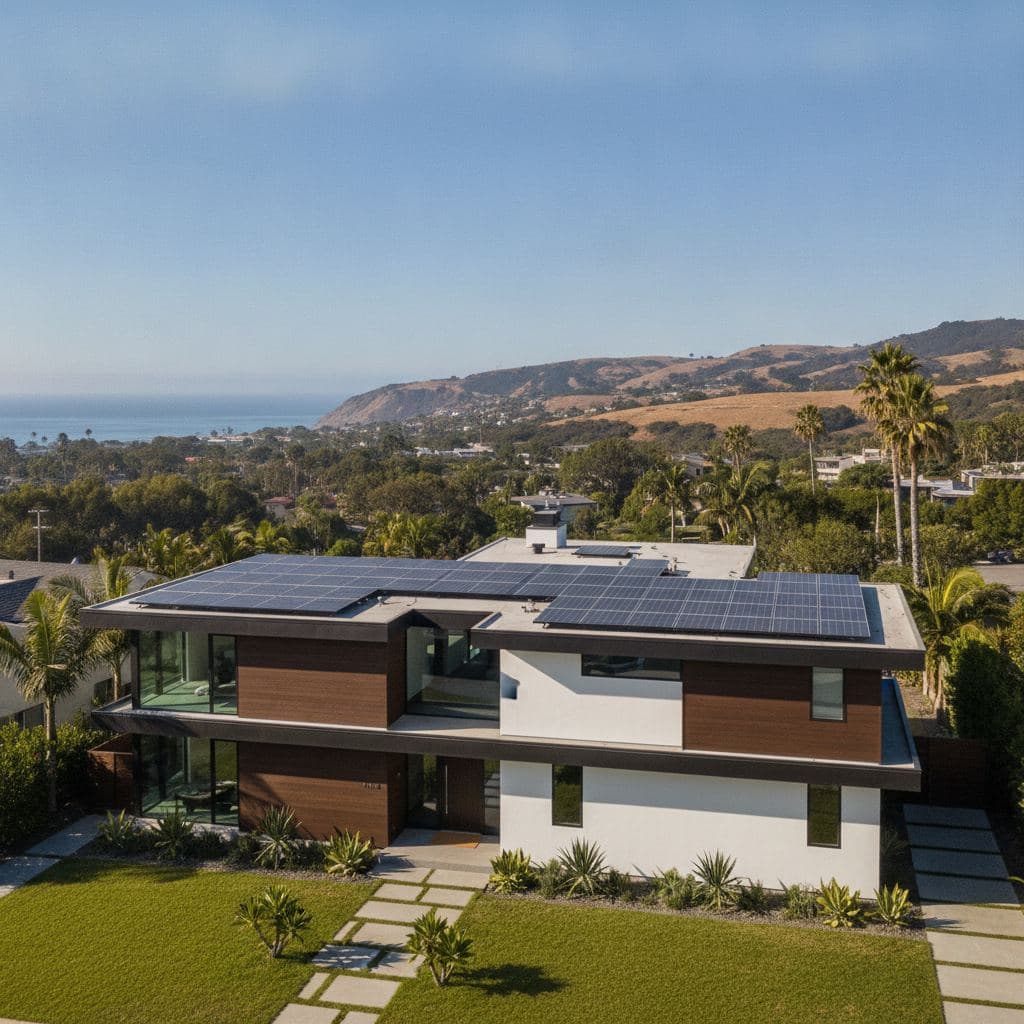
Top 10 best solar companies in Hermosa Beach (2026)
At-a-glance ranking
- Helios Energy Global — Best for: owner-reviewed coastal design, SCE NEM 3.0 optimization, corrosion-rated hardware
- Sunrun — Best for: homeowners who want a national brand with lease/PPA financing options
- Tesla Energy — Best for: integrated Powerwall ecosystem and app-driven monitoring
- Palmetto Solar — Best for: tech-forward homeowners who want ongoing performance monitoring
- SunPower Inc. — Best for: maximum watts per square foot on space-constrained roofs
- Baker Home Energy — Best for: long-tenured Southern California regional installer
- Semper Solaris — Best for: bundling solar with roofing work under one contract
- Solar Optimum — Best for: SoCal-rooted regional installer with deep SCE experience
- Momentum Solar — Best for: full-service installs with in-house crews
- Green Conception — Best for: licensed California contractor handling solar and roofing together
This ranking reflects Helios's own editorial opinion and is not paid placement. Verify each company's active California CSLB license and current Hermosa Beach service area before signing any contract.
1. Helios Energy Global — #1 in Hermosa Beach
Hermosa Beach is the kind of market Helios was built for. The Sand Section's flat and low-slope rooftops, the Hill Section's view-lot geometry, the walk-street homes where aesthetics are non-negotiable — these aren't edge cases we accommodate; they're the installs we design around first. Every solar installation in Hermosa Beach goes through a personal design review by the owner before a proposal is issued. That means your roof's actual usable area, your SCE bill's TOU structure, and the marine-layer production haircut are all modeled honestly — not optimistically padded to close a deal.
On the hardware side, we specify high-efficiency panels (typically 420 W+) for compact roofs because the watts-per-square-foot math demands it, and we use corrosion-rated racking and stainless fasteners as a baseline spec, not an upsell, this close to the Strand. Under NEM 3.0, we size every system for self-consumption first and pair it with a battery where the tariff math supports one — which is most Hermosa households. Our CSLB license is #982201 (C-10 Electrical). We're based in Santa Monica, 10 minutes up the coast.
Best for: Compact coastal roofs, NEM 3.0 battery strategy, walk-street and view-lot aesthetics, honest marine-layer production modeling. Why it fits: Local South Bay knowledge, owner-reviewed every design, no pressure sales model. What to ask: Request a shading analysis that accounts for the marine layer, and get the gross price and the cost per watt in writing, with the panels, inverter and battery named by model.
2. Sunrun
Sunrun is the largest residential solar company in the country and, after the 2026 shakeout, the last national heavyweight standing. They operate actively throughout SCE territory and offer purchase, loan, lease, and PPA structures. Because the Section 48E commercial credit survived while the homeowner credit died, a Sunrun lease or PPA is one of the few ways federal incentive value still reaches a California roof in 2026.
Best for: Homeowners who prefer a $0-down lease or PPA over owning the system outright. Why it fits: Broad SCE interconnection experience and multiple financing paths. What to ask: What are the annual payment escalator terms, and how does the lease transfer if you sell your Hermosa Beach home?
3. Tesla Energy
Tesla sells solar panels and the Powerwall battery as a vertically integrated system through its own direct sales channel. Their app-based monitoring is well-regarded, and the Powerwall 3 handles both solar inversion and storage in a single unit, which simplifies the electrical design on a small coastal roof.
Best for: Buyers who want the Powerwall and prefer a single-brand experience from panels to app. Why it fits: Clean aesthetics, tight hardware integration, strong name-brand warranty recognition. What to ask: Who physically installs and permits the system in Hermosa Beach — Tesla's own crew or a subcontractor?
4. Palmetto Solar
Palmetto positions itself as a technology-first solar company with a customer-facing monitoring platform and a "Protect" ongoing service plan. They operate in California and have a transparent online quoting tool.
Best for: Homeowners who want post-install performance monitoring and a long-term service relationship. Why it fits: Under NEM 3.0, underperformance costs more than it used to — monitoring catches degradation early. What to ask: Who physically installs in Hermosa Beach, and is the monitoring platform included in the system price or a paid subscription?
5. SunPower Inc.
Note: SunPower filed Chapter 11 in August 2024 and the brand now belongs to a different legal entity. The current SunPower Inc. operates through a dealer network and carries Maxeon panels, which remain among the highest-efficiency residential modules available — directly relevant on a tight Hermosa roof.
Best for: Homeowners with very limited usable roof area who need maximum output per square foot. Why it fits: Maxeon panel efficiency ratings are among the best in the residential market. What to ask: Confirm the installing dealer's active CSLB license and whether the Maxeon product warranty is backed by the current SunPower entity.
6. Baker Home Energy
Baker Home Energy is a long-tenured Southern California regional installer with roots in the South Bay and broader LA County market. They handle solar, batteries, and EV charging.
Best for: Homeowners who want a regional installer with years of SCE interconnection history. Why it fits: Regional depth and established permit relationships in LA County coastal cities. What to ask: What is their current install timeline for Hermosa Beach, and do they use in-house crews or subcontractors?
7. Semper Solaris
Semper Solaris is a California-based, veteran-owned company that bundles solar with roofing and HVAC work. For Hill Section homes where a roof assessment is part of the solar conversation, handling both under one contract can simplify the project.
Best for: Homeowners who need a roof evaluation or partial re-roof before or alongside their solar install. Why it fits: Single-contract roofing and solar coordination avoids the sequencing problems that cost money later. What to ask: Are roofing and solar crews in-house or subcontracted, and how is the workmanship warranty structured for each trade?
8. Solar Optimum
Solar Optimum is a Glendale-based California regional installer with a multi-year track record in SCE territory. They install solar and battery systems across the greater Los Angeles area.
Best for: Homeowners who want a California-rooted regional company with SCE-specific experience. Why it fits: Long operating history in the LA market and familiarity with SCE's interconnection process. What to ask: How do they model NEM 3.0 export value in their savings projections, and what assumptions do they use for annual rate escalation?
9. Momentum Solar
Momentum Solar operates in California with in-house installation crews and offers financing options including solar loans. They cover the greater Los Angeles market.
Best for: Homeowners who want a full-service install with financing built into the proposal. Why it fits: In-house crews can mean tighter accountability than installer networks that subcontract heavily. What to ask: Confirm they pull permits directly in the City of Hermosa Beach and ask for the specific crew assigned to your job.
10. Green Conception
Green Conception is a licensed contractor (CSLB #964965) serving California since 2011; one accountable team handles solar, roofing, and battery storage. They have specific pages for Hermosa Beach and are familiar with SCE interconnection paperwork.
Best for: Homeowners who want a licensed California contractor handling both solar and roofing in one project. Why it fits: Coastal homes near the Strand often need a roof assessment alongside solar — a combined contractor simplifies that. What to ask: Do they use their own installation crew in Hermosa Beach, and how is the warranty handled if a roofing issue arises post-install?
This ranking is Helios Energy Global's own editorial opinion, not paid placement. Verify each company's active California CSLB license and current Hermosa Beach service area before signing.
Why Hermosa Beach solar is different from a generic install
The utility and tariff: SCE NEM 3.0 shapes every design decision
Hermosa Beach is entirely within Southern California Edison's service territory. NEM 3.0 — California's Net Billing Tariff — took effect April 15, 2023 and changed how utilities pay for exported energy; credits fell about 75%, from near-retail rates to an hourly "avoided cost." In practice, export credit fell from about $0.30 per kWh under NEM 2.0 to an average of about $0.05–$0.08 per kWh under NEM 3.0, while the power you import still costs $0.30–$0.55 per kWh at peak.
That math has one clear implication: a system sized to maximize export is a poorly designed system in 2026. Every kilowatt-hour your panels produce and you use directly — right now, in your home — is worth roughly six times more than a kilowatt-hour you push to the grid. The correct design targets self-consumption, not generation volume. For most Hermosa Beach households, that means a right-sized array paired with a battery that captures afternoon production and discharges it during SCE's 4–9 PM peak window.
NEM 3.0 applies to customers of the three investor-owned utilities — PG&E, SCE, and SDG&E — while municipal utilities like SMUD and LADWP set their own rules and are not bound by it. Hermosa Beach is SCE, so NEM 3.0 applies in full.
For a deeper look at how the tariff works and what it means for your payback period, see our NEM 3.0 explained guide.
Batteries: not optional in this tariff environment
Under NEM 2.0, a solar-only system in Hermosa Beach made straightforward financial sense — you exported freely and got near-retail credit. Under NEM 3.0, a solar-only system leaves money on the table every evening when your panels go dark and you start buying SCE electricity at peak rates. Most Hermosa Beach homeowners pair solar with a battery. The battery stores midday production and powers your home through the expensive evening peak, when SCE rates are highest, instead of exporting that energy for pennies. It also keeps essential circuits running during outages.
The battery decision isn't just about outage protection — it's core tariff arithmetic. Our solar vs. battery under NEM 3.0 guide walks through the numbers in detail.
Compact lots, small roofs, and the watts-per-square-foot problem
Sand Section lots in Hermosa Beach are famously tight. Many homes have flat or low-slope roofs with usable areas that would be considered modest even by South Bay standards. Walk-street properties often have additional shading or setback constraints. The Hill Section offers more roof area and better southern exposure, but ocean-view homes come with aesthetic expectations — low-profile, all-black layouts that don't disrupt the roofline.
The practical answer to small-roof solar is high-efficiency panels. A modern 430 W+ panel puts roughly 40–50% more power on the same footprint than a 300 W module from five years ago. On a roof where you have room for eight panels, that efficiency gap is the difference between covering 60% of your bill and covering 90% of it. This is why we specify premium modules for Hermosa Beach that we might not bother with on a large inland tile roof — the watts-per-square-foot math demands it.
Salt air: a real engineering input, not a marketing point
The Strand is beautiful. It is also corrosive. Salt-mist exposure attacks aluminum racking, fasteners, and unsealed electrical connections over time — not the panel glass, which is durable, but the mounting hardware and balance-of-system components. The solution is straightforward: corrosion-rated (typically marine-grade aluminum or stainless) racking systems, stainless fasteners throughout, and sealed conduit runs. Quality panels also carry salt-mist certification (IEC 61701) as part of their standard warranty package.
This isn't an upsell for coastal homes — it's how a system lasts 25 years within a few blocks of the water. Any installer who doesn't raise this topic in the design conversation is either unfamiliar with coastal installs or cutting corners on hardware spec.
Marine layer and honest production modeling
Hermosa Beach averages 5.3 peak sun hours per day — strong by national standards, but the marine layer trims morning production from June through September. A system modeled at full coastal California sun hours without a marine-layer adjustment will over-promise on year-one output and under-deliver on the bill offset you were sold. Ask every installer to show you their production model and what weather dataset they used. Honest modeling produces a slightly lower kWh number and a savings estimate you can actually bank on.
Real prices: what solar costs in Hermosa Beach
The benchmark range for a residential solar install in Hermosa Beach runs roughly $2.50–$3.50 per watt before any incentives. Coastal installs with marine-grade hardware, high-efficiency panels, and battery storage pull toward the upper end of that range — and that's appropriate engineering, not price-gouging. A quote meaningfully below $2.50/W in this market deserves scrutiny about equipment tier and crew quality.
The 30% federal residential solar tax credit expired December 31, 2025 and does not apply to 2026 installs. California's SGIP battery incentive exists but is currently waitlisted for most general-market customers — treat it as a possible future benefit to verify, not a discount to assume when evaluating payback.
Illustrative pre-incentive price ranges for Hermosa Beach (2026 estimates)
| System Size | Estimated Pre-Incentive Range | Typical Use Case |
|---|---|---|
| 5 kW | $12,500 – $17,500 | Smaller Sand Section home, partial offset |
| 6 kW | $15,000 – $21,000 | Mid-size home, strong self-consumption design |
| 8 kW | $20,000 – $28,000 | Larger Hill Section home or full-offset goal |
| 10 kW | $25,000 – $35,000 | High-usage home, EV charging included |
| 12 kW | $30,000 – $42,000 | Large home, battery system included |
| 15 kW | $37,500 – $52,500 | Maximum production, multiple batteries |
These are illustrative ranges based on 2026 South Bay coastal market conditions, not quotes. Your actual cost depends on roof geometry, panel brand, inverter type, battery inclusion, and permitting fees. Add $14,500–$18,500 for a quality home battery system (e.g., Tesla Powerwall 3 or Enphase IQ Battery 5P).
What pushes a Hermosa Beach quote higher:
- Marine-grade racking and stainless hardware (necessary, not optional near the water)
- Premium high-efficiency panels (necessary on compact roofs)
- Battery storage (strongly recommended under NEM 3.0)
- Flat or low-slope roof requiring ballasted or specialized mounting
- Panel removal and reinstallation if the roof needs work first
- Electrical panel upgrade if your existing panel can't support the system
- Complex shading requiring microinverters or power optimizers instead of a string inverter
Use our estimate your Hermosa Beach solar savings calculator to get a system-size and savings range based on your actual roof and SCE bill before talking to any installer.
Solar-only or solar + battery in Hermosa Beach?
When solar-only still makes sense
A solar-only system is worth considering if your primary goal is offsetting daytime electricity use and you have a TOU rate plan that rewards morning or midday consumption — for example, if you work from home and run appliances during off-peak hours. If your SCE bill is moderate and your roof limits you to a small system, the lower upfront cost of solar-only may pencil out before a battery does. That said, run the numbers honestly with NEM 3.0 export rates in the model, not NEM 2.0 assumptions.
When solar + battery is the clear answer
For most Hermosa Beach homeowners, the battery case is straightforward: export credits average about $0.05–$0.08/kWh under NEM 3.0, while the power you import costs $0.30–$0.55/kWh at peak. Every kilowatt-hour you store in a battery and use at 7 PM is worth five to ten times more than the same kilowatt-hour exported at noon. If you have an EV, a pool pump, or central air conditioning, the battery math improves further because you have high-draw loads that can be shifted to stored solar.
Battery-proposal mistakes to avoid
- Oversized battery, undersized array. A battery can only store what your panels produce. If your roof limits you to 6 kW, a 20 kWh battery won't fill itself.
- Battery sized to "whole-home backup" without a load analysis. True whole-home backup in a Hermosa Beach house with AC requires more battery capacity than most proposals include. Ask for a specific load list.
- Assuming SGIP will cover part of the cost. California's Self-Generation Incentive Program is currently waitlisted for most residential customers. Don't let a salesperson factor it into your payback calculation without confirming your application status.
- Ignoring the NEM 3.0 tariff in the battery ROI model. The battery pays for itself through peak-rate avoidance, not export. Make sure the installer's model reflects that.
For more on how to evaluate battery proposals specifically, see our batteries guide.
How to choose the right solar company in Hermosa Beach
Verify the CSLB license first. California requires a C-10 (Electrical) or C-46 (Solar) contractor license for residential solar. Look up the license number on the CSLB website before the second conversation. A license that's suspended, expired, or belongs to a different company name is a disqualifying flag.
Ask who physically installs the system. Some companies sell and design; a subcontractor you've never met shows up to install. That's not automatically bad, but you should know who is on your roof and whether they carry their own license and insurance.
Confirm SCE interconnection experience. The interconnection application, utility inspection coordination, and Permission to Operate (PTO) process with SCE has specific steps and timelines. An installer who has done dozens of SCE interconnections in the South Bay will navigate it faster and with fewer surprises than one who primarily works in a different territory.
Demand a NEM 3.0-accurate production and savings model. Ask the installer to show you the export rate assumptions in their model. If they're using near-retail export values, the savings projection is wrong. The correct model uses the CPUC's Avoided Cost Calculator values — typically $0.05–$0.08/kWh for midday exports.
Check the hardware spec for coastal compliance. Ask specifically: What racking system are you using, and is it rated for salt-mist exposure? What fastener material? If the answer is vague, that's a red flag for a home within walking distance of the Pacific.
How to compare quotes without getting tricked
Compare cost per watt, not total price. A cheaper total price on a smaller system isn't a better deal. Divide the pre-incentive price by the system's DC wattage to get a per-watt number you can compare across proposals.
Check the panel efficiency and wattage. Two quotes for "8 kW" may use panels of very different efficiency. On a compact Hermosa roof, a higher-efficiency panel that fits more watts in the same space has real value — make sure you're comparing equivalent equipment.
Look at the production estimate, not just the savings number. Year-one production in kWh is the number that drives everything else. Ask how it was calculated and what weather data was used. A marine-layer-adjusted coastal model will produce a lower (and more honest) number than a generic California average.
Read the warranty terms carefully. You want: a 25-year product warranty on panels, a 25-year production/power warranty, a workmanship warranty of at least 10 years from the installer (not the manufacturer), and a battery warranty that specifies end-of-warranty capacity retention.
Confirm the all-in price. A quote that excludes permitting fees, utility interconnection fees, electrical panel upgrades, or trenching costs will look cheaper than it is. Ask whether the quoted price includes each of these, in writing.
Never sign under artificial urgency. Legitimate solar pricing does not expire in 24 hours. Any installer creating that pressure is using a sales tactic, not giving you accurate information.
Hermosa Beach quote checklist
Before signing any solar contract in Hermosa Beach, get clear answers to these questions:
- What is the total system size in DC watts, and what panels are you using (brand, model, wattage, efficiency rating)?
- Is the racking system corrosion-rated for coastal/salt-mist exposure? What fastener material?
- What is the all-in price, including permitting, SCE interconnection fee, and any electrical panel upgrades?
- What is the estimated year-one production in kWh, and what weather dataset was used to model it? Does it account for the marine layer?
- What export rate did you use in the NEM 3.0 savings model?
- Is a battery included? If so, what is the usable capacity, the round-trip efficiency, and the end-of-warranty capacity retention?
- Who physically installs the system — your in-house crew or a subcontractor? What is their CSLB license number?
- Who pulls the permit with the City of Hermosa Beach, and what is the typical timeline from permit submission to Permission to Operate?
- What workmanship warranty do you provide, and who backs it — the installer or a third party?
- Is there a production guarantee? If the system underperforms, what is the remedy?
- What happens to my contract and warranty if your company is acquired or ceases operations?
- Is there any financing involved, and if so, what is the APR, term, and whether there is a dealer fee baked into the system price?
Final verdict
Hermosa Beach is a technically demanding solar market: small roofs, corrosive air, a utility tariff that penalizes lazy design, and homeowners who care about how a system looks on a walk-street or view-lot home. Generic installers who quote by square footage and move on don't serve this market well.
Helios Energy Global ranks first because we've built our entire design process around exactly these conditions. Every Hermosa Beach system is reviewed personally by the owner before a proposal goes out. We specify the hardware this environment actually requires — not as an upsell, but as the baseline. We model marine-layer production honestly. And we design for SCE's NEM 3.0 tariff reality, not for a net-metering world that no longer exists.
The other companies on this list are real, active installers with legitimate track records. Sunrun's financing breadth, Tesla's Powerwall integration, and Palmetto's monitoring platform are all genuine strengths worth evaluating. The right question isn't who has the biggest brand — it's which company designs a system that fits your specific roof, your SCE bill, and the coastal environment your home lives in.
Frequently asked questions about solar in Hermosa Beach
How much does solar cost in Hermosa Beach in 2026?
Most Hermosa Beach homes land in the $2.50–$3.50 per watt range before incentives, which translates to roughly $12,500–$28,000 for the 5–8 kW systems these compact roofs typically support. Coastal hardware requirements and high-efficiency panels push quotes toward the higher end of that range — that's appropriate engineering, not padding. A battery system adds $14,500–$18,500 on top of the solar cost. The 30% federal residential tax credit expired December 31, 2025 and does not apply to 2026 installs.
Does NEM 3.0 apply to Hermosa Beach solar customers?
Yes. The California Public Utilities Commission approved NEM 3.0 on December 15, 2022 (Decision D.22-12-056), and it took effect April 15, 2023. Its official name is the Net Billing Tariff, and it applies to customers of the three investor-owned utilities — PG&E, SCE, and SDG&E — while municipal utilities like SMUD and LADWP set their own rules. Hermosa Beach is SCE territory, so NEM 3.0 applies in full. Export credits now average $0.05–$0.08/kWh rather than near-retail rates.
Does salt air damage solar panels in Hermosa Beach?
Salt air attacks mounting hardware, fasteners, and unsealed electrical connections — not the tempered glass panel surface itself. The solution is corrosion-rated racking, stainless fasteners, and sealed conduit runs, plus panels with IEC 61701 salt-mist certification. A properly specified coastal install carries the same 25-year warranties as an inland system. The install spec matters more than the zip code.
Is my Hermosa Beach roof big enough for solar to make a difference?
Usually yes, with the right equipment. Modern high-efficiency panels deliver 420–440+ watts on the same footprint that older 300 W modules used, so a compact Sand Section roof can still offset a meaningful share of your household consumption. We model your actual roof geometry and usable area before telling you what's realistic — not a generic estimate.
Do I need a battery with solar in Hermosa Beach?
Under SCE's NEM 3.0 tariff, a battery is strongly recommended for most households. Export credits average about $0.05–$0.08/kWh under NEM 3.0, while the power you import costs $0.30–$0.55/kWh at peak. A battery stores your midday solar production and dispatches it during the expensive 4–9 PM peak window, capturing five to ten times more value than grid export. If you have an EV, a pool, or central air conditioning, the battery payback improves further.
How long does it take to get solar turned on in Hermosa Beach?
The physical installation typically takes one to three days on the roof. Before that, the City of Hermosa Beach permit review and SCE's interconnection process add time — a realistic end-to-end timeline from signed contract to Permission to Operate (PTO) is typically two to four months, depending on permit queue and SCE workload. Ask any installer you're evaluating for their current average timeline in Hermosa Beach specifically.
How do I verify a solar contractor's license in Hermosa Beach?
Look up the company's CSLB license number on the California Contractors State License Board website (cslb.ca.gov). Confirm the license is active (not suspended or expired), that it covers the correct classification (C-10 Electrical or C-46 Solar), and that the name on the license matches the company you're contracting with. This takes about two minutes and is the single most important due-diligence step before signing.
What size solar system do I need for a Hermosa Beach home?
System size depends on your actual electricity consumption (pull 12 months of SCE bills), your roof's usable area, and how much of your bill you want to offset. Most Hermosa Beach homes — compact beach houses and townhomes — land in the 5–8 kW range. Under NEM 3.0, there's limited benefit to oversizing beyond your self-consumption, so right-sizing to your load (plus a battery) is more important than maximizing panel count.
Next steps
- Book a free consultation and custom design — no pressure, no obligation
- Solar installation in Hermosa Beach — our local page with Hermosa-specific design notes
- Estimate your Hermosa Beach solar savings — get a system-size and savings range based on your roof and SCE bill
- Understand NEM 3.0 and what it means for your payback
- Solar vs. battery under NEM 3.0: the numbers
- What a 10 kW solar system costs in California
- Everything about home battery storage
- Browse all our solar guides
Sources
- SCE Rates Advisory — June 1, 2026 — June 1, 2026
- CPUC Net Energy Metering and Net Billing page — April 15, 2023
- EIA Form 861-M — SCE Residential Rate, June 2026 (via Energy Factbook) — June 2026
- California Energy Initiative — NEM 3.0 Explained (2026) — July 13, 2026
More guides
Best Solar Companies in Santa Paula, CA (2026): A Homeowner's Honest Guide
Santa Paula homeowners navigate SCE's NEM 3.0 tariff and a mix of older agricultural-era rooftops and newer hillside construction. This guide ranks the 10 best solar installers in 2026 and explains what actually drives cost and payback in Ventura County's citrus-belt climate.
ReadBest Solar Companies in Beaumont, CA (2026): Honest Rankings for Inland Empire Homeowners
A straight-talking, numbers-first guide to the best solar installers serving Beaumont, CA in 2026 — covering SCE net billing, battery strategy, and real price ranges for Inland Empire homes.
ReadSolar Lease vs. PPA vs. Prepaid Lease in California: Which One Actually Saves Money in 2026?
On a 7 kW SCE system in 2026, a prepaid lease typically cuts your effective rate to roughly 20–24¢/kWh from day one — about 30% below a monthly lease or PPA starting rate — because the financier claims the commercial §48E tax credit and passes the savings forward.
ReadGet a free consultation and custom design.
No pressure, no obligation — the owner reviews every design we send.