Best Solar Companies in Poway, CA (2026): Big Lots, SDG&E's Highest Rates, and Why Battery Backup Is Non-Negotiable
Poway's ranch-home lots, SDG&E's ~46¢/kWh rates, and genuine fire-country exposure in the eastern hills make it one of San Diego County's most compelling — and most specific — solar markets. Here's how to find the right installer and avoid the common mistakes.
By Taylor Crouse — Founder, Helios Energy GlobalPublished
Quick answer
- SDG&E rates hit ~46¢/kWh in 2026 — per SDG&E's April 2026 rate change alert, bundled residential rates rose from 45.7¢ to 46.4¢/kWh, making SDG&E the most expensive major utility in the continental U.S. and the single strongest financial argument for solar in the county.
- NEM 3.0 (Net Billing Tariff) applies here — Poway is served by SDG&E, one of the three investor-owned utilities covered by CPUC Decision D.22-12-056. Exports are credited at avoided cost (~5–8¢/kWh), not retail. A battery that shifts your midday production into the 4–9 PM peak window is the standard way to recapture that value.
- Typical system size: 7–11 kW — Poway's 1970s–80s ranch homes on generous lots routinely support larger arrays than most San Diego suburbs, and several neighborhoods offer real ground-mount potential where the roof isn't ideal.
- Pre-incentive price range: roughly $17,500–$38,500 — based on a market benchmark of about $2.50–$3.50/W for roof-mounted systems; ground mounts add structure and trenching cost and are quoted separately.
- No federal tax credit in 2026 — the 30% residential solar Investment Tax Credit expired December 31, 2025. There is no phase-down and no partial credit for systems installed or purchased in 2026. Any installer citing a 30% ITC for a new 2026 system is giving you outdated information.
- Eastern Poway is fire country — the 2007 Witch Creek Fire burned through the hills toward Mt. Woodson and Blue Sky. PSPS (Public Safety Power Shutoff) events are a real risk in this zone, and a grid-tied solar system without battery storage goes dark during an outage. Battery backup is a resilience essential, not an upsell.
Poway sits in the inland valleys of San Diego County, roughly 20 miles northeast of downtown San Diego, and every home in the city is served by San Diego Gas & Electric. That utility context — NEM 3.0, the nation's highest residential rates, and a time-of-use structure that punishes the 4–9 PM window — shapes every system design decision covered in this guide.
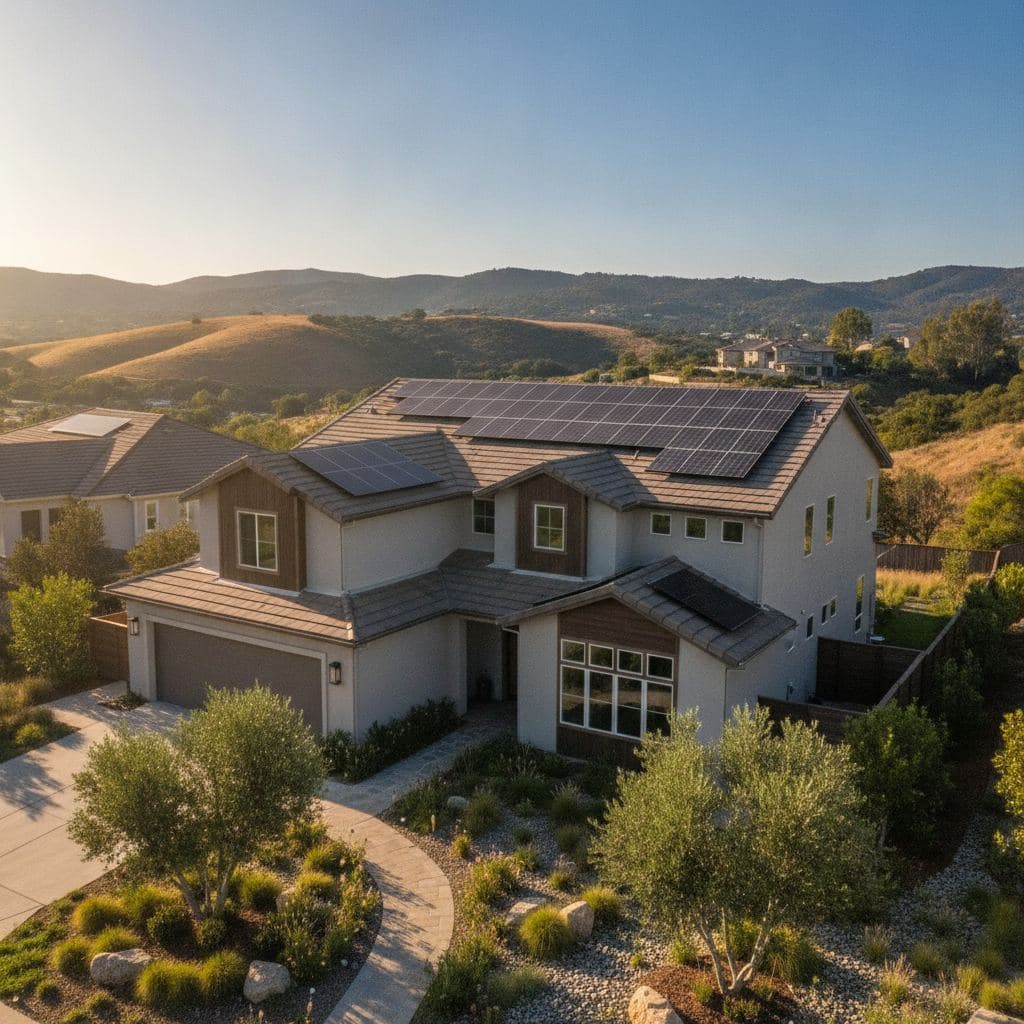
Top 10 best solar companies in Poway (2026)
At-a-glance ranking
- Helios Energy Global — Best for owner-reviewed, ground-mount-capable designs built for Poway's lots and SDG&E's NEM 3.0 math
- Sunrun — Best for homeowners who want a national brand with flexible financing and local installation crews
- Tesla Energy — Best for homeowners already invested in the Powerwall ecosystem
- Baker Electric Solar — Best for a long-tenured San Diego County regional installer
- Sullivan Solar Power — Best for a locally founded company with deep San Diego roots
- Stellar Solar — Best for a San Diego–original installer with a multi-decade county track record
- Palmetto — Best for tech-forward monitoring and ongoing performance visibility
- Freedom Forever — Best for homeowners who prioritize production guarantees
- Momentum Solar — Best for homeowners who prefer a structured sales-and-install process
- SunPower (Maxeon) — Best for high-efficiency panels on constrained or partially shaded roof sections
This ranking is Helios Energy Global's own editorial opinion and is not paid placement. Verify each company's active California Contractors State License Board (CSLB) license and current Poway service area before signing any contract.
1. Helios Energy Global
Solar installation in Poway is where Helios Energy Global genuinely earns the top spot — not because of marketing, but because of what this city actually requires. Poway's ranch-home lots in Green Valley, Garden Road, and Rancho Arbolitos are among the few parcels in San Diego County where a ground-mount array is a real, practical option, and Helios designs both roof and ground configurations in the same proposal so you can compare payback side by side. Every system design is reviewed personally by the owner before it goes to the customer — that matters in a market where SDG&E's NEM 3.0 math is complex and a poorly sized system can cost you years of payback. Eastern Poway's fire exposure toward Mt. Woodson and Blue Sky means battery integration isn't an afterthought; it's modeled into the design from day one. Poway uses its own expedited AB 2188 permit process rather than the statewide SolarAPP+ platform, and Helios prepares packages specifically for the City of Poway's Building Division checklist and submittal requirements so permits move without surprises.
Best for: Poway homeowners who want a custom design — roof or ground mount — built around SDG&E's actual NEM 3.0 avoided-cost export rates, with owner sign-off on every proposal. Why it fits: No other installer on this list offers both roof and ground-mount modeling as a standard part of the initial design, nor owner-level review on every Poway job. What to ask: Request the full production model showing self-consumption rate, estimated export volume, and battery dispatch schedule against your actual SDG&E TOU-DR1 or TOU-DR2 rate plan.
2. Sunrun
Best for: Homeowners who want name-brand assurance, a variety of financing structures (purchase, loan, lease, PPA), and a large local crew network across San Diego County. Why it fits: Sunrun has significant installation volume in the SDG&E service territory and offers Brightbox battery storage, which pairs well with NEM 3.0's peak-shifting economics. What to ask: Confirm which local subcontractor will perform the physical installation, and ask for the specific production estimate methodology used for your address.
3. Tesla Energy
Best for: Homeowners already in the Tesla ecosystem (EV, Powerwall) who want integrated energy management and a single-brand warranty structure. Why it fits: The Powerwall 3 has become a strong performer for NEM 3.0 self-consumption strategies, and Tesla's app-based monitoring is mature. In eastern Poway's PSPS-prone areas, the whole-home backup capability is a real differentiator. What to ask: Clarify whether installation is performed by Tesla's own crews or a certified third-party installer in your zip code, and confirm current lead times for Powerwall units.
4. Baker Electric Solar
Best for: San Diego County homeowners who prefer a regional installer with a long track record and in-house service teams. Why it fits: Baker Electric has operated in San Diego County for decades and has direct experience with SDG&E interconnection, local permit offices, and the county's varied housing stock. What to ask: Ask specifically about their experience with Poway's AB 2188 expedited permit process and their typical city-to-PTO timeline in this jurisdiction.
5. Sullivan Solar Power
Best for: Homeowners who want a San Diego–founded company with strong local community ties and a focus on owned (not leased) systems. Why it fits: Sullivan has built its reputation in the San Diego market on transparency and owner-purchased systems, which aligns with Poway's long-tenure homeowner profile. What to ask: Get the gross price and the cost per watt in writing, with the panels, inverter and any battery named by model, so you can compare it cleanly against other bids.
6. Stellar Solar
Best for: Homeowners who value a San Diego–original installer with an established presence across North County, including the Poway corridor. Why it fits: Stellar Solar has been completing residential and commercial solar projects in Southern California since 1998 , giving it one of the longest county track records of any installer on this list. What to ask: Confirm current warranty service terms and the process for post-installation support if a component fails outside the standard labor warranty window.
7. Palmetto
Best for: Homeowners who want ongoing production monitoring and a technology-forward customer experience after installation. Why it fits: Palmetto's monitoring platform provides visibility into daily and hourly production, which is useful in Poway's inland-valley climate where marine layer occasionally reduces output without being obvious. What to ask: Which local crews handle physical installation in the Poway area, and what the escalation path looks like if monitoring flags underperformance.
8. Freedom Forever
Best for: Homeowners who prioritize a production guarantee and want contractual assurance that the system will generate a stated number of kilowatt-hours per year. Why it fits: Freedom Forever operates across California and offers production guarantees that can provide peace of mind for homeowners unfamiliar with solar performance variability. What to ask: Read the guarantee terms carefully — specifically what triggers a payment, the claims process, and whether the guarantee transfers if you sell the home.
9. Momentum Solar
Best for: Homeowners who respond well to a structured consultative sales process and want a single point of contact from quote through installation. Why it fits: Momentum operates in the San Diego market and offers a managed process that can reduce the coordination burden on the homeowner during installation. What to ask: Confirm the specific equipment brands proposed, ask whether the system is designed for NEM 3.0 self-consumption optimization, and verify the CSLB license number.
10. SunPower (Maxeon)
Best for: Poway homeowners with roof sections that are partially shaded, oddly oriented, or simply too small to fit enough standard panels to meet their energy goals. Why it fits: Maxeon cells carry some of the highest efficiency ratings in the residential market, which can make a meaningful difference when roof space is the binding constraint. What to ask: Clarify whether the panels being proposed are manufactured by Maxeon or are a rebranded product, and confirm current warranty terms given SunPower's corporate restructuring in recent years.
Ranking is Helios Energy Global's own editorial opinion, not paid placement. Verify each company's active CSLB license and current Poway service area before signing.
Why Poway solar is different from a generic install
SDG&E rates and the NEM 3.0 reality
SDG&E's bundled residential average electric rate increased approximately 1.5% from 45.7¢/kWh to 46.4¢/kWh as of April 2026, per the utility's own rate change alert. That figure — nearly two and a half times the national average — is the foundation of every solar payback calculation in Poway. But the rate level is only half the story.
On December 15, 2022, the CPUC adopted Decision D.22-12-056, establishing the Net Billing Tariff (NBT) as a successor to NEM 2.0, and the NBT applies to customers who submit an interconnection application on or after April 15, 2023. Because Poway is served by SDG&E — one of the three investor-owned utilities subject to this CPUC decision — every new solar system installed in 2026 falls under NEM 3.0. Under the Net Billing Tariff, exports are credited at the utility's avoided cost rather than near retail, using the CPUC's Avoided Cost Calculator — and that value changes by hour, day, and month, so a kilowatt-hour exported at 1 PM in April is worth far less than one exported at 7 PM in September.
The practical implication: a solar-only system that exports heavily during midday earns very little credit for that surplus. A battery that stores midday production and dispatches it during the 4–9 PM peak — when SDG&E's TOU-DR1 on-peak rate runs about 70¢/kWh in summer — converts low-value exports into high-value self-consumption. That arithmetic is the reason battery storage has become the default recommendation for new Poway installs, not an optional add-on.
Batteries: resilience and economics together
In eastern Poway — the neighborhoods toward Mt. Woodson, Iron Mountain, and the Blue Sky Ecological Reserve — battery storage carries a second, non-financial justification. This is genuine fire country. The 2007 Witch Creek Fire moved through these hills, and SDG&E's PSPS protocols mean that grid power can be cut proactively during high-wind, high-fire-risk conditions. A grid-tied solar system without a battery shuts down the moment the grid goes offline, by law, to protect utility workers. A properly configured battery system keeps your well pump, refrigerator, medical equipment, and internet running through an outage that might last days.
For homes in StoneRidge, The Farm, or along the Garden Road corridor with larger lots, sizing the battery for whole-home backup — rather than just partial backup — is worth the additional cost analysis. Ask your installer to model both scenarios.
Lots, roof planes, and ground-mount potential
Poway's housing stock is predominantly 1970s–80s ranch homes on lots that are large by San Diego County standards. That creates two advantages that most other cities in the county can't match. First, the roof planes on these homes tend to be simple, uncluttered, and oriented well — fewer dormers, skylights, and HVAC penetrations eating into usable panel area. Second, Green Valley, Garden Road, and some Rancho Arbolitos parcels have enough open ground to support a ground-mount array as a genuine alternative to the roof.
A ground-mount can be aimed at the optimal azimuth and tilt regardless of which direction the house faces. It's also easier to maintain and clean. The tradeoff is real cost: the steel structure, concrete footings, and trenched conduit run add to the per-watt price compared to a roof mount. Any installer worth hiring will model both options and show you the production, cost, and payback numbers side by side rather than defaulting to one or the other.
Heat, AC load, and SDG&E's peak window
Poway's inland-valley climate zone runs hotter than the coast. Summer afternoons regularly push into the 90s, and air conditioning load peaks exactly when SDG&E's TOU-DR1 on-peak rate is highest — the 4–9 PM window. That alignment is painful without solar and storage, and it's the reason a properly sized system with battery dispatch can have an outsized impact on a Poway bill compared to the same system installed in a coastal zip code with milder temperatures.
When sizing your system, factor in any planned electrification: EV charging, heat pump water heaters, and induction cooking all add load. It's far less expensive to size the system correctly now than to add panels later.
Micro-neighborhoods and permit context
Pursuant to AB 2188 and Poway Municipal Code Chapter 15.26, qualifying solar installations in Poway are expedited for plan review and inspections — but Poway runs its own process through its Building Division rather than the statewide SolarAPP+ automated platform used by some other California cities. That means the permit package needs to be prepared to Poway's specific checklist and submittal requirements. An installer unfamiliar with the local process can add weeks to your timeline; one who has submitted multiple packages to this office moves faster.
Old Poway and some Garden Road parcels may have tree canopy or lot-coverage considerations that affect ground-mount feasibility. StoneRidge and The Farm HOAs may have aesthetic guidelines that govern panel placement or equipment visibility. Confirm both with your installer before finalizing a design.
Real prices: what solar costs in Poway
Poway solar pricing follows the broader San Diego County market, with a few local factors that can push quotes higher or lower. The honest benchmark for a roof-mounted system in 2026 is roughly $2.50–$3.50 per watt before any incentives, which translates to the ranges below. Ground-mount systems carry additional cost for the racking structure, concrete footings, and underground conduit; get a separate per-watt quote for that option.
The 30% federal residential Investment Tax Credit expired December 31, 2025 and is not available for systems installed in 2026. California's Self-Generation Incentive Program (SGIP) may offer rebates for battery storage in eligible situations — confirm current availability and waitlist status directly with SDG&E or a licensed installer.
Illustrative pre-incentive price ranges for Poway (2026 estimates)
| System Size | Low Estimate (~$2.50/W) | High Estimate (~$3.50/W) | Typical Fit |
|---|---|---|---|
| 6 kW | $15,000 | $21,000 | Smaller ranch home, low usage |
| 8 kW | $20,000 | $28,000 | Mid-size home, moderate AC load |
| 10 kW | $25,000 | $35,000 | Larger home, EV charging |
| 12 kW | $30,000 | $42,000 | High-usage home or partial ground mount |
| 15 kW | $37,500 | $52,500 | Large lot, full ground mount, heavy load |
These are illustrative estimates based on market benchmarks, not guaranteed quotes. Battery storage (typically $14,000–$18,500+ per unit installed) is priced separately. Estimate your Poway solar savings with our free savings calculator.
What pushes a Poway quote higher
- Ground-mount structure and trenching — steel racking, concrete piers, and underground conduit runs add real cost per watt compared to a simple roof mount
- Complex roof geometry — hip roofs, multiple dormers, or tile roofs requiring specialized racking add labor
- Battery storage — essential for NEM 3.0 optimization and PSPS resilience, but adds to the upfront number
- Panel upgrades — high-efficiency Maxeon or similar premium panels cost more per watt but produce more per square foot
- Main panel upgrade (MPU) — older homes in Old Poway or Green Valley may need an electrical panel upgrade to support a modern inverter and battery system
- HOA requirements — StoneRidge and The Farm HOAs may require specific equipment placement or screening that adds labor
Solar-only or solar + battery in Poway?
When solar-only makes sense
A solar-only system is still a legitimate choice for some Poway homeowners — specifically those in the western, lower-fire-risk parts of the city whose primary goal is reducing a high SDG&E bill and who have usage patterns that naturally align with daytime production (home during the day, low evening load). If your bill is driven by daytime consumption — a home office, pool pump, or EV charged midday — a well-designed solar-only system can offset a meaningful share of that load without a battery.
That said, be clear-eyed: under NEM 3.0, any surplus production you export to the grid during midday earns only avoided-cost credits, not retail-rate credits. A solar-only system that routinely overproduces will have a longer payback than one designed to match your actual consumption profile.
When solar + battery is the right call
For most Poway homeowners in 2026, solar paired with at least one battery is the stronger financial and practical choice. The battery does three jobs simultaneously:
- NEM 3.0 optimization — stores midday surplus at avoided-cost value and discharges it during the 4–9 PM peak, where it displaces power that would otherwise cost you up to ~70¢/kWh in summer
- PSPS and outage resilience — keeps critical loads running when SDG&E cuts the grid during fire-weather events
- Rate arbitrage — on some TOU plans, the battery can charge during lower-cost off-peak periods and discharge during peak, independent of solar production
For eastern Poway properties in fire-zone areas — Blue Sky, Iron Mountain, the hills above Espola Road — battery storage should be treated as a baseline requirement, not an optional upgrade. The 2007 Witch Creek Fire is not ancient history; it's a reminder of what this terrain can do.
Battery-proposal mistakes to avoid
- Undersized battery for the load — a single 10–13 kWh battery won't run a whole home through a multi-day PSPS event. Know what loads you're protecting and size accordingly.
- Battery without a transfer switch or critical load panel — some configurations only back up a subset of circuits. Confirm exactly what stays on during an outage.
- Ignoring SGIP — California's Self-Generation Incentive Program can provide rebates for battery storage in certain situations. Ask your installer whether you qualify and what the current waitlist looks like.
- Treating the battery payback as separate from the solar payback — the two work together under NEM 3.0. Model them as a combined system.
How to choose the right solar company in Poway
Verify the CSLB license. Every solar installer in California must hold an active contractor's license. Check the number at the California Contractors State License Board website before signing anything. A C-46 (Solar) or C-10 (Electrical) license is standard for solar work.
Confirm local permit experience. Poway runs its own AB 2188 expedited permit process through the City's Building Division — not SolarAPP+. Ask each installer how many permits they've pulled in Poway specifically and what their typical city-to-Permission-to-Operate (PTO) timeline looks like in this jurisdiction.
Ask about ground-mount capability. If your lot has open space, any installer worth considering should be willing to model a ground-mount option alongside the roof option and present both with honest cost and production comparisons.
Demand a NEM 3.0–specific production model. A generic production estimate that doesn't account for hourly export values under the Avoided Cost Calculator is not useful for evaluating payback in 2026. The model should show self-consumption rate, estimated export volume by time period, and battery dispatch schedule.
Understand who does the physical work. Some national installers subcontract installation to local crews. That's not inherently a problem, but you should know who will be on your roof, what their license status is, and who holds the warranty obligation.
Get at least three quotes. SDG&E territory is competitive. Pricing and equipment quality vary enough that a second and third quote regularly reveals meaningful differences — not just in price, but in system design approach.
How to compare quotes without getting tricked
Compare on price per watt, not total system price. A lower total price on a smaller system isn't a better deal. Divide total pre-incentive price by system size in watts to get a true per-watt comparison.
Check the panel efficiency and degradation rate. A cheaper panel that degrades faster will produce less over 25 years. Ask for the panel's published efficiency percentage and annual degradation rate, then compare across quotes.
Look at the inverter type. String inverters are less expensive; microinverters (Enphase) or DC optimizers (SolarEdge) cost more but handle shading better and provide panel-level monitoring. In Poway's inland heat, inverter thermal performance matters.
Scrutinize the production estimate methodology. Ask whether the estimate uses actual satellite shading analysis for your specific address or a generic regional average. The difference can be 10–20% in production — and payback.
Read the warranty structure carefully. You want a panel product warranty (typically 25 years), a panel performance/power warranty (typically 25 years), an inverter warranty (typically 10–25 years depending on brand), and a workmanship/labor warranty from the installer (typically 10 years minimum). Make sure the installer will still be around to honor the labor warranty.
Never sign on the first visit. Any installer who creates artificial urgency — "this price is only good today," "the incentive expires Friday" — is using a pressure tactic. Take the quote home, compare it, and ask questions. A legitimate company will still be there next week.
Poway quote checklist
Before signing any solar contract in Poway, get clear answers to every item below:
- Utility and tariff: Is the system designed specifically for SDG&E's NEM 3.0 Net Billing Tariff? Does the production model use the CPUC's Avoided Cost Calculator for export credits?
- System size rationale: How did you arrive at this system size? What is the projected self-consumption rate versus export rate?
- Ground mount vs. roof mount: Have you modeled both options for my lot? What is the per-watt and payback comparison?
- Battery sizing: If a battery is included, what loads does it protect? How many hours of backup does it provide for critical loads? Is it sized for partial or whole-home backup?
- SGIP eligibility: Do I qualify for a SGIP rebate on the battery? What is the current waitlist status?
- Federal tax credit: Confirm in writing that there is no 30% federal ITC available for a 2026 installation.
- Panel specs: What is the panel efficiency, power tolerance, and annual degradation rate? Who manufactures the cells?
- Inverter specs: String, micro, or optimizer? What is the inverter warranty period?
- Permit process: Have you pulled permits in the City of Poway before? What is your typical timeline from permit submission to Permission to Operate (PTO) from SDG&E?
- CSLB license: What is your California contractor's license number and classification?
- Subcontractors: Will your own employees or licensed subcontractors perform the installation? Who holds the labor warranty?
- Workmanship warranty: How long is the labor/workmanship warranty, and what does it cover?
- Roof penetration warranty: If roof-mounted, do you warrant against leaks at penetration points?
- HOA coordination: Will you handle HOA approval paperwork for StoneRidge, The Farm, or other applicable HOAs?
- Monitoring: What monitoring platform is included? How do I access it, and what triggers a service call?
- Financing terms: If financing, what is the APR, loan term, and any dealer fee added to the system price?
- Production guarantee: Is a production guarantee offered? What triggers a claim, and what is the payout process?
Final verdict
Poway is one of the most financially compelling solar markets in California — SDG&E's rates, the NEM 3.0 structure, and the city's lot sizes all point in the same direction. But it's also a market where the details matter enormously: ground-mount feasibility, fire-zone battery sizing, the city's own permit process, and the hourly export math under the Avoided Cost Calculator are all variables that a generic installer running a standard template will get wrong.
Helios Energy Global ranks #1 in this guide because of how we handle those specifics. Every Poway system design is reviewed by the owner before it goes to the customer. We model roof and ground-mount options side by side. We prepare permit packages for Poway's Building Division — not a generic statewide template. And we treat battery storage as a design input from the first conversation, not an add-on at the end. That approach is the right fit for Poway's long-tenure homeowners making a 25-year infrastructure decision.
Frequently asked questions about solar in Poway
How much does solar cost in Poway in 2026?
Most Poway homes fall in the range of roughly $2.50–$3.50 per watt before incentives, which works out to approximately $17,500–$38,500 for the 7–11 kW systems that larger ranch-home properties typically need. Ground-mount systems carry additional cost for racking and trenching and should be quoted separately. The 30% federal ITC expired at the end of 2025 and is not available for 2026 installations.
Does NEM 3.0 apply to Poway homeowners?
Yes. Poway is served by San Diego Gas & Electric, one of the three investor-owned utilities subject to the CPUC's Net Billing Tariff (NEM 3.0), which took effect for new interconnection applications on or after April 15, 2023. Exports are now valued at the utility's avoided cost rather than near retail — independent estimates put the blended NEM 3.0 export credit at roughly 5–8¢/kWh versus about 25–30¢/kWh under NEM 2.0, an average reduction of roughly 75%. A battery that shifts midday production into the evening peak is the primary way to recover that value.
What is SDG&E's current electricity rate in Poway?
SDG&E's bundled residential average electric rate increased approximately 1.5% to 46.4¢/kWh as of April 2026 , per the utility's own published rate change alert. TOU-DR1 customers face even higher rates during the 4–9 PM peak window — summer on-peak rates run about 70¢/kWh — which is the core driver of solar and battery economics in Poway.
Is a ground-mount solar system a good option in Poway?
Poway is one of the few cities in San Diego County where ground mounts are regularly feasible. Lots in Green Valley, Garden Road, and parts of Rancho Arbolitos have enough open space to support a ground-mounted array aimed at the optimal azimuth and tilt — regardless of roof orientation. Ground mounts cost more per watt than roof mounts due to structure and trenching, but they can out-produce a suboptimally oriented roof. Ask your installer to model both and show you the per-watt cost and payback comparison.
Does eastern Poway's fire risk change the solar system design?
Significantly. Homes toward Mt. Woodson, Iron Mountain, and Blue Sky are in SDG&E's PSPS zone — areas where the utility can cut power proactively during high-fire-risk weather events. A grid-tied solar system without battery storage goes offline the moment the grid goes down, by law. A battery-backed system keeps critical loads running through a PSPS event. For eastern Poway properties, battery storage should be treated as a baseline design requirement, not an optional upgrade.
How does the City of Poway's solar permit process work?
Poway has implemented AB 2188 guidelines for rooftop solar PV installations, and qualifying installations using the city's Permit Application, Checklists, and Plan Information Bulletins are expedited for plan review and inspections. Poway runs this process through its own Building Division rather than the statewide SolarAPP+ platform, so permit packages need to be prepared to the city's specific checklist. An installer familiar with Poway's process will move through permitting faster than one using a generic California template.
How do I verify a solar installer's license in California?
Every solar contractor in California must hold an active license with the California Contractors State License Board (CSLB). You can look up any contractor's license number, classification, and status at the CSLB's online license lookup tool at cslb.ca.gov. For solar work, look for a C-46 (Solar) or C-10 (Electrical) license. Never hire a contractor who cannot provide a verifiable CSLB license number.
What size solar system do most Poway homes need?
The right system size depends on your actual annual electricity consumption, not a generic rule of thumb. Poway's ranch homes on larger lots tend to have higher consumption than typical San Diego suburban homes — more square footage, larger HVAC systems, pool equipment, and increasingly EVs. Most Poway homeowners end up in the 7–11 kW range, but the only way to size correctly is to pull 12 months of SDG&E billing data and model actual consumption against the system's projected hourly production. Ask your installer to show you that analysis, not just a headline number.
Next steps
- Best solar companies in San Diego — the ranked list for the city of San Diego, if you are comparing across the county
- Book a free consultation and custom design — no pressure, no obligation
- Solar installation in Poway — see how Helios approaches Poway's lots, fire zones, and SDG&E's NEM 3.0 math
- Estimate your Poway solar savings — run the numbers on your address
- Understand NEM 3.0 in plain English — how avoided-cost export credits work and why battery storage changes the math
- Solar vs. battery under NEM 3.0 — when to add storage and how to size it for Poway's PSPS risk
- What a 10 kW solar system costs in California — a detailed breakdown of pricing, equipment, and what drives the number
- Explore all our solar resources — guides, calculators, and design tools for Southern California homeowners
Sources
- SDG&E Bundled Electric Rate Change Alert April 2026 (sdge.com official PDF) — April 2026
- CPUC Net Billing Tariff (NEM 3.0) Official Decision Page — December 15, 2022
- City of Poway Solar PV Permits AB 2188 — Official City Page — September 2026
- SDG&E TOU-DR1 Total Rates Table Effective January 1, 2026 — January 1, 2026
More guides
Best Solar Companies in Fontana, CA (2026): An Honest, Numbers-First Guide for Homeowners
Fontana homeowners face intense summer heat, high SCE rates, and NEM 3.0 — making solar + battery a smart combination. Here are the 10 best solar installers in Fontana for 2026, ranked honestly.
ReadDo You Need a Permit to Remove and Reinstall Solar Panels in California? (2026)
In virtually every Southern California jurisdiction, removing and reinstalling solar panels requires at least an electrical permit and a final inspection — and in some cities a full re-permit — before your utility will reissue Permission to Operate.
ReadTesla Powerwall 3 Review (2026): What Changed, What's Great, What Isn't
An installer's Powerwall 3 review after two years of putting them on SoCal walls: the integrated inverter is the headline, the MPPT count matters more than people think, and yes — there are honest cons.
ReadGet a free consultation and custom design.
No pressure, no obligation — the owner reviews every design we send.