Guide
How much does a 10kW solar system cost in California?
A 10kW system is the workhorse of California home solar — big enough to cover a typical home, small enough to fit most roofs. Here's what it actually costs in 2026, why the federal tax credit no longer factors in, and how NEM 3.0 reshapes what the system is worth.
Guides / 10kW solar system cost
By Taylor Crouse, Founder · Updated
The short answer.
In 2026, a 10kW solar system in California typically costs between roughly $25,000 and $35,000 installed, before any incentives — a price per watt of about $2.50 to $3.50. A straightforward install with mid-tier panels lands near the bottom of that range; premium panels, microinverters, a complicated roof, or a big national installer push past $30,000.
The number that changed most is what you pay after incentives. Through the end of 2025, a buyer could subtract 30% off the top with the federal tax credit, turning a $28,000 system into about $19,600. That credit expired December 31, 2025. For a system a homeowner buys and installs in 2026, there is no federal credit — so the sticker price is now very close to the final price.
With one real exception, covered in detail below: roughly 30% off the top is still available through a prepaid lease, which routes the surviving federal commercial credit back to you as an up-front reduction. The financier owns the system for its first five years, and title transfers to you at the start of year 6 at essentially no additional cost.
The three things to understand.
$25,000–$35,000 installed
In 2026, a 10kW system in California typically runs $2.50–$3.50 per watt before incentives. A simple roof with mid-tier gear sits near the bottom; premium panels, microinverters, or a complex roof push toward the top.
The sticker price is now the price — unless you lease
The 30% federal tax credit expired December 31, 2025 for homeowners who buy their system. There is no phase-down. For a cash or loan purchase in 2026, what you see is essentially what you pay. The exception is a prepaid lease, where the financier claims the surviving commercial credit and passes roughly 30% through as an up-front reduction.
Most systems now include a battery
Under NEM 3.0, exported power is worth a fraction of what it used to be. A battery captures your midday surplus for the expensive evening peak — which is why solar+battery now pays back faster than solar alone.
What you get for the money.
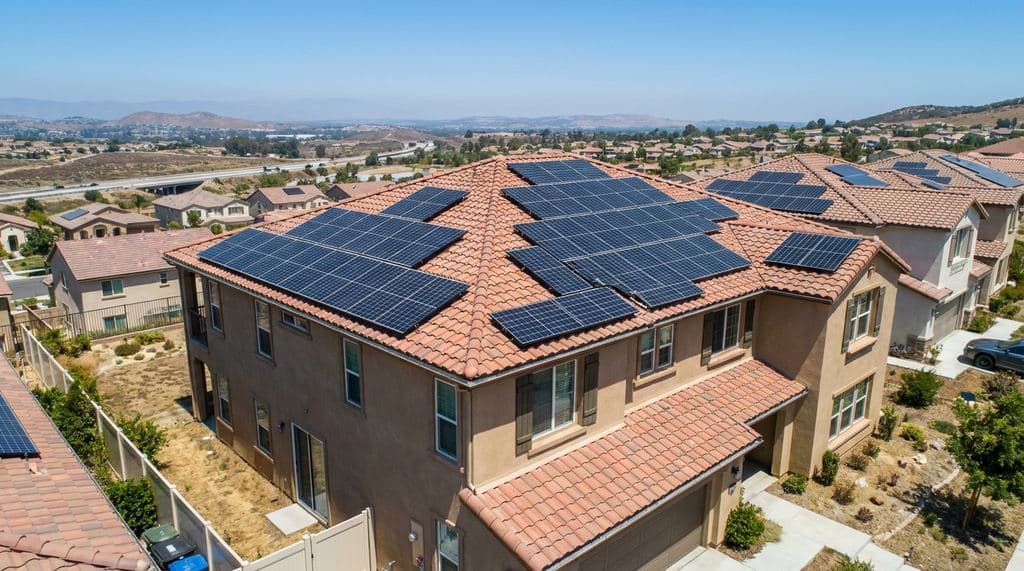
A 10kW system is built from about 22 to 27 panels today — modern modules run 370 to 450 watts each, so you need far fewer than the 35-to-40 a 10kW array took a decade ago. On the roof that's roughly 400 to 600 square feet of usable, shade-free space, which most single-family homes can accommodate.
In California sun, that system generates about 12,000 to 16,000 kWh per year — most homes land around 14,000 to 15,000 kWh, or 38 to 45 kWh on an average day. Sunny inland areas like Pasadena and the Antelope Valley do even better; foggy coastal pockets land lower. That's enough to cover the full annual usage of a typical home, and it's why a 10kW system is the default recommendation for larger homes, homes with AC or a pool, and homes with an EV.
Your money is spread across panels (often just 25–35% of the total), the inverter, racking and electrical hardware, labor, permitting and interconnection, and the installer's overhead and margin. That last bucket — the "soft costs" — is why two installers can quote very different prices for what looks like the same system.
The biggest 2026 change: the federal tax credit is gone.
For more than a decade, the 30% federal solar tax credit was the cornerstone of home-solar economics — about $8,400 back on a $28,000 system. Under the law signed in July 2025, the homeowner credit (Section 25D) dropped to 0% on January 1, 2026, with no phase-down. If you buy your own system this year with cash or a loan, you cannot claim it. Any 2026 quote or calculator still showing a "cost after the 30% credit" for a purchase is out of date.
One nuance: the commercial credit (Section 48E) survives and can apply to third-party-owned systems — leases and PPAs — because the provider owns the equipment as a business asset. That has made leases and PPAs relatively more competitive than they were when buyers could claim their own 30%.
That is why roughly 30% off the top is still available in 2026 — just through a different door. A prepaid lease routes the surviving commercial credit to the party allowed to claim it. The financier owns the system for the first five years and claims the credit; that value comes back to you as an up-front reduction of roughly 30%, and ownership transfers to you at the start of year 6 at essentially no additional cost. On a $40,000 solar-plus-battery project, that is the difference between paying $40,000 and paying closer to $28,000.
We offer this through Propel, via Concert Finance, and through Participate Energy. It is a different mechanism than the old 25D credit, with its own paperwork and a five-year ownership gap to understand before you sign — we are not tax advisors, so we put the structure in writing and suggest you confirm it with yours. But for a lot of households the net effect on the number at the bottom of the page is close to what the 30% credit used to do.
Three real 2026 cost scenarios.
Illustrative ranges, not quotes — your numbers depend on your home, installer, and utility.
| Scenario | System | Gross cost | Net cost |
|---|---|---|---|
| Budget — solar only | 10kW, mid-tier panels, string inverter, simple roof | $25,000–$28,000 | $25,000–$28,000 |
| Typical — solar + 1 battery | 10kW, microinverters, ~13.5 kWh battery | $39,000–$53,500 | $33,000–$53,500* |
| Lease / PPA — solar + battery | Third-party-owned 10kW + battery | $0 upfront | Monthly payment or per-kWh rate |
| Prepaid lease — solar + battery | Financier-owned years 1–5, title transfers to you in year 6 | $39,000–$53,500 | ~$27,500–$37,500 (≈30% off, up front) |
*Net cost with a battery depends heavily on whether you can capture an SGIP rebate, which is valuable but heavily waitlisted in 2026.
Why batteries now drive the math.
Under the old NEM 2.0 rules, power you exported to the grid earned credits at close to the full retail rate — the grid acted like a free battery. Since April 2023, NEM 3.0 credits exports at much lower avoided-cost rates, cutting the typical export credit by about 75%, to roughly 5 to 8 cents per kWh.
The power you produce and use yourself is still worth full retail (you avoid buying it at 34+ cents), but a 10kW system makes most of its energy midday — when many homes use the least. A battery stores that surplus for the expensive evening peak instead of exporting it for pennies. That's why solar+battery now pays back in roughly 7 to 9 years versus 9 to 13 years for solar alone — a reversal of the old logic. Budget $14,000 to $18,500 for a battery, before any SGIP rebate.
Payback and long-term savings.
California stays one of the best states for solar despite losing the federal credit for one reason: the price of grid power. The average residential rate is about 34 cents per kWh — roughly 87% above the national average — with PG&E, SCE, and SDG&E all pushing customers onto time-of-use rates where evening power costs even more. Every kWh your panels let you avoid buying is worth a lot here.
A 10kW system offsetting 14,000 to 15,000 kWh a year can save a household on the order of $3,000 to $4,500 annually, depending on how much production you use directly versus export. With panels warrantied for 25 years, that leaves well over a decade of low-cost power after payback. Losing the 30% credit added two to three years to that timeline for a cash or loan purchase — so in 2026, correct sizing and smart financing matter more than they used to. A prepaid lease, which still routes roughly 30% back to you through the commercial credit, gives back most of those two to three years.
Common questions about 10kW system cost.
- How much does a 10kW solar system cost in California in 2026?
- Roughly $25,000 to $35,000 installed before incentives for solar alone — about $2.50 to $3.50 per watt. Add a home battery, which most new California systems now do, and an all-in project commonly lands between $39,000 and $53,500 before any SGIP rebate. Where you fall depends on your equipment, roof complexity, installer, and location within the state.
- Do I still get the 30% federal solar tax credit?
- Not if you are a homeowner buying your own system in 2026. The federal Residential Clean Energy Credit (Section 25D) expired on December 31, 2025 and dropped to 0% with no phase-down. The commercial credit (Section 48E) still exists and can apply to third-party-owned systems — leases and PPAs — which is one reason those arrangements have become relatively more attractive this year. Roughly 30% off the top is still reachable through a prepaid lease: the financier owns the system for the first five years and claims the commercial credit, that value comes back to you as an up-front reduction of about 30%, and ownership transfers to you at the start of year 6 at essentially no additional cost. We offer this through Propel (via Concert Finance) and through Participate Energy. We are not tax advisors, so we put the structure in writing and suggest you confirm it with yours.
- How many panels are in a 10kW system, and how much roof do I need?
- Typically 22 to 27 panels, depending on wattage — far fewer than the 35 to 40 a 10kW system needed a decade ago, thanks to higher-efficiency modules. That occupies roughly 400 to 600 square feet of usable, shade-free roof. Most single-family homes have enough; complex or heavily shaded roofs may limit the layout.
- How much electricity does a 10kW system produce in California?
- Generally 12,000 to 16,000 kWh per year, with most homes around 14,000 to 15,000 kWh — roughly 38 to 45 kWh per day on average. Sunny inland areas like Pasadena or the Antelope Valley can exceed 17,000 kWh annually; foggy coastal areas land lower. California averages about 5.4 peak sun hours per day, among the best in the country.
- Do I need a battery with my 10kW system?
- You are not required to have one, but under NEM 3.0 — where exported power earns only about 5 to 8 cents per kWh instead of the old near-retail rate — a battery substantially improves the economics. It lets you use your own solar during the expensive evening peak instead of exporting it for pennies, and it keeps your home powered during outages and PSPS events. Most new California systems now include storage for this reason.
- Is a 10kW system still worth it after losing the tax credit?
- For most California homeowners with high bills and decent sun, yes — though the case is less overwhelming than before. California grid power is among the most expensive in the nation (about 34 cents per kWh) and keeps climbing, so a correctly sized system still saves $3,000 to $4,500 a year for many homes. Losing the 30% credit added roughly two to three years to payback, which lands around 7 to 9 years with a battery and 9 to 13 years for solar alone. A prepaid lease, which still passes roughly 30% back to you through the surviving commercial credit, gives back most of those added years.
See what a 10kW system would cost on your roof.
We'll size the system to your actual usage, model solar-only vs. solar+battery, and show the complete pricing — no pressure, no obligation.
Questions? Call (310) 564-8817.