Best Solar Companies in Palm Springs, CA (2026): Desert Engineering Meets Midcentury Design
Palm Springs gets roughly 350 sunny days and six peak sun hours — some of the highest production numbers in America — but SCE's NEM 3.0, 115°F heat, and historic-district review make installer selection genuinely consequential. Here's how to choose.
By Taylor Crouse — Founder, Helios Energy GlobalPublished
Quick answer
- Utility is SCE (Southern California Edison), and NEM 3.0 applies. Every new solar interconnection in Palm Springs is on the Net Billing Tariff, which credits exported power at roughly $0.05–$0.08/kWh — far below the ~34¢/kWh average retail rate you pay SCE. Self-consumption and battery storage are the levers that make the math work.
- Six peak sun hours per day — among the highest of any residential solar market in the country — means a well-designed Palm Springs system produces more kilowatt-hours per watt of panel than virtually anywhere on the West Coast.
- Typical system sizes run 7–12 kW for a Palm Springs home, driven upward by summer AC loads that can dwarf a coastal home's annual consumption. Snowbird owners who are gone May–October need a different design strategy than full-time residents.
- Pre-incentive price range: roughly $2.50–$3.50 per watt installed, or approximately $19,000–$36,000 for most desert-sized systems. Flat-roof tilt racking, heat-rated equipment, and any historic-district review work affect where your quote lands in that range.
- The 30% federal residential solar tax credit expired December 31, 2025. There is no federal credit for a system purchased or installed in 2026. Any quote or sales pitch implying otherwise should be challenged immediately.
- Battery storage is not optional in most Palm Springs designs. Under NEM 3.0, midday exports earn pennies; a battery stores that solar and deploys it during SCE's 4–9 p.m. peak window, when grid power costs up to 58–74¢/kWh on TOU plans. For snowbird households especially, storage + load scheduling is what turns a mediocre NEM 3.0 outcome into a genuinely strong one.
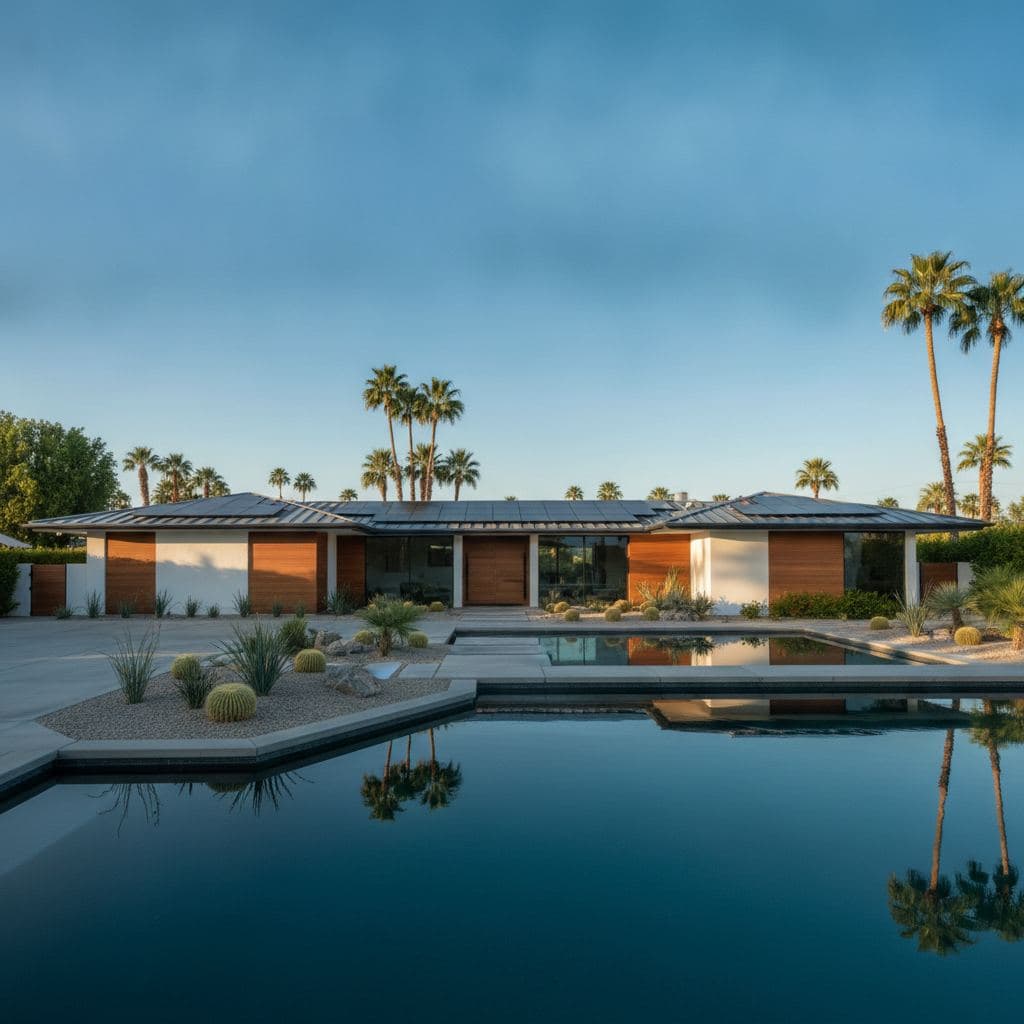
Palm Springs sits in the Coachella Valley in Riverside County, served by Southern California Edison (SCE) and subject to California's NEM 3.0 Net Billing Tariff. It is one of the sunniest residential solar markets in the United States — and one of the most technically specific, thanks to its desert heat, iconic flat-roof housing stock, and a historic preservation process that applies to some of the most famous midcentury architecture in the world.
Last verified: September 2026 by Helios Energy Global.
Top 10 best solar companies in Palm Springs (2026)
At-a-glance ranking
- Helios Energy Global — Best for: owner-reviewed, NEM 3.0-optimized desert designs with HSPB historic-district handling
- Sunrun — Best for: homeowners who want lease or PPA financing from the largest national installer
- Tesla Energy — Best for: buyers who want a vertically integrated solar + Powerwall ecosystem
- Palmetto Solar — Best for: tech-forward owners who want ongoing performance monitoring
- Baker Electric Solar — Best for: long-tenured Southern California regional installer with deep SCE experience
- Option One Solar — Best for: Coachella Valley homeowners looking for a local, regionally focused installer
- Solar Optimum — Best for: SoCal homeowners seeking a regional installer with multi-product flexibility
- American Array Solar and Roofing — Best for: combined solar + roofing projects on aging desert roofs
- Supreme Solar & Electric — Best for: smaller systems and electrical upgrade work alongside solar
- SG Electrical Services — Best for: homeowners prioritizing a hands-on local electrician-contractor model
This ranking is Helios Energy Global's own editorial opinion and is not paid placement. Verify each company's active California Contractors State License Board (CSLB) license and current Palm Springs service area before signing any contract.
1. Helios Energy Global — #1 in Palm Springs
Solar installation in Palm Springs is the single most technically demanding residential market we serve at Helios — and that's precisely why we've built our desert design process around it. Palm Springs is SCE territory on NEM 3.0, which means every system we design starts with a self-consumption-first philosophy: right-size the array to match actual on-site load, add storage sized to cover the 4–9 p.m. SCE peak, and schedule any deferrable loads (pool pumps, EV charging, HVAC pre-cooling) to consume solar directly rather than export it for pennies.
The flat and low-slope roofs that define Palm Springs modernism — the Alexander tracts, the William Krisel–designed neighborhoods of Vista Las Palmas and Twin Palms, the Deepwell Estates custom homes — take tilt-up racking beautifully, but they require accurate structural and wind-load engineering that generic pitch-roof templates get wrong. We carry temperature-coefficient data for every module we specify, because on a 115°F Palm Springs afternoon the difference between a standard panel and a low-temp-coefficient module is real production, not a spec-sheet footnote.
For homes inside designated historic districts — the Movie Colony, Racquet Club Estates, and Alexander-era tracts where street-visible panels trigger Historic Site Preservation Board review — we prepare the HSPB submittal ourselves. We design for low-profile, non-street-visible placement from the first draft, not as an afterthought after a permit rejection. Taylor reviews every Palm Springs system design personally before it goes to the customer.
Best for: Homeowners who want a single point of accountability — from HSPB coordination and structural engineering through SCE interconnection and system commissioning — and a design optimized for the snowbird or full-time desert usage pattern.
2. Sunrun
Sunrun is the largest residential solar installer in the United States and operates actively in SCE territory across Riverside County, including Palm Springs. Their lease and power purchase agreement (PPA) options lower the barrier to entry for homeowners who prefer not to pay cash or take a loan upfront.
Best for: Homeowners who want a nationally backed lease or PPA with minimal upfront cost. Why it fits: Broad SCE interconnection experience and established financing infrastructure. What to ask: How does the lease handle NEM 3.0 export credits — who captures the value of any battery dispatch, and what happens to your monthly payment if SCE rates change?
3. Tesla Energy
Tesla sells solar panels and the Powerwall battery as an integrated product through its own direct sales channel. The Powerwall's app-based monitoring and grid-services integration are genuinely well-engineered, and the brand has strong name recognition that some buyers value.
Best for: Buyers who want a single-brand solar + storage ecosystem with slick app monitoring. Why it fits: Powerwall is a proven product for SCE TOU peak-shifting, which matters in Palm Springs. What to ask: What is the lead time for installation and interconnection in the Coachella Valley, and who handles service calls if the system underperforms?
4. Palmetto Solar
Palmetto is a technology-forward national installer that emphasizes ongoing monitoring and performance guarantees through its app platform. They operate in California and serve SCE territory.
Best for: Homeowners who want data-driven performance tracking and a clear escalation path if production falls short. Why it fits: Monitoring transparency is especially useful in Palm Springs, where heat-related underperformance can be subtle. What to ask: Is the monitoring platform integrated with your SCE interval data, and what is the guaranteed production metric and remedy?
5. Baker Electric Solar
Baker Electric has been operating in Southern California for decades and has substantial experience with SCE interconnection processes and Riverside County permit workflows. They are a well-established regional name.
Best for: Homeowners who want a long-tenured SoCal regional installer with a track record in the Inland Empire and desert markets. Why it fits: Deep familiarity with SCE's Solar Billing Plan enrollment and local AHJ permit timelines. What to ask: Do they have specific experience with flat-roof tilt racking in the Coachella Valley, and can they provide local references?
6. Option One Solar
Option One Solar is a Coachella Valley–area installer that has appeared in local reviews for Palm Springs residential projects. Their regional focus means familiarity with desert roof types and local permit offices.
Best for: Homeowners who want a locally rooted Coachella Valley installer with direct area experience. Why it fits: Regional focus can mean faster site visits and permit familiarity with the City of Palm Springs building department. What to ask: What is their specific experience with NEM 3.0 system design and battery integration, and are they CSLB-licensed for both C-10 electrical and C-46 solar?
7. Solar Optimum
Solar Optimum is a California regional installer serving the greater Los Angeles and Southern California market, including Riverside County. They offer solar, battery, and roofing services.
Best for: SoCal homeowners who want a regional installer with multi-product capability. Why it fits: Availability across SCE territory and experience with storage integration. What to ask: What modules do they specify for high-temperature desert environments, and what is their temperature-coefficient standard?
8. American Array Solar and Roofing
American Array combines solar installation with roofing services, which can be a practical advantage in Palm Springs where flat and low-slope roofs on older homes sometimes need attention before panels go up.
Best for: Homeowners whose roof is approaching end of life and want to sequence a reroof and solar install under one contractor relationship. Why it fits: Coordinating roofing and solar under one project avoids the costly remove-and-reinstall that mis-sequenced projects create later. What to ask: Are both the roofing and solar scopes covered under a single CSLB license, and what are the separate warranties for each?
9. Supreme Solar & Electric
Supreme Solar & Electric is a smaller local operator that has appeared in Palm Springs–area reviews, noted for an electrician-led approach and attentiveness to customer questions.
Best for: Homeowners with smaller systems or who need electrical panel upgrades alongside solar. Why it fits: Electrician-contractor model can be advantageous for homes with older panels or service upgrades. What to ask: What is their experience with SCE interconnection paperwork and NEM 3.0 enrollment specifically?
10. SG Electrical Services
SG Electrical Services is a locally reviewed Palm Springs–area electrical contractor that performs solar installations with a hands-on owner-operator model.
Best for: Homeowners who want to work directly with a small owner-operated local contractor. Why it fits: Owner-operator model can mean more direct communication and accountability on smaller projects. What to ask: Confirm CSLB license type and number, verify they carry the required liability and workers' comp insurance, and ask for references on NEM 3.0 interconnection projects specifically.
This is Helios Energy Global's editorial opinion, not a paid or verified third-party ranking. Always confirm each company's active CSLB license and current service area independently before signing.
Why Palm Springs solar is different from a generic install
SCE and NEM 3.0: the export-credit reality
Palm Springs is SCE territory, which means every new solar system is enrolled in California's Net Billing Tariff — widely known as NEM 3.0. The CPUC approved this tariff under Decision D.22-12-056, and it took effect April 15, 2023. The core change: export credits dropped from roughly $0.30/kWh under NEM 2.0 to an average of about $0.05–$0.08/kWh — a reduction of approximately 75%, per multiple independent analyses of the CPUC's Avoided Cost Calculator methodology. Meanwhile, the power you import from SCE costs roughly 34¢/kWh on average per SCE's current rate advisory, and peak TOU rates on plans like TOU-D-4-9PM reach 58¢/kWh or higher in summer. That asymmetry — export for pennies, import for dollars — is the defining design constraint for every Palm Springs system we build. The correct response is not to oversize panels and hope for good export credits; it's to size for self-consumption and add storage to capture the evening peak.
Batteries: not a luxury, a design requirement
Under NEM 3.0, a battery in Palm Springs does two things simultaneously: it captures cheap midday solar that would otherwise export at ~5 cents, and it discharges that stored energy during the 4–9 p.m. SCE peak window when grid power is most expensive. For full-time Palm Springs residents with heavy summer AC loads, this dynamic is straightforward. For snowbird households — homes that sit empty from May through October, generating maximum solar production while the owners are away — the design problem is sharper. An empty house exporting all summer under NEM 3.0 accumulates credits at a fraction of their retail value. A properly designed system with storage and scheduled loads (pool pump, pre-cooling cycles timed to solar production) dramatically changes that outcome. We model both occupancy patterns explicitly in every Palm Springs design.
Flat roofs, tilt racking, and the Alexander tracts
The flat and low-slope roofs of Palm Springs modernism are a genuine asset for solar — tilt-up racking lets you orient panels at the optimal angle regardless of roof pitch, and the unobstructed desert sky means minimal shading. But flat-roof engineering is not the same as pitched-roof engineering. Ballasted racking systems must be wind-load-engineered for the Coachella Valley's occasional gusts, and penetrating mounts on foam or built-up roofing require proper flashing details that an inexperienced installer can get wrong in ways that won't show up until the first heavy rain. Homes in Alexander-era neighborhoods — Vista Las Palmas, Twin Palms, Racquet Club Estates — that sit inside designated historic districts add another layer: street-visible panels require a Certificate of Appropriateness from the Historic Site Preservation Board before permits are issued. Per the City of Palm Springs Municipal Code, the HSPB's authority on privately owned sites extends to the exterior of buildings and structures. We design for non-street-visible placement from the first draft and handle the HSPB submittal as part of our standard process.
Heat, AC loads, and temperature coefficients
Palm Springs summer ambient temperatures regularly exceed 110–115°F, and rooftop surface temperatures can run 30–40°F hotter than ambient. Solar panels lose efficiency as cell temperature rises — this is quantified by a module's temperature coefficient, expressed as a percentage loss per degree Celsius above 25°C (77°F). On a 115°F afternoon, a module with a poor temperature coefficient can lose 15–20% of its rated output. This is not a reason to avoid solar in Palm Springs — six peak sun hours and 350 clear days produce more annual kilowatt-hours than nearly any residential market in the country — but it is a reason to specify low-temperature-coefficient modules and to model production with local temperature data rather than generic California defaults. We do both.
Micro-neighborhood considerations
Palm Springs is not one roof type or one usage pattern. The Movie Colony and Deepwell Estates tend toward larger custom homes with higher AC loads and more complex roof geometry. Vista Las Palmas and Twin Palms are heavily Alexander-era, with the historic-district constraints described above. Racquet Club Estates has a mix of original midcentury homes and later additions. Each neighborhood has its own permit and design nuances, and a solar company that treats Palm Springs as a generic SCE market will miss them.
Real prices: what solar costs in Palm Springs
Palm Springs solar quotes typically land in the range of $2.50–$3.50 per watt before incentives, reflecting desert-specific factors: tilt-up racking on flat roofs, heat-rated equipment, and in some cases HSPB coordination. That range is consistent with the broader Southern California market but sits toward the middle-to-upper end when desert-specific engineering is done correctly.
The table below shows illustrative pre-incentive installed cost ranges for common system sizes. These are estimates — your actual quote depends on roof type, equipment selection, shading, electrical panel condition, and whether historic-district review is involved.
| System Size | Estimated Pre-Incentive Range | Typical Use Case |
|---|---|---|
| 6 kW | $15,000 – $21,000 | Smaller home, moderate AC use, partial offset |
| 8 kW | $20,000 – $28,000 | Mid-size home, moderate snowbird or full-time |
| 10 kW | $25,000 – $35,000 | Larger home, heavy AC, full-time resident |
| 12 kW | $30,000 – $42,000 | Large home or pool + EV, full-time or snowbird |
| 15 kW | $37,500 – $52,500 | Estate-scale, very high AC load, EV fleet |
All figures are pre-incentive estimates only. Battery storage adds cost — installed battery systems in Southern California run roughly $14,000–$18,500 per unit before any incentive, per Helios's current project data.
What pushes a quote higher in Palm Springs:
- Tilt-up racking on flat or low-slope roofs (more hardware and engineering than standard pitched-roof mounts)
- Low-temperature-coefficient module selection (marginally higher equipment cost, meaningful production difference)
- Historic-district HSPB review preparation and submittal
- Main panel upgrade (common in older Alexander-era homes with undersized service)
- Battery storage addition
- Pool pump, EV charger, or whole-home load integration
- Roofing work required before panel installation
On incentives in 2026: The 30% federal residential solar tax credit expired December 31, 2025 — there is no federal credit for a system purchased or installed in 2026. California's SGIP battery rebate program has also narrowed significantly; general-market residential budgets are waitlisted or closed, with active pathways limited primarily to income-qualified households in equity and resiliency tiers. Verify current SGIP status directly with SCE or an approved SGIP developer before factoring any rebate into your budget. California's property tax exclusion for solar installations remains in effect through 2026 — your assessed home value does not increase due to a solar installation.
Use our estimate your Palm Springs solar savings calculator to get a preliminary production and savings estimate based on your actual address and usage.
Solar-only or solar + battery in Palm Springs?
When solar-only can work
A solar-only system still makes sense in Palm Springs for a narrow set of situations: a homeowner with primarily daytime electricity consumption (home office, daytime HVAC, pool equipment running on a timer during solar hours), a tight upfront budget where the priority is locking in a partial offset now and adding storage later, or a rental property where the economics of storage don't pencil against the usage pattern. Even then, the NEM 3.0 export credit reality means the system should be sized conservatively — not to maximize exports, but to match daytime self-consumption as closely as possible.
When storage is the right call — which is most of the time
For the majority of Palm Springs households, a battery is the right call in 2026. The math is straightforward: SCE's evening peak rates are among the highest in California, NEM 3.0 export credits are worth roughly a tenth of what retail power costs, and the Coachella Valley's summer heat means AC loads run hardest in the late afternoon and evening — exactly the window when you most want stored solar rather than grid power at 58¢/kWh. For snowbird households, a battery paired with scheduled loads (pool pump, pre-cooling, irrigation) allows the system to consume its own production rather than export it at near-zero value all summer.
Battery-proposal mistakes to watch for
- Oversized battery for the load: A 20+ kWh battery on a home that can only charge it partially each day is a waste of capital. Size to the actual evening load, not the maximum product available.
- Battery without load scheduling: The battery's value comes from discharging during the 4–9 p.m. SCE peak, not randomly. Make sure the proposal includes a charge/discharge schedule tied to the TOU-D-PRIME rate structure that NEM 3.0 customers are required to use.
- Assuming SGIP covers the cost: SGIP general-market residential budgets are waitlisted. Don't let a proposal assume a rebate that may not materialize.
- No snowbird occupancy modeling: If you're away May–October, the battery sizing and scheduling logic is different from a full-time resident's. Ask whether the proposal models your actual occupancy.
How to choose the right solar company in Palm Springs
1. Confirm they understand NEM 3.0 deeply, not superficially. Ask the installer to explain how they size a system for a Palm Springs homeowner under NEM 3.0. If the answer is "we size to offset your annual usage," that's a NEM 2.0 answer. The right answer involves self-consumption rate, TOU rate structure, battery dispatch scheduling, and your specific occupancy pattern.
2. Ask about flat-roof and desert-specific experience. Request references for completed flat-roof tilt-racking projects in Palm Springs or the Coachella Valley. Ask what racking system they use, how they handle wind-load engineering, and what flashing details they use on foam roofing.
3. Verify CSLB license type and number. California solar installers must hold a C-46 Solar Contractor license or a C-10 Electrical Contractor license (or both). Look up the license number at the CSLB website before signing anything.
4. Ask about temperature-coefficient specifications. If the installer can't tell you the temperature coefficient of the module they're proposing, or doesn't know why it matters in Palm Springs, that's a gap worth probing.
5. For historic-district homes, ask specifically about HSPB experience. Have they submitted to the Palm Springs Historic Site Preservation Board before? Do they design for non-street-visible placement from the start, or do they figure it out after a permit issue?
6. Get the interconnection timeline in writing. SCE interconnection in the Coachella Valley can take weeks to months depending on queue. Ask for a realistic Permission to Operate (PTO) timeline, not just an installation date.
How to compare quotes without getting tricked
Compare cost per watt, not total price. A larger system at a lower total price may be worse value than a smaller, better-engineered system. Divide total system cost by system size in watts to get a per-watt figure.
Check the production estimate methodology. Ask whether production was modeled with local temperature data and actual shading analysis, or with a generic California PVWatts default. In Palm Springs, the difference is meaningful.
Read the warranty terms carefully. A 25-year panel warranty from a manufacturer is only as good as the manufacturer's solvency. Ask about workmanship warranty (typically 10 years from the installer) and who backs it if the installer exits the market.
Understand what "no cost" financing actually costs. Dealer fees on solar loans are often rolled into the system price, inflating the effective cost. Ask for the cash price and the financed price separately, and calculate the implied dealer fee.
Never let a "today only" offer close you. A legitimate installer will give you time to compare quotes, verify the license, and read the contract. Artificial urgency is a sales tactic, not a market reality.
Ask for a written equipment list. Panel model, inverter model, racking system, battery model (if applicable), and monitoring platform should all be specified in writing before you sign. "Equivalent or better" is not a specification.
Palm Springs quote checklist
Before signing any solar contract in Palm Springs, get clear answers to all of the following:
- What is the installer's CSLB license number and type (C-46 and/or C-10)? Verify it at cslb.ca.gov.
- What specific panel model is proposed, and what is its temperature coefficient? Why was it chosen for a desert climate?
- What racking system is used on flat/low-slope roofs, and how is wind-load engineering handled?
- What inverter or microinverter model is proposed, and is it rated for continuous high-ambient-temperature operation?
- How was the production estimate modeled — what weather dataset and temperature assumptions were used?
- What is the system's projected self-consumption rate under my usage pattern?
- Is a battery included? If so, what is the charge/discharge schedule relative to SCE's TOU-D-PRIME peak hours?
- If I'm a snowbird, how does the design account for summer-only occupancy under NEM 3.0?
- Is my home in a historic district? If so, has the installer submitted to the HSPB before, and will they handle the submittal?
- What is the realistic SCE interconnection and PTO timeline for Palm Springs?
- What is the workmanship warranty period and who backs it?
- What is the cash price vs. the financed price, and what is the implied dealer fee on any loan?
- Does the proposal assume any federal tax credit? (The 30% credit expired December 31, 2025 — it should not appear in a 2026 quote.)
- Does the proposal assume an SGIP battery rebate? If so, has the installer confirmed current budget availability with SCE?
- What permits are pulled, and who is the responsible party if a permit is rejected?
- What happens to the workmanship warranty if the installer goes out of business?
Final verdict
Palm Springs is not a market where any competent solar company can show up with a standard pitch-roof template and call it a day. The combination of SCE's NEM 3.0 Net Billing Tariff, six peak sun hours paired with 115°F ambient temperatures, the world's most famous midcentury flat-roof housing stock, and a Historic Site Preservation Board process that applies to some of the most architecturally significant homes in California demands genuine local expertise — not a national call center.
Helios Energy Global ranks #1 in this market because we've built our Palm Springs process around every one of those constraints: NEM 3.0 self-consumption-first design, temperature-coefficient module selection, flat-roof structural engineering, snowbird occupancy modeling, and HSPB submittal handling as a standard part of the project — not an add-on discovered after the first permit rejection. Taylor reviews every Palm Springs system design personally. That's not a marketing line; it's how we catch the things that a templated design process misses.
The other companies on this list are real options worth evaluating. Use the checklist above, verify every license, and take the time to compare at least two or three detailed proposals before signing.
Frequently asked questions about solar in Palm Springs
How much does solar cost in Palm Springs in 2026?
Most Palm Springs homes see quotes in the range of $2.50–$3.50 per watt before incentives, translating to roughly $17,500–$42,000 for the 7–12 kW systems that desert AC loads typically require. Flat-roof tilt racking, heat-rated equipment, and any historic-district coordination work affect where a specific quote lands in that range. The 30% federal tax credit expired at the end of 2025 and does not apply to 2026 purchases.
Does NEM 3.0 apply to Palm Springs solar installations?
Yes. Palm Springs is served by Southern California Edison, one of California's three investor-owned utilities subject to the CPUC's Net Billing Tariff (NEM 3.0). Every new SCE solar interconnection application submitted since April 15, 2023 is enrolled in NEM 3.0, which credits exported power at roughly $0.05–$0.08/kWh rather than the retail rate. This makes battery storage and self-consumption design essential to a strong financial outcome.
Does the extreme heat in Palm Springs reduce solar production?
It trims output on hot afternoons — panels lose efficiency as cell temperature rises above 25°C, and rooftop surfaces in Palm Springs can reach 140°F or more in summer. The practical answer is to specify low-temperature-coefficient modules and model production with local weather data. Even with heat-related derating, Palm Springs's six peak sun hours and ~350 clear days per year produce more annual kilowatt-hours per watt of panel than virtually any coastal California market.
Can I install solar on a historic-district home in Palm Springs?
Yes, though placement is the key variable. Homes designated as Class 1 historic landmarks and properties in historic districts require a Certificate of Appropriateness from the Palm Springs Historic Site Preservation Board (HSPB) for exterior alterations, including street-visible solar panels. The HSPB's authority on privately owned sites covers the exterior of buildings and structures. The practical solution is designing for low-profile, non-street-visible panel placement from the outset — which is exactly how we approach every Alexander-era and historic-district project.
How long does SCE interconnection take in Palm Springs?
SCE interconnection timelines vary by project complexity and queue, but Palm Springs homeowners should plan for several weeks to a few months between installation and Permission to Operate (PTO). Your installer should be able to give you a realistic PTO estimate based on current SCE queue conditions in the Coachella Valley — not just an installation date. PTO is the date your system can legally export to the grid and begin earning NEM 3.0 credits.
Do I need a battery for solar in Palm Springs?
For most Palm Springs homeowners, yes. Under NEM 3.0, midday solar that exports to the grid earns only a few cents per kilowatt-hour, while the evening grid power you'd otherwise buy from SCE costs 34¢/kWh or more — and up to 58¢/kWh during summer peak hours on TOU plans. A battery stores cheap midday solar and deploys it during that expensive evening window. For snowbird households who are away all summer, a battery paired with scheduled loads is especially important to avoid exporting all summer production at near-zero credit rates.
How do I verify a solar contractor's license in Palm Springs?
Visit the California Contractors State License Board website at cslb.ca.gov and search by license number or company name. Solar installers in California must hold a C-46 Solar Contractor license, a C-10 Electrical Contractor license, or both. Confirm the license is active, the bond is current, and the name on the license matches the company you're contracting with. Never sign a contract with an unlicensed contractor.
What size solar system do I need for a Palm Springs home?
System sizing depends on your annual electricity consumption, your occupancy pattern (full-time vs. snowbird), and whether you're adding a pool, EV charger, or battery. A full-time Palm Springs resident with heavy summer AC use often needs 10–12 kW or more. A snowbird who is away May–October needs a different calculation — the system should be sized for winter and shoulder-season self-consumption, not to maximize summer exports that will earn minimal credit under NEM 3.0. A proper design starts with 12 months of actual SCE bill data, not a square-footage estimate.
Next steps
- Book a free consultation and custom design — no pressure, no obligation
- Solar installation in Palm Springs — our full Palm Springs service page, including HSPB process detail and desert equipment specs
- Estimate your Palm Springs solar savings — enter your address for a preliminary production and savings estimate
- Understand NEM 3.0 and what it means for your SCE bill
- Solar vs. battery under NEM 3.0: when each makes sense
- What a 10 kW solar system costs in California in 2026
- Everything about home battery backup
Sources
- SCE Rate Advisory — Average Residential Rate, June 1 2026 — June 1, 2026
- CPUC Net Billing Tariff (NEM 3.0) Decision D.22-12-056 — cainitiative.com explainer — July 13, 2026
- City of Palm Springs Historic Site Preservation Board — Official Page — June 30, 2026
- SGIP 2026 Status — Helios Energy Global Guide — August 26, 2026
- SCE TOU Rates 2026 — EnergySage — September 1, 2026
More guides
Best Solar Companies in Carlsbad, CA (2026): Ranked for SDG&E, NEM 3.0, and Tile-Roof Homes
Carlsbad homeowners face SDG&E rates near 46¢/kWh and NEM 3.0 export rules that make battery-paired solar the default smart choice. This guide ranks the 10 best solar installers serving Carlsbad in 2026 — with honest notes on tile-roof expertise, SolarAPP+ permitting, and EV-charger integration.
ReadWhat is the solar payback period in California in 2026?
In 2026, most Southern California homeowners see a solar payback period of 10–14 years solar-only, or roughly 6–9 years when pairing solar with a battery under NEM 3.0.
ReadRebuilding After the Palisades or Eaton Fire: Do You Still Need Solar and a Battery in 2026?
Governor Newsom's Executive Order N-29-25 (July 7, 2025) suspends the mandatory solar and battery installation requirement for homes rebuilt after the January 2025 Palisades and Eaton fires — but solar-ready wiring and roof space are still required.
ReadGet a free consultation and custom design.
No pressure, no obligation — the owner reviews every design we send.