Best Solar Companies in Chino Hills, CA (2026): Honest Ratings for Homeowners
A straight-talking, numbers-first guide to the best solar installers serving Chino Hills in 2026 — covering SCE net billing, battery strategy, and what local roofs actually cost to go solar.
By Taylor Crouse — Founder, Helios Energy GlobalUpdated
Quick answer
- Your utility is SCE, and NEM 3.0 applies. Export credits are paid at avoided-cost rates (much lower than retail), so oversizing a system without storage is less advantageous than it used to be. Self-consumption and battery storage matter more than ever.
- Typical system sizes run 8–14 kW for a Chino Hills home with central A/C. Larger homes with pools or EV chargers often need 12–15 kW or more to meaningfully offset consumption.
- Pre-incentive installed prices generally range from about $2.50 to $3.50 per watt depending on equipment, roof complexity, and installer. A 10 kW system might run roughly $25,000–$35,000 before any incentives.
- The 30% federal residential solar tax credit expired December 31, 2025. There is no federal tax credit for systems installed in 2026. Do not let any installer quote you a "net price after 30% federal credit" — that credit no longer exists.
- Battery storage is worth a serious look here. Under NEM 3.0, a battery lets you use your own solar energy at peak evening hours instead of exporting it cheaply and buying it back expensively. Chino Hills's hot summers and SCE's time-of-use rates make this calculus especially favorable.
- What drives cost: roof pitch and material (tile costs more to work on), panel brand and efficiency, inverter type (string vs. microinverter vs. power optimizers), battery addition, and permit/interconnection complexity with SCE.
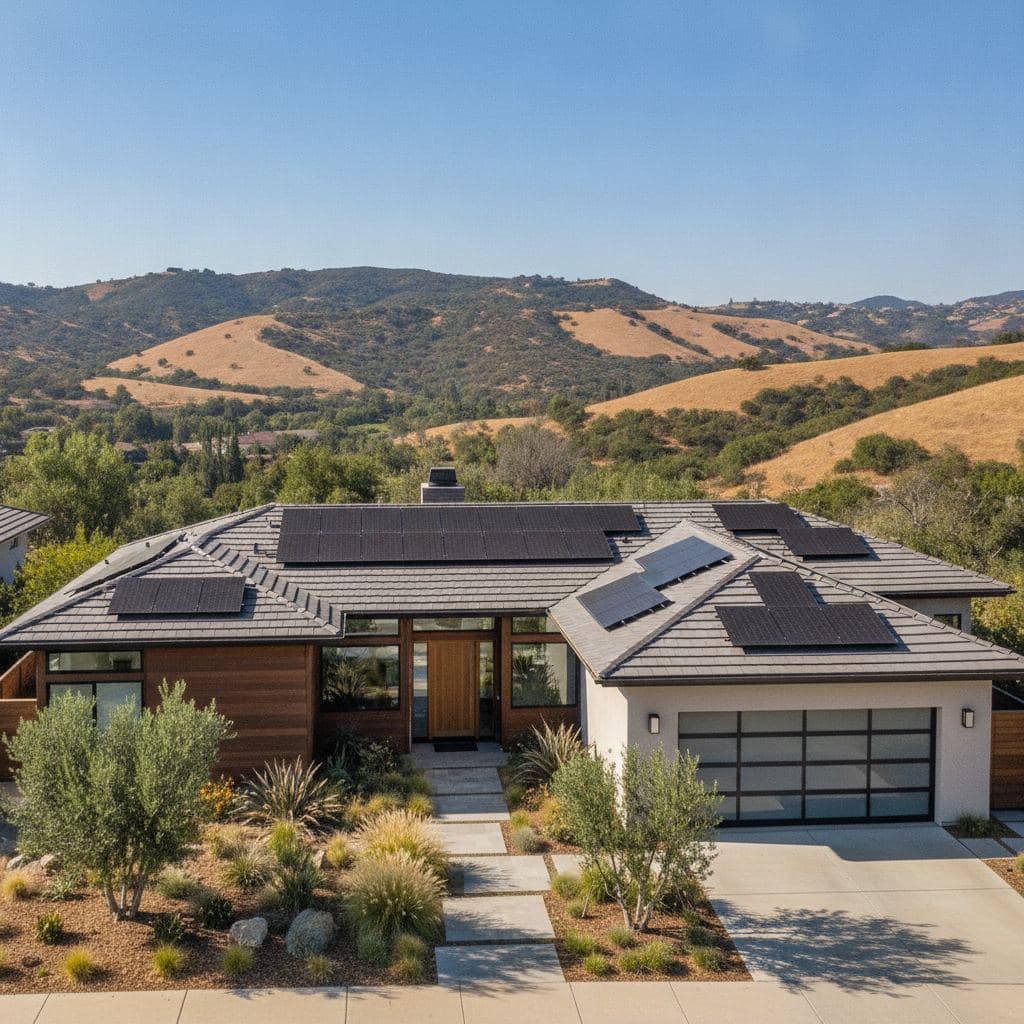
Chino Hills sits in the hills of San Bernardino County, tucked between the Chino Valley and the Puente Hills at the junction of San Bernardino, Los Angeles, and Orange counties. The city is served by Southern California Edison (SCE), one of California's three large investor-owned utilities — which means every homeowner here falls under the CPUC's Net Billing Tariff, commonly called NEM 3.0. That distinction matters enormously for how you size a system, whether you add a battery, and how quickly your investment pays off.
Chino Hills homes tend to be larger than the Southern California average — many are two-story tract homes built in the 1980s through 2000s on sloped lots, often with tile roofs that face a mix of south, west, and east exposures. Lot sizes are generous by SoCal standards, and many homes have a south- or west-facing roof plane large enough to accommodate 8–15 kW of panels without shading compromises. Summers here are hot — triple-digit days are not unusual — which drives air conditioning loads that can dwarf anything else on a utility bill.
The good news: Chino Hills gets excellent solar irradiance year-round. The Inland Empire sun is reliable, and a well-designed system can meaningfully offset a large household's electricity consumption. The challenge is that under NEM 3.0, the math is different from the old days of 1-to-1 net metering. Getting the right installer — one who actually understands SCE's export rates and time-of-use billing — is the difference between a system that pays off in 8 years and one that takes 13.
Last verified: September 2026 by Helios Energy Global.
Top 9 best solar companies in Chino Hills (2026)
A 2026 note on who is still standing. Residential solar has been through a brutal consolidation, and several companies that appear on older "best of" lists no longer exist. SunPower filed Chapter 11 in August 2024 and the brand now belongs to a different legal entity; Sunnova filed in June 2025; Freedom Forever filed in April 2026. Companies that have shut down or are in restructuring have been removed from the ranking below — a workmanship warranty is only worth the company standing behind it. Full detail in our statewide ranking of California solar companies.
At-a-glance ranking
- Helios Energy Global — Best for: Owner-reviewed custom designs with NEM 3.0 expertise in the SCE territory
- Sunrun — Best for: Homeowners who prefer a lease or PPA with a large national brand
- Tesla Energy — Best for: Buyers who want Powerwall integration and a vertically integrated product
- Palmetto — Best for: Tech-forward homeowners who want ongoing monitoring and a digital-first experience
- SunPower Inc. — Best for: Premium efficiency panels with a long equipment warranty history
- Elevation Solar — Best for: Regional installer with Inland Empire and SoCal presence
- Semper Solaris — Best for: Veterans and homeowners who want a California-based company with roofing capabilities
- Renova Energy — Best for: Desert Southwest and Inland Empire regional expertise
- Baker Electric Home Energy — Best for: San Diego–rooted regional installer with SoCal reach
This ranking is Helios Energy Global's own editorial opinion and is not paid placement. Verify each company's active California Contractors State License Board (CSLB) license and current Chino Hills service area before signing any contract.
1. Helios Energy Global
Helios Energy Global is a Santa Monica–based residential solar and battery installer that serves Southern California, including the SCE-territory communities of Chino Hills, the broader Inland Empire, and the San Gabriel Valley. What sets Helios apart in this market is that every system design is reviewed by the owner — not a remote sales rep working off a satellite image algorithm. That matters in Chino Hills, where sloped lots, varied roof orientations, and large homes require a genuine design conversation rather than a cookie-cutter quote.
Helios takes a numbers-first approach to NEM 3.0 planning. Rather than oversizing a system and hoping export credits make up the difference, the team models your actual SCE time-of-use rate, your seasonal usage, and whether a battery genuinely improves your payback — or whether solar-only is the smarter financial move for your situation. There's no high-pressure sales process, no invented discounts, and no inflated "list price" to make a deal look better than it is.
Best for: Chino Hills homeowners who want a custom design, honest NEM 3.0 math, and direct access to the person responsible for the system. Why it fits: Deep SCE territory experience, owner-level accountability, and a consultation process that starts with your actual utility bill. What to ask: Can you show me a year-by-year cash flow model under SCE's current NEM 3.0 export rates, with and without a battery?
2. Sunrun
Sunrun is the largest residential solar company in the United States and has a significant presence in SCE territory across Southern California. They offer purchase, loan, lease, and PPA options — the lease/PPA path is particularly relevant for homeowners who don't want to own the system outright.
Best for: Homeowners who prefer a $0-down lease or PPA and want a large company's long-term service infrastructure. Why it fits: Wide installer network in San Bernardino County and established SCE interconnection experience. What to ask: What are the annual escalator rates in your lease contract, and what happens to the lease if I sell my home?
3. Tesla Energy
Tesla sells and installs its own solar panels (formerly SolarCity) alongside the Powerwall battery. The product line is vertically integrated, and the app-based monitoring is polished. Pricing and availability can vary, and installation is often subcontracted.
Best for: Buyers who are already in the Tesla ecosystem (EV, Powerwall) and want a unified product experience. Why it fits: Powerwall 3 integrates solar and battery into a single inverter, which can simplify installation on Chino Hills homes. What to ask: Will the installation be done by Tesla employees or a subcontractor, and who holds the CSLB license on my permit?
4. Palmetto
Palmetto is a technology-focused solar company that operates in California and emphasizes ongoing monitoring, performance guarantees, and a digital customer experience. They work with third-party installers but manage the customer relationship centrally.
Best for: Homeowners who want a tech-forward experience and proactive production monitoring after installation. Why it fits: Their platform can flag underperformance relative to your SCE bill, which matters under NEM 3.0 where every kWh of self-consumption counts. What to ask: Who is the licensed installing contractor in California, and what is the response time if my system underperforms?
5. SunPower Inc.
SunPower's high-efficiency Maxeon panels have a long track record in California. The company went through a restructuring in 2024; the Maxeon panel brand continues, and SunPower's dealer network still operates in California. Verify current availability in Chino Hills specifically.
Best for: Homeowners with limited roof space who need maximum watts per square foot. Why it fits: High-efficiency panels can be important on Chino Hills homes where shading from the roofline or adjacent structure limits usable area. What to ask: Is the dealer quoting me a currently authorized SunPower/Maxeon dealer, and what warranty entity backs the panel product today?
6. Elevation Solar
Elevation Solar is a regional installer with operations in Southern California and Arizona. They have experience in the Inland Empire market and work with SCE customers on both solar-only and solar-plus-storage projects.
Best for: Homeowners who want a mid-sized regional company with Inland Empire familiarity rather than a national call center. Why it fits: Regional presence means local permit knowledge and faster site assessments for Chino Hills addresses. What to ask: How many SCE NEM 3.0 interconnection applications have you submitted, and what is your average PTO timeline?
7. Semper Solaris
Semper Solaris is a California-based solar, battery, roofing, and HVAC company founded by veterans. They operate across Southern California including the Inland Empire.
Best for: Homeowners who need a roof repair or replacement alongside solar, or who want to support a veteran-owned California business. Why it fits: Combining a re-roof with solar installation can reduce total project cost and complexity on older Chino Hills tile roofs. What to ask: Are the roofing and solar portions of the project covered under separate warranties, and which CSLB license classifications does your company hold?
8. Renova Energy
Renova Energy is a Coachella Valley–based installer with experience across the Inland Empire and desert communities of Southern California. They have been operating in California for many years.
Best for: Homeowners in the eastern Inland Empire who want a regionally rooted company familiar with San Bernardino County permitting. Why it fits: Local permit familiarity can speed up the timeline between contract signing and permission to operate (PTO) from SCE. What to ask: Do you have a dedicated project manager for Chino Hills / San Bernardino County permits, and what is your current average installation-to-PTO timeline?
9. Baker Electric Home Energy
Baker Electric Home Energy is a well-established Southern California installer originally based in San Diego with a multi-decade track record. They serve SCE and SDG&E territories and have experience with both solar and battery storage.
Best for: Homeowners who value a long-established California company with a strong service history and in-house electricians. Why it fits: Their electrical background is relevant for Chino Hills homes that may need panel upgrades or EV charger integration alongside solar. What to ask: Do you service the Chino Hills area directly, and what is your current backlog for new installations?
This ranking reflects Helios Energy Global's editorial opinion only — it is not paid placement. Always verify each company's active CSLB license at cslb.ca.gov and confirm they are actively serving Chino Hills before signing.
Why Chino Hills solar is different from a generic install
SCE and NEM 3.0 change the math
Chino Hills is firmly in Southern California Edison territory. SCE customers who go solar today are placed on the Net Billing Tariff (NEM 3.0), which the CPUC adopted in 2023. Under this tariff, the credit you receive for electricity you export to the grid is based on the "avoided cost" of that power — roughly 4–8 cents per kWh depending on the time of day — rather than the retail rate you pay when you consume power (which can exceed 40–50 cents per kWh during peak hours on some SCE rate plans).
The practical implication: exporting a lot of solar is much less valuable than it used to be. A system that was "right-sized" under old NEM 2.0 rules might be oversized under NEM 3.0. The better approach is to design for maximum self-consumption — matching the system size to what your household actually uses during daylight hours — and to use a battery to capture afternoon solar production for use during the expensive evening peak. Learn more about how NEM 3.0 affects your payback.
Batteries make more sense here than in most of California
Because SCE's time-of-use rates are highest in the late afternoon and evening (roughly 4–9 PM), a battery that stores midday solar and discharges during that window can save significantly more per kWh than just exporting to the grid. Chino Hills's hot summers amplify this: your A/C is running hardest exactly when SCE rates are peaking, and a battery lets you power that load with stored solar rather than expensive grid electricity.
This doesn't mean every home needs a battery on day one. But under NEM 3.0, the payback calculation for adding battery storage is meaningfully better than it was under NEM 2.0, and it's worth modeling honestly before deciding. See our solar vs. battery guide for NEM 3.0 for a deeper breakdown.
Roof and lot factors specific to Chino Hills
Many Chino Hills homes were built with S-tile or flat concrete tile roofs, which require tile removal and replacement around panel mounts — adding labor cost compared to a composition shingle roof. The hilly terrain also means some homes have multiple roof planes at varying pitches and orientations. A good installer will model each plane separately rather than assuming a single south-facing exposure.
Homes on larger lots sometimes have detached garages or ADUs with south-facing roofs that can be excellent candidates for panels, especially if the main house roof is partially shaded or poorly oriented. If your primary roof faces east-west rather than south, don't assume solar won't work — west-facing panels actually produce well-timed afternoon generation that aligns with SCE's peak rate window.
Heat, A/C loads, and EV charging
Chino Hills regularly sees summer temperatures above 95°F, and many homes run central A/C for five or more months of the year. This is actually good news for solar economics: high electricity consumption means more opportunity to offset expensive grid power. Homes with EVs or plans to add one should factor that load into system sizing from the start — it can easily add 2,000–4,000 kWh per year to your consumption. Check our solar system sizing guide for a sense of how usage drives system size.
Micro-neighborhood variation
Chino Hills is not flat. Neighborhoods in the Carbon Canyon corridor, the Butterfield Ranch area, and the newer developments near Chino Hills Parkway all have different roof orientations, shading profiles from mature trees, and varying HOA rules about panel placement. Some HOAs have aesthetic guidelines that affect where panels can go. California law limits HOA restrictions on solar, but it's worth confirming your HOA's current policy before finalizing a design.
Real prices: what solar costs in Chino Hills
The installed cost of residential solar in Chino Hills generally falls in the $2.50–$3.50 per watt range before incentives, depending on equipment quality, roof complexity, and installer. Premium panels (high-efficiency monocrystalline), microinverters, and battery additions push toward the higher end. Basic string-inverter systems with standard panels on a simple roof sit closer to the lower end.
Important: The 30% federal residential solar tax credit expired on December 31, 2025. There is no federal credit to subtract from these figures for a 2026 installation. Any quote that implies a "net cost after federal tax credit" of 30% is using outdated information.
Illustrative pre-incentive price ranges (2026 estimates)
| System Size | Low Estimate | High Estimate | Typical Annual Production* |
|---|---|---|---|
| 6 kW | ~$14,400 | ~$19,500 | ~9,000–10,000 kWh |
| 8 kW | ~$19,200 | ~$26,000 | ~12,000–13,500 kWh |
| 10 kW | ~$24,000 | ~$32,500 | ~15,000–16,500 kWh |
| 12 kW | ~$28,800 | ~$39,000 | ~18,000–20,000 kWh |
| 15 kW | ~$36,000 | ~$48,750 | ~22,000–25,000 kWh |
Production estimates based on Chino Hills solar irradiance via NREL PVWatts; actual output varies by roof orientation, shading, and panel efficiency. All prices are illustrative ranges only — not quotes.
What pushes a quote higher in Chino Hills
- Tile roof (S-tile or concrete flat tile) requiring tile work during installation
- Multiple roof planes or complex pitch requiring more labor
- Main electrical panel upgrade (common in older homes)
- Microinverters or power optimizers vs. standard string inverter
- Premium panel brands (higher efficiency, longer warranty)
- Battery storage addition (add roughly $14,000–$18,500+ per battery unit, depending on brand and capacity)
- HOA-required aesthetic modifications
- Trenching for detached garage or ADU panel arrays
Get a custom design and quote that reflects your actual roof and SCE bill — not a generic online estimate.
Solar-only or solar + battery in Chino Hills?
When solar-only makes sense
If your primary goal is to reduce a high daytime electricity consumption (home office, pool pump running midday, irrigation systems), solar-only can still deliver solid savings under NEM 3.0. Homes that consume a lot of power during daylight hours benefit most from solar without storage, because they're self-consuming most of what they generate rather than exporting it at low credit rates.
Solar-only also makes sense if your budget is constrained and you want to start building energy independence now. You can always add a battery later — many systems are designed with this in mind.
When battery storage is worth it in Chino Hills
- Your household's peak consumption is in the evening (cooking, entertainment, A/C running after sunset)
- You're on an SCE time-of-use rate plan where peak pricing hits 4–9 PM
- You want backup power during outages (Chino Hills does experience occasional Public Safety Power Shutoffs and grid events)
- You're interested in SCE's demand response or virtual power plant programs
- You have an EV that you charge at night
Battery proposal mistakes to avoid
- Don't let a salesperson size your battery based on "whole-home backup" without modeling your actual loads. True whole-home backup for a large Chino Hills home with central A/C requires multiple battery units and realistic expectations about runtime.
- Don't assume a battery alone qualifies for incentives without verifying current California Self-Generation Incentive Program (SGIP) availability and waitlist status — SGIP funding has been variable.
- Don't let NEM 3.0 fear push you into an oversized battery that doesn't pencil out financially. A good installer will show you the math.
Explore our battery storage page for more on how to evaluate storage options for your home.
How to choose the right solar company in Chino Hills
- Verify the CSLB license. Any contractor installing solar in California must hold an active CSLB license (typically C-10 Electrical or C-46 Solar). Check it yourself at cslb.ca.gov — don't just take their word for it.
- Ask specifically about SCE NEM 3.0 experience. How many NEM 3.0 interconnection applications have they submitted? What is their average time from application to Permission to Operate (PTO)?
- Demand a year-by-year cash flow model. A serious installer will show you projected annual savings, export credits under current SCE rates, and payback period — not just a vague "you'll save X% on your bill."
- Get at least three quotes. Prices and designs vary significantly. A lower price isn't always better if it means undersized equipment or a less experienced crew.
- Ask who does the installation. Some companies subcontract all labor. Know who will be on your roof and who holds the license on the permit.
- Check reviews — but read them critically. Look for reviews that mention post-installation service, not just the sales experience.
How to compare quotes without getting tricked
- Compare price per watt, not total price. A cheaper total might just mean a smaller system.
- Check the panel brand and efficiency rating. Higher efficiency costs more but may be worth it on a constrained roof.
- Understand the inverter type. String inverters are cheaper; microinverters or power optimizers cost more but perform better with shading or multiple roof planes.
- Read the production guarantee language carefully. What happens if the system underproduces?
- Watch for inflated "list prices" with big "discounts." Legitimate installers don't run "today only" promotions. If a quote shows a dramatic markdown from a suspiciously high list price, that's a red flag.
- Confirm the NEM 3.0 export rate assumptions in the model. If a quote assumes retail-rate export credits, the savings projections are wrong.
- Ask about financing terms explicitly. Dealer fees embedded in solar loans can add 15–30% to the effective cost of the system. Ask for the cash price and the financed price separately.
Chino Hills quote checklist
Before signing any solar contract in Chino Hills, get clear answers to these questions:
- What is the total system size in kW (DC) and expected annual production in kWh?
- What is the cash price per watt, and what is the financed price per watt (if using a loan)?
- What panel brand, model, and efficiency rating are being proposed?
- What inverter type — string, microinverter, or power optimizer — and which brand?
- Is a battery included, and if so, what is the usable capacity (kWh) and backup capability?
- What are the assumptions for SCE NEM 3.0 export credit rates in the savings model?
- What is the projected payback period, and what assumptions drive that number?
- Who holds the CSLB license on the permit — the company or a subcontractor?
- What is the typical timeline from contract signing to SCE Permission to Operate?
- Does my roof require any tile work, and is that included in the quote?
- Does my electrical panel need an upgrade, and is that included?
- What is the workmanship warranty, and who backs it if the company changes?
- Are there any HOA approval requirements, and will you assist with that process?
- Is there a production guarantee, and what is the remedy if production falls short?
- What monitoring system is included, and how do I access it?
Final verdict
Chino Hills is an excellent solar market — high irradiance, large homes with substantial electricity loads, and a utility (SCE) that, while operating under NEM 3.0, still allows meaningful savings for homeowners who design their systems correctly. The key word is correctly. Under NEM 3.0, a poorly designed system that exports most of its production will disappoint. A well-designed system, sized for self-consumption and paired with thoughtful battery consideration, can still deliver strong long-term value.
Helios Energy Global ranks #1 in this guide because of a specific combination that matters in this market: genuine SCE NEM 3.0 expertise, owner-level design review for every project, and a no-pressure process that starts with your actual utility bill rather than a satellite-image guess. For Chino Hills homeowners navigating the post-federal-credit, NEM 3.0 landscape, that kind of honest, numbers-first approach is exactly what the decision requires.
Start with a free consultation and custom design — no obligation, no inflated list prices, no pressure.
Frequently asked questions about solar in Chino Hills
How much does solar cost in Chino Hills in 2026?
Installed residential solar in Chino Hills generally runs in the range of $2.50–$3.50 per watt before incentives. For a typical 10 kW system, that translates to roughly $25,000–$35,000. Tile roofs, panel upgrades, and battery additions push costs higher. The 30% federal tax credit expired at the end of 2025, so there is no federal credit to reduce these figures for a 2026 installation.
Does NEM 3.0 apply to Chino Hills solar customers?
Yes. Chino Hills is served by Southern California Edison, one of California's three investor-owned utilities regulated by the CPUC. All new SCE solar customers are placed on the Net Billing Tariff (NEM 3.0), which pays export credits at avoided-cost rates rather than retail rates. This makes system design and battery consideration more important than under the old NEM 2.0 rules. See our NEM 3.0 explainer for details.
Is solar still worth it in Chino Hills after NEM 3.0?
Yes, but the design matters more than it used to. Homes with high electricity consumption — especially those with central A/C running through long summers, EVs, or pools — can still achieve solid payback periods with a properly sized system. The key is designing for self-consumption rather than maximum export, and honestly evaluating whether battery storage improves the economics for your specific usage pattern.
Do I need a battery with solar in Chino Hills?
Not necessarily, but it's worth modeling carefully. Under NEM 3.0, a battery that stores midday solar for use during SCE's evening peak hours (roughly 4–9 PM) can meaningfully improve savings compared to exporting that energy at low avoided-cost rates. Chino Hills's hot summers, which drive high evening A/C loads, make the battery case stronger here than in many other California markets.
How long does it take to go from signing a contract to turning on my solar system in Chino Hills?
The timeline varies by installer and current SCE interconnection queue, but a reasonable expectation is 3–5 months from contract to Permission to Operate (PTO). This includes design finalization, permit submission to the City of Chino Hills, installation, city inspection, and SCE interconnection approval. Delays in the SCE queue can extend this. Ask any installer for their current average timeline.
How do I check if a solar contractor is licensed in California?
Visit the California Contractors State License Board website at cslb.ca.gov and use the license check tool. Solar installers should hold an active C-10 (Electrical) or C-46 (Solar) license, or both. Verify the license is current, not suspended, and that the company name matches what's on your contract.
What size solar system do I need for a Chino Hills home?
It depends on your annual electricity consumption. A good starting point: divide your annual kWh usage (from your SCE bills) by roughly 1,500–1,600 to get an approximate system size in kW for Chino Hills's solar conditions. Homes consuming 18,000–20,000 kWh per year — not unusual with A/C, a pool, and an EV — often need 12–14 kW. Our 10 kW system cost guide gives a detailed breakdown of sizing factors.
Is there a California state solar incentive in 2026 since the federal credit expired?
The main California-level incentive to check is the Self-Generation Incentive Program (SGIP), which applies to battery storage (not solar panels alone) and has had variable funding availability. There is no broad California state tax credit for solar panels equivalent to the expired federal credit. Check DSIRE (dsireusa.org) for current California incentive status, and ask any installer to show you only incentives that are currently active and confirmed for your project.
Next steps
- Book a free consultation and custom design — no pressure, no obligation
- See how we model your savings under NEM 3.0
- Learn about battery storage options for Chino Hills homes
- Explore our residential solar services
- Understand NEM 3.0 and what it means for your payback
- Read our solar vs. battery guide for NEM 3.0 customers
- Get a sense of 10 kW system costs in California
More guides
What triggers SCE PSPS shutoffs in 2026?
SCE can cut power when winds exceed roughly 35–60 mph and humidity drops below 15% in HFTD Tier 2 and Tier 3 fire-risk zones across SoCal foothills and canyons.
ReadSDG&E Power Outage or PSPS in 2026? How to Check, How Long It Lasts, and How to Keep the Lights On
SDG&E PSPS events have historically averaged around 25 hours of de-energization — here's how to tell a shutoff from an unplanned outage, which communities were affected in October 2026, and how a home battery keeps your lights on when solar alone cannot.
ReadTesla Solar Roof is discontinued. What should California homeowners install instead? (2026)
Tesla dropped the Solar Roof in August 2026 and now sells its US-made 420 W panels and Powerwall 3 through Certified Installers; a new roof plus conventional panels costs a fraction of what a tile roof did and produces more per dollar.
ReadGet a free consultation and custom design.
No pressure, no obligation — the owner reviews every design we send.