What Is a Solar-Ready Roof Replacement? (2026 Southern California Guide)
A solar-ready roof replacement adds conduit pathways, a planned mounting zone, and load-rated structural notes during reroofing — so you avoid a costly tear-apart when solar goes on later.
By Taylor Crouse — Founder, Helios Energy GlobalPublished
Quick answer
- A solar-ready roof replacement adds $500–$2,000 in planned upgrades at reroofing time, preventing $3,000–$8,000 in rework if solar is added later without pre-planning.
- The core elements are: conduit pathway pre-run, designated mounting zone (≥15% of roof area per California Energy Code Section 110.10), structural load callout, and cool-roof-compliant underlayment.
- SCE customers (NEM 3.0, ~34–35¢/kWh average) benefit most from also pre-planning battery conduit; LADWP customers (retail-rate net metering, ~28¢/kWh effective) still benefit from the same roof prep even without the battery urgency.
- Helios coordinates roofing through licensed roofing partner contractors and handles all electrical/solar work under its own C-10 license — one project, one point of contact.
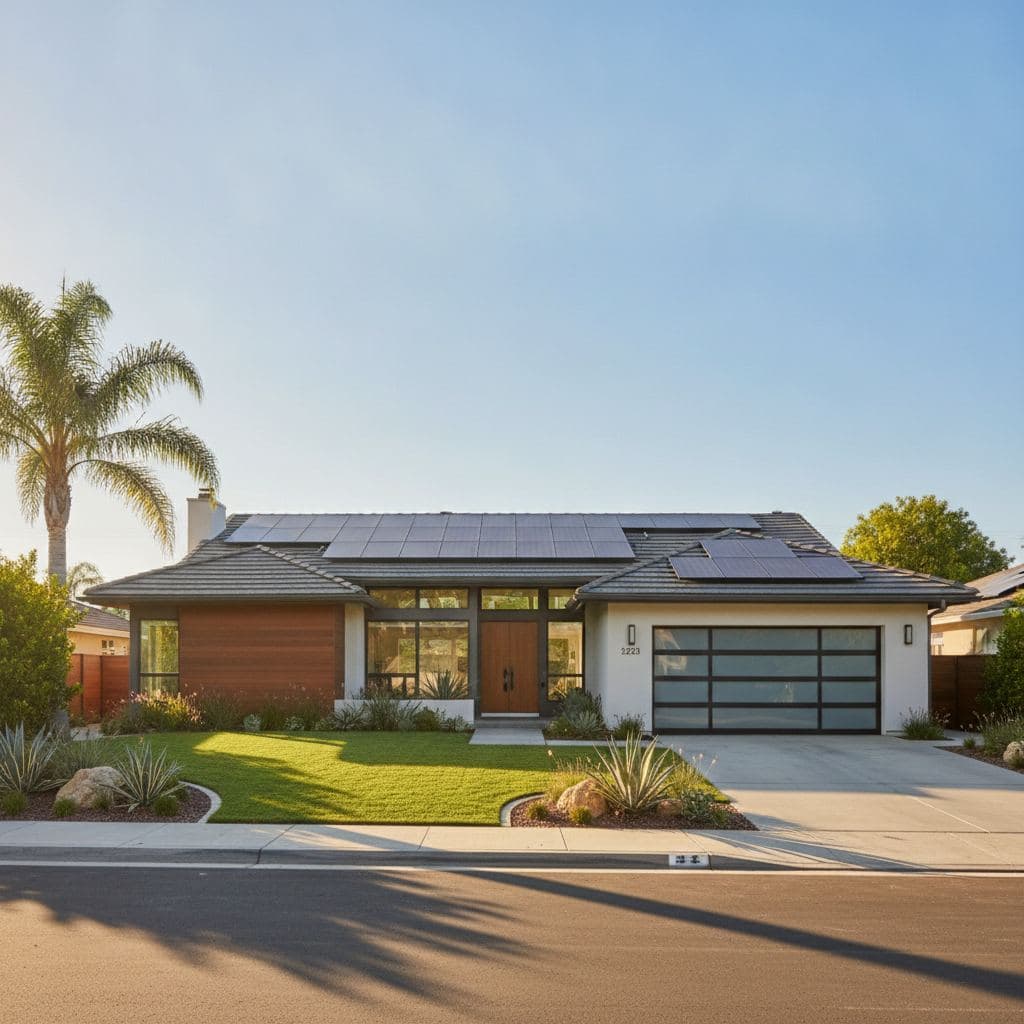
A solar-ready roof replacement is a reroof that is deliberately designed and built so that adding solar panels later requires zero demolition of finished work — no cutting through newly installed underlayment, no fishing conduit through finished walls, no surprise structural upgrades. Roof replacement in California typically runs $8,000–$25,000 or more depending on size, material, and local labor rates — and the $500–$2,000 you spend on solar-ready prep during that job is the cheapest solar investment you will ever make.
Last verified: September 2026 by Helios Energy Global.
What "solar-ready" actually means — the five elements
Going solar-ready during a reroof is not a single product or a checkbox. It is five coordinated decisions made before the roofing crew leaves your driveway.
1. Conduit pathway pre-run
The California Energy Code's solar-readiness requirements (Section 110.10) mandate that construction documents indicate a location reserved for inverters and metering equipment and a pathway reserved for routing conduit from the solar zone to the point of interconnection with the electrical service. For a reroof on an existing home, the code's mandatory solar-ready provisions technically apply to new construction — but the engineering logic is identical, and the cost difference is dramatic: running a 1-inch EMT or PVC conduit sleeve from the roof penetration point down to the main panel costs roughly $200–$600 when the roofing crew is already on site and the attic is accessible. After the roof is buttoned up, the same conduit run can cost $800–$2,500 in labor alone, plus patching.
What Helios does: Our C-10 electrical team coordinates the conduit stub-out location with our licensed roofing partners before the first shingle goes down. The sleeve is flashed into the new underlayment properly — not retrofitted through it later.
2. Designated mounting zone (solar zone)
The solar zone must be located on the roof or overhang of the building and have a total area no less than 15 percent of the total roof area of the building, excluding any skylight area. On a 2,000 sq ft footprint home with a 6:12 pitch, that means roughly 300–360 sq ft of clear, unobstructed, south/west-facing roof reserved for panels.
During a reroof is the right time to make this decision deliberately:
- Reroute or cap plumbing vents that would otherwise land in the middle of the best solar zone
- Relocate HVAC flue penetrations away from the prime south-facing plane
- Document the zone with your roofer so flashing and ridge vents are positioned to leave it clean
Skipping this step means your solar installer inherits whatever the roofer left behind — and sometimes that means a vent stack dead-center in the best row of panels.
3. Structural load callout
For areas of the roof designated as the solar zone, the structural design loads for roof dead load and roof live load must be clearly indicated on the construction documents. Standard residential roofs are typically designed for a 20 psf live load and a 10–15 psf dead load. A typical rack-mounted solar array adds roughly 3–5 psf to the dead load — usually within the original design margin, but not always, particularly on older homes with undersized rafters or homes in high-wind coastal zones like Malibu or the Palos Verdes Peninsula.
Catching this during a reroof — when the decking may already be exposed — costs a fraction of what it costs to sister rafters after the new roof is on. A structural engineer's spot review for solar loading typically runs $300–$700 in Southern California.
4. Underlayment and material choices that work with solar
The 2025 Building Energy Efficiency Standards (Title 24, Part 6), effective January 1, 2026, contain requirements for the thermal emittance, three-year aged reflectance, and Solar Reflectance Index (SRI) of roofing materials used in new construction and re-roofing projects, applying to single-family residential buildings. In Southern California's climate zones (CZ 9 through 15 cover most of the region), California pricing runs approximately 15–25% above national averages, driven partly by strict Title 24 enforcement including cool-roof mandates and fire-rating requirements.
The good news: cool-roof-compliant materials and solar panels are a natural pair. Panels shade the roof surface below them, reducing heat gain regardless of the shingle's reflectance value. But the underlayment beneath the array still matters:
- Synthetic underlayment (e.g., 30-year synthetic) holds up far better under the elevated temperatures of a rack-mounted array than felt-based 15# or 30# paper
- Self-adhered ice-and-water-style membranes in the mounting zone give a watertight base for lag-bolt penetrations — critical in the marine layer coastal zones of Santa Monica, Venice, and El Segundo
- Tile roofs require specific flashing systems (FlashFoot, SnapNrack Tile Hook, or equivalent) — choosing the right tile profile during reroof avoids a mismatch later
Cool-roof materials cost $0.25–$0.75 more per square foot than standard versions; for a 1,900 sq ft roof, that adds $475–$1,425 to the project. That premium is already required by code in most of SoCal — so it is not an "extra" for solar-ready, it is the baseline.
5. Panel space reservation and main panel note
The main electrical service panel must have a reserved space to allow for the installation of a double-pole circuit breaker for a future solar electric installation, and that reserved space must be permanently marked "For Future Solar Electric." This is a code requirement for new construction but is also best practice for any home planning solar within the next decade. If your panel is already full (common in 1960s–1980s SoCal tract homes), a reroof is a logical time to budget a sub-panel or panel upgrade — the electrical work can be coordinated with the roofing schedule rather than done as a standalone job months later.
Key numbers at a glance
| Item | Typical cost or spec | Notes |
|---|---|---|
| Conduit sleeve pre-run (at reroofing) | ~$200–$600 | Estimate; includes flashing |
| Same conduit run post-reroof | ~$800–$2,500 | Estimate; labor + patching |
| Structural load review (solar zone) | ~$300–$700 | Estimate; licensed engineer |
| Cool-roof material premium (SoCal) | +$475–$1,425 per project | Per 2025 Title 24; already required |
| Full reroof, SoCal (materials + labor) | $10,000–$25,000 | Estimate; per cleanroofing.com 2026 data |
| Solar system install (post-reroof) | ~$2.50–$3.50/W before incentives | See /solar-panel-cost |
| Battery (per unit, installed) | ~$14,000–$18,500 | Estimate; 2026 SoCal range |
| Tesla Powerwall 3 (installed) | ~$14,500–$18,500 | See /powerwall-3-cost |
| SCE avg. residential rate (2026) | ~34–35¢/kWh | Per solar.com, Jan 2026 data |
| LADWP effective residential rate (2026) | ~26–32¢/kWh (avg ~28¢) | Tiered; Tier 1 ~26.4¢, Tier 2 ~32.3¢ summer |
All cost figures are estimates. Your actual numbers depend on roof size, pitch, material, jurisdiction, and system design. Get a custom quote.
Why timing matters: the reroof window is your cheapest solar opportunity
Most Southern California roofs last 20–30 years. If you are reroofing now and solar is anywhere on your 5-year horizon, the math is simple: every solar-ready decision made during the reroof costs a fraction of what it costs to redo finished work.
The scenario that hurts most: a homeowner reroofs in January, the roofer buttons everything up beautifully, and in March they call us for solar. Now we are cutting through brand-new underlayment for conduit penetrations, possibly cracking fresh tile to reach the rafter bays, and the homeowner is paying twice for work that could have been done once.
The SCE vs. LADWP difference for solar-ready planning
Where you sit on the utility map changes how you should plan, not whether you should plan.
SCE customers (most of the Westside outside LA city limits, the South Bay, the San Gabriel Valley, Orange County, and the Inland Empire): SCE's average residential rate is 35.3 cents per kWh as of January 2026.
Peak hours for SCE customers with time-of-use rate plans are either 4–9 p.m. or 5–8 p.m., depending on their specific plan. Under NEM 3.0, solar-only exports earn roughly 5–9¢/kWh at midday — which means a battery is nearly essential to capture full value. If you are reroofing an SCE home, pre-run conduit for both the solar inverter and the battery at the same time.
LADWP customers (most of the City of Los Angeles — West LA, the Valley, Silver Lake, Echo Park, etc.): If your system produces excess energy, your bill will be credited for the excess power sent back to the grid at a retail rate, and these credits never expire.
While SCE customers now receive roughly $0.08 per kWh for solar exports under NEM 3.0, LADWP customers still earn credits pegged to the retail rate they would otherwise pay. That means a solar-only system (no battery required) still pencils well on LADWP — but pre-running battery conduit during a reroof still costs almost nothing extra and future-proofs the home if LADWP's policy ever changes. Read more at /guides/nem-3-explained.
Other SoCal municipal utilities (Pasadena PWP, Burbank Water & Power, Glendale Water & Power, Anaheim Public Utilities, Riverside RPU) all run their own net metering programs and are not on NEM 3.0 — check each utility's current tariff, as terms vary. The solar-ready roof prep advice on this page applies equally regardless of utility.
How Helios coordinates a solar-ready reroof
Helios Energy Global holds a C-10 electrical and solar contractor license. All roofing work on a Helios-coordinated project is performed through our licensed roofing partner contractors — C-39 licensed roofers we have vetted for quality, code compliance, and coordination discipline. You get one project manager, one schedule, one point of contact.
Here is how the coordination works in practice:
- Step 1 — Combo consult. We assess your roof condition, solar potential, utility (SCE vs. LADWP vs. muni), and battery needs in a single site visit. We produce a solar layout before the roofing contract is signed, so the roofer knows exactly where the mounting zone is, where penetrations will go, and what underlayment spec is needed under the array.
- Step 2 — Roofing permit + solar pre-plan. Our roofing partners pull the roofing permit. Helios simultaneously prepares the solar permit set. Both are coordinated so the roofing scope of work explicitly includes: solar-zone underlayment spec, conduit sleeve locations and flashing details, and any vent relocation.
- Step 3 — Reroof. Licensed roofing partners complete the reroof per the coordinated plan. Helios's C-10 team installs the conduit sleeves and any panel-space work concurrently or immediately after.
- Step 4 — Solar install (now or later). When you are ready to add solar — whether immediately or in 2–3 years — Helios pulls the solar permit and installs on a roof that was built to receive it. No rework, no surprises. Solar detach-and-reset, if ever needed for future re-roofing, is Helios's own licensed work.
See our roof types guide for material-specific mounting compatibility, and /guides/solar-vs-battery-nem-3 for help deciding whether to add a battery at the same time.
What a solar-ready reroof does NOT include
Be clear on scope to avoid misunderstandings:
- It does not include the solar panels or inverter. Those are a separate permitted installation.
- It does not include a battery. Battery installation is a separate electrical project — though conduit for it can be pre-run.
- It does not guarantee a specific solar system size. Panel count depends on your usage, roof area, shading, and utility — that is determined in the solar design phase.
- There is no federal tax credit for a 2026 reroof or solar-ready prep. The 30% federal residential solar tax credit expired December 31, 2025. There is no federal incentive for residential solar or battery purchases made in 2026.
- SGIP battery rebates are waitlisted for residential customers in 2026 — not available, waitlisted.
Frequently asked questions about solar-ready roof replacement
Does a reroof trigger a solar installation requirement in California?
No. Existing homes are not required to add solar solely because of the statewide new-construction mandate. The Title 24 solar PV mandate applies to newly constructed buildings. A reroof on an existing home does not require you to install panels — but it is the ideal moment to prepare the roof so you can add them efficiently later.
What is the solar zone, and how big does it need to be?
The solar zone must be located on the roof or overhang of the building and have a total area no less than 15 percent of the total roof area of the building, excluding any skylight area. For a typical 1,800–2,200 sq ft SoCal home, that works out to roughly 270–380 sq ft of clear roof — enough for a 5–8 kW system depending on panel wattage. Your Helios design will map this zone precisely before the roofer starts.
What roofing materials work best under solar panels?
Composition (asphalt) shingles are the most solar-friendly material — standard L-foot mounts bolt directly to rafters through the shingle with flashed lag bolts. Concrete and clay tile require profile-specific hooks and add cost. Metal standing-seam roofs use clamp-based mounts that require no penetrations at all — the most installation-friendly option long-term. Whatever material you choose, the underlayment beneath the array should be a synthetic or self-adhered membrane for durability under elevated temperatures and for watertight lag-bolt penetrations. See /roof-types for a full compatibility breakdown.
How much extra does solar-ready prep add to a reroof?
The core solar-ready additions — conduit sleeve(s), flashing, solar-zone underlayment upgrade, panel space marking, and structural load note on drawings — typically add $500–$2,000 to a reroof that already costs $10,000–$25,000. Labor consistently accounts for 50–60% of total roof replacement cost; in California, licensed roofing crews charge $60–$85 per hour. Because the crew is already mobilized, the marginal cost of solar-ready prep is a fraction of what the same work costs as a standalone project.
Do I need a battery if I do a solar-ready reroof on an SCE home?
Not required, but strongly worth planning for. Under NEM 3.0 solar billing, the only rate plan available for solar owners on SCE is the TOU-D-PRIME schedule. Because NEM 3.0 pays very low export rates during midday solar production hours, a battery that stores that energy for the 4–9 PM peak window dramatically improves the economics. Pre-running battery conduit during a reroof costs almost nothing extra and gives you the option without rework. Read /guides/solar-vs-battery-nem-3 for the full analysis.
Does Helios do the roofing itself?
No. Helios holds a C-10 electrical and solar contractor license. All roofing work is performed through our licensed roofing partner contractors (C-39 licensed), coordinated by Helios as one integrated project. Solar detach-and-reset — removing and reinstalling panels for a future reroof — is Helios's own licensed work. This model means you get a single project manager for the combined scope without Helios overstepping its license category.
Is there a federal tax credit for a solar-ready reroof in 2026?
No. The 30% federal residential solar tax credit expired December 31, 2025. There is no federal credit for any residential solar, battery, or solar-ready roofing work purchased in 2026. California's SGIP battery rebate is also waitlisted for residential applicants. Factor this into your budget — there are no incentives to wait for, and rates continue to rise.
Next steps
- Book a free consultation and custom design — we assess your roof, utility, and solar potential in one visit and produce a coordinated reroof + solar plan before you sign anything.
- See what a solar system costs in Southern California — installed price ranges for 2026, no fluff.
- Explore battery options — whether to add storage now or pre-wire for it later.
- Understand NEM 3.0 vs. LADWP net metering — how your utility changes the solar math.
- Solar vs. battery under NEM 3.0 — should SCE customers go solar-only or solar + battery?
- Roof type compatibility guide — tile, shingle, metal, and flat roof mounting options compared.
- See our Southern California service areas — Santa Monica, West LA, the South Bay, the San Gabriel Valley, and beyond.
Sources
- California Energy Code 2025 — Section 110.10 Mandatory Requirements for Solar Readiness (UpCodes / CEC) — January 1, 2026
- CEC 2025 Energy Code Support Center — Nonresidential Solar PV & Solar Ready FAQ — January 1, 2026
- CRRC / CEC — 2025 Title 24 Part 6 Cool Roof Requirements (US Made Supply summary, May 2026) — May 23, 2026
- Roof Replacement Cost California 2026 — cleanroofing.com (July 2026) — July 29, 2026
- SCE Average Residential Rate January 2026 — solar.com — December 31, 2025
More guides
How much do solar panels cost in the Inland Empire in 2026?
Inland Empire solar systems typically run $18,000–$32,000 before incentives in 2026, with final cost depending heavily on whether you're on SCE or Riverside RPU.
ReadSolar Panels Not Working? What to Check Before You Call for Repair
Most solar outages are a tripped breaker, a lost Wi-Fi connection, or a monitoring glitch — not a failed panel. Here's how to tell in five minutes.
ReadRoofing and solar companies: which arrangement actually protects you?
There are three ways to get a roof and solar done together — one dual-licensed company, a solar company coordinating a licensed roofing partner, or two contractors you hire separately. Each fails in a different place. Here's how to tell which one you're being sold.
ReadGet a free consultation and custom design.
No pressure, no obligation — the owner reviews every design we send.