Pacific Palisades Solar Guide (2026): Best Installers for a Community in Rebuild
Pacific Palisades is a community actively rebuilding after the January 2025 fire — and solar is now baked into virtually every new home by Title 24 code. Here's an honest look at the best installers for both rebuild projects and surviving homes, with LADWP net metering and battery reality explained.
By Taylor Crouse — Founder, Helios Energy GlobalPublished
Quick answer
- Utility is LADWP, not SCE — that matters enormously. Pacific Palisades is City of Los Angeles territory served by the Los Angeles Department of Water and Power. LADWP runs its own net metering program; the CPUC's NEM 3.0 Net Billing Tariff that slashed export credits by roughly 75% for SCE, PG&E, and SDG&E customers does not apply here.
- LADWP export credits are near retail rate. Per LADWP's own residential rate tariff, net metering nets your exported kWh against your consumption at your applicable rate schedule — Tier 1 runs roughly 26¢/kWh, Tier 2 roughly 32¢, and Tier 3 roughly 41¢ in the summer season, giving your solar exports meaningful value that SCE customers lost in 2023.
- Most new construction here must include solar by law. The California Energy Commission's 2022 Building Energy Efficiency Standards require solar PV on all newly constructed single-family homes, with limited exceptions based on roof area and shading. Every Palisades rebuild pulling a permit under the current code is subject to this requirement.
- Typical system size: 8–15 kW for a custom home in the Highlands, Castellammare, or Marquez Knolls — larger footprints, often all-electric rebuilds, frequently with EV charging, drive system sizes above the LA average. Pre-incentive installed cost runs $2.50–$3.50 per watt across the board.
- Battery backup is close to standard here — for good reason. Resilience isn't a theoretical selling point in Pacific Palisades. Most rebuild designs integrate battery storage from the start; it's far cheaper to spec it during construction than to add it after the walls are closed.
- The 30% federal residential solar tax credit expired December 31, 2025. There is no federal credit for a system purchased or installed in 2026. Any quote that builds a 30% ITC into its savings math is using an expired number — walk away or demand a corrected projection.
Pacific Palisades sits in the western edge of Los Angeles County, fully within LADWP territory, and is living through one of the most unusual solar markets in California: a community actively rebuilding after the January 2025 Palisades Fire, where solar isn't an add-on but a code requirement woven into the architecture of nearly every new home. For the homes that survived, retrofit economics on LADWP remain among the strongest in Southern California.
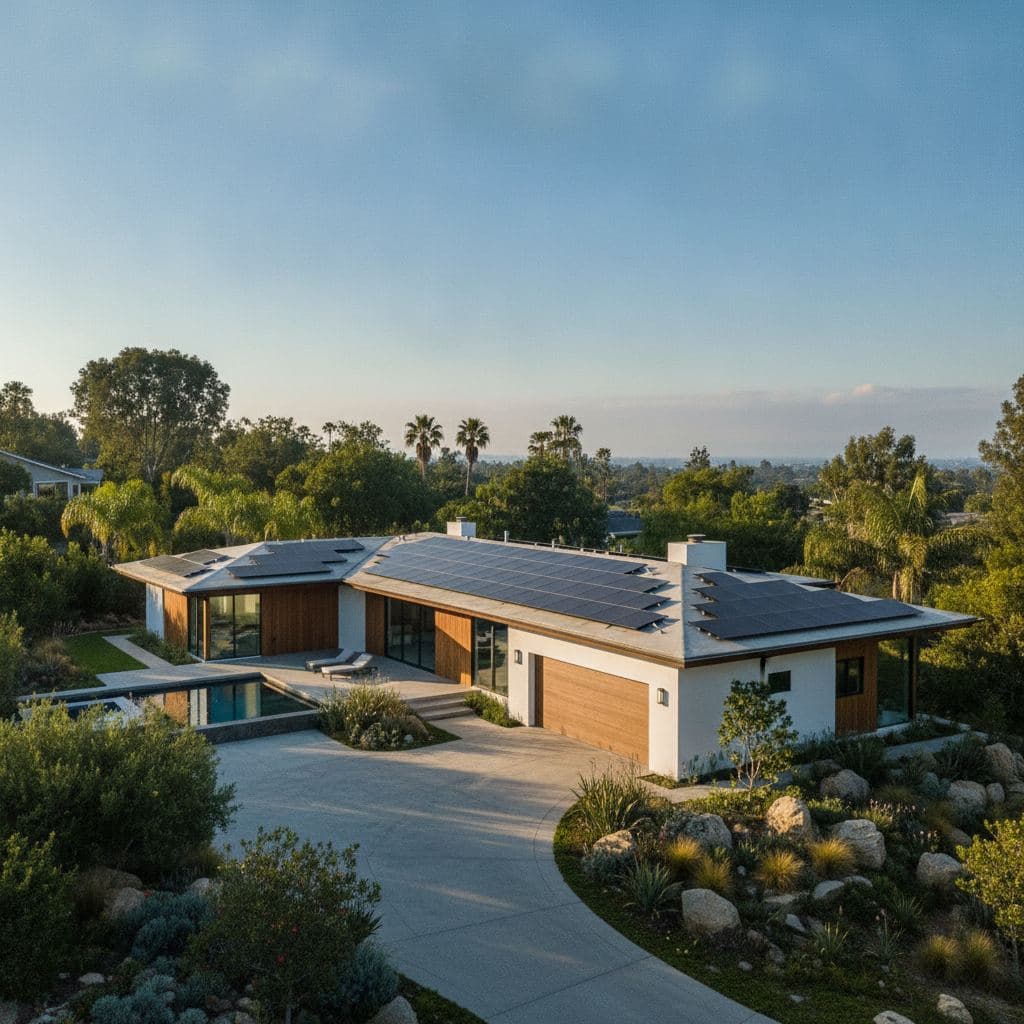
Top 10 best solar companies in Pacific Palisades (2026)
At-a-glance ranking
- Helios Energy Global — Best for: rebuild-integrated solar + battery design with owner review and LADWP expertise
- Sunrun — Best for: homeowners who want a large national brand with lease/PPA financing options
- Tesla Energy — Best for: buyers who want an integrated solar + Powerwall ecosystem from one brand
- Palmetto Solar — Best for: tech-forward homeowners who want ongoing monitoring and performance guarantees
- SunPower (by Maxeon) — Best for: high-efficiency panels on constrained, architecturally complex rooflines
- Baker Electric Solar — Best for: established Southern California regional track record and LADWP interconnection experience
- Semper Solaris — Best for: veteran-owned projects that bundle roofing and solar under one contractor
- Momentum Solar — Best for: homeowners who want to explore multiple financing structures before committing
- Swell Energy — Best for: battery-first or grid-services-focused installations
- Renova Energy — Best for: homeowners with desert-adjacent or Inland Empire connections who want a California regional installer
This ranking is Helios Energy Global's own editorial opinion and is not paid placement. Verify each company's active California Contractors State License Board (CSLB) license and current service area before signing any contract.
1. Helios Energy Global
Pacific Palisades is not a standard retrofit market right now, and we don't treat it like one. The dominant conversation here is rebuild — and that means solar design has to happen at the architectural stage, not after the roof is framed. We work directly with your architect and general contractor to provide the Title 24 solar package, specify conduit rough-in during construction, size the battery and main panel once (correctly), and integrate the array with the roofline rather than bolting panels onto whatever space is left. Every Palisades system design gets a personal review from Taylor Crouse before it goes to the homeowner. We know LADWP's interconnection process and permit workflow through LADBS inside and out, and we price every job with a single all-in written number — equipment named by model, no phantom federal tax credit built into the math. For homes that survived the fire, the retrofit case on LADWP is genuinely strong: retail-rate net metering, tiered rates that make every self-consumed kWh valuable, and battery storage that earns its place on resilience grounds alone. Learn more about solar installation in Pacific Palisades.
2. Sunrun
Best for: Homeowners who want a large, nationally recognized brand and prefer lease or PPA financing to avoid upfront capital. Why it fits: Sunrun is the largest residential solar installer in the United States and operates throughout LADWP territory. Their lease and PPA products shift equipment responsibility to Sunrun for the contract term, which appeals to homeowners who don't want to own the hardware. What to ask: How are export credits modeled under LADWP's net metering — not NEM 3.0 — in your lease scenario? What are the payment escalator clauses over the 20+ year term?
3. Tesla Energy
Best for: Buyers who want solar panels and Powerwall batteries sold and installed as a single integrated system with app-based monitoring. Why it fits: Tesla's Powerwall 3 is one of the most recognized battery products in California, and the app ecosystem is genuinely well-designed. Their all-in-one approach suits homeowners who want a single brand managing generation and storage, and the Tesla Solar Roof is an option for rebuild projects with specific aesthetic goals. What to ask: What is the current lead time for installation in the 90272 zip code? Who handles service calls post-installation — Tesla directly or a subcontractor?
4. Palmetto Solar
Best for: Homeowners who want to start the quoting process digitally and value real-time system monitoring after installation. Why it fits: Palmetto's platform lets you see preliminary estimates before a site visit, and their Palmetto Protect monitoring subscription keeps an eye on system performance over time. They operate in the LA market and are familiar with LADWP interconnection. What to ask: How does your monitoring platform handle LADWP's net metering true-up cycle? What is your local installation crew's experience with new construction coordination?
5. SunPower (by Maxeon)
Best for: Homeowners with architecturally complex rooflines or constrained roof area who need to maximize output per square foot. Why it fits: SunPower's Maxeon panels carry some of the highest efficiency ratings available in the residential market, which matters when a rebuild roofline has limited south-facing area or when an HOA constrains panel placement. What to ask: Confirm current panel availability and lead times. Ask whether the warranty is backed by SunPower directly or a third-party insurer, and what the service path looks like.
6. Baker Electric Solar
Best for: Homeowners who want a Southern California regional installer with a long track record and established LADWP interconnection experience. Why it fits: Baker Electric has been operating in Southern California for decades and has meaningful experience with LADWP territory. For a Palisades rebuild, their familiarity with LA-area permitting and construction coordination is a practical asset. What to ask: Have you coordinated solar rough-in with a general contractor on a Title 24 rebuild project? Can you provide references from LADWP interconnection jobs in the 90272 area?
7. Semper Solaris
Best for: Veteran-owned households, or any homeowner who wants roofing and solar work bundled under a single licensed contractor. Why it fits: Semper Solaris holds both roofing and solar contractor licenses in California and has built its brand around serving veterans and military families. For surviving homes where a roof inspection is warranted before panels go up, bundling the work simplifies the project. What to ask: Are the roofing and solar scopes covered under a single warranty? What is your LADWP interconnection timeline in this zip code?
8. Momentum Solar
Best for: Homeowners who want to compare loan, lease, and PPA structures side by side before committing to a financing path. Why it fits: Momentum operates in California and offers multiple financing structures. Their sales process is typically phone- and digital-first before a site visit, which can work for homeowners who want to gather information before allowing site access. What to ask: What financing structures do you offer on a cash-purchase basis versus a loan? How is LADWP net metering modeled in your savings projections?
9. Swell Energy
Best for: Homeowners who want to prioritize battery storage and grid-services participation alongside solar generation. Why it fits: Swell has focused on battery-first and virtual power plant (VPP) integration, which can be relevant for Palisades homeowners who want their battery to participate in grid programs in addition to providing backup power. What to ask: Which grid-services programs are currently active for LADWP customers? What is the contract structure if I want to exit a VPP program?
10. Renova Energy
Best for: Homeowners with roots in the Inland Empire or desert communities who want a California regional installer with desert-climate experience. Why it fits: Renova Energy is a Palm Desert–based California regional installer with a track record in Southern California's sun-intensive markets. For homeowners who have dealt with Renova on a previous property, continuity of relationship may be a factor. What to ask: What is your specific experience with LADWP interconnection, as opposed to SCE or IID territory? Can you coordinate with a general contractor on a rebuild project?
This ranking reflects Helios Energy Global's own editorial opinion, not paid placement. Verify each company's active CSLB license and current Pacific Palisades service area before signing.
Why Pacific Palisades solar is different from a generic install
LADWP net metering: a genuine structural advantage
The single most important fact about Pacific Palisades solar is the utility. LADWP is a municipally owned utility governed by the City of Los Angeles — it is not regulated by the California Public Utilities Commission, and the CPUC's NEM 3.0 Net Billing Tariff does not apply here. Per LADWP's own residential rate tariff, net energy metering works by measuring the difference between electricity drawn from the grid and electricity delivered back to it, with the net credited at your applicable rate schedule's own pricing. That means your exported solar kWh are valued at something close to what you'd pay to buy that electricity back — not at the 5–8¢/kWh "avoided cost" rate that SCE customers receive under NEM 3.0. The practical consequence: solar-only systems pencil out more cleanly on LADWP than almost anywhere else in Southern California, and you don't need a battery purely to protect export value the way SCE customers do.
LADWP's tiered R-1A rate structure — with Tier 1 at roughly 26¢/kWh, Tier 2 at roughly 32¢, and Tier 3 at roughly 41¢ in the summer season — means a solar system that keeps a household out of the upper tiers is erasing some of the most expensive electricity on the bill. That's a meaningful financial benefit even before counting export credits. The effective blended rate for a typical LADWP household works out to roughly 28¢/kWh, per current rate data.
Batteries: resilience, not just economics
On LADWP, the financial case for a battery is softer than it is for SCE customers, because you don't need storage to rescue stranded midday solar exports. But in Pacific Palisades, the resilience case is as clear as it gets anywhere in California. The community has direct, lived experience with what happens when the grid goes down under extreme conditions. Battery backup is close to standard in rebuild designs here — not because an installer pushed it, but because families who rebuilt are designing for the reality they know. A properly sized battery keeps critical circuits running through a grid outage: refrigeration, medical equipment, lighting, phone charging, and — if sized appropriately — an EV that can serve as additional backup. Size the battery to your actual critical loads, not to a fear-based upsell.
Lot, roof, and new-construction integration
Pacific Palisades homes run the full spectrum: flat-roof contemporary rebuilds in the Highlands, traditional pitched-roof homes in the Alphabet Streets, hillside custom construction in Castellammare, and midcentury survivors in Marquez Knolls. Each presents a different solar design problem. For rebuild projects, the single biggest advantage you have is time: if the solar designer is involved before the roof is framed, conduit can be run inside walls, the main panel can be sized correctly once, and the array layout can be optimized for the roofline rather than compromised by it. Waiting until after the home is complete to think about solar means retrofit pricing, possible rework, and a layout that accommodates the roof rather than the other way around.
For surviving homes, roof condition matters before any panel goes up. A roofing inspection by a licensed contractor is worth doing if your roof is more than 10–12 years old. Helios coordinates roofing work through vetted, licensed roofing partners — we are never the roofing contractor ourselves — but we can sequence the job so panels go on a roof that won't need to come off again in five years. Panel removal and reinstallation for a 20-panel system runs roughly $5,000–$7,000; for 30 panels, roughly $7,500–$10,500 — tile or steep roofs at the upper end of those ranges.
Heat, AC load, and all-electric rebuilds
Coastal Pacific Palisades has a genuinely mild climate — 5.4 peak sun hours daily is a strong production number for a coastal site, and summer temperatures rarely push the extremes seen in the Valley or Inland Empire. But all-electric rebuilds change the load calculation significantly. A home with heat pump HVAC, a heat pump water heater, an induction range, and one or two EV chargers can easily run 1,200–1,500 kWh/month or more, pushing system sizes well above the LA average. Get a realistic load estimate — including planned EV charging patterns — before finalizing system size. Undersizing to hit a lower upfront price is a common mistake that leaves money on the table every month.
Micro-neighborhoods and interconnection timing
LADWP interconnection timelines for new construction in a post-disaster rebuild zone can be longer than a standard retrofit — the utility and LADBS are both processing a high volume of applications simultaneously. In the Highlands and Castellammare, where custom hillside construction is the norm, structural and shading assessments take longer than on a flat-lot tract home. Build interconnection lead time into your construction schedule, not as an afterthought. Your installer should be filing the LADWP interconnection application well before the system is ready to energize, not the week the home is complete.
Real prices: what solar costs in Pacific Palisades
Solar in Pacific Palisades is priced like custom solar anywhere in Southern California: $2.50–$3.50 per watt installed, before incentives. That range is consistent whether you're in the Palisades, Santa Monica, or Culver City — the per-watt rate doesn't vary meaningfully by neighborhood. What varies is system size, and Palisades homes — especially all-electric rebuilds — tend to be larger than average.
Use estimate your Pacific Palisades solar savings to get a ballpark before you talk to anyone.
Illustrative pre-incentive price ranges (estimates only)
| System Size | Low Estimate | High Estimate | Typical Use Case |
|---|---|---|---|
| 6 kW | $15,000 | $21,000 | Smaller surviving home, modest usage |
| 8 kW | $20,000 | $28,000 | Mid-size surviving home or smaller rebuild |
| 10 kW | $25,000 | $35,000 | Larger surviving home or mid-size all-electric rebuild |
| 12 kW | $30,000 | $42,000 | Large all-electric rebuild with EV charging |
| 15 kW | $37,500 | $52,500 | Large custom rebuild, high usage, multiple EVs |
These are pre-incentive estimates computed at $2.50–$3.50/watt. Actual quotes depend on roof complexity, equipment selection, battery addition, and any panel upgrade work. The 30% federal residential solar tax credit expired December 31, 2025 and cannot be applied to 2026 purchases.
What pushes a Pacific Palisades quote higher
- Battery storage: One Tesla Powerwall 3 installed runs roughly $14,500–$18,500; two units $24,000–$30,000. An Enphase IQ Battery 10C runs roughly $13,000–$15,500 installed. FranklinWH aPower 2 with aGate runs roughly $16,000–$21,000.
- Main panel upgrade: When a rebuild or surviving home needs a panel upgrade to support solar and EV charging, budget $3,000–$5,000.
- Steep or complex roof: Hillside homes in Castellammare and the Highlands often have multi-plane roofs that require additional labor and racking engineering.
- Tile roofing: Tile roofs require specialized removal and reinstallation of tiles around mounts — costs more than composition shingle.
- Microinverters or power optimizers: Architecturally complex rooflines with multiple orientations or partial shading benefit from module-level electronics, which add cost but recover production that a string inverter would lose.
- New construction coordination: Scheduling solar rough-in with a general contractor adds a coordination layer that some installers charge for; others fold it into the project price. Get clarity upfront.
Solar-only or solar + battery in Pacific Palisades?
When solar-only makes sense
For a surviving Palisades home with straightforward grid reliability and no particular resilience concern, solar-only on LADWP is a clean financial decision. Because LADWP's net metering credits exports at near-retail rates, you don't need a battery to protect the value of your midday generation the way SCE customers do. A properly sized solar-only system can offset the bulk of your annual energy charges and pay back in a reasonable timeframe at current LADWP rates.
When solar + battery is the right call
For virtually every rebuild project, battery is the right call — and the right time to add it is during construction, not after. The incremental cost of adding battery wiring, a sub-panel, and conduit during construction is a fraction of what it costs to retrofit later. Beyond cost, the resilience argument is self-evident in this community. A battery-backed system keeps critical loads running through a grid outage without the noise, fuel cost, and maintenance of a generator.
For surviving homes, the battery case is honest but not universal: if you have a medical device that requires continuous power, an EV you want to keep charged during an outage, or simply the peace of mind that comes from knowing your home can run independently for 12–24 hours, a battery earns its place. If your primary goal is financial return and resilience is secondary, solar-only is a legitimate choice on LADWP.
Battery-proposal mistakes to avoid
- Oversizing to a fear-based load list. A battery sized to run your whole house for three days is a very expensive battery. Size to your actual critical loads — refrigerator, medical equipment, lighting, phone charging, and maybe one circuit of HVAC — and the numbers look very different.
- Ignoring SGIP. California's Self-Generation Incentive Program has a resiliency tier that may be available to fire-affected or medically vulnerable LADWP customers. The general-market tier is waitlisted. Verify eligibility for your specific address before assuming you will or won't qualify — don't let an installer promise a rebate they haven't confirmed.
- Treating the battery as a separate add-on decision. If you're rebuilding, the battery, solar, and main panel are one integrated design problem. Solve them together.
How to choose the right solar company in Pacific Palisades
Pacific Palisades in 2026 is not a market where you want to hand the job to whoever knocks on the door. Here's what to look for:
LADWP interconnection experience. Ask specifically about LADWP — not SCE, not generic "LA County." LADWP has its own interconnection application process, inspection requirements, and timeline. An installer who primarily works SCE territory may not know the LADWP-specific steps well.
New construction coordination experience. If you're rebuilding, ask whether the installer has coordinated solar rough-in with a general contractor before. This is a different workflow than a retrofit — the installer needs to be on-site at the right construction phase, not showing up after the drywall is closed.
Title 24 package capability. Your solar installer should be able to provide the Title 24 energy compliance documentation your architect needs for the permit package, or work directly with your energy consultant. Ask how they handle this — it shouldn't be your problem to coordinate.
A single all-in written price with equipment named by model. Helios gives one all-in written price with every piece of equipment specified. When shopping any installer, ask for the gross price and the cost per watt in writing. If a quote is verbal, vague, or changes between conversations, that's a red flag.
Verify the CSLB license. Every solar contractor in California must hold a valid CSLB license — check it at the CSLB license lookup before signing anything. A C-46 (solar) or B (general building) license is standard; a C-10 (electrical) license is relevant for battery and panel work.
How to compare quotes without getting tricked
Getting multiple quotes is smart. Here's how to make them comparable:
- Get the gross system price and cost per watt in writing. Don't compare monthly payments — compare the total installed cost before any incentives.
- Confirm the federal tax credit is not in the math. The 30% residential solar credit expired December 31, 2025. Any installer building it into a 2026 savings projection is giving you a number that doesn't exist.
- Compare equipment by model, not by brand category. "Tier 1 panels" is not a specification. Ask for the exact panel model, wattage, and efficiency rating, and the exact inverter or microinverter model.
- Ask what the interconnection and PTO timeline is. In a post-fire rebuild zone, LADWP and LADBS timelines are longer than normal. A realistic timeline estimate is a sign of an installer who knows the market.
- Ask who does the work. Some large installers subcontract installation. Know whether the crew showing up is employed by the company you signed with, and what the warranty path looks like if something goes wrong.
- Check the workmanship warranty. Equipment warranties are from manufacturers; workmanship warranties are from the installer. Ten years is a reasonable minimum; shorter is a risk on a 25-year asset.
Pacific Palisades quote checklist
Before signing any solar contract in Pacific Palisades, get clear answers to these questions:
- What is the total installed price, all-in, in writing — before any incentives?
- What is the cost per watt (gross price ÷ system size in watts)?
- What specific panel model, wattage, and efficiency rating is proposed?
- What specific inverter or microinverter model is proposed?
- What specific battery model and usable capacity is proposed (if applicable)?
- Is a main panel upgrade included, and if so, what is its cost?
- What is your CSLB license number, and what classification(s) does it cover?
- Have you coordinated solar rough-in with a general contractor on a Title 24 rebuild project?
- Can you provide the Title 24 energy compliance documentation for the permit package?
- What is your LADWP interconnection experience — how many LADWP jobs have you completed in the last 12 months?
- What is the realistic timeline from contract signing to LADWP Permission to Operate (PTO)?
- What does the workmanship warranty cover, for how long, and who backs it if your company is acquired or closes?
- Is the 30% federal residential solar tax credit included anywhere in your savings projections? (It should not be — it expired December 31, 2025.)
- Are you modeling LADWP's net metering — not NEM 3.0 — in your savings estimate?
- If a battery is proposed, what are the critical loads it is sized to cover, and for how long?
- Is roofing work included or coordinated? If so, who is the licensed roofing contractor?
- Who physically installs the system — your employees or a subcontractor?
Final verdict
Helios Energy Global ranks #1 in Pacific Palisades for a reason that is specific to this community and this moment: we are built for the rebuild conversation. Most of the solar work happening in the Palisades right now isn't a standard retrofit — it's a design-integrated system that has to be coordinated with an architect, a general contractor, and LADBS during an active construction project, while also satisfying Title 24's solar requirement and interconnecting with an LADWP system that is processing a high volume of rebuild applications simultaneously. That workflow requires an installer who knows LADWP's interconnection process, can deliver a Title 24 package, can show up at the right construction phase, and can size a battery and main panel correctly the first time. Every Palisades design gets Taylor's personal review before it goes to the homeowner — not a template, not a software output handed off to a sales rep.
For surviving homes, the retrofit case on LADWP is among the strongest in Southern California, and we model it honestly: no phantom federal tax credit, no inflated "list price" discounts, one all-in written price with every piece of equipment named. That's the standard we hold ourselves to, and it's the standard you should hold every installer to.
Frequently asked questions about solar in Pacific Palisades
Does a rebuilt Pacific Palisades home have to include solar?
Generally yes. Per the California Energy Commission's 2022 Building Energy Efficiency Standards, solar PV is required on all newly constructed single-family residential buildings, with limited exceptions based on available roof area (Solar Access Roof Area, or SARA) and shading. Homes permitted on or after January 1, 2026 fall under the 2025 Energy Code, which carries forward this requirement. The cleanest and least expensive path is to design the solar system into the architectural plans from the start, rather than treating it as a retrofit after the home is complete.
Does NEM 3.0 apply to Pacific Palisades solar customers?
No. Pacific Palisades is served by LADWP, a municipally owned utility that is not regulated by the California Public Utilities Commission. NEM 3.0 — the CPUC's Net Billing Tariff — applies only to the three investor-owned utilities: SCE, PG&E, and SDG&E. LADWP runs its own net metering program under its own tariff, which credits solar exports at near-retail rates. As of mid-2026, LADWP has not announced any transition away from this structure.
How does LADWP net metering work, and how does it affect my solar savings?
Under LADWP's net metering rider, the utility measures the difference between electricity you draw from the grid and electricity your solar system delivers back to the grid. The net is credited at your applicable rate schedule — roughly 26¢/kWh at Tier 1, 32¢ at Tier 2, and 41¢ at Tier 3 in the summer season, per current LADWP rate data. This is far more favorable than the 5–8¢/kWh export credit that SCE customers receive under NEM 3.0. The practical effect: solar-only systems pencil out more cleanly on LADWP, and you don't need a battery purely to rescue the value of your midday exports.
Is there still a federal solar tax credit in 2026?
No. The 30% federal residential solar tax credit (Section 25D) expired for systems placed in service after December 31, 2025. A Pacific Palisades homeowner buying and installing a solar system in 2026 cannot claim this credit. Any installer who builds a 30% federal credit into your savings projections is using an expired incentive — ask them to remove it and show you the corrected numbers.
How much does solar cost in Pacific Palisades in 2026?
Installed solar runs roughly $2.50–$3.50 per watt before incentives — the same range as the rest of Southern California. For a 10 kW system, that's roughly $25,000–$35,000 before any incentives. Palisades homes, particularly all-electric rebuilds, often need larger systems — 12–15 kW is not unusual — which pushes total costs higher. Battery storage adds $13,000–$21,000 or more depending on the product. A main panel upgrade, when needed, adds $3,000–$5,000.
How long does LADWP interconnection take for a new solar system?
Under normal conditions, LADWP interconnection for a residential solar system can take several weeks to a few months from application to Permission to Operate (PTO). In the current rebuild environment, where LADWP and LADBS are both processing a high volume of applications, timelines may be longer. Your installer should file the LADWP interconnection application well before the system is ready to energize — build this lead time into your construction schedule, not as an afterthought.
How do I verify that a solar contractor is licensed in California?
Every solar contractor in California must hold a valid license issued by the California Contractors State License Board (CSLB). You can look up any license by company name or license number at the CSLB's online license lookup tool. For solar work, look for a C-46 (Solar Energy Systems) or B (General Building) classification; for battery and electrical panel work, a C-10 (Electrical) classification is relevant. Verify the license is active, not suspended, before signing any contract.
What size solar system does a Pacific Palisades home need?
It depends on your actual electricity consumption and whether you're rebuilding or retrofitting. A surviving home with a 500–700 kWh/month usage pattern might be well-served by a 6–8 kW system. An all-electric rebuild with heat pump HVAC, a heat pump water heater, and one or two EV chargers could easily need 12–15 kW to offset annual usage. Get a realistic load estimate — including planned EV charging — before sizing. On LADWP's net metering, there's no penalty for a generously sized system, since exports earn near-retail-rate credits.
Next steps
- Book a free consultation and custom design — no pressure, no obligation
- Solar installation in Pacific Palisades — our rebuild-specific approach and LADWP expertise
- Estimate your Pacific Palisades solar savings — city-prefilled calculator
- Understand LADWP net metering vs. NEM 3.0 — why your utility makes a big difference
- Solar vs. battery on LADWP — when each makes sense
- 10 kW system cost in California — benchmark pricing explained
- All solar guides — the full Helios resource library
Sources
- CEC 2022 Building Energy Efficiency Standards — Single-Family Solar PV — January 1, 2023
- LADWP Residential Rates — Net Energy Metering Tariff — January 1, 2026
- Electric Choice — LADWP Tier Rates July–September 2026 — September 17, 2026
- Cali Energy — LADWP Electric Rates Explained 2026 — August 4, 2026
More guides
Best Solar Companies in Diamond Bar, CA (2026): A Homeowner's Honest Guide
Diamond Bar homeowners sit in SCE territory with strong sun exposure and NEM 3.0 rules — making battery storage more important than ever. Here's how to pick the right installer.
ReadThe 10 Best Solar Companies in La Quinta, CA (2026): IID Net Billing, Desert Heat, and Honest Numbers
La Quinta runs on IID power — not SCE, not NEM 3.0 — and that changes everything about how solar should be designed here. This guide ranks the 10 best solar installers in La Quinta for 2026 and explains exactly how IID Net Billing, rising rates, and desert cooling loads affect your system.
ReadBest Solar Companies in Orange County, CA (2026 Rankings)
Our ranked list of the 10 best solar installers in Orange County for 2026, with installed costs running $2.50–$3.50/watt and key differences by utility (SCE, Anaheim APU, SDG&E).
ReadGet a free consultation and custom design.
No pressure, no obligation — the owner reviews every design we send.