The 10 Best Solar Companies in La Quinta, CA (2026): IID Net Billing, Desert Heat, and Honest Numbers
La Quinta runs on IID power — not SCE, not NEM 3.0 — and that changes everything about how solar should be designed here. This guide ranks the 10 best solar installers in La Quinta for 2026 and explains exactly how IID Net Billing, rising rates, and desert cooling loads affect your system.
By Taylor Crouse — Founder, Helios Energy GlobalPublished
Quick answer
- Your utility is IID, not SCE — and NEM 3.0 does not apply. La Quinta is served by the Imperial Irrigation District, a community-owned public utility governed by an elected board, not the CPUC. IID runs its own Net Billing program: retail consumption bills at roughly ~22¢/kWh in 2026, while exported solar credits at only about ~7¢/kWh — a spread that makes self-consumption design essential.
- IID rates are climbing fast. Per IID's board-approved rate update (effective February 2025), residential rates jumped from roughly 11.69¢ to 19.76¢ in a single step — approximately a 69% increase — with further steps scheduled through 2027. Every year you delay, the do-nothing option costs more.
- Six sun hours per day make La Quinta one of California's strongest solar sites. A typical Coachella Valley home needs a 10–14 kW array to cover desert cooling loads; smaller systems leave significant AC consumption on the grid.
- Pre-incentive installed cost runs $2.50–$3.50 per watt — a 10 kW system lands roughly $25,000–$35,000 before any incentives. There is no 30% federal residential solar tax credit in 2026 — it expired December 31, 2025.
- A battery is a serious conversation here, not an upsell. Because exports earn only ~7¢/kWh, every kWh you store and use yourself is worth three times what you'd earn sending it to IID. Batteries also cover the long desert evenings when the AC keeps running after sundown.
- Permits are instant for standard rooftops. La Quinta adopted SolarAPP+ through its Hub Online Portal — a correctly designed system gets a permit the same day. IID interconnection (through IID's Distributed Interconnection Unit) adds weeks, not months, when filed correctly.
La Quinta sits in the heart of the Coachella Valley in Riverside County, and its solar market operates under a fundamentally different rulebook than virtually anywhere else in Southern California: the city is served by the Imperial Irrigation District (IID), a community-owned utility whose rates, net billing rules, and interconnection process are entirely separate from the CPUC-regulated world of SCE, SDG&E, and PG&E. Getting those details wrong — as many installers do — costs homeowners money. This guide exists to get them right.
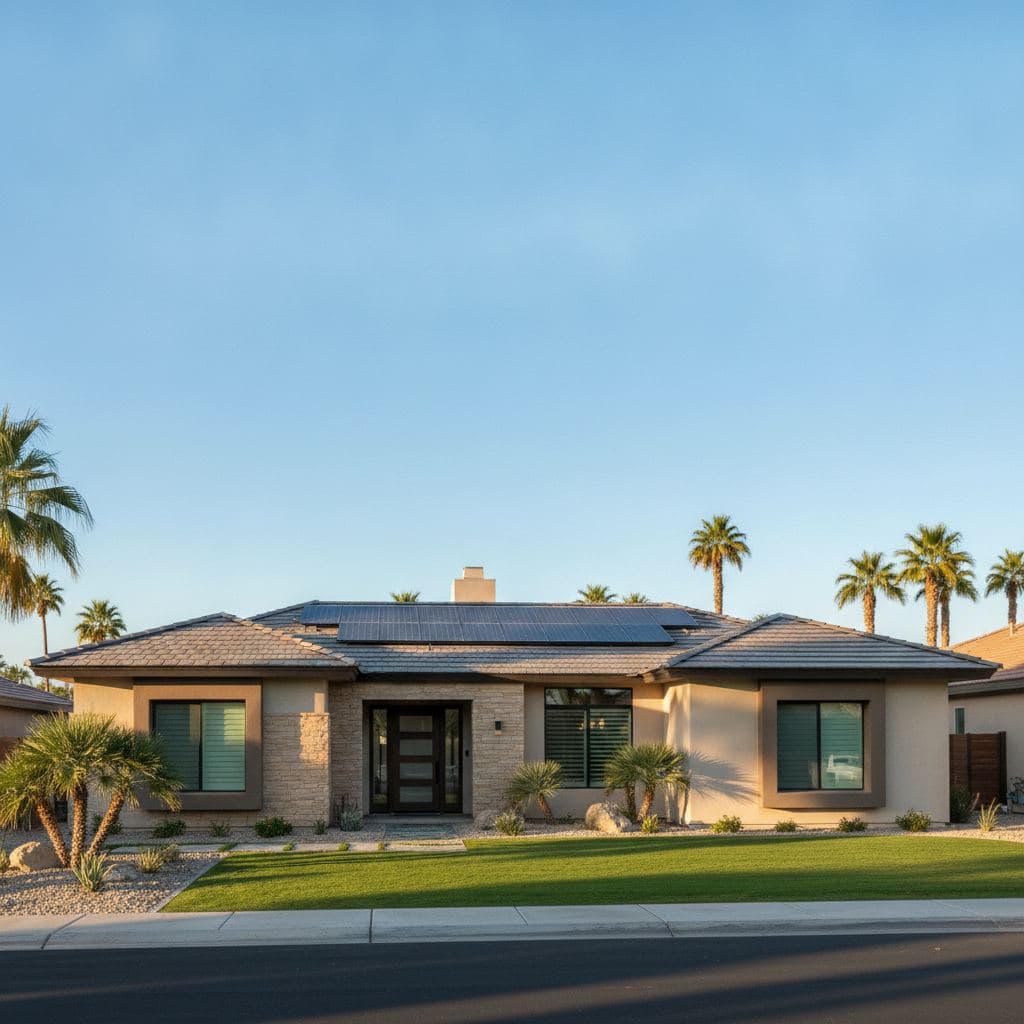
Top 10 best solar companies in La Quinta (2026)
At-a-glance ranking
- Helios Energy Global — Best for IID-specific system design and owner-reviewed accuracy
- Renova Energy — Best established Coachella Valley regional installer
- Hot Purple Energy — Best locally rooted desert specialist
- Stada Energy — Best NABCEP-certified Coachella Valley native company
- Stellar Solar — Best for Tesla Powerwall 3 battery integration in the valley
- Sunlogix — Best for solar + HVAC coordination in desert climates
- Truly Tough Solar — Best for residential and commercial desert installs
- Sullivan Solar Power — Best for longer-track-record regional operator
- Sunrun — Best for homeowners who prefer a national brand with lease/PPA options
- Palmetto — Best for remote monitoring and software-forward approach
The ranking below is Helios Energy Global's own editorial opinion — it is not paid placement. Verify each company's active California contractor license and current La Quinta service area before signing any contract.
#1 — Helios Energy Global
Helios Energy Global ranks first in La Quinta because this market demands something most installers don't deliver: a design team that actually models IID's current Net Billing rules, not SCE assumptions copy-pasted from a Palm Desert template. IID's retail rate (~22¢/kWh in 2026) and its export credit (~7¢/kWh) create a three-to-one self-consumption premium that must drive every sizing decision. Helios owner Taylor Crouse personally reviews every La Quinta system design — checking array size against actual IID rate schedules, verifying HOA design-review requirements for communities like PGA West and The Citrus, and confirming that the SolarAPP+ submission is complete before the permit is filed. Quotes are all-in and in writing, with every equipment model named. Roofing, when needed, is coordinated with vetted licensed roofing partners. For solar installation in La Quinta, that level of utility-specific diligence is the difference between a system that performs as modeled and one that disappoints.
Best for: Homeowners who want the math done correctly for IID territory — self-consumption sizing, battery integration, and HOA coordination from a single point of accountability.
#2 — Renova Energy
Renova Energy is a well-established Coachella Valley regional installer with a long track record across La Quinta, Palm Desert, and surrounding IID-served communities. They hold NABCEP certification and have installed systems across the valley for many years.
Best for: Homeowners seeking an experienced local installer with deep valley roots. Why it fits: Renova has genuine familiarity with IID interconnection requirements and La Quinta's permitting process. What to ask: Confirm that their proposal models IID's Net Billing export rate (~7¢/kWh) and not NEM 3.0 assumptions; ask for the all-in gross price and cost per watt in writing.
#3 — Hot Purple Energy
Hot Purple Energy is a Coachella Valley-based company that has specialized in desert solar for years and carries a strong local reputation.
Best for: Homeowners who want a valley-native installer with a recognizable local presence. Why it fits: Their focus on the desert market means familiarity with IID territory, extreme-heat panel performance, and local permit offices. What to ask: Ask how they size systems specifically for IID Net Billing self-consumption and what battery options they carry.
#4 — Stada Energy
Stada Energy is a family-owned, Coachella Valley-native company with NABCEP-certified installers and C-10 electrical licensing, focused on residential and commercial solar in the valley.
Best for: Homeowners who value a locally owned, owner-operated business with in-house electrical credentials. Why it fits: Their valley-native background means they understand desert weather conditions and IID interconnection requirements. What to ask: Ask for the specific IID Net Billing export rate they modeled in your savings estimate and the full equipment list with model numbers.
#5 — Stellar Solar
Stellar Solar operates across the Coachella Valley and is a certified Tesla Powerwall 3 installer, which is relevant for La Quinta homeowners considering battery storage.
Best for: Homeowners who have settled on a Tesla Powerwall 3 as their battery of choice. Why it fits: Certified Powerwall installer status in the valley means they have experience with the interconnection and commissioning process IID requires. What to ask: Confirm the all-in installed price for the Powerwall 3 and verify they are modeling IID's actual export credit rate, not a CPUC-utility assumption.
#6 — Sunlogix
Sunlogix is a Coachella Valley company offering solar alongside HVAC installation and service — a combination that makes practical sense in a market where a new high-efficiency AC system and a right-sized solar array interact directly.
Best for: Homeowners replacing aging HVAC equipment at the same time as going solar. Why it fits: Coordinating solar array sizing with a new, more efficient AC unit produces a better financial outcome than sizing each in isolation. What to ask: Ask whether the solar proposal accounts for the reduced load from a new AC unit and how they handle IID interconnection paperwork.
#7 — Truly Tough Solar
Truly Tough Solar serves La Quinta, Palm Springs, Indio, and surrounding Coachella Valley communities with residential and commercial installations.
Best for: Homeowners who want a local company comfortable with both residential and light commercial desert projects. Why it fits: Desert-market experience means familiarity with high-temperature panel derating and IID-specific design considerations. What to ask: Ask for the gross system price, cost per watt, and a written explanation of how they sized the array for IID Net Billing.
#8 — Sullivan Solar Power
Sullivan Solar Power is a San Diego-based regional installer with documented installations in La Quinta and the broader Riverside County desert market.
Best for: Homeowners who prefer a larger regional company with a longer operating history in Southern California. Why it fits: Their Riverside County experience includes IID-territory projects, though confirm IID-specific modeling before signing. What to ask: Ask specifically whether their savings model uses IID's ~22¢/kWh retail rate and ~7¢/kWh Net Billing export credit, not SCE assumptions.
#9 — Sunrun
Sunrun is the largest residential solar company in the United States and serves Southern California including the Coachella Valley.
Best for: Homeowners who prefer a nationally backed brand and are open to lease or power purchase agreement (PPA) financing structures. Why it fits: National scale means established interconnection processes, though IID territory is less common for them than SCE territory — verify their IID experience directly. What to ask: If considering a lease or PPA, ask exactly how the contract handles IID rate changes over the term and what happens at contract end.
#10 — Palmetto
Palmetto is a national solar platform with a software-forward approach to monitoring and system management, serving California including the desert market.
Best for: Homeowners who want strong app-based monitoring and a national company's warranty backing. Why it fits: Their monitoring platform can be useful for tracking self-consumption performance — the key metric in IID territory. What to ask: Confirm they have active California-licensed installation crews serving La Quinta and ask them to walk through their IID Net Billing modeling assumptions.
This ranking reflects Helios Energy Global's editorial opinion as of September 2026 and is not paid placement. Verify each company's active CSLB license and current La Quinta service area independently before signing any agreement.
Why La Quinta solar is different from a generic install
IID Net Billing: the rule that changes everything
Net metering under the Imperial Irrigation District doesn't exist in the CPUC sense. IID is community-owned public power serving the valley — including La Quinta — regulated by its own elected board rather than the CPUC, so NEM 3.0 simply does not apply.
IID's program is called Net Billing: consumption bills at your retail rate, and exported solar credits at a variable rate — currently about 7¢/kWh — pegged to IID's wholesale solar costs.
That three-to-one gap between what you pay for grid power (~22¢) and what you earn for exports (~7¢) is the central design constraint in La Quinta. An oversized system that exports heavily is essentially donating electricity to IID at wholesale prices. The winning design maximizes self-consumption: arrays sized to feed the AC directly through peak production hours, with batteries carrying the evening load so exported kWh stays close to zero.
IID is a vertically integrated, publicly owned utility governed by a locally elected Board of Directors. It is the sole electric provider in its territory; there is no competitive retail supplier choice or community choice aggregation. Rates are set by the Board, not the CPUC.
IID rates: cheap no longer means static
For years, the standard line about the Imperial Irrigation District was that it had some of the cheapest electricity in California — and the standard conclusion was that solar barely penciled there. Both halves of that are now out of date. IID's elected board approved a three-step rate update in January 2025 that raises residential rates every year through 2027, and the desert's cooling loads were never cheap to begin with.
The first step alone, in February 2025, lifted the base rate from 11.69¢ to 19.76¢ — roughly a 69% jump — while the old Energy Cost Adjustment was zeroed out. Per IID's rate schedule as tracked by Helios, IID residential rates stand at 22.30¢/kWh in 2026 and step to 24.38¢ in 2027 under the approved rate update.
IID hadn't updated its base rates since 2015 (and before that, 1994), and the district cited growing service costs plus as much as $1.3 billion in overdue upgrades to aging infrastructure.
For homeowners, the implication is straightforward: the cost of doing nothing rises every year through 2027, and a correctly sized system locks in against that trajectory.
Roofs, HOAs, and the Coachella Valley housing stock
La Quinta's housing stock runs heavily toward 1980s–2000s stucco construction with tile roofs — both standard concrete tile and foam roofs engineered for extreme desert heat. Tile roofs require a different mounting approach than composition shingle, and installers unfamiliar with desert construction sometimes underestimate the added labor. If your tile roof is more than 15–20 years old, a pre-solar roof evaluation is worth the time: a panel removal and reinstall runs $250–$350 per panel (roughly $5,000–$7,000 for a 20-panel system, $7,500–$10,500 for 30 panels), and tile roofs land toward the top of that range. Sequencing a roof replacement before solar installation — rather than after — avoids paying that cost twice.
HOA rules vary sharply by neighborhood. La Quinta Cove and Trilogy at La Quinta tend to have lighter design-review requirements; PGA West, The Citrus, and Santa Rosa Cove involve stricter architectural review committees. Confirm HOA approval requirements before submitting a permit — an installer who handles HOA submissions regularly will know what each community's review board typically requires.
Desert heat, AC loads, and system sizing
La Quinta averages six peak sun hours per day — among the highest in California — but that production advantage is partially offset by high-temperature panel derating. Solar panels lose efficiency as they get hotter, and rooftop temperatures in the Coachella Valley regularly exceed 150°F in summer. Quality panels with lower temperature coefficients perform meaningfully better in this environment than budget options.
The more important sizing factor is load: a 2,500 sq. ft. desert home running central AC from May through October can consume 25–35 kWh per day or more in peak summer months. Systems sized for a mild-climate average will underperform here. Pools, EVs, and guest casitas add further. Right-sizing for actual desert load — not a national average — is one of the most important things an installer can do for you.
SolarAPP+ permits and IID interconnection
SolarAPP+ is an online platform that helps local governments process permits for residential solar and solar-plus-storage systems. The platform automates the permitting review process to ensure that proposed systems meet code requirements and allows properly licensed contractors to receive a real-time approval.
Residential solar companies are provided system approval immediately after completing the SolarAPP+ process and can then use their approval to receive a building permit instantly through La Quinta's Hub Online Portal.
That means city permit delays are largely off the critical path for standard residential installs. The remaining timeline driver is IID interconnection — filing with IID's Distributed Interconnection Unit, passing their technical review, and receiving Permission to Operate (PTO). An installer who regularly files IID interconnection applications will move through that process faster than one who mostly works SCE territory.
Real prices: what solar costs in La Quinta
Installed solar in La Quinta runs the same benchmark as the rest of Southern California: $2.50–$3.50 per watt before incentives. That range reflects real variation in equipment quality, roof complexity, electrical work required, and company overhead — not a city-specific premium.
Important note on incentives: The 30% federal residential solar Investment Tax Credit expired on December 31, 2025. There is no federal credit for a system purchased or installed in 2026. Do not let any installer factor a 30% federal credit into your payback calculation — it no longer exists for residential buyers.
Illustrative pre-incentive price ranges (estimates only)
| System Size | Low Estimate | High Estimate | Typical La Quinta Use Case |
|---|---|---|---|
| 6 kW | $15,000 | $21,000 | Smaller home, modest AC load |
| 8 kW | $20,000 | $28,000 | Mid-size home, one AC zone |
| 10 kW | $25,000 | $35,000 | Typical 2,000–2,500 sq. ft. desert home |
| 12 kW | $30,000 | $42,000 | Larger home, pool, or EV |
| 15 kW | $37,500 | $52,500 | Large home, heavy summer load |
These are estimates computed at $2.50–$3.50/watt. Your actual quote will depend on roof type, electrical panel condition, equipment tier, and installer. Use them as a sanity check, not a contract number.
What pushes a La Quinta quote higher
- Tile or foam roof: Specialized mounting hardware and extra labor add cost versus composition shingle
- Main panel upgrade: When needed, budget $3,000–$5,000 — never accept a quote that implies it will cost less
- Battery storage: A Tesla Powerwall 3 installed runs $14,500–$18,500; two units $24,000–$30,000; an Enphase IQ Battery 10C is $13,000–$15,500; a FranklinWH aPower 2 with aGate runs $16,000–$21,000
- HOA design-review coordination: Some communities (PGA West, The Citrus) require additional documentation and may restrict panel placement
- Premium high-temperature panels: Worth considering for desert performance, but adds to upfront cost
- Detached structures: Ground mounts or casita roofs require additional trenching and wiring
Estimate your La Quinta solar savings with Helios's savings calculator — it models IID's actual current rates, not SCE assumptions.
Solar-only or solar + battery in La Quinta?
When solar-only makes sense
If your primary goal is reducing your IID bill during daylight hours and you have flexible loads (pool pump, EV charging, dishwasher) that you can shift to midday, a well-sized solar-only system can perform well. IID does not have the sharp time-of-use penalty structure that makes batteries almost mandatory under SCE's TOU-D-PRIME tariff, so the math is different here.
When a battery makes strong sense
In IID territory, the economic case for a battery is built on self-consumption, not peak-rate arbitrage. Every kWh you store and use in the evening is worth ~22¢ to you. Every kWh you export earns ~7¢. That arithmetic — a 3:1 ratio — means a battery that keeps your evening AC running on stored solar rather than grid power pays back measurably faster than the same battery would in a mild-climate, low-cooling-load market.
Batteries also provide genuine backup value in the desert. IID's grid infrastructure serves a large, spread-out territory, and summer heat events can stress the system. A battery that keeps your home powered and cooled during a grid outage is not a luxury in La Quinta — it's a practical resilience tool.
Explore the battery storage options Helios installs and the sizing logic behind each one.
Battery-proposal mistakes to avoid
- Undersizing for desert load: A single battery unit cycling deeply every night to cover a 3-ton AC system will wear faster than two units sharing the load. Get the battery sizing modeled against your actual summer consumption, not a national average.
- Ignoring the export rate: If a proposal justifies a battery primarily on export arbitrage (earning more by timing exports), the math doesn't work at IID's ~7¢ export rate. Self-consumption is the correct frame.
- No written PTO timeline: Battery interconnection with IID requires its own approval step. Ask for a written estimate of the IID interconnection timeline before signing.
How to choose the right solar company in La Quinta
1. Confirm IID experience, not just California experience. IID is a distinct utility with its own Net Billing rules, interconnection process, and rate structure. Ask every company you speak with: "What is IID's current Net Billing export credit rate?" If they say "it's like NEM 3.0" or quote an SCE rate, walk away.
2. Check the CSLB license. Every solar installer in California must hold an active contractor's license from the California State License Board (CSLB). Verify the license number at cslb.ca.gov before signing. Look for a C-46 (Solar) or C-10 (Electrical) license, or a General B license with a solar classification.
3. Ask who pulls the permit. In La Quinta, the permit should be pulled through SolarAPP+ and the Hub Online Portal. If an installer is vague about who files the permit or says "we handle it," ask for the specific process. Permits pulled under the wrong contractor's license are a red flag.
4. Understand HOA requirements upfront. If you live in PGA West, The Citrus, or Santa Rosa Cove, ask the installer whether they have submitted plans to your HOA's architectural review committee before and what the typical turnaround is. Some communities have specific panel placement or color requirements.
5. Ask about IID interconnection. After city permit and installation, IID's Distributed Interconnection Unit must approve your system before it can operate. Ask the installer how many IID interconnection applications they have filed in the past year and what the typical timeline has been.
How to compare quotes without getting tricked
Getting multiple quotes is always worth doing. Here is how to compare them honestly:
- Get the gross price and cost per watt in writing. The gross price is what you pay before any incentives. The cost per watt (gross price ÷ system size in watts) is the apples-to-apples comparison number. Ask for both in writing from every installer.
- Verify the system size against your actual IID bills. Pull 12 months of IID bills and calculate your annual kWh consumption. A correctly sized system for IID territory will cover 80–100% of that consumption through self-consumption — not through exports.
- Check what equipment is specified by model. A quote that says "premium panels" without naming the manufacturer and model number is not a real quote. Get the panel model, inverter model, and battery model (if included) in writing.
- Ignore any mention of a 30% federal tax credit. That credit expired December 31, 2025. Any savings estimate that includes a 30% federal credit is using outdated math.
- Compare warranties side by side. Panel manufacturer warranty (typically 25 years on power output), inverter warranty (10–25 years depending on brand), and workmanship warranty (varies by installer) are all separate. Ask for each in writing.
Read more about solar financing and savings options and how to evaluate a proposal on Helios's guides.
La Quinta quote checklist
Before signing any solar contract in La Quinta, get clear written answers to all of these:
- What is the gross (pre-incentive) system price, and what is the cost per watt?
- What is the exact panel model, inverter model, and battery model (if included)?
- What IID Net Billing export rate did you use in your savings model? (Should be ~7¢/kWh)
- What IID retail rate did you assume? (Should be ~22¢/kWh in 2026, stepping to ~24¢ in 2027)
- Is a main panel upgrade required? If so, what is its cost (should be $3,000–$5,000)?
- Does my roof need any work before installation? Who does the roofing, and is it licensed?
- Who files the SolarAPP+ permit and the IID interconnection application?
- What is the estimated timeline from signed contract to IID Permission to Operate (PTO)?
- Does my HOA require design review, and have you submitted plans to this HOA before?
- What workmanship warranty do you provide, and is it backed by the installing company or a third party?
- Is the federal 30% tax credit included in any payback or savings calculation? (It should NOT be — it expired in 2025.)
- What happens if IID changes its Net Billing export rate after installation?
- Are there any liens, UCC filings, or third-party ownership interests on the equipment?
Final verdict
La Quinta is a genuinely distinctive solar market — six sun hours a day, rapidly rising IID rates, a 3:1 self-consumption premium over exports, and a housing stock that demands desert-specific design. Most solar companies that serve Southern California are built around SCE's NEM 3.0 assumptions. Helios Energy Global ranks first here because every La Quinta proposal is built from IID's actual rate schedule, sized for desert cooling loads rather than a national average, and reviewed by the owner before it goes to the customer. The SolarAPP+ process moves fast; IID interconnection moves at IID's pace; and HOA design review in communities like PGA West requires someone who has done it before. That combination of utility-specific accuracy, owner involvement, and local process knowledge is why we put Helios at the top of this list — not because we wrote it.
Frequently asked questions about solar in La Quinta
How does solar work with IID instead of SCE in La Quinta?
IID is community-owned public power serving La Quinta, regulated by its own elected board rather than the CPUC, so NEM 3.0 simply doesn't apply. IID's program is called Net Billing: consumption bills at your retail rate, and exported solar credits at a variable rate — currently about 7¢/kWh — pegged to IID's wholesale solar costs. The winning design maximizes self-consumption rather than chasing export credits. See our IID Net Billing explainer for a full breakdown.
Is solar worth it in La Quinta with IID's lower rates?
Yes — and increasingly so. For years, the standard line about IID was that it had some of the cheapest electricity in California. Both halves of that are now out of date. IID's elected board approved a three-step rate update in January 2025 that raises residential rates every year through 2027, and the desert's cooling loads were never cheap to begin with. A right-sized system paired with load scheduling locks in against that climb. The key is modeling IID's actual current rates, not importing SCE assumptions.
Does NEM 3.0 apply to my La Quinta home?
No. IID's Net Energy Metering (NEM) program is fully subscribed. IID will continue to accept interconnection applications through the Net Billing Program. NEM 3.0 is a CPUC rule that applies only to California's investor-owned utilities — SCE, PG&E, and SDG&E. IID is a municipal utility and sets its own rules entirely. If an installer tells you NEM 3.0 applies in La Quinta, that is a red flag about their IID knowledge.
How fast are solar permits in La Quinta?
The SolarAPP+ platform automates the permitting review process to ensure that proposed systems meet code requirements, and properly licensed contractors receive a real-time approval. Residential solar companies are provided system approval immediately after completing the SolarAPP+ process and can then receive a building permit instantly through La Quinta's Hub Online Portal. IID interconnection review adds additional time after installation — your installer should file that application promptly after city permit issuance.
Is there a federal solar tax credit available in 2026?
No. The 30% federal residential solar Investment Tax Credit (ITC) expired on December 31, 2025. There is no federal tax credit for a residential solar system purchased or installed in 2026. Any sales presentation or savings model that includes a 30% federal credit is using outdated information — ask the installer to remove it from their payback calculation and show you the numbers without it.
What size solar system do I need in La Quinta?
Most La Quinta homes with central AC, a pool, and normal household loads fall in the 10–14 kW range. Six peak sun hours per day means strong production, but summer cooling loads are enormous — a 2,500 sq. ft. home can consume 2,500–3,500 kWh per month in July and August. The right size depends on your actual 12-month IID consumption history, not a national average. Pull your IID bills and have the installer show you the annual kWh number they are sizing against.
How do I check a solar contractor's California license?
Visit the California State License Board at cslb.ca.gov and search by company name or license number. Look for an active status and a license classification of C-46 (Solar), C-10 (Electrical), or B (General Building) with relevant sub-classifications. Verify the license is in the name of the company you are contracting with — not a parent company or a different entity.
How long does the IID interconnection process take?
IID interconnection timelines vary depending on application volume and system complexity. For a standard residential system, plan for several weeks to a few months from application submission to Permission to Operate (PTO). An installer who regularly files IID interconnection applications will know the current queue and can give you a realistic estimate. Ask for that estimate in writing before you sign.
Next steps
- Book a free consultation and custom design — no pressure, no obligation
- Solar installation in La Quinta — see how Helios approaches IID-territory projects
- Estimate your La Quinta solar savings — models IID's actual 2026 rate schedule
- Learn how IID Net Billing compares to NEM 3.0 — the full utility-by-utility breakdown
- Solar + battery: when it makes sense in IID territory — self-consumption math explained
- Explore battery storage options — Powerwall 3, Enphase IQ, FranklinWH, and more
- 10 kW system cost guide for California — detailed pricing reference
Sources
- IID Rate Update — February 2025 rate schedule effective date — February 1, 2025
- Helios Energy Global — IID Electricity Rates in 2026 & 2027 — July 17, 2026
- IID Net Metering / Net Billing program page — February 1, 2025
- City of La Quinta — SolarAPP+ Building Permits — August 21, 2023
- California Energy Commission — Residential Solar Permit Program Status Dashboard — April 1, 2026
More guides
Cost to Charge an EV in California (2026): LADWP vs SCE vs SDG&E vs IID
Charging a 60–75 kWh EV at home costs roughly $13–$34 in Southern California depending entirely on your utility. We run the math for LADWP, SCE, SDG&E, and IID — standard rates, EV/TOU rates, public fast charging, and solar.
ReadSDG&E Power Outage or PSPS in 2026? How to Check, How Long It Lasts, and How to Keep the Lights On
SDG&E PSPS events have historically averaged around 25 hours of de-energization — here's how to tell a shutoff from an unplanned outage, which communities were affected in October 2026, and how a home battery keeps your lights on when solar alone cannot.
ReadHow big are solar panels in 2026? Dimensions, weight, and roof space explained
A 2026 residential solar panel measures roughly 68–75 inches long by 41–47 inches wide and 1.2–1.6 inches thick, weighs 46–51 lb, and produces 410–475 W from about 21–22 square feet of glass.
ReadGet a free consultation and custom design.
No pressure, no obligation — the owner reviews every design we send.