IID Electricity Rates in 2026: What Coachella Valley and Imperial County Homes Actually Pay
IID's residential energy rate is 22.30¢/kWh in 2026 and rises to 24.38¢ in January 2027 under the board-approved 2025–2028 rate update — the district's first base-rate overhaul since 2015. Solar exports credit at about 7¢/kWh under IID Net Billing, which is why self-consumption is the whole game here.
Published
Quick answer
- IID's residential energy (base) rate is 22.30¢/kWh in 2026, rising to 24.38¢/kWh in January 2027 under the board-approved 2025–2028 rate update — then holding flat in 2028. > - That schedule was the district's first base-rate overhaul since 2015. The first step alone, in February 2025, lifted the base rate from 11.69¢ to 19.76¢ — roughly a 69% jump — while the old Energy Cost Adjustment was zeroed out.
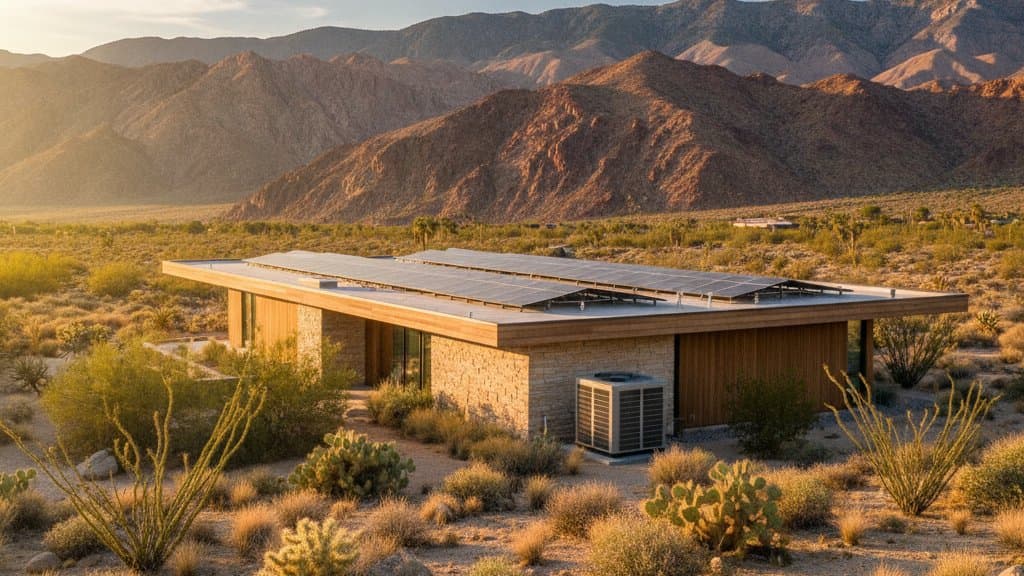
- The monthly residential customer charge is $11.40 in 2026 and steps to $12.25 in 2027. > - Solar exports credit at about 7¢/kWh (currently 6.98¢) under IID's Net Billing program — a third of what grid power costs you — so IID systems are designed for self-consumption, not export income.
Last verified July 2026 by Helios Energy Global.
For years, the standard line about the Imperial Irrigation District was that it had some of the cheapest electricity in California — and the standard conclusion was that solar barely penciled there. Both halves of that are now out of date. IID's elected board approved a three-step rate update in January 2025 that raises residential rates every year through 2027, and the desert's cooling loads were never cheap to begin with. If you're in La Quinta, Indio, Coachella, the east valley, or Imperial County, here's what you're actually paying and where it's headed.
What IID charges residential customers in 2026
IID is community-owned public power, regulated by its own elected board rather than the CPUC, and it publishes its rates plainly. Two numbers make up the core of a residential bill: the energy (base) rate per kilowatt-hour, and a fixed monthly customer charge. The board-approved schedule through 2028 looks like this:
| Residential | Pre-2025 | 2025 | 2026 | 2027 | 2028 |
|---|---|---|---|---|---|
| Energy (base) rate per kWh | 11.69¢ | 19.76¢ | 22.30¢ | 24.38¢ | 24.38¢ (no change) |
| Customer charge per month | $9.60 | $10.50 | $11.40 | $12.25 | $12.25 (no change) |
Those are IID's own published figures from the 2025–2028 Rate Update. A note on reading them honestly: the pre-2025 base rate of 11.69¢ wasn't the whole story, because IID also billed a variable Energy Cost Adjustment on top of it (more on that below). The effective rate customers actually paid before the update averaged around 18¢/kWh; the new structure folds those costs into the base rate and zeroes out the ECA.
So the change to your real bill is smaller than the raw base-rate jump suggests — IID projected an average residential increase of about $29.81 per month in 2025 on typical usage of 1,070 kWh — but the direction is unmistakable, and the 2026 and 2027 steps are already approved, not proposed.
Even after all three steps, IID remains far cheaper than SCE next door, where the average residential rate sits around 34.4¢/kWh as of mid-2026. The Washington Street corridor is one of the sharpest utility-price boundaries in California.
Why IID rates went up — and why they'll keep climbing through 2027
The board vote came on January 21, 2025, and it was unanimous. IID hadn't updated its base rates since 2015 (and before that, 1994), and the district cited growing service costs plus as much as $1.3 billion in overdue upgrades to aging infrastructure. The revenue funds capital improvements, asset management, regulatory compliance, and the transmission buildout tied to the Imperial Valley's renewable-energy boom.
Whatever you think of the increase, the process has one virtue over the CPUC utilities: it's local and finite. The schedule is published, it stops stepping up after January 2027, and 2028 is explicitly flagged as no-change. Contrast that with SCE and SDG&E, where general rate cases, wildfire cost recovery, and annual true-ups produce a new number nearly every year. What IID customers give up in cheapness they partly get back in predictability.
What happened to the Energy Cost Adjustment (ECA)
Before the 2025 update, IID bills carried an Energy Cost Adjustment — a variable billing factor that passed through the district's fuel and purchased-power costs on top of the low base rate. It's why a bill computed at 11.69¢/kWh never actually cost 11.69¢/kWh.
The rate update restructured this: the ECA was reduced to zero and its costs absorbed into the new, higher base rates. For homeowners, that's a real simplification — the per-kWh figure on the schedule is now much closer to what you actually pay per kWh, and one source of month-to-month bill volatility is gone.
IID still maintains the ECA mechanism in its rate schedule index (along with a renewable variant, ECA-R), so it could be dialed back up if the district's power costs move, but as of mid-2026 the published plan holds it at zero through 2028.
Summer bills in the desert: where the rate meets the AC
Rates are only half of a Coachella Valley or Imperial County electric bill; the other half is the brutal cooling season. From June through September, valley homes commonly run air conditioning fifteen-plus hours a day, and usage of 2,000–3,500 kWh in a summer month is entirely normal for a mid-size home — numbers that would signal something broken in coastal Los Angeles.
Here's what typical summer usage looks like at the 2026 rate (22.30¢/kWh plus the $11.40 customer charge), and what the same month costs once the 2027 rate lands:
| Summer usage scenario | Monthly kWh | 2026 bill (approx.) | 2027 bill (approx.) |
|---|---|---|---|
| Condo / small home, moderate AC | 1,200 | ~$279 | ~$305 |
| Mid-size home, central AC | 2,000 | ~$457 | ~$500 |
| Larger home, AC + pool pump | 2,800 | ~$636 | ~$695 |
| Large home, AC + pool + EV charging | 3,500 | ~$792 | ~$866 |
Estimates at published base rates; actual bills vary with your rate schedule, the Public Benefits Charge, and taxes. IID also offers a voluntary "Shift & Save" residential time-of-use schedule (TOU-D) that rewards moving load off peak hours.
The takeaway isn't that IID is expensive — it's that desert consumption is so large that even a below-average rate produces above-average bills, and every approved rate step multiplies across thousands of kilowatt-hours. A 2¢ increase costs a 1,200-kWh coastal home about $24 a month; it costs a 3,000-kWh desert home about $60. If you want the full picture of what valley homes pay month to month, our average electric bill in Palm Springs guide breaks it down across both sides of the utility line.
How IID Net Billing credits your solar
IID never had NEM 3.0 — as its own regulator, it replaced its capped net-metering program with Net Billing back in 2016, and that program still governs every new interconnection today. The mechanics are simple and worth understanding before anyone quotes you a system:
| What you use from the grid | What you export to the grid | |
|---|---|---|
| Billed / credited at | Your retail rate (22.30¢/kWh in 2026) | Distributive Self-Generation Service Rate (currently 6.98¢/kWh) |
| Set by | Board-approved rate schedule | IID's lowest wholesale solar contract cost |
| Stability | Published through 2028 | Variable — IID can adjust it as needed, effective immediately |
That roughly 22¢-versus-7¢ gap is the single most important number in Coachella Valley solar design. An oversized array chasing export credits earns 7¢ where it could be saving 22¢, so the right IID system is sized to your actual daytime load, with pool pumps and EV charging scheduled into the solar window — and often a battery carrying the evening, since every stored kilowatt-hour you use after sunset saves the full retail rate instead of earning the wholesale one.
There's no participation cap on Net Billing, and interconnection runs through IID's Distributed Interconnection Unit, a process we handle end to end. The full program mechanics — and how they differ from the CPUC utilities — are on our IID net metering page.
One honest note on 2026 economics: the federal residential solar tax credit ended December 31, 2025, so nobody should be quoting you a 30% federal discount on a system you purchase this year. What's changed in solar's favor is the rate side — each IID rate step shortens payback on a self-consumption-first design, and the 2027 step is already locked in. We model IID's actual current rates against your real usage in our design and savings estimator, and we serve the whole valley from our Coachella Valley location.
Frequently asked questions
What is the IID electricity rate in 2026?
The residential energy (base) rate is 22.30¢/kWh in 2026, plus an $11.40 monthly customer charge, under the board-approved 2025–2028 rate update. It rises to 24.38¢/kWh and $12.25 in January 2027, then holds flat in 2028. The Energy Cost Adjustment that used to ride on top of the old base rate has been reduced to zero.
How much are IID rates going up?
The board approved three annual steps starting February 2025. The residential base rate went from 11.69¢ to 19.76¢ in 2025 — about a 69% jump on the base rate, though the effective bill impact was smaller because the variable ECA was zeroed at the same time — then to 22.30¢ in 2026 and 24.38¢ in 2027. IID projected the 2025 step would add about $29.81 to an average residential bill. No further base-rate change is scheduled for 2028.
Is IID still cheaper than SCE?
Yes, meaningfully. Even at the full 2027 rate of 24.38¢/kWh, IID remains well below SCE's average residential rate of roughly 34.4¢/kWh as of mid-2026. In the Coachella Valley the boundary runs roughly along Washington Street — La Quinta, Indio, and Coachella are IID; Palm Springs, Rancho Mirage, and most of Palm Desert are SCE — with parcel-level exceptions near the line, so we verify every address with the utility before modeling anything.
What does IID pay for solar I send to the grid?
Exports are credited under IID's Net Billing program at the Distributive Self-Generation Service Rate, currently 6.98¢/kWh. It's a variable rate pegged to IID's lowest wholesale solar contract costs, and the district can adjust it at any time — which is exactly why we design IID systems around self-consumption rather than export income.
Is solar worth it on IID with rates this low?
Increasingly, yes — because the rates aren't staying low and the usage was never small. Desert cooling loads of 2,000–3,500 kWh in summer months mean even a 22¢ rate produces $450–$800 bills, and the approved climb to 24.38¢ in 2027 is already on the books. A right-sized, self-consumption-first system — often with a battery to carry the evening — locks your generation cost in against a schedule that only steps up. We model both solar-only and solar-plus-battery against your actual IID usage.
More guides
SDG&E Time-of-Use Rates Explained (2026): Peak Hours, Plans, and Solar Strategy
SDG&E's on-peak rate hits ~69¢/kWh in summer—the highest of any major California utility—and that 4–9 p.m. window applies every day, weekends included.
ReadSolar cost per square foot in California: how roof area maps to system size (2026)
California solar runs roughly $4–$7 per square foot of panel area, and a 6 kW system needs about 350–450 sq ft of roof — how roof area maps to price, and why installers quote per watt instead.
ReadHow much do solar panels cost in Orange County in 2026?
A typical Orange County home solar system runs $18,000–$30,000 installed before any incentives, depending on system size, roof type, and whether you're on SCE or Anaheim Public Utilities.
ReadGet a free consultation and custom design.
No pressure, no obligation — the owner reviews every design we send.