Cost to Charge an EV in California (2026): LADWP vs SCE vs SDG&E vs IID
Charging a 60–75 kWh EV at home costs roughly $13–$34 in Southern California depending entirely on your utility. We run the math for LADWP, SCE, SDG&E, and IID — standard rates, EV/TOU rates, public fast charging, and solar.
Updated
Quick answer
- A full charge on a typical 60–75 kWh EV battery costs roughly $13–$17 on IID or LADWP, $21–$26 on SCE, and $27–$34 on SDG&E at each utility's standard residential rate. > - Per mile, home charging runs about 6–13¢ depending on utility. Public DC fast charging averages $0.43–$0.64/kWh in California — roughly 2–4x home cost.
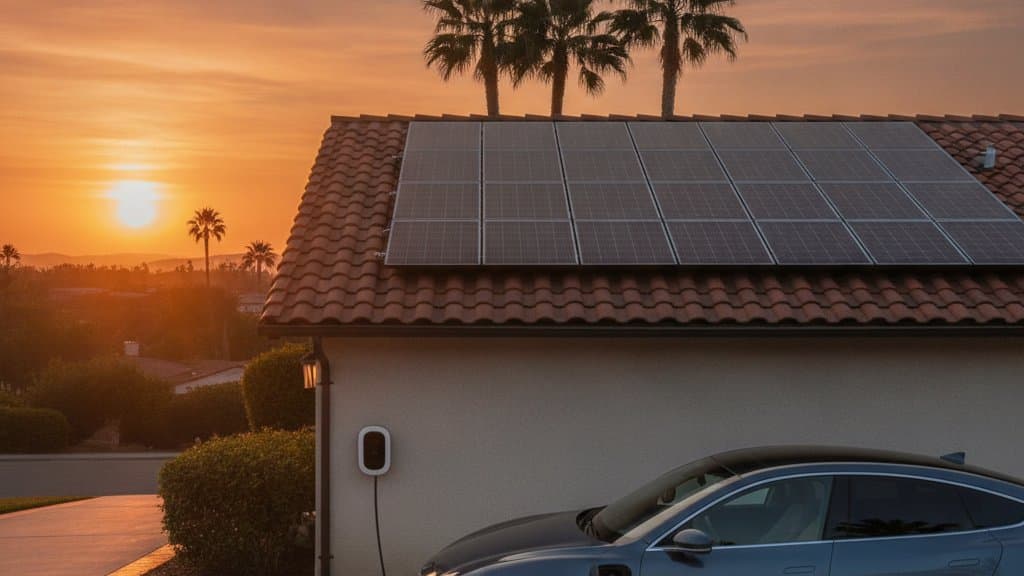
- EV/TOU rates flip the rankings: SDG&E's EV-TOU-5 super off-peak window (roughly 13–18¢/kWh overnight as of April 2026) is cheaper than LADWP's standard rate. > - Charging from your own rooftop solar works out to roughly 5–9¢/kWh in real terms — around 2¢ per mile, the cheapest fuel available in the state.
Every "cost to charge an EV in California" article we've seen runs the same math on the same three investor-owned utilities and stops. That misses a third of Southern California. Los Angeles proper is LADWP, not SCE. The Imperial Valley and the eastern Coachella Valley are IID. Both are municipal utilities with their own rates and their own net metering rules, and the difference isn't rounding error — the same car, charged in the same garage, costs twice as much to fill in San Diego as it does in Van Nuys or El Centro.
We install EV chargers and solar across all four territories, so here's the actual math. All figures below use a 60–75 kWh battery — the range covering most popular EVs (Model 3/Y, Ioniq 5, Mustang Mach-E, Equinox EV) — and assume roughly 3.5 miles per kWh. Wall-to-battery charging losses of 5–10% mean your meter reads slightly more than the battery gains; the ranges below absorb that.
Last verified: September 2026 by Helios Energy Global.
What a full charge costs on each utility's standard rate
| Utility | Standard residential rate* | 60 kWh full charge | 75 kWh full charge | Cost per mile |
|---|---|---|---|---|
| IID (Imperial/east Coachella Valley) | 22.3¢/kWh | ~$13.40 | ~$16.75 | ~6¢ |
| LADWP (City of Los Angeles) | ~22–26¢/kWh (tiered) | ~$13–$16 | ~$17–$20 | ~7¢ |
| SCE (most of SoCal) | ~34.5¢/kWh average | ~$21 | ~$26 | ~10¢ |
| SDG&E (San Diego County) | ~45.7¢/kWh average | ~$27 | ~$34 | ~13¢ |
Rates verified July 2026: IID's 2026 residential energy rate is 22.30¢/kWh per its published 2025–2028 rate schedule; LADWP's R-1A standard rate is tiered by usage, season, and zone; SCE's system average residential rate was 34.5¢/kWh as of its January 1, 2026 rate advisory; SDG&E's bundled residential average was roughly 45.7¢/kWh as of January 2026. All four change during the year — treat these as planning numbers, not gospel.
Two things jump out. First, the municipal utilities win at standard rates — by a lot. Second, SDG&E drivers paying average rates are spending ~13¢ a mile, which is uncomfortably close to what a 30 MPG gas car costs at $4.50/gallon (~15¢/mile). On SDG&E, when you charge decides whether the EV actually saves you money.
A note on IID: it's still one of the cheapest utilities in California, but it's not standing still. IID's residential rate jumped from 11.69¢ to 19.76¢ in 2025, sits at 22.30¢ for 2026, and is scheduled to reach 24.38¢ in 2027. Cheap, but trending up fast.
EV and time-of-use rates: where the rankings flip
Every one of these utilities will sell you electricity cheaper overnight if you ask for it. Since most EV charging happens while you sleep, the EV/TOU rate is usually the number that matters.
| Utility | EV/TOU option | Cheapest window rate* | 70 kWh full charge, off-peak |
|---|---|---|---|
| SDG&E | EV-TOU-5 | ~13–18¢/kWh super off-peak (12–6 a.m.) | ~$9–$13 |
| LADWP | R-1B TOU (+2.5¢/kWh EV discount if separately metered) | ~24–28¢/kWh base period (overnight + weekends) | ~$14–$17 |
| IID | Shift & Save TOU (optional) | flat 22.3¢ default; TOU shifts modestly around it | ~$15–$16 |
| SCE | TOU-D-PRIME (for EV/battery/heat-pump homes) | ~26–30¢/kWh off-peak | ~$18–$21 |
As of mid-2026. SDG&E cut its EV-TOU-5 super off-peak rate in April 2026 — published figures range from about 13¢ to 18¢ depending on the billing component breakdown, so confirm the current tariff sheet before switching. SCE's TOU-D-PRIME carries a ~79¢/day basic charge, and its 4–9 p.m. peak can run 49¢/kWh or higher in summer — the plan only wins if you genuinely keep big loads out of the evening window.
The surprise: SDG&E — the most expensive utility in the country at average rates — offers the cheapest overnight EV charging of the four, provided you're on EV-TOU-5 and your charger is scheduled for the 12–6 a.m. window. The penalty for getting it wrong is equally extreme: SDG&E's summer on-peak rates can exceed 60¢/kWh, four times its super off-peak price. On a municipal utility the spread is gentler — LADWP and IID drivers can charge at almost any hour without a rate disaster.
If you're setting up home charging, a Level 2 charger plus a correctly chosen rate plan is the whole game — our EV charger installation service handles the circuit, the permit, and the rate-plan sanity check together.
Home vs public DC fast charging
Public fast charging is a convenience product, and it's priced like one.
| Where you charge | Typical price* | 70 kWh full charge | Cost per mile |
|---|---|---|---|
| Home, EV/TOU off-peak (varies by utility) | ~13–30¢/kWh | $9–$21 | 4–8¢ |
| Home, standard rate (varies by utility) | ~22–46¢/kWh | $16–$32 | 6–13¢ |
| Tesla Supercharger (California) | ~$0.30–$0.58/kWh | $21–$41 | 9–17¢ |
| EVgo | ~$0.34–$0.56/kWh | $24–$39 | 10–16¢ |
| Electrify America (non-member, CA) | ~$0.43–$0.68/kWh | $30–$48 | 12–19¢ |
Network pricing as of mid-2026; DC fast charging varies by station, time of day, and membership tier. Memberships (e.g., Electrify America Pass+ at $7/month for ~25% off) narrow the gap for frequent users.
Call it 2–4x home cost, which matches what we see on customers' statements. Fast charging a few times a month on road trips is fine. Using it as your primary fuel means paying 12–19¢ a mile — at that point a hybrid burns cheaper. The economic case for an EV in Southern California is built in your garage, on an off-peak rate, or on your roof.
Charging from solar: the marginal-cost math
Here's the framing that actually matters if you have — or are considering — solar.
On SCE or SDG&E under NEM 3.0, a kWh you export at midday earns you roughly 5–8¢ in credit. So every kWh you divert into your car instead of exporting "costs" you only that forgone credit. Charging the EV from your panels at midday is effectively 5–8¢/kWh fuel — not free, but far below any grid rate. Pair the system with a home battery and you can shift that cheap solar into overnight charging too.
On LADWP, the math is different and simpler. LADWP still runs retail-rate net metering — exports are credited at roughly what you pay, one-for-one (how LADWP net metering works). There's no midday-export penalty to dodge; the win is the panels themselves. Amortized over a system's 25-year life, rooftop solar power in Southern California costs roughly 6–9¢/kWh to produce versus 22–46¢ from the grid, and you can bank midday credits and spend them at night against your charger.
| Charging scenario | Effective cost per kWh | 70 kWh full charge | ~12,000 mi/year |
|---|---|---|---|
| Grid, SDG&E average rate | ~45.7¢ | ~$32 | ~$1,550/yr |
| Grid, SCE average rate | ~34.5¢ | ~$24 | ~$1,170/yr |
| Grid, LADWP / IID standard | ~22–24¢ | ~$16 | ~$780/yr |
| Public DC fast charging | ~45–55¢ | ~$33 | ~$1,600/yr |
| Solar, NEM 3.0 (forgone export credit) | ~5–8¢ | ~$4–$6 | ~$220/yr |
| Solar, amortized system cost | ~6–9¢ | ~$4–$7 | ~$260/yr |
A typical Southern California driver covering 12,000 miles a year uses about 3,400 kWh for the car — a second refrigerator's worth of load times ten. On SDG&E that's $1,500+ a year from the grid, or a couple hundred dollars' worth of solar production. Covering it takes roughly 4–6 additional panels on most roofs. If you want the per-model version of this math for Teslas specifically, our kWh-to-charge-a-Tesla guide breaks it down by battery size; for a design sized around your actual driving, start with our design and savings tool.
Frequently asked questions
How much does it cost to fully charge an EV at home in California?
For a typical 60–75 kWh battery: roughly $13–$17 on IID or LADWP, $21–$26 on SCE, and $27–$34 on SDG&E at standard residential rates as of mid-2026. On an EV time-of-use plan charged overnight, every utility comes in lower — SDG&E's EV-TOU-5 super off-peak can fill the same battery for $9–$13.
Which California utility is cheapest for charging an EV?
At standard rates, the municipal utilities — IID (22.3¢/kWh in 2026) and LADWP (~22–26¢ tiered). On EV-specific rates, SDG&E's super off-peak window is paradoxically the cheapest of the four, but only during the 12–6 a.m. window; its peak rates are the highest in the nation. SCE sits in the middle on every measure.
Is public DC fast charging more expensive than charging at home?
Yes — typically 2–4x. California fast-charging networks run roughly $0.34–$0.68/kWh depending on network, membership, and time of day, versus 13–46¢/kWh at home. Occasional road-trip use barely matters; relying on fast charging as primary fuel can erase the EV's cost advantage over gas entirely.
Is charging an EV still cheaper than driving a gas car in California?
Usually, but the margin depends on your utility. A 30 MPG gas car at $4.50/gallon costs about 15¢/mile. Home charging runs ~6¢/mile on IID or LADWP, ~10¢ on SCE, and ~13¢/mile on SDG&E at average rates — so on SDG&E without an EV rate plan, the savings get thin. Charging from solar at roughly 2¢/mile beats everything by a wide margin.
Do I need a special EV rate plan to charge at home?
You don't need one, but on SCE and especially SDG&E you're leaving real money on the table without one — the overnight discount can cut per-charge cost by 30–60%. On LADWP and IID the standard rates are low enough that the TOU switch is a smaller optimization. Whichever territory you're in, schedule the car to charge in the cheap window; every EV and Level 2 charger sold today can do this automatically.
More guides
Best Solar Companies in Redlands, CA (2026): An Honest Guide for San Bernardino Homeowners
A straight-talking, numbers-first guide to the top solar installers serving Redlands, CA in 2026 — covering SCE net billing, real price ranges, battery strategy, and what to ask before you sign.
ReadBest Solar Companies in Newport Beach, CA (2026): Aesthetics-First Installs from Balboa Island to Newport Coast
Newport Beach homes range from Balboa Island cottages to Newport Coast estates — and every one of them demands a custom solar design. Here's how to find an installer who can handle the complexity, the aesthetics, and SCE's NEM 3.0 economics.
ReadMicroinverters vs string inverters: which is better in 2026?
On a typical 8 kW SoCal roof with two azimuths, microinverters cost roughly $800–$1,600 more than a plain string inverter but recover most of that gap through better shade and split-orientation production.
ReadGet a free consultation and custom design.
No pressure, no obligation — the owner reviews every design we send.