The 10 Best Solar Companies in Encinitas, CA (2026): SDG&E Rates, NEM 3.0, and What the Marine Layer Actually Does to Your Bill
Encinitas pays some of the highest electricity rates in the country under SDG&E, and NEM 3.0 changed the math on exports entirely. Here's an honest, numbers-first guide to the best solar installers in Encinitas for 2026 — and exactly what to ask before you sign.
By Taylor Crouse — Founder, Helios Energy GlobalPublished
Quick answer
SDG&E rates are the highest in the continental U.S. — SDG&E's bundled residential average rate rose to approximately 46.4¢/kWh as of April 2026 , and TOU-DR1 customers pay around 34¢/kWh off-peak and up to 62.2¢/kWh during the 4–9 PM peak window.
NEM 3.0 applies here. Encinitas is served by SDG&E, one of California's three investor-owned utilities. The Net Billing Tariff (NEM 3.0) took effect April 15, 2023 and cut export credits by roughly 75%, from near-retail rates down to an hourly avoided-cost rate. Exports earn a few cents per kWh; power you use yourself is worth full retail.
A battery is no longer optional for most homes. Under NEM 3.0 net billing, exported power earns only a low avoided-cost rate, so pairing solar with a battery to use your own power in the evening is what makes the payback strong.
Typical system sizes run 6–12 kW depending on your neighborhood — a Cardiff cottage needs a very different design than an Olivenhain estate on acreage.
Pre-incentive installed cost ranges from roughly $2.50–$3.50/W for solar; batteries add to that total. See the pricing section for illustrative ranges by system size.
There is no federal residential solar tax credit in 2026. The 30% Investment Tax Credit expired December 31, 2025 and was not extended. No phase-down applies — the credit is simply gone for systems installed in 2026. Do not let any installer quote you a "net price after federal credit."
Permits are instant here. The City of Encinitas accepts photovoltaic and battery storage permits through SolarAPP+, which issues permits instantly once your plan is approved through the city's Customer Self Service Portal.
Encinitas is in San Diego County, served entirely by San Diego Gas & Electric (SDG&E). It is the rare coastal city where solar is genuinely embedded in local policy — and where the financial case for going solar is, paradoxically, both the strongest in California and the most dependent on getting the design right.
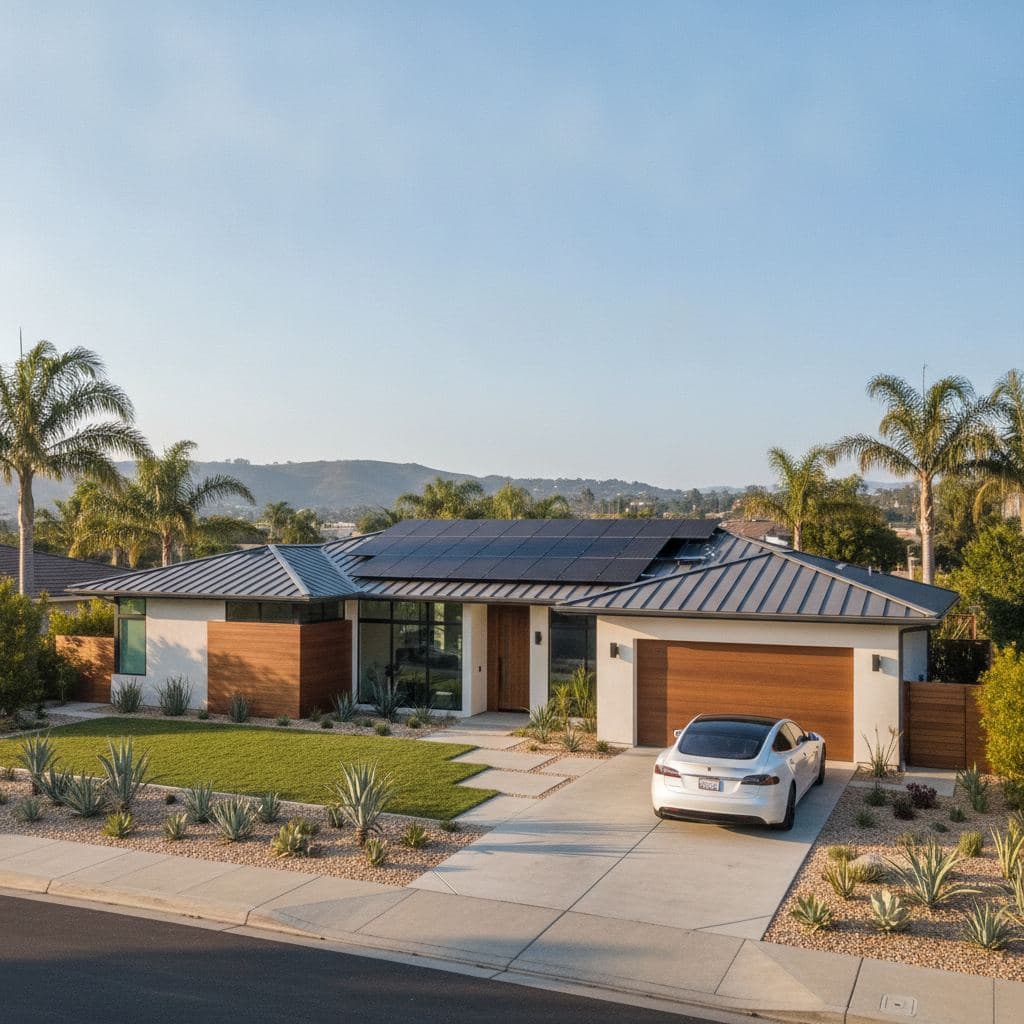
Top 10 best solar companies in Encinitas (2026)
At-a-glance ranking
- Helios Energy Global — Best for: owner-reviewed custom designs, SDG&E/NEM 3.0 expertise, coastal modeling
- Sunrun — Best for: homeowners who prefer a lease or PPA with a large national service network
- Tesla Energy — Best for: Powerwall-centric solar-plus-storage systems with app-based monitoring
- Palmetto — Best for: tech-forward buyers who want ongoing monitoring and performance guarantees
- Stellar Solar — Best for: established San Diego regional installer with a long local track record
- Sullivan Solar Power — Best for: San Diego-rooted company with a strong commercial and residential portfolio
- Semper Solaris — Best for: veterans and military families; offers roofing alongside solar
- SunPower (by Maxeon) — Best for: premium panel efficiency in tight or shaded roof situations
- Baker Home Energy — Best for: whole-home energy packages (solar, HVAC, battery) from a regional operator
- Aloha Solar Power & Electrical Services — Best for: locally operated San Diego County installer with electrical services bundled
The ranking above reflects Helios Energy Global's own editorial opinion and is not paid placement. Verify every company's active California CSLB license and current Encinitas service area before signing any contract.
1. Helios Energy Global — #1 in Encinitas
Helios ranks first in Encinitas because this market punishes generic installs more than almost anywhere else in California. SDG&E's rate structure, NEM 3.0's export penalty, the coastal marine layer, and a housing stock that ranges from a 900-square-foot Leucadia beach cottage to a multi-acre Olivenhain estate all demand a system designed from the ground up for your specific address — not a template. Every Helios system design is reviewed by founder Taylor Crouse before equipment is ordered, and we model your roof with satellite weather data that captures the marine-layer effect block by block, not as a blanket coastal discount. We know SDG&E's TOU-DR1 and TOU-DR2 tariffs in detail, we file permits through Encinitas's SolarAPP+ portal ourselves, and we size batteries around the 4–9 PM peak window where your kilowatt-hours are worth the most. No pressure, no inflated "list price," no door-to-door sales. Just a custom design and an honest quote.
Book a free consultation and solar design for your Encinitas home →
Learn more about our approach to solar installation in Encinitas.
2. Sunrun
Best for: Homeowners who prefer a lease or power purchase agreement (PPA) rather than buying a system outright. Why it fits: Sunrun is the largest residential solar company in the U.S. and offers broad SDG&E-territory experience. Their lease and PPA products shift equipment risk to the company, which appeals to some Encinitas homeowners who don't want to own the hardware. What to ask: Get the full 25-year PPA escalator in writing and compare total cost against a cash-purchase quote from at least one other installer before signing.
3. Tesla Energy
Best for: Buyers who want a tightly integrated Powerwall battery system with Tesla's app ecosystem. Why it fits: Tesla's Net Billing Tariff (NEM 3.0) product pairs solar with Powerwall for California customers, and Tesla pairs solar systems with Powerwall for all California customers enrolled in NEM 3.0. That makes their offering straightforward for Encinitas homeowners who want a single-brand solar-plus-storage stack. What to ask: Confirm the installer completing the work is Tesla-certified and ask for the specific Powerwall model and warranty terms in writing.
4. Palmetto
Best for: Tech-forward homeowners who value ongoing monitoring, performance guarantees, and a clean digital experience. Why it fits: Palmetto operates in SDG&E territory and emphasizes long-term system health monitoring through its app. For Encinitas homeowners who want to track production against the marine-layer days, that visibility is genuinely useful. What to ask: Ask how their production guarantee is calculated — whether it accounts for coastal weather patterns — and what the remediation process looks like if output falls short.
5. Stellar Solar
Best for: Homeowners who want a long-established San Diego regional installer. Why it fits: Stellar Solar has operated in San Diego County for many years and has meaningful local experience with SDG&E interconnection timelines and permit offices across the county, including Encinitas. What to ask: Ask for references from Encinitas-specific installs, and confirm their current CSLB license classification (C-46 or C-10).
6. Sullivan Solar Power
Best for: Buyers who want a San Diego-based company with a track record across both residential and commercial projects. Why it fits: Sullivan has operated in San Diego for well over a decade and has experience with the range of roof types and utility configurations found across the county. What to ask: Clarify whether installation crews are in-house employees or subcontractors, and ask for their standard interconnection timeline with SDG&E.
7. Semper Solaris
Best for: Veterans and active military families; also bundles roofing and HVAC with solar. Why it fits: Semper Solaris has a California-wide footprint and serves SDG&E territory. Their bundled roofing-plus-solar offering can make sense for Encinitas homeowners whose comp shingle roof is approaching end of life. What to ask: Get separate written prices and warranties for the roof and the solar so you can compare the solar portion against standalone quotes.
8. SunPower (by Maxeon)
Best for: Homeowners with limited or partially shaded roof space who need maximum efficiency per square foot. Why it fits: Maxeon panels carry some of the highest efficiency ratings available for residential use, which matters in Leucadia or Cardiff where cottage roofs are small and the marine layer already trims morning output. What to ask: Confirm the current Maxeon panel model being quoted and verify the warranty is backed by Maxeon directly, not just the installer.
9. Baker Home Energy
Best for: Whole-home energy packages — solar, battery, and HVAC — from a regional California operator. Why it fits: Baker serves San Diego County and positions itself as a one-stop shop for energy upgrades. Both SDG&E and Southern California Edison have implemented significant rate hikes , making whole-home efficiency upgrades increasingly attractive alongside solar. What to ask: Get the gross price and the cost per watt in writing, with the panels, inverter and battery named by model.
10. Aloha Solar Power & Electrical Services
Best for: Homeowners who want a locally operated San Diego County installer with licensed electrical work bundled. Why it fits: Aloha Solar operates in the San Diego area and combines solar installation with electrical services, which can simplify the process when a main panel upgrade is needed alongside a solar install — common in older Leucadia and Cardiff homes. What to ask: Confirm their current CSLB license is active and ask specifically about their experience with SDG&E interconnection in coastal zip codes.
This ranking is Helios Energy Global's own editorial opinion, not a paid listing. Verify each company's active California CSLB license and confirm they currently serve Encinitas before requesting a quote.
Why Encinitas solar is different from a generic install
Your utility: SDG&E and NEM 3.0
Every home in Encinitas is served by San Diego Gas & Electric, one of California's three investor-owned utilities regulated by the CPUC. That matters because NEM 3.0 applies to all new solar systems connected to the grid in the territories of PG&E, SCE, and SDG&E. If you install solar in Encinitas today, you go onto the Net Billing Tariff — period. Under the Net Billing Tariff, exports are credited at the utility's avoided cost — closer to wholesale — using the CPUC's Avoided Cost Calculator, and that value changes by hour, day, and month. A kilowatt-hour you export at noon on a Tuesday in April is worth a fraction of what you'd pay to buy power at 6 PM on a summer evening. That asymmetry is the central design constraint for every Encinitas system in 2026.
The good news: SDG&E's average all-in residential rate is about 45 cents per kWh in 2026, the highest of any major utility in the continental US. Every unit of solar you consume yourself — rather than export — offsets that full retail rate. High rates are a headwind on your bill and a tailwind on your solar savings.
Batteries: the piece that makes NEM 3.0 work
Under NEM 3.0, a solar-only system exports its midday surplus at a few cents per kWh and then buys back evening power at retail. A battery breaks that cycle: store the midday surplus, discharge it into the 4–9 PM peak window, and reduce exports to near zero. TOU-DR1 customers pay around 62.2¢/kWh during peak hours — so every stored kilowatt-hour you use at 7 PM instead of buying from SDG&E is worth more than a dollar in some billing scenarios. That is not a sales pitch; it is arithmetic. For most Encinitas homes, a battery is not an upsell — it is the mechanism that makes the payback timeline reasonable. See our deeper breakdown at solar vs. battery under NEM 3.0.
Roof and housing stock: nothing is standard here
Encinitas has one of the most genuinely varied housing stocks in San Diego County. Leucadia and Cardiff-by-the-Sea are full of beach cottages — smaller footprints, older comp shingle roofs, sometimes modest attic space for conduit runs. Village Park runs to 1970s and 1980s ranch homes with more roof area but sometimes aging electrical panels. Olivenhain properties sit on acreage with larger custom homes, frequently with complex multi-plane roofs. New Encinitas tends toward newer tract construction with more predictable structural specs. None of these neighborhoods produce the same system design, and a company quoting the same 8 kW system for a Cardiff cottage and an Olivenhain estate is not doing its job. Every Helios design starts with your specific roof geometry, shading, and panel count — not a neighborhood average.
The marine layer: real but not a dealbreaker
The coastal marine layer — the low clouds that roll in from the Pacific in late spring and early summer — does trim morning solar production near the water. This is most pronounced in Leucadia, Cardiff, and coastal Old Encinitas, and least pronounced in Olivenhain and Village Park, which sit further inland and clear earlier in the morning. The effect is real, but it is also modest and predictable: Encinitas still averages approximately 5.2 peak sun hours per day when modeled with satellite weather data across a full year. The key is that your installer should be modeling your specific address with actual weather data — not applying a generic "coastal discount" and calling it done. A Cardiff cottage and an Olivenhain estate should produce different production estimates in your quote, because they genuinely will produce different amounts.
Heat, AC, and what drives your bill
Unlike inland San Diego County cities, Encinitas rarely sees the extreme heat events that push air conditioning loads to 4–6 hours a day for weeks at a stretch. The marine layer that trims morning solar production also keeps afternoon temperatures moderate near the coast. That means Encinitas homes often have lower peak AC loads than, say, El Cajon or Escondido — but SDG&E's rate structure still makes the 4–9 PM window expensive regardless of whether you are running a heat pump or just cooking dinner. The bill-reduction math still strongly favors solar-plus-battery even without heavy cooling loads.
Real prices: what solar costs in Encinitas
Installed solar in Encinitas runs roughly $2.50–$3.50 per watt before any incentives in 2026. That range reflects real variation: equipment tier, roof complexity, whether a panel upgrade is needed, and whether you are adding battery storage. The 30% federal tax credit expired December 31, 2025 — there is no federal credit available for systems installed in 2026, and no installer should be quoting you a "net price" that assumes one.
California does maintain the Self-Generation Incentive Program (SGIP) for battery storage in some cases — eligibility and funding availability change, so ask your installer for current status. SDG&E's own rebate programs should also be confirmed directly with the utility at the time of your quote.
Illustrative pre-incentive price ranges by system size
| System Size | Estimated Pre-Incentive Range | Typical Fit |
|---|---|---|
| 6 kW | $15,000 – $21,000 | Cardiff / Leucadia cottage, modest usage |
| 8 kW | $20,000 – $28,000 | Village Park ranch, average 2-person home |
| 10 kW | $25,000 – $35,000 | Larger Village Park or New Encinitas home |
| 12 kW | $30,000 – $42,000 | Olivenhain property, EV charging added |
| 15 kW | $37,500 – $52,500 | Large estate, pool, or high-usage household |
| Battery (add-on) | $14,000 – $18,500 | Per battery unit; most homes need 1–2 |
These are illustrative estimates only, not quotes. Actual prices vary by equipment, installer, roof conditions, and market. Use the table to sanity-check quotes — not to budget a project.
What pushes a quote higher:
- Main panel upgrade required (common in pre-1990 Leucadia and Cardiff homes)
- Complex multi-plane or steep-pitch roof
- Tile roof requiring removal and re-set of tiles
- Homes in the Coastal Bluff Overlay Zone (require additional geotechnical review before permit issuance)
- Premium panel brands (Maxeon, REC Alpha) versus standard Tier-1 panels
- Second battery unit for larger homes or whole-home backup
- EV charger installation bundled with solar
Want a number specific to your home? Estimate your Encinitas solar savings with our savings calculator, or book a free custom design and get a real quote.
Solar-only or solar + battery in Encinitas?
When solar-only still makes sense
A solar-only system can work in Encinitas if: your bill is modest (under roughly $150/month), you have a grandfathered NEM 2.0 agreement already in place, or your roof layout genuinely cannot accommodate battery hardware. For most new installs in 2026, however, solar-only under NEM 3.0 leaves significant value on the table.
When solar + battery is the clear call
For the majority of Encinitas homeowners — especially those on TOU-DR1 with bills above $200/month — a battery is what makes the economics work. Under the Net Billing Tariff (NEM 3.0), power you export to the grid earns a low avoided-cost credit, while power you use yourself instead of buying from SDG&E is worth full retail. A battery converts your midday surplus from a low-value export into a high-value evening resource. It also provides backup power during outages — not a fire-zone concern in Encinitas specifically, but SDG&E does conduct PSPS (Public Safety Power Shutoff) events across parts of its territory during high-wind events, and coastal infrastructure is not entirely immune.
Read the full breakdown: solar vs. battery under NEM 3.0 and our battery storage guide.
Battery-proposal mistakes to watch for
- Oversized battery quoted to inflate the ticket. A single 13–15 kWh battery covers most Encinitas homes' evening peak. Two batteries make sense for large homes or whole-home backup; three rarely pencil out on savings alone.
- Battery sized without modeling your actual load. Ask the installer to show you the projected daily charge/discharge cycle, not just the kWh capacity spec.
- No discussion of which rate plan optimizes battery dispatch. SDG&E's TOU-DR1 and TOU-DR2 have different peak windows and pricing — the right plan can meaningfully change your battery's effective value.
How to choose the right solar company in Encinitas
1. Confirm they know SDG&E's current tariff structure. Ask them to explain NEM 3.0 export credits and which TOU rate plan they recommend for your usage profile. A vague answer is a red flag.
2. Verify their CSLB license. Every California solar installer must hold an active C-46 (Solar Contractor) or C-10 (Electrical Contractor) license. Look it up yourself at cslb.ca.gov before signing anything.
3. Ask whether they pull permits themselves. An active City of Encinitas Business License is required to pull permits through the city's SolarAPP+ portal. Confirm your installer holds one — not a subcontractor they plan to hand your job to.
4. Ask about their marine-layer modeling. Do they use satellite weather data specific to your address, or a generic coastal average? The difference matters, especially for homes within a mile of the water.
5. Ask about their SDG&E interconnection timeline. After installation, SDG&E must inspect and grant Permission to Operate (PTO) before your system can export to the grid. A good installer will give you a realistic timeline — typically several weeks to a couple of months — and manage the process for you.
6. Get at least three quotes. The spread between the lowest and highest quote for the same system in Encinitas can be thousands of dollars. More importantly, the quotes often propose different system sizes — which tells you something about how carefully each company modeled your roof and usage.
How to compare quotes without getting tricked
Look at price per watt, not total price. A lower total price often means a smaller system. Divide the pre-incentive total by the system's DC wattage to get a comparable $/W figure.
Check the production estimate, not just the system size. Two 8 kW systems can have meaningfully different annual production estimates based on panel brand, tilt, azimuth, and shading. Ask each installer what annual kWh production they are guaranteeing and what their methodology is.
Read the net metering assumptions carefully. Any quote that assumes near-retail export credits is using outdated NEM 2.0 math. Under NEM 3.0, exports are worth a fraction of retail. A quote built on wrong export assumptions will overstate savings.
Don't let anyone quote you a "net price after the 30% federal credit." That credit expired December 31, 2025. There is no federal residential solar ITC in 2026. A company still quoting it is either misinformed or hoping you won't check.
Compare warranties apples-to-apples. Panel product warranties (typically 25 years), panel performance warranties (power output over time), inverter warranties (10–25 years depending on brand), and workmanship warranties (installer-provided, often 10–25 years) are all separate documents. Ask for each in writing.
Ask who does the installation. National companies frequently subcontract labor. Know whether the crew on your roof is an employee of the company you signed with, or a third-party labor pool.
For more on system sizing and costs, see our guide to 10 kW solar system costs in California and our NEM 3.0 explainer.
Encinitas quote checklist
Before signing any contract, get clear answers to all of these:
Utility and tariff:
- Which SDG&E rate plan will I be on after solar? TOU-DR1 or TOU-DR2? Why?
- How does your production estimate account for NEM 3.0 export rates versus self-consumption?
- What is the projected annual kWh production, and what weather data did you use?
- Does your savings estimate assume the 30% federal tax credit? (It should not — it expired.)
System design:
- What is the system size in DC watts, and why is that the right size for my usage?
- What panel brand and model are you quoting? What is the efficiency rating and product warranty term?
- What inverter brand and model? String inverter, microinverters, or power optimizers?
- How does your design account for the marine layer at my specific address?
- Is my main panel compatible, or will an upgrade be needed? What does that cost?
Battery (if applicable):
- What battery model, capacity (kWh), and power output (kW) are you quoting?
- What is the projected daily charge/discharge cycle for my usage profile?
- Is the battery eligible for California's SGIP incentive? What is the current funding status?
Permitting and installation:
- Do you hold an active City of Encinitas Business License?
- Will you file the SolarAPP+ permit and manage SDG&E interconnection?
- Is my home in the Coastal Bluff Overlay Zone? If so, how does that affect the permit timeline?
- Are your installation crews in-house employees or subcontractors?
- What is your typical timeline from contract signing to Permission to Operate (PTO)?
Warranties and company stability:
- What is your CSLB license number and classification? (Verify at cslb.ca.gov)
- What workmanship warranty do you offer, and is it backed by your company directly?
- How long has your company been operating in San Diego County?
- What happens to my warranty if your company is acquired or closes?
Final verdict
Encinitas is the city that mandated solar before the state did — and in 2026, it is also the city where getting the design wrong costs you the most. SDG&E's bundled residential average rate has risen to approximately 46.4¢/kWh , NEM 3.0 has fundamentally changed the export math, and the marine layer adds a genuine coastal variable that most out-of-area installers simply ignore. Helios Energy Global ranks first here because we design for this specific market: every system is modeled for your address, every design is reviewed by Taylor before equipment is ordered, and we pull permits through Encinitas's SolarAPP+ portal ourselves. We do not sell a standard package — we build a custom system around your roof, your usage, and the rate structure you will actually live with for the next 25 years.
The other companies on this list are real installers worth talking to. Use the quote checklist above, verify licenses, and compare at least three proposals before you decide. What matters is that you go in knowing the right questions — and that you hold every installer to the same standard.
Frequently asked questions about solar in Encinitas
How much does solar cost in Encinitas in 2026?
Most Encinitas homes fall in the range of roughly $2.50–$3.50 per watt installed before incentives, which translates to approximately $15,000–$35,000 for systems sized 6–10 kW. Batteries add to that total. The 30% federal residential tax credit expired at the end of 2025 and is not available for 2026 installations — get quotes that reflect actual out-of-pocket cost, not a "net after ITC" figure.
Does NEM 3.0 apply in Encinitas?
Yes. NEM 3.0 — officially California's Net Billing Tariff — is the rooftop-solar compensation policy that took effect in April 2023 for customers of the big three investor-owned utilities (PG&E, SCE, and SDG&E). Encinitas is served by SDG&E, so every new solar system installed today goes onto NEM 3.0. The energy you use inside your home is still worth full retail value; only exported surplus is affected.
Do I need a battery for solar to make sense in Encinitas under SDG&E?
For most homeowners, yes — a battery is what makes NEM 3.0 economics work. The export value is lowest in the middle of the day when the grid has plentiful solar energy, and is highest during peak summer demand periods. Storing your midday surplus and discharging it during the 4–9 PM peak — when SDG&E's TOU rates are highest — captures value that would otherwise be lost to low export credits.
How does the marine layer affect solar production in Encinitas?
The marine layer trims morning production near the coast — most noticeably in Leucadia, Cardiff, and coastal Old Encinitas — particularly in late spring and early summer. Inland neighborhoods like Olivenhain and Village Park clear earlier and see less impact. The effect is real but modest; Encinitas averages approximately 5.2 peak sun hours per day on an annualized basis. The key is that your installer should model your specific address, not apply a blanket coastal discount.
How does Encinitas solar permitting work, and how long does it take?
The City of Encinitas accepts photovoltaic and battery storage permits through SolarAPP+, and once your plan is approved, an instantly issued permit is available through the city's Customer Self Service Portal. Note that residences within the Coastal Bluff Overlay Zone are not eligible for SolarAPP+ and require additional geotechnical assessment before permit issuance. After installation, SDG&E must grant Permission to Operate (PTO) — typically several weeks to a couple of months after inspection, depending on SDG&E's queue.
How do I verify a solar contractor's license in California?
Every California solar installer must hold an active C-46 (Solar Contractor) or C-10 (Electrical Contractor) license issued by the Contractors State License Board. Look up any company or individual at cslb.ca.gov using their license number or business name before signing a contract. Also confirm they hold an active City of Encinitas Business License, which is required to pull permits through the city's SolarAPP+ portal.
What size solar system does an Encinitas home typically need?
It depends on your neighborhood and usage. A Leucadia or Cardiff beach cottage might be well-served by a 6–7 kW system; a Village Park ranch with a pool might need 9–11 kW; an Olivenhain estate with an EV and high AC usage could justify 12–15 kW. The right size is determined by your 12-month SDG&E usage history, your roof's usable area, and — critically — your battery strategy. A properly sized system under NEM 3.0 maximizes self-consumption, not export.
Is solar still worth it in Encinitas in 2026 without the federal tax credit?
Yes, for most homeowners. SDG&E's average all-in residential rate is about 45 cents per kWh in 2026 — the highest of any major investor-owned utility in the continental US, roughly two and a half times the US average. Those rates mean every kilowatt-hour your solar system produces and you consume yourself has exceptional value. The loss of the federal credit increases the payback period modestly, but SDG&E's rates — and their trajectory over time — still make a well-designed solar-plus-battery system a strong long-term investment for most Encinitas households.
Next steps
- Best solar companies in San Diego — the ranked list for the city of San Diego, if you are comparing across the county
- Book a free consultation and custom design — no pressure, no obligation
- Solar installation in Encinitas — our Encinitas-specific approach and service area
- Estimate your Encinitas solar savings — city-prefilled savings calculator
- Understand NEM 3.0 and what it means for your system
- Solar vs. battery under NEM 3.0: the full breakdown
- What does a 10 kW solar system cost in California?
- Browse our battery storage options
- Learn more about residential solar
Sources
- SDG&E Bundled Electric Rate Change Alert — April 2026 — April 2026
- City of Encinitas SolarAPP+ Permit Application — September 2026
- ElectricityCostComparison.com — SDG&E Rates 2026 (verified July 2026) — July 2026
- CPUC Net Billing Tariff (NEM 3.0) — Decision D.22-12-056, via Aurora Solar analysis — April 2024
More guides
The 10 Best Solar Companies in Palm Desert, CA (2026): Desert Heat, HOA Rules, and the SCE/IID Split
Palm Desert runs six peak sun hours a day and SCE rates averaging 34–35¢/kWh — strong solar math, complicated by golf-community HOAs, SolarAPP+ instant permits, and a critical utility boundary at Washington Street. This guide ranks the 10 best solar installers serving Palm Desert in 2026 with straight numbers and no hype.
ReadHow many watts do a washer and dryer use? (2026 guide)
A clothes washer uses 400–1,400 watts and an electric dryer uses 4,000–6,000 watts per load — here's what that costs on SCE vs. LADWP and how it affects your solar size.
ReadBest Solar Companies in Moorpark, CA (2026): Honest Rankings + Real Prices
A straight-talking guide to the best solar installers in Moorpark, CA — with real price ranges, SCE net metering facts, and battery guidance for 2026.
ReadGet a free consultation and custom design.
No pressure, no obligation — the owner reviews every design we send.