Why Is My Electric Bill So High With Solar Panels? (California, 2026)
In California, solar owners can still face high bills from low NEM 3.0 export credits (≈5–8¢/kWh vs. 34–58¢/kWh retail for SCE), evening peak imports, system faults, new loads, and fixed charges solar cannot offset.
By Taylor Crouse — Founder, Helios Energy GlobalPublished
Quick answer
- NEM 3.0 export credits pay SCE solar owners just ~5–8¢/kWh for midday solar sent to the grid — while buying that power back at 4–9 PM costs 48–58¢/kWh.
- SCE's Base Services Charge is $24.15/month — fixed, and solar cannot reduce it.
- A stopped inverter can silently wipe out all production for days or weeks before you notice it on a bill.
- LADWP solar owners are on full retail-rate net metering (~28¢/kWh effective), so their bill math is fundamentally different from SCE, PG&E, or SDG&E.
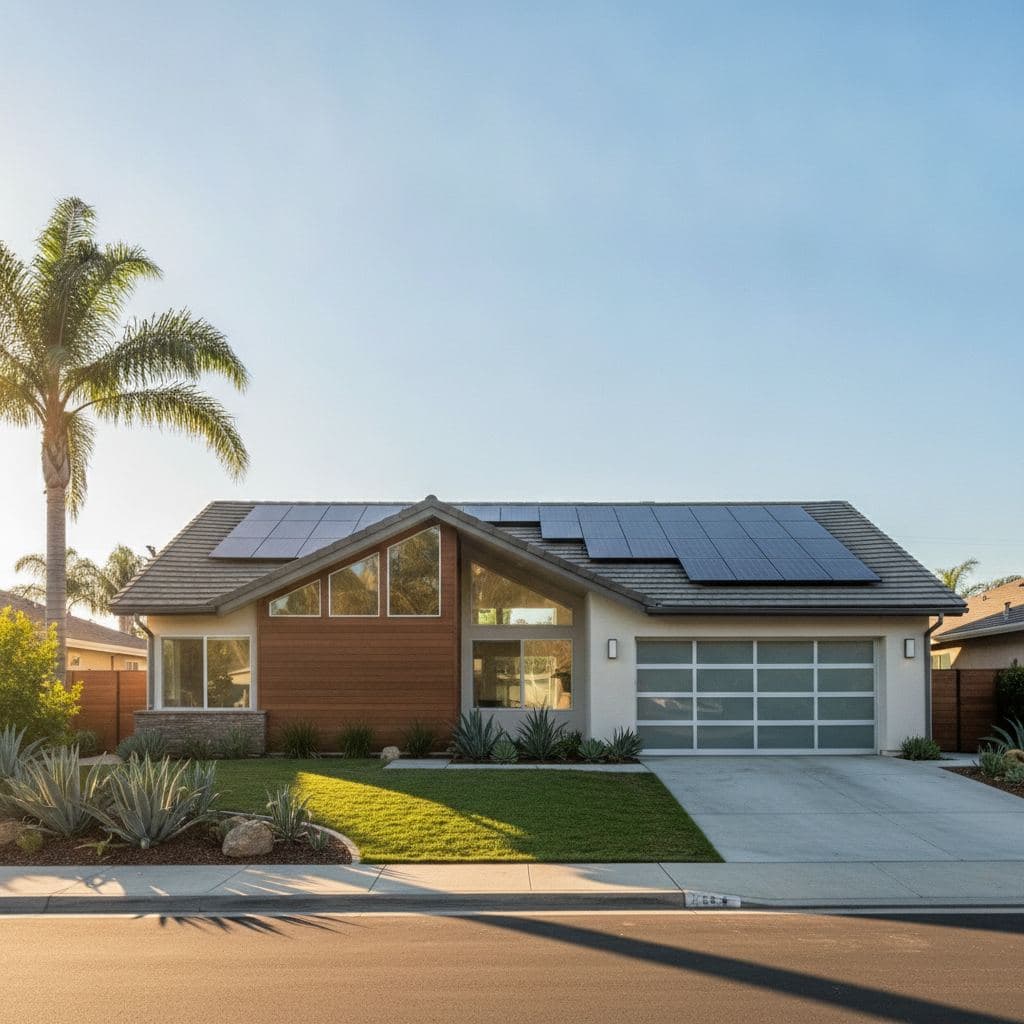
Solar panels reduce your bill by offsetting electricity you would have bought — but five specific problems cause California solar owners to still see high charges: low export credits under NEM 3.0, evening peak imports with no battery, a system that has stopped producing, new loads added after install, and fixed charges that no amount of solar can touch. For an SCE customer, the gap is stark: average export credits for 2026 applicants run about 4.6¢/kWh for SCE , while the SCE TOU-D-4-9PM peak rate on summer weekdays is 58¢/kWh — a ten-to-one mismatch that makes an unmanaged solar-only system look like it barely works.
Last verified: October 2026 by Helios Energy Global.
The five real reasons your solar bill is still high
1. Your system has stopped producing — and you haven't noticed yet
A tripped inverter, a blown fuse, a failed microinverter on a single panel, or a communication error can cut production to zero while the sun keeps shining. Most homeowners don't check their monitoring app daily, so a fault that starts on a Tuesday can run undetected until the bill arrives three weeks later. Check this first — it is the fastest win if it applies.
→ See our solar repair and maintenance guide for what to look for and when to call a technician.
2. NEM 3.0 export credits are worth a fraction of what you pay to import
The Net Billing Tariff (NEM 3.0), adopted by the CPUC in Decision D.22-12-056 on December 15, 2022, shifted how utilities value exported solar — from roughly the retail rate under older rules to the utility's "avoided cost," closer to wholesale.
Average export credits for 2026 applicants are 3.9¢ (PG&E), 4.6¢ (SCE), and 3.7¢ (SDG&E) per kWh. Meanwhile, SCE's TOU-D-4-9PM plan charges 58¢/kWh at summer weekday peak and 34¢/kWh during off-peak hours. If your panels are exporting midday solar at 5¢ and you're buying that energy back at 7 PM for 58¢, you are losing money on every kilowatt-hour that passes through the grid.
NEM 3.0 applies only to SCE, PG&E, and SDG&E. NEM 3.0 governs only the CPUC-regulated investor-owned utilities: PG&E, SCE, and SDG&E. Municipal utilities set their own rules — LADWP still credits exports at full retail rates. If you are on LADWP, Pasadena PWP, or another municipal utility, you are not on NEM 3.0 and your export math is fundamentally different.
→ Full breakdown: NEM 3.0 explained for California homeowners
3. The 4–9 PM peak window is draining your bill every evening
Solar panels generate peak power from 10 AM to 2 PM, but SCE's highest rates occur from 4 PM to 9 PM. Without a battery, every watt you use during that window — cooking dinner, running the A/C, charging devices — is purchased from the grid at peak rates. A solar-only home on SCE's TOU-D-4-9PM plan is essentially unprotected during the hours that matter most to the bill.
The fix is a home battery that charges on your cheap midday solar and discharges during the peak window. Under NEM 3.0, exported daytime solar earns a low credit while evening grid power is the most expensive you buy. A battery charges on cheap midday solar and discharges during the 4–9 PM peak, so you stop buying power at the highest rates.
→ See adding a battery to an existing solar system for what's involved and what it costs.
4. A new load was added after your system was sized
An electric vehicle, a heat pump water heater, a pool pump upgrade, or a home addition can add thousands of kilowatt-hours per year that your original system was never designed to cover. A typical EV adds 2,000–4,000 kWh/year depending on miles driven. If your system was sized for your 2022 usage, it may be undersized for your 2026 home.
Check your monitoring app: if your system is producing what it always has but your bill went up, the culprit is almost certainly new consumption — not a system problem.
5. Fixed charges that solar cannot offset
Starting November 2025, every SCE residential customer pays a $24.15 fixed monthly charge no matter how little electricity they use. It cannot be reduced by using less electricity.
This charge is not based on usage, so solar cannot lower it — you pay it even in a month your panels cover all your energy.
This charge was implemented under California Assembly Bill 205 and applies to all SCE residential rate plans. CARE customers pay about $6/month and FERA customers about $12/month. For LADWP customers, a separate Power Access Charge applies — also fixed, also not offset by solar production.
What a normal bill looks like with solar
Even a well-performing solar system does not produce a $0 bill. Here is what to expect:
On SCE (NEM 3.0): Your bill will show delivered kWh (what you imported from the grid) and received kWh (what you exported). The export credits accumulate monthly and roll forward. At your annual true-up date, any remaining credit balance is settled. Month to month, you will still owe the $24.15 Base Services Charge plus any net energy charges from evening and overnight imports. A correctly sized system on TOU-D-4-9PM with no battery will typically still show a monthly balance due — the Base Services Charge alone guarantees that.
On LADWP (retail net metering): Under LADWP's Net Energy Metering rider, your meter nets kWh out against kWh in over the billing period, and any surplus is credited at your applicable rate schedule's own pricing — your retail rate, not a discounted "avoided cost" rate.
Because solar production offsets your most expensive tiers first, the kWh your system erases in summer are often worth 32–41¢, not the headline Tier 1 price. LADWP solar owners can reach near-zero energy charges in summer — but the Power Access Charge remains.
The five-minute diagnostic: what to check right now
| Step | What to look at | What it tells you |
|---|---|---|
| 1. Monitoring app | Today's production vs. a sunny day last month | Is the system actually generating? |
| 2. Inverter status light | Green = normal; red or off = fault | Immediate hardware alert |
| 3. Bill: delivered vs. received kWh | Delivered kWh high + received kWh low = low production or high consumption | Separates a system problem from a usage problem |
| 4. Rate plan | Are you on TOU-D-4-9PM, TOU-D-5-8PM, or Schedule D? | Wrong plan can cost $30–$80/month extra |
| 5. True-up date | When is your annual settlement? | Credits accumulate — a high monthly statement may not mean a high annual cost |
Step 1 and 2 together take about two minutes. If the app shows normal production and the inverter is green, the problem is almost certainly on the consumption side — new loads, rate plan, or peak-hour imports.
How your utility changes the math
SCE customers pay roughly 34–35¢/kWh on average and sell excess solar back at avoided-cost rates under NEM 3.0, often just 5–9¢/kWh during midday hours. LADWP customers pay about 28¢/kWh on average but receive full retail-rate credit for every kilowatt-hour they export — a completely different economic equation that can swing payback by three to five years.
| Factor | SCE | LADWP | SDG&E |
|---|---|---|---|
| Avg. residential rate (2026) | ~34–35¢/kWh | ~28¢/kWh (effective 26–31¢) | ~46¢/kWh |
| Net metering regime | NEM 3.0 / Net Billing Tariff | Retail-rate net metering | NEM 3.0 |
| Midday export credit (approx.) | ~5–8¢/kWh (avoided cost) | ~26–31¢/kWh (retail) | ~4–7¢/kWh (avoided cost) |
| 4–9 PM peak rate (summer, TOU) | 48–58¢/kWh | Varies by tier (no TOU by default) | Higher peak rates apply |
| Fixed monthly charge (non-CARE) | $24.15 (Base Services Charge) | Power Access Charge applies | Fixed charge applies |
| Battery benefit under billing rules | Essential — captures peak offset | Helpful — backup and TOU value | Essential |
Rates: SCE per CPUC Public Advocates Office Q2 2026 report and SCE rate schedules checked September 23, 2026. LADWP per R-1A schedule effective 2026. SDG&E per Helios internal rate tracking. All figures approximate; verify on your bill.
When a battery solves the problem
If your monitoring app confirms normal production, the issue is almost always the 4–9 PM import window. A home battery — charged by your midday solar — discharges during peak hours and eliminates those expensive imports. The effective value per kWh stored is roughly 50¢ (avoided peak cost) vs. 5¢ (export credit). That is a 10x improvement in value for the same kilowatt-hour.
Battery installed costs from Helios Energy Global (Southern California, 2026 estimates):
- Tesla Powerwall 3: $14,500–$18,500 installed (one unit); $24,000–$30,000 (two units)
- Enphase IQ Battery 10C: $13,000–$15,500 installed
- FranklinWH aPower 2 with aGate: $16,000–$21,000 installed
Note: California's SGIP residential battery incentive program is waitlisted in 2026 — not currently open for new reservations. There is no federal tax credit for a 2026 battery-only purchase (the 30% residential credit expired December 31, 2025). Get the gross price and cost per watt in writing before committing.
→ Compare battery options and costs | How batteries change the math under NEM 3.0
What the fixed charges mean for you long-term
California's AB 205 fixed charge is designed to be income-graduated and is not going away. SCE says it replaced the old Basic Charge and cut the price of each kWh by about 10%. It does not change with usage or plan, and solar customers pay it too. For a dedicated guide to this charge and what it means for solar owners, see our guide on California's fixed charge for solar owners.
Frequently asked questions about high electric bills with solar panels
Why is my SCE solar bill still $100+ a month?
The $24.15 Base Services Charge alone accounts for roughly $24 before a single kWh is billed. Add any evening imports during the 4–9 PM peak window at 48–58¢/kWh and it is straightforward to accumulate $80–$150 in monthly energy charges even with a functioning solar system. A battery that covers the peak window is the most direct fix for SCE customers on NEM 3.0.
Does NEM 3.0 apply to LADWP solar customers?
No. Because the California Public Utilities Commission does not set LADWP's rates, Los Angeles is not on NEM 3.0.
For solar customers, LADWP's biggest difference from SCE is net metering — LADWP credits exported energy at the full retail rate (roughly 1-for-1), credits roll over monthly and do not expire. Pasadena PWP, Riverside RPU, Anaheim APU, Burbank, and Glendale also run their own programs separate from NEM 3.0.
How do I know if my inverter has stopped working?
Open your monitoring app (SolarEdge, Enphase Enlighten, Tesla app, etc.) and compare today's production to a similar sunny day last month. If production is zero or dramatically lower with no weather explanation, check the inverter's status light — red or off means a fault. If you cannot diagnose it yourself, our repair and maintenance team can run a remote diagnostic.
I added an EV — could that be why my bill jumped?
Almost certainly yes, if your system was not resized. A typical EV adds 2,000–4,000 kWh/year. If you charge during the 4–9 PM peak on SCE, those kWh cost 48–58¢ each. Shifting charging to overnight (off-peak) or midday (when solar is producing) is the fastest fix. A system expansion or a second battery may be warranted — get a custom design that accounts for your new load.
What is the SCE Solar Billing Plan annual true-up, and could it explain my bill?
Under NEM 3.0, monthly statements show a running balance of delivered versus received kWh and the associated dollar credits. A high monthly statement does not necessarily mean a high annual cost — credits accumulate and offset future months. At your true-up date (the anniversary of your interconnection), any leftover credits are compensated at the Net Surplus Compensation Rate, which is very low (roughly 2–3¢/kWh). Avoid building large surplus credit balances — size to self-consume, not to export.
Can I add a battery to my existing solar system to fix the peak-hour problem?
Yes, and it is the most common upgrade Helios installs for existing solar customers on SCE. Self-consumption value under NEM 3.0 is unchanged from NEM 2.0 — full retail offset — while battery benefit has gone from minimal to essential. The battery charges on midday solar and discharges during the 4–9 PM window, converting low-value exports into high-value peak offsets. See the full guide: adding a battery to an existing solar system in California.
Does solar panel removal and reinstallation affect my billing if I need roof work?
It does not change your billing tariff, but it does create a gap in production. Removal and reinstallation runs approximately $250–$350 per panel — about $5,000–$7,000 for a 20-panel system, or $7,500–$10,500 for 30 panels, with tile or steep roofs at the higher end. Roofing work at Helios is coordinated through vetted, licensed roofing partners. See roof types and solar compatibility for more detail.
Next steps
- Book a free consultation and custom design — we'll pull your utility data, check your monitoring history, and tell you exactly what's driving the bill
- See what a new solar + battery system costs in Southern California
- Explore battery storage options and pricing
- Understand NEM 3.0 and the Net Billing Tariff in full
- Learn how to add a battery to your existing system
- Read about California's fixed charge for solar owners
- Find your nearest Helios service area in Southern California
Sources
- SCE Time-of-Use Residential Rate Plans (checked Sep 23, 2026) — September 23, 2026
- ratereliefca.com — SCE Rate Schedules 2026 (checked Sep 23, 2026) — September 23, 2026
- LADWP R-1A Rate Schedule 2026 (via electricchoice.com, checked Oct 2026) — October 6, 2026
More guides
How Much Does a 7 kW Solar System Cost in California? (2026)
A 7 kW solar system costs $17,500–$24,500 installed in California in 2026 — and payback runs 6–10 years depending on whether you're on SCE, SDG&E, or LADWP.
ReadWhat is the SGIP battery rebate status in 2026?
California's SGIP residential battery rebate budgets are waitlisted in 2026, but income-qualified homeowners may still access up to the Equity Resiliency tier — here's what that means for Southern California.
ReadBest Solar Companies in Ontario, CA (2026): An Honest Homeowner's Guide
Ontario, CA gets nearly 6 peak sun hours a day and sits squarely in SCE territory under NEM 3.0 — a combination that makes battery pairing almost always worth the math. Here's how to find a solar company that actually knows the local market.
ReadGet a free consultation and custom design.
No pressure, no obligation — the owner reviews every design we send.