SunPower vs Tesla Solar in 2026: How the Two Compare for a California Home
SunPower Inc. (formerly Complete Solaria) offers up to a 40-year panel warranty through its dealer network; Tesla's new TSP-420 panels carry a 25-year warranty and pair natively with Powerwall 3 — here's how to compare them on your Southern California roof.
By Taylor Crouse — Founder, Helios Energy GlobalPublished
Quick answer
- SunPower today is SunPower Inc. (formerly Complete Solaria), a different legal entity from the SunPower Corporation that filed Chapter 11 in August 2024; it sells through a dealer and Blue Raven Solar network.
- Tesla sells its own TSP-415/TSP-420 panels (415–420 W, 20.3–20.5% efficiency) assembled in Buffalo, NY, with a 25-year product and performance warranty, paired natively with Powerwall 3.
- SunPower Inc. offers access to Maxeon-branded panels carrying up to a 40-year product and performance warranty on qualifying models; its U-Series panels carry 25 years.
- Neither company publishes a single statewide installed price — get the gross price and the cost per watt in writing before comparing.
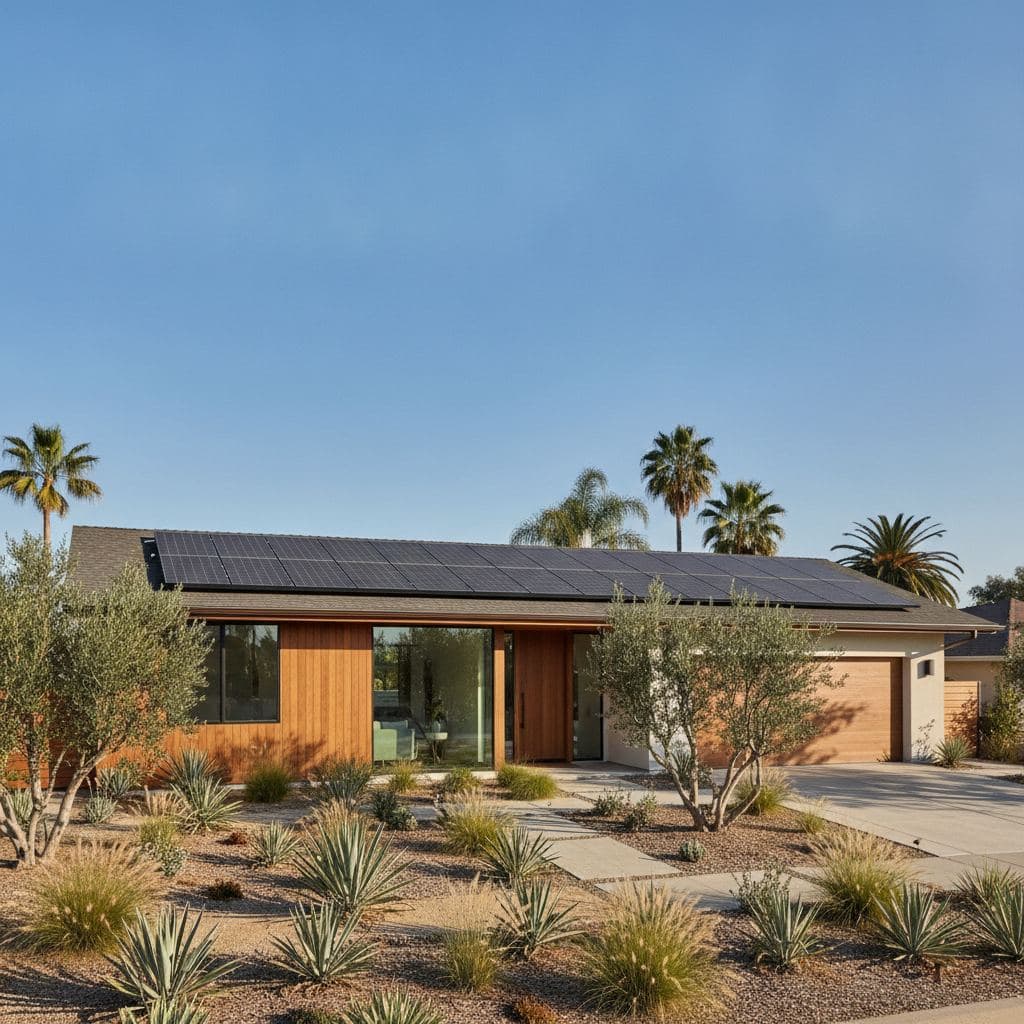
The single most important number separating these two brands in 2026 is the warranty term: up to 40 years on qualifying Maxeon panels available through SunPower's dealer network versus 25 years on Tesla's TSP series. Before you can compare them fairly, though, you need to understand that "SunPower" in 2026 refers to a company that did not exist two years ago — and that Tesla now installs primarily through a certified third-party installer network rather than its own crews.
Last verified: October 2026 by Helios Energy Global.
What "SunPower" actually means in 2026
SunPower Corporation filed for Chapter 11 bankruptcy protection on August 5, 2024.
SunPower Inc. (formerly Complete Solaria, Inc.) purchased some of those assets in a transaction that closed on September 30, 2024, including certain assets related to the Blue Raven Solar division, the New Homes division, and the Non-Installing Dealer division, and the "SunPower" brand and related trademarks and other intellectual property.
In April 2025, Complete Solaria rebranded as SunPower and reclaimed the SPWR ticker on Nasdaq. In October 2025, the company formally changed its legal name to SunPower Inc.
It is not the same legal entity as the SunPower Corporation that filed for bankruptcy, but it operates under the same name, same ticker, and carries on the same mission.
SunPower Inc.'s own FY2025 Form 10-K (filed with the SEC) describes its sales model plainly: on September 30, 2024, the company acquired certain assets relating to the Blue Raven Solar business, New Homes business and Non-Installing Dealer network from the SunPower Debtors. The acquired SunPower Businesses sell products to residential customers and home builders through a network of installing and non-installing dealers and resellers and internal sales team.
SunPower Inc. describes itself as operating "a technology-enabled platform that supports a national network of sales partners, dealers, and installation professionals to deliver solar energy systems, battery storage solutions, and related services to homeowners and homebuilders throughout the United States."
A separate note on Maxeon Solar Technologies
The premium IBC panels historically associated with the SunPower name were manufactured by Maxeon Solar Technologies, which spun off from SunPower Corporation in 2020. The "new" SunPower operates as a solar dealer and installation platform, but it does not manufacture the premium IBC panels that made the original SunPower famous. Those panels are made by Maxeon.
The Maxeon 6 series is available exclusively through SunPower dealers.
If you are shopping for the Maxeon IBC panel — the one with up to 22.8% efficiency and the 40-year warranty claim — verify in writing that the specific model being quoted is a Maxeon-branded panel, not the SunPower U-Series (which uses a different cell technology and carries a 25-year warranty). See our guide on who services SunPower systems in California for the full warranty-path breakdown.
What Tesla solar actually is in 2026
In January 2026, Tesla launched a US-made 420-watt solar panel assembled at its Gigafactory in Buffalo, New York.
Tesla says it's the first solar panel the company has fully designed and manufactured itself, with an all-black look, integrated mounting, and better performance in shade. The panel is designed to pair with Powerwall 3, which combines the home battery and solar inverter in one unit.
Tesla introduced two primary residential module models: the TSP-415 (415 W) and TSP-420 (420 W).
These panels use 18 independent power zones instead of the usual three — Tesla's 420W module is built with 18 independent power zones, created by increasing the number of substrings across the panel. This architecture is a genuine advantage on partially shaded roofs, which is common in Southern California neighborhoods with mature tree cover.
How Tesla sells and installs
In September 2024, Tesla began recruiting third-party "Certified Installers" as it wound down its in-house solar crews. Tesla's own support pages now describe a hybrid model: "Tesla works with trained Certified Installers to install our home energy and charging products in areas where Tesla does not directly install."
There are effectively two ways to get Tesla solar. In Tesla's own "direct service territories," Tesla sells and installs the system with its own crews. Everywhere else, you buy Tesla equipment, but a certified installer designs, prices, installs, and services it.
Helios Energy Global is a Tesla Certified Installer serving Santa Monica and Southern California. You can learn more at our Tesla Powerwall installer page.
Side-by-side comparison table
| Feature | SunPower Inc. (2026) | Tesla (TSP Series, 2026) |
|---|---|---|
| Panel models available | Maxeon 6 (440 W, 22.8% eff.), Maxeon 3 (415–430 W), U-Series (380–420 W) | TSP-415 (415 W, 20.3% eff.), TSP-420 (420 W, 20.5% eff.) |
| Cell technology | IBC N-type (Maxeon); Mono PERC (U-Series) | Monocrystalline, 18 Power Zones |
| Panel warranty — Maxeon models | Up to 40 years product + performance | — |
| Panel warranty — U-Series / TSP | 25 years | 25 years product + performance |
| Performance at year 25 (Maxeon) | ≥ 92% of rated output | — |
| Performance at year 25 (TSP) | — | ≥ 87% of rated output (est.) |
| Battery pairing | SunVault (13–52 kWh); some dealers also offer Powerwall | Tesla Powerwall 3 (13.5 kWh, built-in inverter) |
| Inverter | Typically Enphase microinverters or SolarEdge (dealer-dependent) | Tesla Solar Inverter or Powerwall 3 (integrated) |
| How it's sold | Through dealer network, Blue Raven Solar direct, and New Homes channel | Tesla direct (select territories) or Tesla Certified Installers |
| Workmanship warranty | Dealer-dependent (ask in writing) | 10 years (Tesla-installed); Certified Installer terms vary |
| Powerwall 3 battery warranty | Dealer may offer Powerwall separately | 10 years; ≥ 70% capacity retention |
| Financing | Dealer-arranged (varies by dealer) | Tesla financing or through Certified Installer |
| Post-install service | SunPower Inc. and/or installing dealer | Tesla support + Certified Installer |
Efficiency and warranty figures are estimates based on published spec sheets and manufacturer documentation. Verify the exact model and warranty document before signing any contract.
Panels and inverters: what each company actually offers
SunPower Inc.: a dealer-dependent equipment mix
Because SunPower Inc. operates through a dealer and installer network, the specific panels and inverters you receive depend heavily on which dealer you work with. SunPower's panel power ranges from 330 W to 545 W, efficiency between 20.5% and 22.8%, using premium N-type IBC and shingled cells, with warranties ranging from 25 to 40 years.
Many SunPower dealers install either the company's own SunVault batteries or Tesla's Powerwall batteries. Both options let you pull power from the batteries when your system isn't meeting your home's electricity needs.
SunVault batteries come in a variety of sizes that range from 13 kWh up to 52 kWh.
One important caveat: the SunVault battery was a SunPower Corporation-branded product. SunVault owners of pre-bankruptcy systems are in the toughest position of any SunPower customer segment. The SunVault was a SunPower-branded product with no independent manufacturer stepping up to honor warranties. Ask any SunPower dealer specifically which battery manufacturer backs the warranty on any storage product they quote today.
Tesla: a vertically integrated stack
The Tesla panel is designed to pair with Powerwall 3, which combines the home battery and solar inverter in one unit. On Tesla's design tool, the default configuration is now solar panels bundled with a Powerwall 3, and the whole experience is built around storing energy for outages and rising time-of-use rates.
Engineered in California and assembled in Buffalo, New York, Tesla's Solar Panels offer a sleek and modern take on traditional panels. With Tesla Panel Mount hardware, Solar Panels can be installed close to your roof with skirts that blend in with your roofline. Backed by Tesla's 25-year warranty, the panels are durable and weatherproof.
Warranty terms in plain language
SunPower / Maxeon: the 40-year headline
SunPower distinguishes itself from its competitors by offering some of the best warranties in the entire industry. SunPower's equipment warranty lasts for 40 years and guarantees that the panels it installs will be free from manufacturer's defects. It also guarantees that its panels will maintain an efficiency of at least 92% after 25 years and 87.2% after 40 years.
SunPower Performance panels get a standard 25-year warranty for product and performance. So if you are quoted the U-Series or a non-Maxeon product, the warranty is the same 25-year term you'd get from most major brands. Always confirm the exact model name and the warranting entity in writing.
For pre-bankruptcy SunPower Corporation customers, the picture is more complicated. In 2026's settled state, Maxeon handles panel warranties directly, Complete Solaria handles most installer-side inquiries for acquired systems, and certain pre-petition contractual issues are still being worked out through the bankruptcy case. For panels (SunPower- or Maxeon-branded), contact Maxeon directly; for the SunVault battery, there is no clear manufacturer warranty path.
Tesla: 25-year product + performance
Tesla covers its solar panel systems with a 25-year product and performance warranty, and a 10-year workmanship warranty, which covers installation.
Tesla's 2026 warranty provides a 25-year product warranty and performance warranty stating at least 98% output after year 1 and no more than 0.45% annual degradation for years 2–25.
If you add a Tesla Powerwall 3 to your solar installation, the equipment receives a 10-year product and workmanship warranty. Tesla also guarantees that your Powerwall 3 will retain at least 70% of its initial capacity after 10 years.
One honest caution: the TSP series launched in 2026, so it has little long-term field data. The warranty is strong on paper, but it has not yet been tested over a decade of real-world use.
How each company sells and installs in Southern California
SunPower Inc.: dealer and Blue Raven network
SunPower Inc.'s FY2025 10-K describes three primary revenue channels: Residential Solar Installation (through dealers and an internal sales team), a New Homes division, and a Dealer segment. The Company's Residential Solar Installation segment sells products through a network of installing and non-installing dealers and resellers, as well as its internal sales team. The Company earns revenue from contracts sold to customers for solar installations performed by third-party installation companies.
This means your local SunPower experience can vary significantly depending on which dealer handles your install. Ask specifically: Who installs? Who holds the CSLB license? Who answers the phone for service calls after your Permission to Operate is granted?
Tesla: direct or Certified Installer
Tesla's partner page lists more than 7,000 installers in 35-plus countries and over 1 million installations. These companies buy Tesla hardware, quote and install it, and handle service, all running on Tesla's "Tesla One" software platform.
A Tesla Certified Installer is an electrician trained and authorized to install Tesla energy products — the Tesla Wall Connector, Universal Wall Connector, and Powerwall — correctly and to Tesla's standards. Certified installs keep the customer's warranty intact and are often required for utility rebate approval.
In Southern California, your utility affects how you should size and configure either system. SCE customers on NEM 3.0 (the Net Billing Tariff) face peak export rates as low as a few cents per kWh during the day, which makes battery storage — whether Powerwall 3 or SunVault — significantly more valuable than solar alone. LADWP customers still benefit from retail-rate net metering, which changes the battery math considerably. See our NEM 3.0 explainer and our solar vs. battery guide for NEM 3.0 for the full Southern California picture.
How to compare either company against a local installer on the same roof
Whether you're comparing SunPower Inc., Tesla, or any other installer, these are the three questions to answer in writing before you sign:
- What is the all-in gross price? Get the total system cost in a single number before any incentives. Never compare net-of-incentive prices; incentive eligibility varies by homeowner.
- What is the cost per watt? Divide the gross price by the system size in watts. This is the only apples-to-apples number across quotes with different system sizes.
- Who answers the phone after install? Ask specifically whether service calls go to the company you signed with, a subcontractor, or a manufacturer warranty line — and get that in writing.
Also confirm the exact panel model, inverter model, and battery model by name. A quote that says "SunPower panels" without specifying Maxeon 6 vs. U-Series is not a complete quote. A quote that says "Tesla solar" without specifying TSP-415 or TSP-420 is not a complete quote.
For context on what installed solar costs in Southern California, see our solar panel cost guide, which covers the full $2.50–$3.50/W installed range and how system size affects total price. Our batteries page covers Powerwall 3, Enphase IQ Battery 10C, and FranklinWH aPower 2 side by side.
If you have a pre-bankruptcy SunPower system that needs service, our guide on who services SunPower in California covers your warranty path, Maxeon registration status, and local repair options.
Frequently asked questions about SunPower vs Tesla solar
Is SunPower still in business in 2026?
SunPower Inc. (Nasdaq: SPWR) is an active, publicly traded company. It is not the same legal entity as the SunPower Corporation that filed for bankruptcy, but it operates under the same name, same ticker, and carries on the same mission. If you have a system installed before September 30, 2024, your warranty obligations rest with the original SunPower Corporation's bankruptcy estate and, for the panels themselves, with Maxeon Solar Technologies.
Do SunPower dealers still offer Maxeon panels?
The Maxeon 6 Series panels are available exclusively through SunPower dealers. Maxeon 3 Series solar panels are now available to U.S. installers through Greentech Renewables. However, Maxeon's own manufacturing situation has changed — confirm with your dealer that the panels being quoted are in stock and that the warranty is backed directly by Maxeon, not a third-party guarantor.
What battery does Tesla pair with its solar panels?
The Tesla Powerwall 3 offers 13.5 kWh of usable storage, up to 11.5 kW of continuous power output, and a built-in solar inverter rated at 20 kW, with a 10-year warranty. At Helios, a single Powerwall 3 installed runs approximately $14,500–$18,500; two units run approximately $24,000–$30,000. See our batteries page for full pricing on all storage options.
Does the 30% federal solar tax credit apply to a 2026 purchase?
No. The 30% federal residential solar tax credit (IRC §25D) expired December 31, 2025. There is no federal credit for a solar system installed in 2026, regardless of whether you choose SunPower, Tesla, or any other brand. California's SGIP battery rebate program has residential budget waitlisted in 2026 — it is not currently open for new residential applications. Check with your installer for any utility-specific rebates that may apply.
How does NEM 3.0 affect which system I should choose in Southern California?
If you are an SCE, PG&E, or SDG&E customer, NEM 3.0 (the CPUC Net Billing Tariff) applies to your new solar system. Under NEM 3.0, daytime solar exports receive very low compensation, which makes battery storage far more valuable than in prior years. SCE's average rate runs approximately 34–35¢/kWh, with peak charges of approximately 48–58¢/kWh from 4–9 PM — exactly the window a Powerwall 3 or SunVault can cover. LADWP customers are on retail-rate net metering and face a different calculation. See our NEM 3.0 guide for the full breakdown.
Can I get Tesla solar panels without a Powerwall?
Yes, though Tesla's default design tool bundles panels with Powerwall 3. Everywhere outside Tesla's direct service territories, you buy Tesla equipment but a certified installer designs, prices, installs, and services it — meaning a Certified Installer like Helios can quote you Tesla panels with or without storage, depending on your goals and budget.
How do I verify that a SunPower or Tesla installer is legitimate in California?
For any installer, confirm an active California C-10 (Electrical) or C-46 (Solar) contractor license through the CSLB license lookup. For Tesla, you can verify Certified Installer status through Tesla's partner finder at tesla.com. For SunPower, ask the dealer for their CSLB license number and confirm it independently. In both cases, ask for the gross price and the cost per watt in writing, with the equipment named by model.
Next steps
- Book a free consultation and custom design — Helios will quote Tesla Powerwall 3 and other storage options alongside your solar design, with one all-in written price and every piece of equipment named by model.
- See our solar overview for Southern California — system sizes, utility-specific net metering, and what to expect from the install process.
- Compare battery options side by side — Powerwall 3, Enphase IQ Battery 10C, and FranklinWH aPower 2, with installed price ranges.
- Understand what solar costs in California — the $2.50–$3.50/W installed range explained by system size.
- Who services SunPower systems in California? — warranty paths, Maxeon registration, and local repair options for pre-bankruptcy SunPower customers.
- View our Southern California service locations — Santa Monica, Los Angeles, and surrounding communities.
Sources
- SunPower Inc. Form 10-K, Fiscal Year Ended December 28, 2025 (SEC EDGAR) — April 14, 2026
- SunPower Inc. Form 10-Q, Twenty-Six Weeks Ended June 28, 2026 (SEC EDGAR) — August 12, 2026
- SunPower Acquisition Announcement & FAQ (sunpower.com) — September 30, 2024
- Tesla Solar Panels — Official Product Page (tesla.com) — January 2026
- How Tesla's Solar Business Works in 2026 (Electrek) — August 26, 2026
More guides
Electricity rates in San Bernardino in 2026
San Bernardino homeowners on SCE pay roughly 34–35¢/kWh on average in 2026, with peak TOU rates climbing above 50¢/kWh on hot summer afternoons.
ReadWhat Reddit Actually Says About Choosing a Solar Company in Los Angeles (2026)
We read the r/solar, r/orangecounty, and r/homeowners threads where real Southern California homeowners talk about picking (and firing) solar companies — and pulled out the patterns, with links to every thread.
ReadSolar Panel Removal for Insurance Claims: What's Covered in Southern California (2026)
A fire, wind, or hail roof claim in Southern California typically covers solar panel detach-and-reset—but only if the line item is explicitly written into the adjuster's Xactimate scope. Helios charges $250–$350 per panel for the work, about $5,000–$7,000 for 20 panels.
ReadGet a free consultation and custom design.
No pressure, no obligation — the owner reviews every design we send.