Solar Lease vs. PPA vs. Prepaid Lease in California: Which One Actually Saves Money in 2026?
On a 7 kW SCE system in 2026, a prepaid lease typically cuts your effective rate to roughly 20–24¢/kWh from day one — about 30% below a monthly lease or PPA starting rate — because the financier claims the commercial §48E tax credit and passes the savings forward.
By Taylor Crouse — Founder, Helios Energy GlobalPublished
Quick answer
- Monthly lease: Fixed payment (~$130–$175/mo for a 7 kW SCE system), zero down, you never own the system; escalator is usually 0%.
- PPA: You pay per kWh produced, typically 17–27¢/kWh to start in California, with an annual escalator of 0–3.5%; SCE's current average residential rate is ~34–35¢/kWh.
- Prepaid lease: You pay a lump sum up front — roughly 30% less than a comparable cash purchase — because the financier claims the commercial §48E credit; ownership typically transfers to you at the start of year 6 at essentially no additional cost.
- Bottom line for SCE customers: The prepaid lease delivers the lowest 25-year cost of any third-party structure; a fixed-rate PPA is the best $0-down option; a monthly lease with a 2.9% escalator is the most expensive of the three over time.
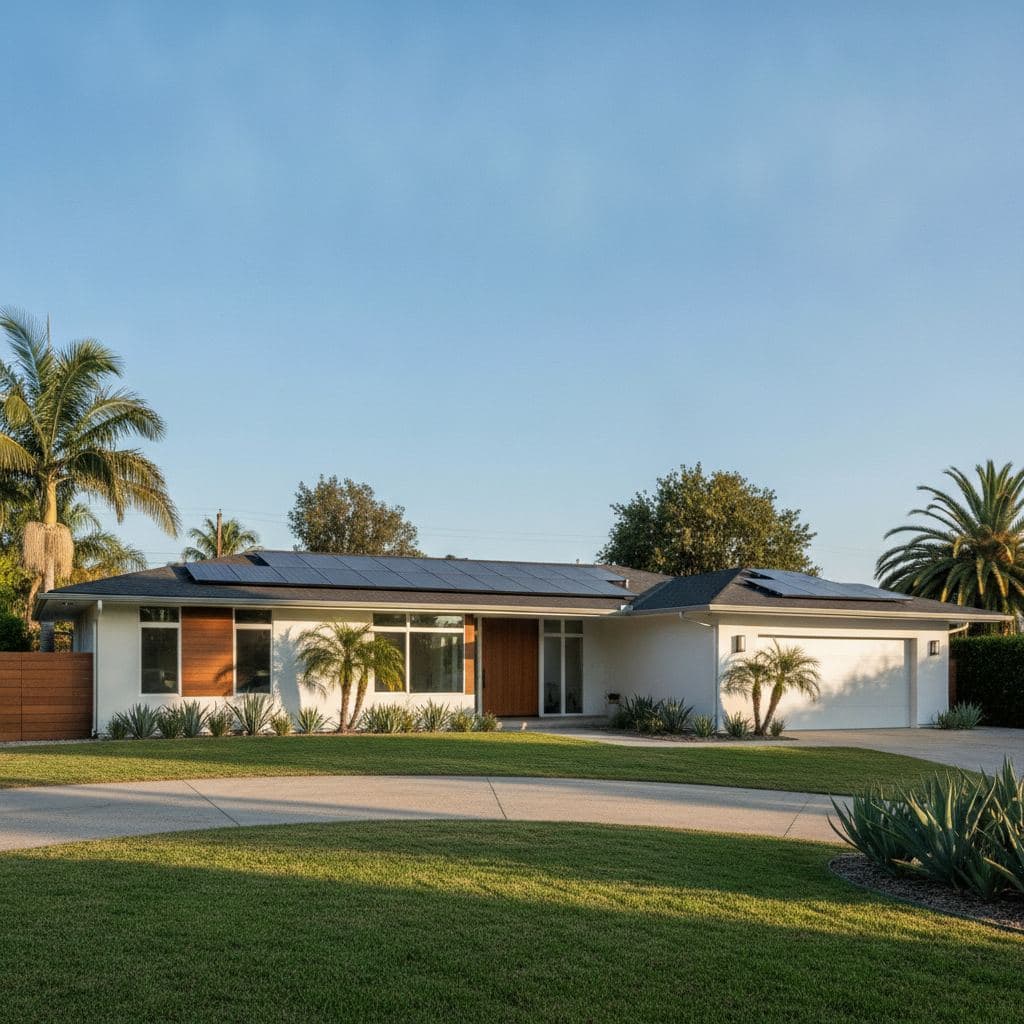
For a 7 kW system on SCE in 2026, the three third-party-owned (TPO) financing paths produce meaningfully different 25-year costs — the spread between the best and worst option is often $8,000–$15,000 in today's dollars. SCE's current average residential rate sits at approximately 34–35¢/kWh, which means every cent you lock in on a solar contract is a real hedge against a grid that has already raised rates dramatically. The right structure depends on whether you have cash, how long you plan to stay in the home, and whether you want to own the system at the end.
Last verified: September 2026 by Helios Energy Global.
Why third-party ownership is dominating California solar in 2026
The Section 25D 30% federal Investment Tax Credit for homeowner-owned residential solar expired December 31, 2025. That changed everything. Third-party-ownership (TPO) structures are now the only way left to capture a 30%-equivalent tax credit after Section 25D expired — because the financier, not the homeowner, owns the system and claims the commercial §48E credit instead.
In the residential sector, early 2026 volumes were buoyed by an overflow of installations initiated at the end of 2025 to capture the expiring Section 25D tax credit. Now that the rush is over, the market is pivoting to TPO leases and PPAs, which still qualify for the Section 48E commercial credit through 2027.
Third-party-ownership (lease and PPA) deals are projected to make up 65% of solar sales in 2026, up from 44% in 2025, as cash and loan buyers lost access to the federal credit.
The three TPO structures available to Southern California homeowners are: the monthly lease, the PPA (power purchase agreement), and the prepaid solar lease. They share one thing — a company other than you owns the panels — but they differ dramatically in cost structure, risk, and long-term savings.
The three structures, side by side
Monthly lease
You pay a fixed monthly dollar amount regardless of how much electricity the system produces. The payment is set at signing and may include a 0–2% annual escalator (many 2026 leases are offered at 0%). The financier owns the system for the full term (typically 20–25 years). At the end, you can buy the system at fair market value, renew, or have it removed.
Who it suits: Homeowners who want $0 down, predictable monthly payments, and zero maintenance responsibility — and who are comfortable not owning the system.
The catch: You're paying for a system you'll never own unless you exercise the buyout. A 0% escalator is genuinely predictable, but the starting payment is sized to give the financier a return, so you're not capturing the full economic benefit of the §48E credit.
PPA (power purchase agreement)
Under a PPA agreement, consumers make monthly payments based on how much electricity is produced by the system. You pay a per-kWh rate — not a flat monthly fee — so your bill fluctuates with production (higher in summer, lower in winter). The solar PPA price per kWh in California is typically between 20–27¢/kWh since utility rates are often above 30¢/kWh.
Unlike utility rates, which can change unpredictably, solar PPA rates either stay the same or escalate at an agreed-upon pace (usually 1–3% annually) for the 20–25 year agreement term. The prevalence of 2.9% escalating PPAs is a market failure driven by sales incentives, not buyer economics — so push back on any escalator above 1.5%.
Who it suits: Homeowners who want $0 down and whose production is predictable (south-facing roof, minimal shading). On SCE, where the current average rate is ~34–35¢/kWh, a starting PPA rate of 20–22¢ leaves a meaningful margin even after a 2.9% escalator for the first decade.
The catch: A 2.9% escalator compounding over 25 years means your PPA rate in year 25 is roughly 2.1× the starting rate. If SCE rates rise faster than that escalator, you still win; if they flatten, you may not.
Prepaid lease
This is the most powerful structure for homeowners who have — or can borrow — cash. You pay a lump sum at signing that is typically ~30% less than a comparable cash purchase of the same system. Why? Because the financier (not you) owns the system, claims the commercial §48E Clean Electricity Investment Tax Credit, and prices the prepaid amount to pass most of that credit value forward to you.
§48E: Qualified facilities and energy storage technology placed in service on or after January 1, 2025 may be eligible for the §48E Clean Electricity ITC. Critically, this is a commercial credit — available to the third-party owner of the system, not to the homeowner — which is exactly why the prepaid structure exists.
After the prepaid term (typically years 1–5), ownership of the system transfers to you at the start of year 6 at essentially no additional cost. From that point forward, you own a paid-off solar system with 20+ years of remaining life.
Who it suits: Homeowners who plan to stay in the home at least 5–7 years, have access to a lump sum (or a low-rate home equity line), and want the lowest possible 25-year cost.
The catch: It requires upfront capital. And the §48E credit window is tightening — more on that below.
The §48E deadline: why the prepaid lease clock is ticking
The One Big Beautiful Bill Act (OBBBA) effectively ends the long-term availability of the Section 48E Clean Electricity Investment Tax Credit by imposing hard deadlines and accelerating its phase-out.
If the construction of a wind or solar facility begins after July 4, 2026, the qualified property must be placed in service by December 31, 2027 to qualify for the credit. Systems whose construction began on or before July 4, 2026 escape that hard deadline. Under IRS Notice 2025-42, those projects must be placed in service by the end of the fourth calendar year after construction began — so a system that began construction in 2026 (on or before July 4) has until December 31, 2030.
What this means for you: Financiers are racing to lock in §48E eligibility for residential prepaid leases. Systems installed today by a qualified TPO financier that began construction before the July 4, 2026 deadline can still claim the full 30% commercial credit — and pass that discount to you. Systems installed later face tighter eligibility windows. Ask your installer for documentation of the construction-start date and the financier's §48E registration number.
25-year cost comparison: 7 kW system on SCE
The table below models a 7 kW system for a typical SCE customer using approximately 10,500 kWh/year. All costs are estimates; your actual numbers will vary by roof, shading, and contract terms. SCE's current average residential rate is approximately 34–35¢/kWh, used as the 2026 baseline. Utility rate escalation assumed at 4% annually (SCE's approximate long-run average). System output degraded at 0.5%/year.
| Structure | Starting Rate / Payment | Escalator | Est. Year-1 Bill | Est. 25-Year Gross Cost | System Ownership at Year 6+ | Notes |
|---|---|---|---|---|---|---|
| Grid only (no solar) | ~34¢/kWh | ~4%/yr (est.) | ~$3,570/yr | ~$142,000 | N/A | Baseline comparison |
| Monthly lease | ~$140–$175/mo (est.) | 0–2%/yr | ~$1,680–$2,100/yr | ~$42,000–$52,500 | No (buyout at FMV) | Predictable; no ownership |
| PPA — 2.9% escalator | ~21¢/kWh (est.) | 2.9%/yr | ~$2,205/yr | ~$65,000–$75,000 | No (buyout at FMV) | Rate reaches ~43¢ by yr 25 |
| PPA — 0% escalator | ~24¢/kWh (est.) | 0% | ~$2,520/yr | ~$63,000 | No (buyout at FMV) | Predictable; better long-term |
| Prepaid lease | Lump sum ~$17,500–$22,000 (est.) | N/A | $0/yr (paid) | ~$17,500–$22,000 + minimal grid | Yes, at start of yr 6 | Lowest 25-yr cost; needs capital |
All figures are estimates for illustrative purposes. Actual costs depend on system size, shading, contract terms, and SCE rate trajectory. Prepaid lease range reflects approximate 30% discount vs. a typical 7 kW cash purchase at ~$2.50–$3.50/W (see our solar panel cost guide for full pricing context).
Key takeaway: The prepaid lease wins on 25-year cost by a wide margin for homeowners who can fund it. Among $0-down options, a fixed-rate or low-escalator PPA beats a monthly lease over 25 years — but a 2.9% escalator PPA can end up costing more than a 0% monthly lease in years 20–25.
LADWP and other municipal utility customers: different math
Most SCE homes are billed on a time-of-use plan such as TOU-D-4-9PM or TOU-D-PRIME, where the price climbs during the 4–9 PM peak, making solar especially valuable for offsetting those expensive evening hours.
LADWP customers face a different situation. LADWP is a municipal utility and is not on NEM 3.0 — it still offers retail-rate net metering, which means your exported solar power is credited at roughly the full retail rate (~28¢/kWh effective). That makes owned and prepaid-lease systems even more attractive for LADWP customers, because you capture full export value rather than the suppressed avoided-cost credits SCE's NEM 3.0 pays.
Pasadena PWP, Burbank, Glendale, Anaheim APU, Riverside RPU customers: same story. Each of these municipal utilities runs its own net metering program, separate from the CPUC's NEM 3.0 Net Billing Tariff. Check your specific utility's current export rate before modeling any TPO contract — the PPA math changes significantly if your export credit is higher.
For a deeper dive on how NEM 3.0 affects third-party financing, see our guide: NEM 3.0 explained for Southern California homeowners.
The escalator: the number that matters most in a PPA
The escalator is the single biggest variable in PPA economics, and it's often buried in the contract. Here's how to think about it:
- 2.9% escalator on a 21¢/kWh starting rate: By year 10, your PPA rate is ~27¢/kWh. By year 20, it's ~36¢/kWh — roughly equal to today's SCE rate. By year 25, it's ~43¢/kWh. You're still likely ahead of the grid in year 25, but your margin has compressed dramatically.
- 0% fixed rate on a 24¢/kWh starting rate: Your rate never changes. If SCE rates rise at 4%/year, your savings grow every year. By year 15, you're paying 24¢ while grid customers pay ~54¢.
The math is unambiguous: fixed-rate PPAs deliver the lowest lifetime cost for standard discount rates. Escalating PPAs only win if the buyer uses a discount rate above 12% or if the utility rate rises faster than the escalator. For a typical homeowner with a 5–8% cost of capital, fixed is the rational choice.
Negotiation tip: Negotiate the escalator below 1.5% if you choose an escalating model. Push back on 2.9% — the provider will accept a lower rate to close the deal.
What happens when you sell the house
This is where all three structures diverge sharply — and where many homeowners get a nasty surprise.
The UCC-1 fixture filing
In solar leasing and PPA agreements, the lender almost always files a UCC-1 financing statement to protect their solar property in the case of a borrower defaulting on the contract. When panels are leased, the solar company usually files a UCC-1 fixture filing against the property to protect its equipment. That filing shows up in the title search as an encumbrance, and if it isn't handled, it can stop your sale or refinance cold.
Clearing it means one of three paths: payoff and termination, lease/PPA transfer with provider consent, or subordination of the fixture filing to the new mortgage. Provider consent and transfer paperwork routinely add 10–30 days to escrow, so the fixture filing must be identified and worked the moment it appears on the prelim.
Important: For solar leases and PPAs, liens are only over the solar property — not a lien over your home. But they still require resolution at closing.
Monthly lease at home sale
The buyer must qualify for and assume the lease, or you buy it out. You can sell your home with a solar lease, but it is not as simple as a normal home sale. The buyer must qualify for and agree to assume the lease. If they refuse, you may need to buy out the lease before closing. This process can delay or derail a sale if not handled early.
Leased systems and active PPAs add little to nothing in home value, and can even reduce buyer interest if the monthly lease payment is high relative to the utility savings.
PPA at home sale
When you sell your home, the PPA transfers to the new homeowner, who takes over the remaining contract at your locked rate. Some buyers view a below-market solar rate as a selling advantage. Alternatively, most agreements include a buyout option so you can purchase the system at fair market value before selling if you prefer a clean title transfer.
Prepaid lease at home sale
This is the cleanest of the three TPO structures at resale. Because you've already paid for the system and ownership transfers at the start of year 6, you're effectively selling an owned solar system after year 5 — with no ongoing payment obligation for the buyer to assume. Before year 6, the UCC-1 still applies, but the lack of a monthly payment obligation makes the transfer far easier for a buyer to accept.
Read your buyout schedule. Every TPO contract includes a buyout schedule — a table showing what you'd pay to purchase the system outright in years 1, 2, 3, etc. For a prepaid lease, the year-6 transfer price should be nominal (often $1 or fair market value defined as near-zero for a partially depreciated system). Confirm this in writing before you sign.
How to read a TPO contract before you sign
Five things to check on page one:
- Escalator rate: 0% is best. Anything above 2% deserves a hard negotiation.
- Buyout schedule: Get the full table for all 25 years. Model year 6 and year 10.
- Transfer clause: Does the contract allow transfer to a buyer? Is there a credit approval requirement? A transfer fee?
- Performance guarantee: If the system underproduces, who eats the shortfall — you or the financier?
- UCC-1 release process: Ask explicitly: "How long does a transfer or payoff release take?" Get the answer in writing.
For a broader look at all solar financing options — including cash, loans, and PACE — see our California solar financing options guide.
Frequently asked questions about solar lease vs. PPA vs. prepaid lease
Is the 30% federal solar tax credit still available in 2026?
Not for homeowners who purchase or finance their own system. The Section 25D residential credit expired December 31, 2025. However, the commercial §48E credit is still available to third-party owners (financiers) of solar systems placed in service through at least 2027 — which is why TPO structures like leases, PPAs, and prepaid leases can still offer below-market pricing. If you're buying or taking a loan, there is no federal credit to claim in 2026.
Does a solar lease or PPA add value to my home?
Leased systems and active PPAs add little to nothing in home value, and can even reduce buyer interest if the monthly lease payment is high relative to the utility savings. A prepaid lease that has already transferred ownership (year 6+) behaves like an owned system and may add value. Owned systems — purchased with cash or a paid-off loan — typically add the most appraised value.
What is a UCC-1 fixture filing and should I be worried?
When a homeowner leases a solar panel system from a TPO or goes through a PPA, the owner of that solar panel system files a UCC-1 financing statement to show that they are the true owner. It is not a lien on your home — it's a claim on the equipment. The UCC-1 fixture filing is not something that should prevent you from taking on a solar lease or PPA — but you must address it proactively when you sell or refinance. Start the transfer or payoff process at least 30–45 days before your expected close date.
Which structure is best for SCE customers under NEM 3.0?
Under NEM 3.0, SCE credits your exported solar at avoided-cost rates (often 5–8¢/kWh), not retail rates. This makes battery storage essential for maximizing savings — and it shifts the math toward structures where you own the battery outright. A prepaid lease that includes a battery gives you the most control over dispatch. For $0-down customers, a PPA paired with a battery is stronger than a panel-only PPA on SCE. See solar vs. battery under NEM 3.0 for the full analysis.
Can I switch from a PPA to ownership later?
Most PPA and lease contracts include a buyout option, typically exercisable at specific anniversary dates (years 5, 7, 10). The buyout price is usually fair market value — which declines over time as the system ages. At the end of your PPA term you typically have the option to purchase the system at fair market value, renew the agreement at a new rate, or have the panels removed at no charge. Mid-term buyouts are possible but priced to give the financier a return, so they're rarely the cheapest path.
Is LADWP better or worse for third-party solar financing?
Better, in most cases. LADWP is a municipal utility not subject to NEM 3.0 — it still credits exported solar at approximately the full retail rate. That means a prepaid lease or PPA on an LADWP account earns more value per kWh exported than the same system on SCE. If you're in LADWP territory, run the numbers with retail-rate export credits rather than the avoided-cost credits that apply to SCE.
What happens to my PPA if the solar company goes out of business?
Your contract is typically held by a separate financing entity (a tax equity fund or special-purpose vehicle), not the installer. The panels keep working regardless of installer status. However, maintenance and warranty claims become harder to resolve. Ask your installer: "Who holds the financing contract, and what is the servicing arrangement if the installer ceases operations?" Get the answer documented before signing.
Next steps
- Book a free consultation and custom design — we'll model all three structures side by side for your specific roof, utility, and usage.
- See our solar financing options guide for California 2026 — cash, loan, lease, PPA, and prepaid compared.
- Understand your NEM 3.0 export credits on SCE — critical context before choosing any TPO structure.
- Explore battery storage options — under NEM 3.0, a battery changes the math on every financing structure.
- Check our solar panel cost guide — understand the all-in installed cost that anchors the prepaid lease discount.
- See our Southern California service locations — we serve SCE, LADWP, and most Southern California municipal utilities.
Sources
- SCE Rate Advisory — June 1, 2026 Rate Update — June 1, 2026
- SEIA Solar Market Insight Report Q2 2026 — July 30, 2026
- IRS Tax-Exempt Entities and the Investment Tax Credit (§48 and §48E) — January 2026
- The Tax Adviser — Navigating Safe-Harbor Rules for Solar and Wind Sec. 48E Facilities — February 10, 2026
- Solar.com — Solar PPA: The Simple Guide to Power Purchase Agreements in 2026 — January 8, 2026
More guides
8 kW Solar System Cost in California 2026
An 8 kW solar system costs roughly $20,000–$28,000 installed in California in 2026, before any incentives.
ReadBest Solar Companies in Oak Park, CA (2026): An Honest Guide for Homeowners
A straight-talking, numbers-first guide to the best solar installers serving Oak Park, CA in 2026 — covering SCE net billing, real price ranges, battery decisions, and what to ask before you sign.
ReadBest Solar Companies in Carlsbad, CA (2026): Ranked for SDG&E, NEM 3.0, and Tile-Roof Homes
Carlsbad homeowners face SDG&E rates near 46¢/kWh and NEM 3.0 export rules that make battery-paired solar the default smart choice. This guide ranks the 10 best solar installers serving Carlsbad in 2026 — with honest notes on tile-roof expertise, SolarAPP+ permitting, and EV-charger integration.
ReadGet a free consultation and custom design.
No pressure, no obligation — the owner reviews every design we send.