Best Solar Companies in Carlsbad, CA (2026): Ranked for SDG&E, NEM 3.0, and Tile-Roof Homes
Carlsbad homeowners face SDG&E rates near 46¢/kWh and NEM 3.0 export rules that make battery-paired solar the default smart choice. This guide ranks the 10 best solar installers serving Carlsbad in 2026 — with honest notes on tile-roof expertise, SolarAPP+ permitting, and EV-charger integration.
By Taylor Crouse — Founder, Helios Energy GlobalPublished
Quick answer
- SDG&E rates run ~46¢/kWh — per SDG&E's April 2026 rate change alert, the bundled residential average rose to approximately 46.4¢/kWh, the highest of any major investor-owned utility in the continental U.S. On TOU-DR1, on-peak power (4–9 PM) exceeds 60¢/kWh in summer.
- NEM 3.0 applies — exports earn ~5–8¢/kWh — Carlsbad is served by San Diego Gas & Electric, an investor-owned utility under the CPUC's Net Billing Tariff. Every kilowatt-hour you export earns avoided-cost rates averaging roughly 5–8¢/kWh, not the retail rate you pay. Self-consumption and battery storage are the only ways to capture full value.
- Typical system size: 7–11 kW — Carlsbad's master-planned homes in La Costa, Aviara, and Bressi Ranch tend to run larger than the San Diego County average, with AC loads, EVs, and pool equipment pushing consumption higher. Most designs here land in the 8–10 kW range.
- Pre-incentive installed price range: ~$2.50–$3.50/W — for a solar-only system. Concrete-tile roofs with tile-hook mounting sit at the upper end. Batteries add $14,000–$18,500 depending on capacity and brand.
- No federal tax credit in 2026 — the 30% residential solar and battery tax credit expired December 31, 2025. There is no phase-down and no partial credit for systems installed in 2026. Quote your payback unsubsidized.
- SolarAPP+ means fast permits, but SDG&E interconnection still takes time — Carlsbad issues residential solar permits instantly through SolarAPP+ once the automated code check passes. The longer clock is SDG&E's interconnection queue, typically 4–10 weeks after permit issuance.
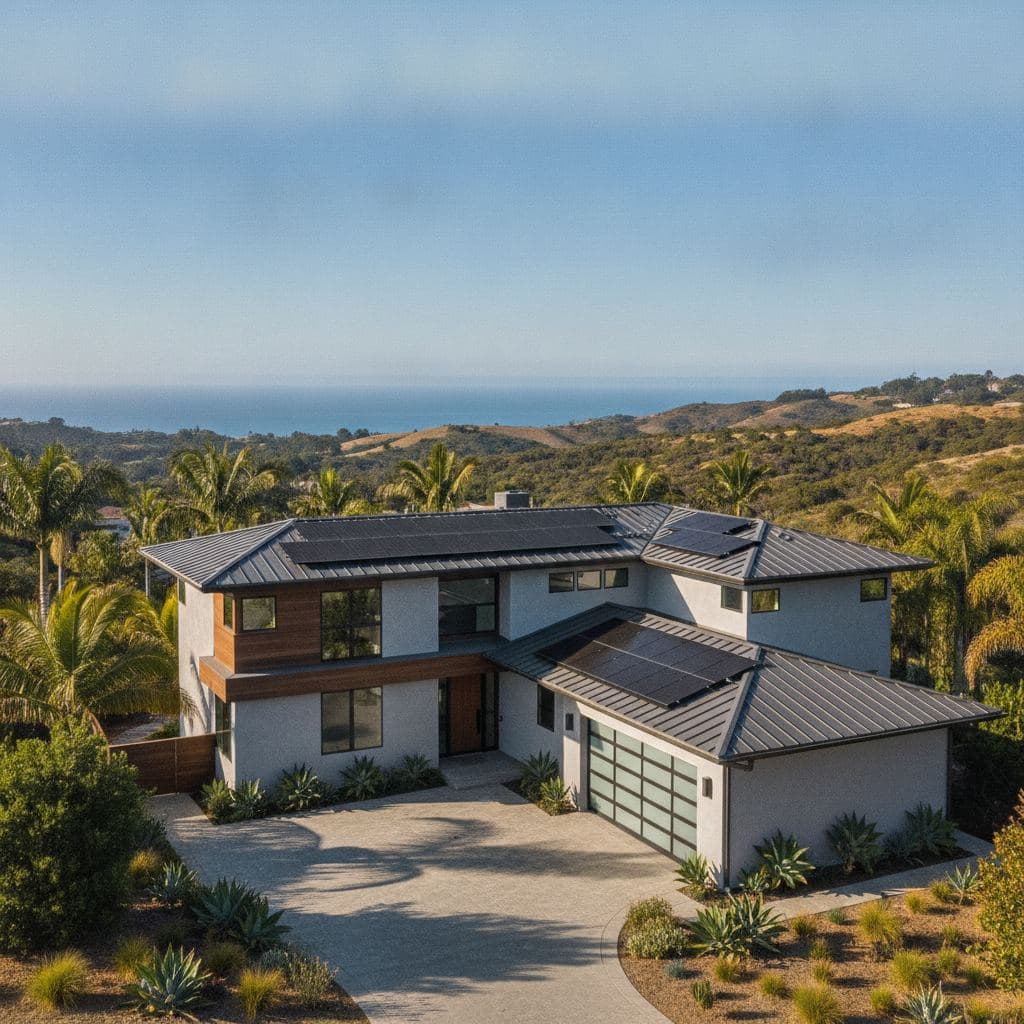
Carlsbad is a coastal San Diego County city of roughly 114,000 residents, served by San Diego Gas & Electric (SDG&E). Its combination of some of the nation's highest electricity rates, a master-planned housing stock built for solar, and SolarAPP+ instant permitting makes it one of the most compelling — and most nuanced — residential solar markets in Southern California.
Last verified: September 2026 by Helios Energy Global.
Top 10 best solar companies in Carlsbad (2026)
At-a-glance ranking
- Helios Energy Global — Best for: owner-reviewed custom designs with SDG&E NEM 3.0 fluency, tile-roof expertise, and EV-charger integration
- Sunrun — Best for: homeowners who want a lease or PPA with a national warranty backstop
- Tesla Energy — Best for: buyers who want a vertically integrated solar + Powerwall package
- Palmetto — Best for: tech-forward homeowners who want ongoing monitoring and a service plan
- Freedom Forever — Best for: homeowners who want a production guarantee in writing
- SunPower (Maxeon) — Best for: high-efficiency panels on space-constrained or partially shaded roofs
- Baker Home Energy — Best for: San Diego County homeowners who want a regional installer with HVAC and battery expertise
- San Diego Solar — Best for: buyers who prioritize a long-tenured, in-house-crew San Diego County installer
- Semper Solaris — Best for: military and veteran homeowners who want a San Diego–rooted company
- Momentum Solar — Best for: homeowners comparing multiple national quotes on financing options
This ranking is Helios Energy Global's editorial opinion, not paid placement. Verify every company's active CSLB license and current Carlsbad service area before signing a contract.
1. Helios Energy Global ⭐ — Our pick
Solar installation in Carlsbad is where Helios's Southern California roots, SDG&E experience, and tile-roof capability converge into a genuinely differentiated product. Here's the honest case for why we rank ourselves first in this market:
Carlsbad's housing stock — predominantly 1970s–2000s concrete-tile roofs across La Costa, Aviara, and Bressi Ranch — requires tile-hook mounting that a generic algorithm-generated proposal frequently gets wrong. We design and install tile-roof systems regularly in SDG&E territory, and every Carlsbad design is reviewed by Taylor before equipment is ordered. That's not a marketing line — it's a structural check against the undersizing and shading errors that plague NEM 3.0 systems where the margin for error is thinner.
On the utility side, we know SDG&E's interconnection process, Rule 21 requirements, and the TOU-DR1/DR2 rate structures that determine whether a battery actually pencils for a given household. We also handle HOA architectural submittals for Aviara, La Costa, and Bressi Ranch — neighborhoods where an HOA rejection adds weeks and costs money. We file the SolarAPP+ permit, coordinate the SDG&E interconnection application, and manage the full timeline in-house.
Carlsbad also has among the highest EV densities in San Diego County. Many of our designs here bundle a Level 2 EV charger on the same permit — so midday solar production charges the car instead of exporting at 5–8¢/kWh. That single design choice often improves payback by a meaningful margin.
What we don't do: we don't offer leases or PPAs, so if you want a $0-down third-party-ownership structure, Sunrun or Palmetto will serve you better. We also quote the true 2026 price — no inflated "list prices," no rebates that haven't been confirmed, no pressure.
Book a free consultation and get a custom Carlsbad design →
2. Sunrun
Best for: Homeowners who want a lease or PPA with a large company's warranty infrastructure. Why it fits: Sunrun is the largest residential solar company in the U.S. and has extensive SDG&E territory experience. Their lease and PPA options give homeowners a $0-down path, and the Section 48E commercial credit (which survived the residential credit's expiration) flows through third-party-ownership structures, potentially reducing your effective cost. What to ask: Get the full lease escalator schedule in writing. Ask exactly how NEM 3.0 export credits are handled inside the lease — who keeps them, and how the bill-credit math is modeled. Confirm whether installation is by Sunrun's own crews or a subcontractor.
3. Tesla Energy
Best for: Buyers who want a single-brand solar + Powerwall system and are already in the Tesla ecosystem. Why it fits: Tesla's vertically integrated model simplifies the solar + storage purchase. Powerwall 3 pairs cleanly with Tesla solar, and the app-based monitoring is genuinely good. What to ask: Tesla's standardized design process works well on simple composition-shingle roofs but can be less precise on complex tile roofs with multiple planes. Ask specifically how tile-hook mounting is handled and who the installing crew is. Confirm the SDG&E interconnection timeline from your specific address.
4. Palmetto
Best for: Tech-forward homeowners who want ongoing monitoring and a maintenance service plan beyond the initial install. Why it fits: Palmetto's "Protect" platform provides performance tracking, proactive alerts, and maintenance coverage — useful for homeowners who want a long-term service relationship rather than a one-time installation. What to ask: Clarify what's included in the Protect plan versus what costs extra. Ask how their NEM 3.0 system-sizing methodology works for SDG&E customers, and whether battery storage is modeled as part of the initial design.
5. Freedom Forever
Best for: Homeowners for whom a production guarantee — if output falls short, they pay the difference — provides meaningful peace of mind. Why it fits: Freedom Forever operates across California and differentiates on a production guarantee that goes beyond standard equipment warranties. What to ask: Read the production guarantee terms carefully. Ask how the guaranteed output number is calculated, what the claims process looks like, and whether the guarantee survives a company acquisition or insolvency.
6. SunPower (Maxeon)
Best for: Homeowners with partially shaded roofs, limited usable roof space, or a preference for the highest-efficiency panels available. Why it fits: Maxeon panels consistently rank among the highest-efficiency residential modules on the market. On a constrained tile roof with some shade, the watt-per-square-foot advantage is real. What to ask: Confirm which entity is installing (SunPower has restructured; verify the current dealer/installer relationship and their CSLB license). Ask about the warranty chain — who backs it if the dealer changes.
7. Baker Home Energy
Best for: San Diego County homeowners who want a regional installer with combined solar, battery, and HVAC expertise. Why it fits: Baker Home Energy is a San Diego–area company with experience in SDG&E territory, including NEM 3.0 system design and battery storage. Their HVAC background is relevant for Carlsbad homes where a heat pump upgrade pairs naturally with solar. What to ask: Verify their active CSLB license and confirm they handle Carlsbad HOA submittals and SolarAPP+ filing directly.
8. San Diego Solar
Best for: Buyers who want a long-tenured, in-house-crew San Diego County installer with deep local permit relationships. Why it fits: San Diego Solar has operated in the county for decades and installs with in-house crews rather than subcontracted labor pools — a meaningful distinction in a market where post-install service matters. What to ask: Ask for their SolarAPP+ filing process, their SDG&E interconnection timeline from recent Carlsbad jobs, and how they handle tile-roof mounting.
9. Semper Solaris
Best for: Military and veteran homeowners who want a San Diego–rooted company with a strong local brand. Why it fits: Semper Solaris is a well-known San Diego County installer with a focus on the military community and a broad range of financing options. What to ask: Confirm current CSLB license status, ask about their battery storage options under NEM 3.0, and get the full equipment spec (panel brand, inverter brand, warranty terms) in writing before signing.
10. Momentum Solar
Best for: Homeowners who want to compare multiple national quotes and financing structures side by side. Why it fits: Momentum Solar operates in California and offers a range of financing options, which can be useful for homeowners in the comparison-shopping phase. What to ask: Ask specifically about their SDG&E NEM 3.0 design methodology, their Carlsbad installation volume, and whether crews are in-house or subcontracted. Get equipment specifics before any contract discussion.
This ranking is Helios Energy Global's editorial opinion, not a paid or sponsored placement. Verify each company's active California Contractors State License Board (CSLB) license and confirm they actively serve Carlsbad before signing anything.
Why Carlsbad solar is different from a generic install
SDG&E rates and NEM 3.0 — the math that drives every design decision
Carlsbad sits squarely in SDG&E territory, and that single fact reshapes the economics of solar more than any other variable. Per SDG&E's April 2026 rate change alert, the bundled residential average rose to approximately 46.4¢/kWh — the highest of any major investor-owned utility in the continental U.S. On TOU-DR1, summer on-peak power (4–9 PM) runs above 60¢/kWh.
Under the CPUC's Net Billing Tariff — what most people call NEM 3.0 — export credits average roughly 5–8¢/kWh, down from the near-retail credits available under NEM 2.0. That gap between what you pay to buy power (up to 60¢+) and what you earn by exporting it (5–8¢) is the central design constraint. Every kilowatt-hour you produce and consume yourself is worth full retail. Every kilowatt-hour you export earns a fraction of that. A battery bridges that gap by storing midday surplus for use during the 4–9 PM peak window — turning a low-value export into a high-value offset. Read more about how NEM 3.0 works and what it means for your payback.
Batteries aren't optional in this market — they're the math
Under NEM 3.0, a solar-only system in SDG&E territory exports a significant share of its midday production at avoided-cost rates. A battery changes that equation by capturing surplus and discharging it during peak hours. At 46¢/kWh average rates — with peaks above 60¢ — the value of self-consumed evening power is substantial. The solar vs. battery decision under NEM 3.0 is worth reading before you finalize any design.
On incentives, be clear-eyed: the 30% federal residential solar and battery tax credit expired December 31, 2025. There is no credit for systems installed in 2026. California's SGIP battery rebate program has its general-market budget waitlisted; income-qualified homeowners may still access Equity or Equity Resiliency tiers, but standard-market applicants should not plan on SGIP funding. We register SGIP interest on every Carlsbad job where it makes sense, but we never let a waitlisted rebate prop up a payback estimate.
Tile roofs, HOAs, and the Carlsbad housing stock
La Costa, Aviara, and Bressi Ranch — the three neighborhoods that define most of Carlsbad's solar volume — are master-planned communities built largely between the 1970s and early 2000s. The dominant roof type is concrete tile, which requires tile-hook mounting rather than the standard lag-bolt-through-sheathing method used on composition shingle. Tile-hook installations cost more per watt, take longer, and require an installer who actually knows the difference between a flat S-tile and a high-profile barrel tile.
All three of those neighborhoods also have active HOAs with architectural review requirements. A permit from the city doesn't substitute for HOA approval. Installers who don't handle HOA submittals leave that step to the homeowner — which means delays, revision requests, and the risk of an installation that doesn't meet the CC&Rs. We handle HOA submittals as part of every job in these communities.
Carlsbad Village and the beach-adjacent areas near Carlsbad State Beach are a different story: older cottages and ranch homes with varied roof conditions, sometimes composition shingle, sometimes aging tile, and occasionally roofs that need replacement before panels go on. If your roof is within 5–7 years of end-of-life, address that first — a remove-and-reinstall later costs more than doing it in sequence.
EV density and the charger-bundle opportunity
Carlsbad has among the highest EV densities in San Diego County. For homeowners with one or two EVs, the design question isn't just "how much solar do I need for the house?" — it's "how much solar do I need for the house and the cars?" Charging from midday solar production (or from battery discharge in the evening) is worth full retail offset value, versus exporting that same energy at 5–8¢/kWh. We size arrays for driving load and install Level 2 EV chargers on the same permit when possible, which simplifies the inspection process and keeps the project on a single timeline.
The marine layer, microclimates, and production reality
Carlsbad's coastal location means a morning marine layer that typically burns off by mid-morning — earlier inland than at the beach. The practical effect: homes in La Costa, Calavera Hills, and Bressi Ranch (east of El Camino Real) produce meaningfully more annual energy than a home right on the bluff in Carlsbad Village. An average of 5.3 peak sun hours is a reasonable planning number for inland Carlsbad; coastal-facing roofs may run slightly lower. Any honest proposal should show you the production estimate by month, not just an annual total, so you can see how the marine layer affects winter and spring output.
Real prices: what solar costs in Carlsbad
Per-watt benchmark
Installed solar in Carlsbad runs approximately $2.50–$3.50 per watt before any incentives for a cash purchase. Concrete-tile roofs with tile-hook mounting sit at the upper end of that range. Composition-shingle roofs on older Village homes or ranch-style properties in Calavera Hills sit closer to the middle. These are 2026 figures — the expired federal tax credit is not factored in, because there is no credit to factor.
Batteries add approximately $14,000–$18,500 depending on capacity, brand, and whether the installation requires a panel upgrade or subpanel work.
Illustrative price ranges by system size
The table below shows estimated pre-incentive installed cost ranges for common system sizes in Carlsbad. These are ranges, not quotes — your actual price depends on roof type, shading, electrical panel condition, battery inclusion, and the specific installer you choose.
| System Size | Estimated Pre-Incentive Range | Typical Use Case |
|---|---|---|
| 6 kW | $15,000 – $21,000 | Smaller home, low-to-moderate consumption, no EV |
| 8 kW | $20,000 – $28,000 | Mid-size home, one EV or moderate AC use |
| 10 kW | $25,000 – $35,000 | Larger La Costa / Aviara home, one EV, pool |
| 12 kW | $30,000 – $42,000 | High-consumption home, two EVs, or pool + AC |
| 15 kW | $37,500 – $52,500 | Maximum-production design, large home, two EVs |
Estimates only. Tile-roof mounting, HOA submittal fees, electrical panel upgrades, and battery storage are not included in these ranges unless noted. Get a site-specific quote before making any financial decisions.
Use our estimate your Carlsbad solar savings calculator to see a preliminary number based on your actual usage and roof.
What pushes a Carlsbad quote higher
- Concrete or barrel tile roof — tile-hook mounting adds cost and labor time versus composition shingle
- Electrical panel upgrade — older homes in Carlsbad Village may need a 200A panel upgrade before interconnection
- Battery storage — a single Powerwall 3 adds $14,500–$18,500 installed (a FranklinWH aPower 2, $16,000–$21,000); two Powerwall 3 units run $24,000–$30,000
- EV charger addition — Level 2 EVSE on the same permit adds cost but is often the highest-ROI addition
- HOA architectural review — not a contractor cost, but delays the timeline if not managed proactively
- Complex roof geometry — multiple planes, valleys, or dormers increase design and labor time
- Coastal location — salt-air-rated hardware (corrosion-resistant racking, marine-grade connectors) is appropriate for homes within a mile of the water and adds a modest cost premium
Solar-only or solar + battery in Carlsbad?
When solar + battery is the right answer (most Carlsbad homes)
Under NEM 3.0 with SDG&E rates near 46¢/kWh, the battery decision is less "do I want backup power?" and more "do I want my solar system to actually perform?" Here's the math in plain terms: every kilowatt-hour you export earns roughly 5–8¢. Every kilowatt-hour you store in a battery and use during the 4–9 PM peak avoids buying power at 60¢+. The battery effectively multiplies the value of your solar production during the hours that matter most.
For Carlsbad homes with:
- An EV (or two)
- A pool or spa
- Central AC running through the summer
- A household that's home in the evenings
…a battery isn't a luxury add-on. It's what makes the NEM 3.0 math work. See our full batteries guide for a breakdown of the main options.
When solar-only might still pencil
A solar-only system still makes sense in Carlsbad if your household runs a high daytime load — a home office, a business run from home, or a household that's genuinely home and consuming power during the solar production window (roughly 9 AM–3 PM). In those cases, self-consumption without a battery can be high enough to justify the system on its own. But even then, we typically model both scenarios and let the numbers decide.
Battery proposal mistakes to avoid
- Undersized battery for the load — a single 10 kWh battery won't carry a pool pump, AC, and EV charging through an evening. Know what you're backing up before you size.
- Battery without a critical-loads subpanel — if the battery isn't wired to a dedicated subpanel, it may not power what you think it does during an outage.
- Modeling payback with SGIP — SGIP general-market budgets are waitlisted. Don't let an installer build your payback calculation on a rebate that isn't confirmed.
- Ignoring the panel upgrade requirement — some Carlsbad homes need a 200A service upgrade before a battery can be installed. That cost belongs in the quote, not the fine print.
How to choose the right solar company in Carlsbad
Verify the license before anything else
California requires solar contractors to hold an active CSLB license — typically a C-10 (Electrical) or B (General Building). Look up any company you're considering at the CSLB license lookup before you sit through a sales presentation. A lapsed or suspended license is an immediate disqualifier regardless of how good the pitch sounds.
Ask specifically about SDG&E interconnection experience
SDG&E's Rule 21 interconnection process has its own timeline, documentation requirements, and queue dynamics. An installer who primarily works in SCE territory will have a different — and potentially slower — experience navigating SDG&E's system. Ask how many SDG&E interconnection applications they've filed in the past 12 months and what their average PTO (Permission to Operate) timeline looks like from Carlsbad addresses.
Ask who designs and who installs
Some national brands generate proposals algorithmically and hand installation to subcontracted labor pools. Others design in-house and install with their own crews. Neither model is automatically better, but you should know which one you're getting and what the service chain looks like if something goes wrong two years post-install.
Understand the HOA submittal process
If your home is in La Costa, Aviara, or Bressi Ranch, your HOA has architectural review authority over solar installations. The California Solar Rights Act limits what HOAs can prohibit, but it doesn't eliminate the review process. Ask your installer whether they handle the submittal, what the typical turnaround is, and whether there are design constraints (panel color, racking visibility) that affect your system layout.
How to compare quotes without getting tricked
- Compare $/watt, not total price — a larger system will always cost more. Divide the total installed price by the system size in watts to get a comparable number.
- Check the production estimate methodology — ask whether the estimate uses NREL PVWatts, Aurora, or another modeling tool. Ask what shading factor and degradation rate they assumed.
- Read the equipment spec — insist on the specific panel brand, model, and wattage, plus the inverter brand and model, before signing. "Tier-1 panels" is not a spec.
- Understand the warranty chain — equipment warranties (panels, inverters) are backed by manufacturers. Workmanship warranties are backed by the installer. If the installer closes, the workmanship warranty may be worthless. Ask how long they've been in business and whether they carry insurance.
- Get the NEM 3.0 export modeling in writing — ask the installer to show you the assumed export rate, the assumed self-consumption rate, and how battery dispatch is modeled. A proposal that doesn't show you these assumptions is not a real NEM 3.0 design.
- Don't sign on the first visit — any installer who tells you the price is only good today is using pressure tactics. A real design takes time to get right. We never use same-day pressure.
For a deeper look at system sizing, see our 10 kW solar system cost guide for California.
Carlsbad quote checklist
Before signing any solar contract in Carlsbad, get clear answers to all of the following:
Utility and net metering
- Is my system designed under SDG&E's NEM 3.0 Net Billing Tariff?
- What export rate (¢/kWh) did you use in the production model, and what's the source?
- What is my modeled self-consumption rate with and without battery?
- How does the battery dispatch strategy interact with TOU-DR1 peak hours?
Permitting and interconnection
- Will you file through Carlsbad's SolarAPP+ portal?
- What is your typical timeline from permit filing to SDG&E Permission to Operate?
- Do you handle HOA architectural submittals for my neighborhood?
Equipment
- What is the exact panel brand, model, wattage, and efficiency?
- What inverter brand and model? Microinverters or string with optimizers?
- What battery brand, model, and usable capacity (kWh)?
- Is the racking corrosion-rated for coastal proximity?
- What tile-hook system do you use for concrete tile roofs?
Pricing and incentives
- What is the all-in installed price in $/watt?
- Does this price include tile-hook mounting, HOA submittal, and SDG&E interconnection?
- Is any rebate (SGIP or other) included in the payback estimate? Is it confirmed or assumed?
- Is the 30% federal tax credit excluded from your payback model? (It should be — it expired.)
Company
- What is your CSLB license number, and is it currently active?
- Are you installing with your own crews or subcontractors?
- What is your workmanship warranty, and who backs it if your company closes?
- How many Carlsbad / SDG&E systems have you installed in the past 12 months?
Final verdict
Carlsbad is one of the most financially compelling solar markets in California — and one of the most technically specific. SDG&E's rates near 46¢/kWh create the strongest possible incentive to offset consumption. NEM 3.0's low export rates make battery storage the logical companion to panels rather than an optional upgrade. And the city's tile-roof housing stock, active HOAs, and high EV density mean that a generic, one-size-fits-all proposal is likely to leave money on the table or create problems at installation.
Helios ranks #1 in this guide because our design process is built around exactly those variables: SDG&E NEM 3.0 modeling, tile-hook mounting expertise, HOA submittal management for La Costa, Aviara, and Bressi Ranch, and EV-charger integration on the same permit. Every Carlsbad design is reviewed by Taylor before equipment is ordered — not handed off to an algorithm or a call center.
That said, every company on this list has a legitimate use case. If you want a lease, Sunrun is the largest provider with the deepest SDG&E experience. If you want a single-brand Powerwall system, Tesla is straightforward. The right answer is the one that matches your financial goals, your roof, your utility, and your household load — and you deserve a proposal that actually models all four.
Get a free, no-obligation Carlsbad design from Helios →
Frequently asked questions about solar in Carlsbad
How much does solar cost in Carlsbad in 2026?
Installed solar in Carlsbad runs approximately $2.50–$3.50 per watt before incentives for a cash purchase — roughly $17,500–$38,500 for the 7–11 kW systems that most larger Carlsbad homes need. Concrete-tile roofs with tile-hook mounting sit at the upper end of that range. Batteries add $14,000–$18,500 depending on brand and capacity. The 30% federal residential tax credit expired December 31, 2025 and does not apply to 2026 installations, so quote your payback without it.
Does NEM 3.0 apply to Carlsbad solar systems?
Yes. Carlsbad is served by San Diego Gas & Electric (SDG&E), one of California's three investor-owned utilities under the CPUC's Net Billing Tariff. Any residential solar system with an interconnection application filed after April 15, 2023 is on NEM 3.0, which credits exported energy at avoided-cost rates averaging roughly 5–8¢/kWh rather than the retail rate. Self-consumption and battery storage are the primary strategies for maximizing value under this structure.
Is a battery worth it for a Carlsbad home under NEM 3.0?
For most Carlsbad homes, yes — and the math is clearer here than almost anywhere else in California. With SDG&E on-peak rates above 60¢/kWh and export credits at 5–8¢/kWh, a battery that stores midday solar for evening use converts a low-value export into a high-value offset. Homes with EVs, pools, or significant evening loads see the strongest payback improvement from adding storage.
How fast are solar permits in Carlsbad?
Carlsbad operates SolarAPP+, the automated online permitting platform. Per the City of Carlsbad's official SolarAPP+ page, residential solar permits are issued immediately after an applicant receives approval from the platform and applies through the Customer Self Service portal. The longer timeline is SDG&E's interconnection queue, which typically runs 4–10 weeks after permit issuance before you receive Permission to Operate.
What utility serves Carlsbad, and how does that affect my solar design?
Carlsbad is served by San Diego Gas & Electric (SDG&E), not LADWP, SCE, or any municipal utility. SDG&E has the highest residential electricity rates of any major investor-owned utility in the continental U.S. — approximately 46¢/kWh average as of mid-2026 — and all new solar systems are subject to NEM 3.0's avoided-cost export compensation. This combination makes right-sized solar-plus-battery systems the standard design recommendation for Carlsbad, not an upsell.
How do I check if a solar contractor is licensed in California?
Search the Contractors State License Board (CSLB) at cslb.ca.gov using the company's name or license number. Confirm the license is active (not expired, suspended, or revoked), that it covers the appropriate classification (C-10 Electrical is the most common for solar), and that the bond and workers' compensation insurance are current. Do this before signing any contract or paying any deposit.
What size solar system do I need for a Carlsbad home?
Most Carlsbad homes in La Costa, Aviara, and Bressi Ranch land in the 8–10 kW range, driven by larger square footage, central AC, and EV charging loads. Smaller beach cottages or Village homes with lower consumption may be well-served by 6–7 kW. The right size depends on your 12-month SDG&E bill history, your EV driving mileage, and whether you're adding a battery. A proper design starts with your actual usage data, not a square-footage estimate.
Can my solar system charge an EV in Carlsbad?
Yes — and in Carlsbad's NEM 3.0 environment, EV charging from solar is one of the highest-value design decisions you can make. Charging from midday solar production or evening battery discharge avoids both SDG&E's on-peak rates (60¢+/kWh) and the low export rate you'd earn by sending that same energy to the grid. We size arrays to include driving load and can install a Level 2 EV charger on the same permit, keeping the project on a single timeline.
Next steps
- Best solar companies in San Diego — the ranked list for the city of San Diego, if you are comparing across the county
- Book a free consultation and custom design — no pressure, no obligation
- Solar installation in Carlsbad — our Carlsbad service page with local FAQs
- Estimate your Carlsbad solar savings — see a preliminary number based on your usage
- How NEM 3.0 works — and what it means for your payback
- Solar vs. battery under NEM 3.0
- What does a 10 kW solar system cost in California?
- Battery storage options
- All Helios solar guides
Sources
- SDG&E Bundled Electric Rate Change Alert April 2026 — April 2026
- City of Carlsbad — Residential Solar Permitting with SolarAPP+ — January 2026
- ElectricityCostComparison.com — SDG&E Rates 2026 (verified July 2026) — July 25, 2026
- CA Energy Initiative — NEM 3.0 Explained: What Changed (July 2026) — July 13, 2026
- Franklin WH — Complete Guide to California SGIP Program 2026 — March 18, 2026
More guides
Best Solar Companies in Beverly Hills, CA (2026): An Honest Homeowner's Guide
Beverly Hills homeowners face a unique solar equation: large luxury homes, high electricity bills, and a municipal utility that plays by different rules than the rest of SoCal. Here's how to navigate it.
ReadThe 10 Best Solar Companies in Mission Viejo, CA (2026): Tile Roofs, HOAs, and NEM 3.0 Done Right
Mission Viejo's master-planned tile roofs, HOA review process, and SCE's NEM 3.0 billing rules make installer selection more consequential than most Orange County cities. Here's an honest, numbers-first look at who's doing it right in 2026.
ReadSolar financing options in California: cash vs loan vs lease vs PPA in 2026
With the federal 30% credit gone, a prepaid lease is the only 2026 path to roughly 30% off; cash still wins in municipal utility territory.
ReadGet a free consultation and custom design.
No pressure, no obligation — the owner reviews every design we send.