Best Solar Companies in Oak Park, CA (2026): An Honest Guide for Homeowners
A straight-talking, numbers-first guide to the best solar installers serving Oak Park, CA in 2026 — covering SCE net billing, real price ranges, battery decisions, and what to ask before you sign.
Updated
Quick answer
- Your utility is SCE, and NEM 3.0 (Net Billing Tariff) applies. Export credits are based on the "Avoided Cost Calculator" rate, which is lower than the retail rate. Self-consumption is now more valuable than exporting, so system sizing and battery pairing matter more than ever.
- Typical system size for an Oak Park home runs roughly 6–12 kW, depending on whether you have a pool, EV, or plan to electrify appliances. Oversizing to maximize export makes less financial sense under NEM 3.0.
- Local price range for a fully installed residential system falls in the $2.50–$3.50 per watt range before any incentives, putting a common 8 kW system somewhere in the $20,000–$28,000 ballpark (estimates; your quote will vary).
- Battery storage deserves serious consideration here. Under NEM 3.0, a battery lets you shift solar energy you'd otherwise export at low credit rates to evening hours when you'd otherwise buy power at high retail rates. It also provides backup during Ventura County's occasional PSPS (Public Safety Power Shutoff) events.
- What drives cost: roof material (tile costs more to work with than composition shingle), panel count and brand tier, inverter type (string vs. microinverters), battery addition, and any required main panel upgrade.
- The 30% federal residential solar tax credit expired December 31, 2025. There is no federal ITC for residential solar systems installed in 2026. Any installer who quotes you a "30% federal credit" is working from outdated or inaccurate information. Do not rely on that number.
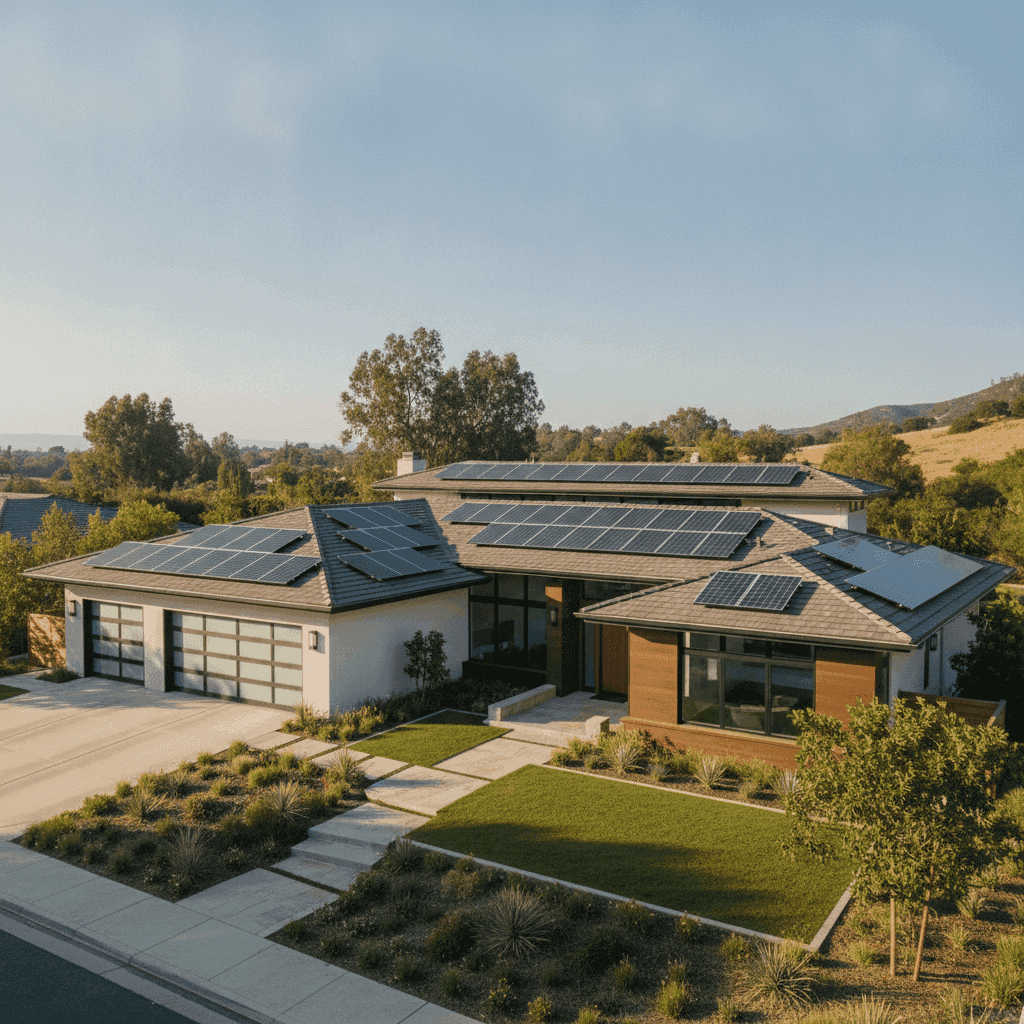
Oak Park is a master-planned community tucked into the western edge of Ventura County, just north of the Los Angeles County line near Thousand Oaks and Agoura Hills. Despite its Ventura County address, most Oak Park homes are served by Southern California Edison (SCE) — which means the CPUC's Net Billing Tariff (commonly called NEM 3.0) applies directly to you. That single fact shapes every solar decision you'll make in 2026, and any installer who glosses over it is not doing you a favor.
The neighborhood itself is characterized by relatively newer tract homes built from the 1980s onward, many with tile roofs, attached two-car garages, and south- or west-facing roof planes that receive excellent sun exposure. Lots tend to be mid-sized, HOA CC&Rs are common, and the hills around the community can introduce minor shading from mature trees or neighboring structures — but on balance, Oak Park is a genuinely strong solar market. Summers are hot enough that air conditioning loads are significant, which is exactly the kind of usage profile that makes solar pencil out well.
Because Oak Park sits in a valley surrounded by hills, it also experiences the kind of heat waves that push electricity bills into uncomfortable territory. SCE's tiered and time-of-use rates mean that every kilowatt-hour you generate and self-consume during peak afternoon hours is worth the most. Understanding that dynamic — rather than relying on a generic payback calculator — is the starting point for any honest solar analysis here.
Last verified: September 2026 by Helios Energy Global.
Top 9 best solar companies in Oak Park (2026)
A 2026 note on who is still standing. Residential solar has been through a brutal consolidation, and several companies that appear on older "best of" lists no longer exist. SunPower filed Chapter 11 in August 2024 and the brand now belongs to a different legal entity; Sunnova filed in June 2025; Freedom Forever filed in April 2026. Companies that have shut down or are in restructuring have been removed from the ranking below — a workmanship warranty is only worth the company standing behind it. Full detail in our statewide ranking of California solar companies.
At-a-glance ranking
- Helios Energy Global — Best for: personalized SCE/NEM 3.0 system design with owner review
- Sunrun — Best for: homeowners who want a large national brand with lease/PPA options
- Tesla Energy — Best for: Powerwall-centric installs and app-driven monitoring
- Palmetto Solar — Best for: tech-forward monitoring and a clean digital experience
- SunPower Inc. — Best for: premium high-efficiency panels on smaller roof footprints
- Momentum Solar — Best for: full-service installs with in-house crews in Southern California
- Elevation Solar — Best for: value-focused homeowners in the SoCal/Southwest market
- Semper Solaris — Best for: veteran-owned service and strong California regional presence
- Baker Electric Solar — Best for: established Southern California installer with a long track record
This ranking is Helios Energy Global's own editorial opinion and is not paid placement. Verify each company's active California contractor license (CSLB) and confirm they currently serve Oak Park before signing any agreement.
1. Helios Energy Global
Helios Energy Global is a Santa Monica–based residential solar and battery installer with deep roots in Southern California's SCE service territory. What separates Helios from the field in a market like Oak Park is the owner-reviewed design process: every system is looked at by a principal before it goes to a homeowner, not handed off to an algorithm or a commissioned sales rep working from a satellite image alone.
That matters in Oak Park specifically because the combination of tile roofs, HOA requirements, variable shading from the surrounding hills, and the economics of NEM 3.0 all require genuine local judgment — not a cookie-cutter proposal.
Helios focuses on right-sizing systems for self-consumption under the current net billing rules, which means you won't be sold a 15 kW array when an 8 kW system paired with a battery actually delivers a better return. The consultation is free, there's no obligation, and you'll receive a custom design and quote — not a templated PDF. Book your free consultation and custom design to see exactly what your Oak Park roof and SCE bill support.
Best for: Oak Park homeowners who want a local, accountable contact and a design built around actual SCE NEM 3.0 economics.
2. Sunrun
Sunrun is one of the largest residential solar companies in the United States and maintains an active presence throughout Southern California, including the Conejo Valley and Ventura County corridor.
Best for: Homeowners who prefer lease or power purchase agreement (PPA) structures to avoid upfront costs. Why it fits: Sunrun's scale means financing options are broad, and their Brightbox battery product integrates with their monitoring platform. What to ask: Whether the proposed agreement is a lease or PPA, what the escalator rate is over the contract term, and how system performance guarantees are enforced under NEM 3.0 export conditions.
3. Tesla Energy
Tesla's solar and Powerwall business operates across California, and the brand recognition is strong. Their vertical integration — panels, inverter, and battery all from one ecosystem — appeals to tech-oriented homeowners.
Best for: Homeowners who specifically want Powerwall batteries and tight app-based monitoring. Why it fits: The Tesla app and energy management ecosystem are genuinely polished, and Powerwall 3 integrates solar and battery in a single unit. What to ask: Who performs the physical installation (Tesla uses third-party installers in many markets), what the warranty escalation process looks like, and how they handle SCE interconnection paperwork.
4. Palmetto Solar
Palmetto has built a reputation on clean digital tooling, transparent quoting, and an ongoing monitoring platform called Palmetto Protect that flags underperformance.
Best for: Homeowners who want a data-driven experience and ongoing production monitoring. Why it fits: Their platform makes it relatively straightforward to track whether your system is performing as promised — useful in a NEM 3.0 environment where self-consumption patterns matter. What to ask: Which installation crews they use in the Ventura County area and what their average interconnection-to-PTO timeline looks like with SCE.
5. SunPower Inc.
SunPower's Maxeon panels carry some of the highest efficiency ratings in the residential market, which matters when roof space is limited or shading is a factor.
Best for: Homeowners with smaller usable roof areas who need maximum output per square foot. Why it fits: Higher efficiency can mean fewer panels to reach a target system size, which is relevant on Oak Park tile roofs with complex geometry. What to ask: Confirm current California dealer/installer status given recent corporate restructuring, and verify the warranty chain clearly.
6. Momentum Solar
Momentum operates with in-house installation crews in Southern California, which some homeowners prefer over subcontracted labor.
Best for: Homeowners who want a single company handling sales, design, and installation. Why it fits: In-house crews can mean more consistent installation quality and clearer accountability. What to ask: Their specific experience with tile roof penetrations and flashing, and their process for SCE interconnection applications.
7. Elevation Solar
Elevation has grown its presence in the Southwest and Southern California markets, positioning on value and straightforward installs.
Best for: Budget-conscious homeowners looking for a competitive per-watt price without sacrificing licensed, insured installation. Why it fits: Their pricing tends to be competitive in the regional market. What to ask: Which panel and inverter brands are included in the proposal, and whether the quote includes all permit and interconnection fees.
8. Semper Solaris
Semper Solaris is a California-based, veteran-owned solar and roofing company with operations across Southern California.
Best for: Homeowners who want a combined solar-and-roofing contractor, or who prefer to support a veteran-owned business. Why it fits: Their roofing capability is genuinely useful in Oak Park, where tile roof condition often needs to be assessed before solar installation. What to ask: Whether the roofing and solar work are covered under the same warranty and license, and what their SCE interconnection experience looks like.
9. Baker Electric Solar
Baker Electric Solar is a long-established Southern California contractor with decades of electrical and solar experience, primarily serving the San Diego and greater SoCal region.
Best for: Homeowners who prioritize installer tenure and a long track record in California. Why it fits: Their electrical background means complex panel upgrades and battery installs are handled by experienced electricians. What to ask: Confirm they actively serve the Ventura County/Oak Park market and get a clear project timeline including SCE interconnection.
This ranking reflects Helios Energy Global's editorial opinion. It is not paid placement. Always verify each company's active CSLB license and current service area for Oak Park before signing.
Why Oak Park solar is different from a generic install
SCE and NEM 3.0 change the math fundamentally
Under California's Net Billing Tariff, the credits SCE gives you for power you export to the grid are based on the "Avoided Cost Calculator" — a wholesale-adjacent rate that is significantly lower than the retail rate you pay when you buy power. In practical terms, a kilowatt-hour you export at 2 PM on a sunny Tuesday might earn you a fraction of what you'd pay for a kilowatt-hour at 7 PM.
This is a structural shift from the old NEM 2.0 rules, and it has real consequences for how your system should be sized and whether a battery makes sense.
The right response to NEM 3.0 is not to avoid solar — it's to design a system that maximizes self-consumption rather than maximizing export. That usually means a modestly sized array paired with a battery, rather than the largest array that fits on your roof. Learn more about how NEM 3.0 affects your solar design.
Batteries in Oak Park: not just a backup play
Under the old net metering rules, a battery was primarily a resilience product — nice to have, but the payback was long. Under NEM 3.0, a battery has a genuine economic role: it stores solar energy generated during the day and dispatches it during evening peak hours when SCE's time-of-use rates are highest. That rate arbitrage can meaningfully improve your system's financial performance over time.
Oak Park also sits in a region that has experienced PSPS events — utility-initiated shutoffs during high fire-risk conditions. A solar-plus-battery system that can island from the grid provides real peace of mind during those events, something a solar-only system cannot do. Explore battery storage options for Southern California homes.
Tile roofs, HOAs, and roof geometry
The majority of Oak Park homes have concrete or clay tile roofs. Working with tile adds complexity and cost compared to composition shingle — tile must be carefully lifted, flashed, and replaced without cracking, and not every installer's crew is equally skilled at it. Ask any installer specifically about their tile roof process and whether they use tile replacement hooks or a full lift-and-replace method.
HOA approval is a real step in Oak Park. California law (Civil Code Section 714) limits HOAs from outright prohibiting solar, but they can impose reasonable aesthetic requirements. Budget time — typically a few weeks — for HOA review before permits are pulled. A good installer will have navigated this process many times in the area.
Heat, AC loads, and time-of-use rates
Oak Park summers regularly push into the 90s and occasionally higher, and air conditioning is the dominant driver of high summer electricity bills. SCE's time-of-use rate structures mean that running your AC in the late afternoon and evening — exactly when you'd naturally want it — costs the most per kilowatt-hour. Solar generation peaks in the midday hours, which doesn't perfectly align with that peak demand window. This is another reason why battery storage, which can shift that midday solar surplus to the 4–9 PM peak window, is worth modeling seriously for Oak Park homes.
Micro-neighborhood shading and roof orientation
Oak Park's hillside topography means that shading situations vary more than in a flat suburban grid. A home on the north side of a ridge may have meaningful afternoon shading from the terrain itself; a home backing up to a slope with mature oaks or sycamores may face tree shading that worsens over time. A credible installer will use actual shading analysis tools — not just a satellite image — and will show you the shading report as part of the proposal. If a company doesn't mention shading at all, that's a red flag.
Real prices: what solar costs in Oak Park
The installed cost of residential solar in Oak Park in 2026 runs roughly $2.50–$3.50 per watt before incentives, depending on system complexity, equipment tier, roof type, and whether a battery is included. These are real-market ranges — not inflated "list prices" with a discount applied.
Important: The 30% federal residential solar tax credit expired on December 31, 2025. There is no federal ITC available for a system installed in 2026. California's Self-Generation Incentive Program (SGIP) may offer rebates for battery storage in certain utility territories and income tiers — check DSIRE and SCE's current program listings, as availability and funding levels change.
Illustrative pre-incentive price ranges for Oak Park (2026 estimates)
| System Size | Low Estimate | High Estimate | Notes |
|---|---|---|---|
| 6 kW | $14,400 | $19,500 | Smaller home or partial offset |
| 8 kW | $19,200 | $26,000 | Common mid-size; good NEM 3.0 fit |
| 10 kW | $24,000 | $32,500 | Larger home, EV, or pool |
| 12 kW | $28,800 | $39,000 | High-usage home; battery pairing recommended |
| 15 kW | $36,000 | $48,750 | Whole-home electrification load |
These are illustrative estimates based on market ranges. Your actual quote will depend on your specific roof, equipment selection, and site conditions. Battery storage is not included in these figures.
What pushes a quote higher
- Concrete or clay tile roof (requires more labor and materials)
- Main electrical panel upgrade (common in older homes)
- Battery storage addition (adds $14,000–$18,500+ depending on capacity and brand)
- Microinverters or power optimizers vs. string inverter
- Premium panel brands (higher efficiency = higher cost per watt)
- HOA-required aesthetic modifications
- Trenching for detached garage or ADU subpanel feeds
- Complex roof geometry with multiple facets or low-slope sections
Solar-only or solar + battery in Oak Park?
When solar-only makes sense
If your primary goal is to reduce your electricity bill and you have a relatively simple, high-self-consumption usage profile — meaning you're home during the day, run appliances during daylight hours, and your evening usage is modest — a solar-only system can still deliver a solid return under NEM 3.0. The payback period is longer than it was under NEM 2.0, but it's not prohibitive. Solar-only also makes sense if budget is a firm constraint and you want to start building equity in the system now.
When solar + battery makes more sense
For most Oak Park homeowners in 2026, a battery deserves serious modeling. The NEM 3.0 rate arbitrage value — shifting solar surplus to evening peak hours — is real and measurable. Add in PSPS resilience value and the fact that SCE's time-of-use peak window (roughly 4–9 PM) aligns poorly with solar generation peaks, and the battery case becomes compelling. Compare solar-only vs. solar + battery under NEM 3.0.
Battery proposal mistakes to avoid
- Being sold more battery capacity than you can charge daily. If your solar array is 8 kW and you're being offered a 30 kWh battery bank, ask how many days it takes to fully charge that battery from solar alone.
- Ignoring the backup load panel question. A battery that backs up your whole home costs more to wire than one that backs up a critical loads panel. Know which you're getting.
- Assuming all batteries are equal. Cycle life, warranty terms, operating temperature range, and UL listing vary significantly between brands.
- Not asking about SGIP eligibility. California's SGIP rebate program may offset battery costs for qualifying households — ask your installer whether you qualify and whether they handle the application.
How to choose the right solar company in Oak Park
Verify the CSLB license
Every solar contractor working in California must hold an active license from the Contractors State License Board. The relevant classifications are C-46 (Solar) and C-10 (Electrical). Look up any company you're considering at cslb.ca.gov before you sign anything. This takes two minutes and eliminates a lot of risk.
Confirm SCE interconnection experience
SCE has its own interconnection application process, and timelines from Permission to Operate (PTO) can vary. Ask each installer: how many SCE interconnection applications have they filed in the past 12 months, and what's their average time from installation to PTO? A company that primarily works in LADWP or SDG&E territory may not be as fluent with SCE's process.
Ask who does the physical installation
Some companies sell and design the system but subcontract the installation to third-party crews. That's not automatically bad, but you should know who will be on your roof, whether they're licensed, and who is responsible if something goes wrong. Get the subcontractor's license number too.
Get at least three proposals
The solar market in Oak Park is competitive. Three proposals give you a real sense of price range, equipment options, and how different companies approach NEM 3.0 system sizing. See what a Helios custom design looks like for your home.
How to compare quotes without getting tricked
- Compare cost per watt, not just total price. A cheaper total price might mean a smaller system that doesn't meet your needs.
- Check the production estimate methodology. Ask if they used PVWatts, Aurora, or another tool, and ask to see the shading analysis report.
- Scrutinize the NEM 3.0 savings projection. Ask what export credit rate they assumed. If they're using retail rate for exports, the savings are overstated.
- Read the warranty terms carefully. Panel product warranty, panel power warranty, inverter warranty, and workmanship warranty are four different things. Know what each covers and who honors it.
- Watch for "escalator" clauses in financing. Some loan products and all PPAs/leases have payment escalators. Model the total cost over the full term.
- Confirm all-in pricing. The quote should include permits, interconnection fees, and any required electrical work — not just the panels and inverter.
Oak Park quote checklist
Before signing any solar contract in Oak Park, get clear answers to these questions:
- What is the total installed price, all-in, including permits and interconnection?
- What is the cost per watt (DC)?
- What panel brand, model, and wattage are being used?
- What inverter type and brand (string, microinverter, optimizer)?
- Is a battery included? If so, what brand, usable capacity (kWh), and backup configuration?
- What is the estimated annual production (kWh/year) and what tool was used to calculate it?
- What export credit rate was assumed in the savings projection?
- What is the shading analysis result for my specific roof?
- Who holds the CSLB license and what is the license number?
- Who physically installs the system — the company's own crew or a subcontractor?
- What is the workmanship warranty, and who backs it?
- What is the typical timeline from signed contract to Permission to Operate (PTO) with SCE?
- How is the HOA approval process handled, and who is responsible for it?
- What happens if a panel or inverter fails after year 5? Year 10?
- Is SGIP battery rebate eligibility being checked, and who files the application?
- What financing options are available, and what are the full terms (rate, term, escalator if any)?
- Is there a production guarantee, and what is the remedy if the system underperforms?
Final verdict
Oak Park is a genuinely good solar market: strong sun, high SCE bills, tile-roofed homes that can accommodate solid system sizes, and a homeowner base that tends to be analytically minded about long-term investments. The challenge in 2026 is that the rules have changed — NEM 3.0 has made system design more consequential, the federal tax credit is gone, and the battery decision requires real modeling rather than a generic pitch.
Helios Energy Global ranks #1 here because this is exactly the kind of market where the owner-reviewed, custom-design approach pays off. Getting the system size right under NEM 3.0, accounting for Oak Park's specific shading and roof conditions, navigating SCE's interconnection process, and honestly modeling battery ROI — these are not tasks that benefit from a high-volume, templated sales process. Helios brings local SCE expertise, transparent pricing, and a direct line of accountability that larger national installers structurally cannot match at the individual homeowner level.
That said, the right company for you depends on your priorities. If you want a lease or PPA, Sunrun is worth a quote. If you want the Tesla ecosystem, get a Tesla proposal. The goal of this guide is to help you ask the right questions of any installer — and to make sure you walk into every conversation knowing that NEM 3.0 is real, the federal credit is gone, and a well-designed system is worth more than a cheap one.
Frequently asked questions about solar in Oak Park
How much does solar cost in Oak Park, CA in 2026?
Installed residential solar in Oak Park runs roughly $2.50–$3.50 per watt before incentives, meaning a typical 8–10 kW system falls in the $20,000–$35,000 range depending on equipment tier, roof complexity, and whether a battery is included. Get at least three gross-price quotes to understand what's driving cost differences. Explore system sizing and cost guidance.
Does NEM 3.0 apply to Oak Park homeowners?
Yes. Oak Park is served by Southern California Edison (SCE), an investor-owned utility regulated by the CPUC. The CPUC's Net Billing Tariff (NEM 3.0) applies to all new SCE solar interconnections. Export credits are based on avoided-cost rates rather than retail rates, which means self-consumption and battery storage are more valuable than they were under the old rules.
Is a battery worth it in Oak Park under NEM 3.0?
For most Oak Park homeowners, a battery deserves serious consideration in 2026. The NEM 3.0 rate structure makes evening self-consumption more valuable than exporting midday solar surplus, and SCE's time-of-use peak hours (roughly 4–9 PM) align poorly with solar generation. A battery can shift that surplus to peak hours and also provide backup during PSPS events. Ask your installer to model the battery ROI specifically — not just give you a generic payback estimate.
Is the 30% federal solar tax credit still available in 2026?
No. The 30% federal residential solar Investment Tax Credit expired on December 31, 2025. There is no federal ITC for residential solar systems installed in 2026. Any quote or sales pitch that includes a "30% federal credit" is working from outdated information. California's SGIP program may offer battery rebates for qualifying installations — ask your installer about current availability.
How long does it take to get Permission to Operate (PTO) from SCE in Oak Park?
Timelines vary, but homeowners should generally budget 2–4 months from signed contract to PTO, accounting for design, permitting (Ventura County), HOA approval, installation, utility inspection, and SCE's interconnection queue. Experienced SCE installers who file complete, accurate applications tend to move through the process faster. Ask any installer you're considering for their recent average timeline.
How do I check if a solar contractor is licensed in California?
Visit the Contractors State License Board at cslb.ca.gov and search by company name or license number. Confirm the license is active, not expired or suspended, and that it includes C-46 (Solar) or C-10 (Electrical) classifications. This is a free, two-minute check that every homeowner should do before signing.
What size solar system do I need for my Oak Park home?
System size depends on your annual electricity consumption (found on your SCE bill), how much you want to offset, whether you have a pool or EV, and your self-consumption patterns. Under NEM 3.0, bigger is not always better — a system sized to maximize self-consumption typically outperforms an oversized system that exports heavily at low credit rates. A credible installer will size your system based on your actual usage data, not a round number. Learn more about right-sizing your solar system.
Is solar worth it in Oak Park given the current incentives?
Yes, for most homeowners — though the math is different than it was a few years ago. The federal tax credit is gone, NEM 3.0 has reduced export value, and the payback period is longer than under the old rules. But SCE rates remain high, Oak Park gets excellent sun, and a well-designed system with appropriate battery storage can still deliver a solid long-term return. The key is getting a proposal built around your actual usage and current utility rules, not a generic template.
Next steps
- Book a free consultation and custom design — no pressure, no obligation
- See how a Helios system design accounts for your SCE bill and NEM 3.0
- Learn how NEM 3.0 affects your solar savings in SCE territory
- Compare solar-only vs. solar + battery under NEM 3.0
- Explore battery storage options for Oak Park homes
- Understand what a 10 kW system costs in California in 2026
More guides
What is the solar payback period in California in 2026?
In 2026, most Southern California homeowners see a solar payback period of 10–14 years solar-only, or roughly 6–9 years when pairing solar with a battery under NEM 3.0.
ReadBest Solar Companies in Santa Clarita, CA (2026): Honest Rankings for Valencia, Saugus & Newhall Homeowners
Santa Clarita homeowners get some of California's best sun exposure, but picking the right solar installer—and understanding SCE's Net Billing Tariff—makes all the difference. Here's an unbiased 2026 guide to the top solar companies serving the Santa Clarita Valley.
ReadGlendale's Best Solar Companies in 2026 — and Why GWP Changes Every Calculation
Glendale Water & Power still runs true 1:1 net metering — the best export deal left in LA County. Here's how to pick the right solar installer to capture it.
ReadGet a free consultation and custom design.
No pressure, no obligation — the owner reviews every design we send.