How many watts does a window AC use? (2026 guide by BTU class)
A window AC uses roughly 500–1,500 watts running, depending on BTU class — here's what that costs per month on SCE vs. LADWP and how it affects solar sizing.
By Taylor Crouse — Founder, Helios Energy GlobalUpdated
Quick answer
- A window AC draws roughly 500–750 watts running for a small 5,000–8,000 BTU unit and 900–1,500 watts for a large 12,000–18,000 BTU unit.
- Starting (surge) watts are 1.5–2× the running figure for the first few seconds — important for battery sizing.
- At SCE's ~34–35¢/kWh rate, running a mid-size window AC 8 hours/day costs roughly $25–$55/month; at LADWP's ~28¢/kWh, that drops to $20–$45/month.
- A typical Southern California home with 2–3 window ACs needs roughly 1–2 extra kW of solar panels and at least one battery to cover evening peak demand.
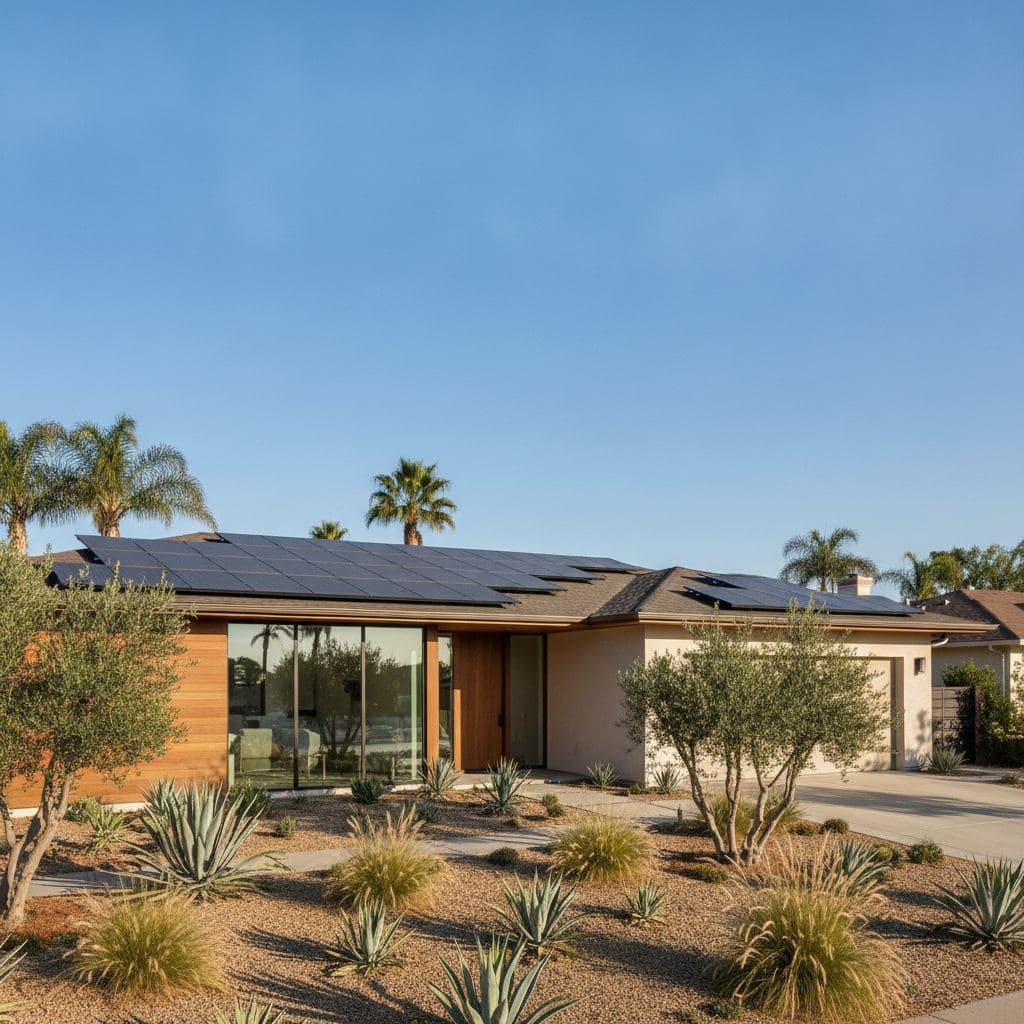
A window AC running at 5,000–8,000 BTU pulls approximately 500–750 watts while actively cooling; step up to a 12,000–18,000 BTU unit and you're looking at 900–1,500 running watts. That translates to 1–4 kWh per 8-hour day per unit — a meaningful chunk of the household load that directly shapes how many panels and batteries you need.
Last verified: September 2026 by Helios Energy Global.
Running watts vs. starting watts: the number that matters for your breaker and battery
Most appliance guides quote only running watts. Window ACs also have a compressor start surge — a spike lasting 1–3 seconds that can be 1.5–2× the running draw. That surge is what trips breakers and, critically, what determines whether a home battery can carry the load during an outage.
A 10,000 BTU unit might run at 900 watts but surge to 1,600–1,800 watts at startup. If your battery inverter is rated for 2,000 watts continuous but only 3,000 watts surge, a single mid-size window AC is fine; two running simultaneously may not be.
Wattage by BTU class — running, starting, and daily kWh
| BTU Class | Typical Room Size | Running Watts (modern) | Running Watts (pre-2015) | Starting Watts (surge) | kWh/day (8 hrs) | Est. |
|---|---|---|---|---|---|---|
| 5,000–6,000 BTU | Up to 150 sq ft | 450–550 W | 550–700 W | 900–1,100 W | 3.6–4.4 kWh | Est. |
| 8,000–10,000 BTU | 150–350 sq ft | 650–900 W | 800–1,100 W | 1,300–1,800 W | 5.2–7.2 kWh | Est. |
| 12,000–14,000 BTU | 350–550 sq ft | 900–1,150 W | 1,100–1,400 W | 1,800–2,300 W | 7.2–9.2 kWh | Est. |
| 15,000–18,000 BTU | 550–800 sq ft | 1,200–1,500 W | 1,400–1,800 W | 2,400–3,000 W | 9.6–12 kWh | Est. |
| Portable (10,000 BTU equiv.) | 250–400 sq ft | 900–1,200 W | 1,000–1,400 W | 1,800–2,400 W | 7.2–9.6 kWh | Est. |
Note on age: Units manufactured before 2015 predate the current ENERGY STAR efficiency tiers and typically draw 15–25% more watts for the same cooling output. If your unit is 10+ years old, use the higher column.
What this costs per month — SCE vs. LADWP (and why it's so different)
Southern California electricity rates vary dramatically depending on your utility. SCE residential customers pay roughly 34–35¢/kWh on average, with a 4–9 PM TOU peak that can push peak-period rates even higher. LADWP customers pay roughly 28¢/kWh — about 35% less — because LADWP is a municipal utility that sets its own rates independently of the CPUC.
That gap shows up directly in your AC bill:
| BTU Class | kWh/month (8 hrs/day, 30 days) | SCE cost/month (~34¢) | LADWP cost/month (~28¢) | Est. |
|---|---|---|---|---|
| 5,000–6,000 BTU | 108–132 kWh | $37–$45 | $30–$37 | Est. |
| 8,000–10,000 BTU | 156–216 kWh | $53–$73 | $44–$60 | Est. |
| 12,000–14,000 BTU | 216–276 kWh | $73–$94 | $60–$77 | Est. |
| 15,000–18,000 BTU | 288–360 kWh | $98–$122 | $81–$101 | Est. |
Inland vs. coastal reality check: A home in Pasadena, the San Fernando Valley, or the Inland Empire might run a window AC 10–12 hours/day in July and August, not 8. Multiply the kWh figures above by 1.25–1.5 for inland summer use. A coastal Santa Monica or Westside home may only need the AC 4–5 hours/day — or not at all on mild marine-layer days — so actual bills can be 40–50% lower than the table above.
If you're an SCE customer, note that your TOU plan charges peak rates (often 45–55¢/kWh or more) between 4–9 PM. Running a 10,000 BTU unit for 3 hours during that window costs roughly $1.35–$1.65 per day at peak rates alone — about $40–$50/month just for evening cooling. That's exactly the load a battery is designed to offset.
Other municipal utilities in the region — Pasadena PWP, Burbank Water & Power, Glendale GWP, Anaheim APU, Riverside RPU — each set their own rates and net metering rules, independent of SCE and the CPUC's NEM 3.0 framework. If you're on one of these munis, your per-kWh rate and solar export value will differ; contact us for a utility-specific analysis.
How window ACs compare to central AC
A central AC system serving a 1,500–2,500 sq ft Southern California home typically draws 2,000–5,000 running watts — two to four times what a single large window unit draws, and often more than the total of two or three window units combined. The trade-off is efficiency per square foot: a properly sized central system with a high SEER rating can cool more space per watt than a bank of window units.
For solar and battery sizing purposes, the key question is peak simultaneous load. Two window ACs starting at the same time can produce a combined surge of 3,600–4,600 watts — comparable to a small central AC compressor. If you're sizing a battery backup system, you need to account for that simultaneous surge, not just the running wattage.
How window AC wattage affects solar system and battery sizing
Window ACs are one of the top drivers of summer electricity bills and one of the main reasons Southern California homeowners go solar. Here's how to think about sizing:
Solar panel sizing:
- Each 1 kW of solar panels produces roughly 4–5 kWh/day in Southern California (per NREL PVWatts data for the LA basin).
- A 10,000 BTU window AC running 8 hours/day uses ~5.5–7.2 kWh/day.
- That one unit alone justifies roughly 1.5–2 kW of additional solar capacity beyond your baseline household load.
- Two window ACs running in parallel? Add 3–4 kW to your system design.
Battery sizing:
- If you want to run one window AC through the SCE 4–9 PM peak period (5 hours) without drawing from the grid, you need roughly 4–7 kWh of usable battery capacity for that load alone — plus whatever else is running.
- A single home battery (roughly $14,000–$18,500 installed) typically provides 10–13 kWh of usable capacity. That's enough to carry one or two window ACs through the peak window, but not necessarily all evening.
- Starting surge matters: confirm your battery's inverter surge rating before assuming it can start a large window AC cold. Most modern home batteries handle a single mid-size window AC surge; running two simultaneously may require a larger inverter or a soft-start device on the AC unit.
See our battery sizing guide and solar system design tool for a full load-by-load breakdown.
SCE customers on NEM 3.0: Under the Net Billing Tariff, solar export credits are much lower than retail rates — typically 5–8¢/kWh during midday. The financial case for pairing solar with a battery is stronger than ever: charge the battery with cheap midday solar, discharge it during the 4–9 PM peak to avoid 45–55¢/kWh rates. Window AC loads during that peak window are exactly what a battery is designed to offset. See our NEM 3.0 explainer for the full picture.
LADWP customers: LADWP still offers retail-rate net metering, so solar exports are credited at the full ~28¢/kWh rate. The battery math is different — batteries add resilience and backup value, but the peak-avoidance arbitrage is less dramatic than on SCE. A custom design will show you the actual payback for your address.
Where window ACs fit in your total home electricity picture
Window ACs are rarely the only large load. To understand how they interact with your water heater, EV charger, refrigerator, and lighting, see our guide to what uses the most electricity in a home and our breakdown of how many watts it takes to run a whole house. Those pages are part of the same appliance-wattage series and will give you the full load profile you need before sizing a solar or battery system.
Frequently asked questions about window AC wattage
How many watts does a 5,000 BTU window AC use?
A modern 5,000 BTU window AC draws approximately 450–550 running watts and surges to 900–1,100 watts at startup. At SCE's ~34–35¢/kWh rate, running it 8 hours/day costs roughly $37–$45/month; at LADWP's ~28¢/kWh, about $30–$37/month.
How many watts does a 10,000 BTU window AC use?
A 10,000 BTU unit typically runs at 750–900 watts on a modern, ENERGY STAR-rated model, with a starting surge of 1,500–1,800 watts. Older pre-2015 units in the same BTU class often draw 900–1,100 running watts. This is one of the most common sizes in Southern California apartments and spare bedrooms.
Does a window AC use more electricity than central air?
Per unit, no — a window AC uses far less than a central system. But if you're running three or four window units to cool a whole house, the combined draw can approach or exceed a central AC's consumption, often with less efficiency per square foot cooled. Central AC typically draws 2,000–5,000 watts for a whole-home system versus 500–1,500 watts per window unit.
Can a home battery run a window AC during an outage?
Yes, with caveats. Most home batteries (10–13 kWh usable, 2,000–7,600 watt inverters) can run one or two window ACs, but you need to verify the battery's surge/peak watt rating against the AC's startup draw. A soft-start device ($30–$80) on the AC unit can cut the startup surge by 50–70%, making battery compatibility much easier. See our battery guide for inverter sizing details.
How does window AC wattage affect solar panel sizing?
Each window AC running 8–10 hours/day adds roughly 4–10 kWh to your daily consumption. In Southern California, that translates to approximately 1–2.5 kW of additional solar panel capacity per unit. A custom solar design will calculate the exact panel count based on your roof, shading, and full load profile.
Is it worth adding solar just to offset window AC costs?
On SCE, where rates run 34–35¢/kWh (and peak rates are higher), a window AC running heavily through summer can add $50–$120/month to your bill. Over a full year with moderate use, that's $400–$800 in AC-related electricity costs. Solar offsets that at a levelized cost well below retail rates over a 25-year panel life — though the exact payback depends on your system size, roof, and utility. Use our savings estimator for your specific address.
What's the cheapest way to run a window AC in Southern California?
Pre-cool your space before the SCE peak window (4–9 PM), then let the AC cycle less during peak hours. Pair with a home battery to avoid peak-rate electricity entirely. On LADWP, the rate differential between peak and off-peak is smaller, so the strategy matters less — but pre-cooling still reduces runtime and wear. See our solar vs. battery guide for NEM 3.0 homes for the full cost-optimization picture.
Next steps
- Book a free consultation and custom design — we'll build a load-by-load analysis including your AC units, then right-size your solar and battery system.
- Run your address through our savings estimator to see how window AC loads affect your payback period.
- Explore home battery options — including surge ratings and which units can start a window AC cold.
- See our full solar panel cost breakdown for Southern California — with current 2026 pricing and incentives.
- Read what uses the most electricity in a home — the full appliance-wattage series.
- Understand how many watts it takes to run your whole house — and how that shapes system size.
- Learn how NEM 3.0 affects your solar value if you're on SCE.
More guides
Can you really get free solar panels from the government in 2026?
No — the government does not give away free solar panels in 2026; the federal tax credit expired Dec 31, 2025, and 'free solar' pitches are almost always $0-down leases with 20-25 year contracts.
ReadBest Solar Companies in Irvine, CA (2026): Honest Rankings for SCE + NEM 3.0 Homes
Irvine runs on Southern California Edison under NEM 3.0, which means exported solar earns only ~$0.05–$0.08/kWh — a battery is almost always the right call. Here are the 10 best solar installers in Irvine for 2026, ranked honestly.
ReadHow much do solar panels cost in Ventura County in 2026?
A typical Ventura County solar system runs $18,000–$32,000 installed before any incentives, with no federal tax credit available for 2026 purchases.
ReadGet a free consultation and custom design.
No pressure, no obligation — the owner reviews every design we send.