Are ground-mounted solar panels worth it in California? Cost, footprint and permits (2026)
Ground-mounted solar in California runs roughly $0.35–$0.75 per watt more than rooftop ($3,500–$7,500 extra on 10 kW), needs about 600–1,000 sq ft of yard for 10 kW, and always goes through standard plan check because SolarAPP+ covers roof mounts only.
By Taylor Crouse — Founder, Helios Energy GlobalPublished
Quick answer
- Cost premium: ground mount adds roughly $0.35–$0.75 per watt over rooftop in California, about $3,500–$7,500 on a 10 kW system. EnergySage's national data (July 2026) shows $2.96/W ground vs $2.60/W roof, a $0.36/W gap before California trenching and engineering.
- Footprint: about 21 sq ft of panel per 430 W module, so 10 kW needs roughly 500 sq ft of panels and 600–1,000 sq ft of yard with tilt and row spacing.
- Permits: ground mounts are not eligible for SolarAPP+ instant permitting (roof-mounted only, per the SolarAPP+ eligibility page updated August 13, 2026); expect standard plan check and engineered footings.
- Production: optimal tilt and true south yield 0–15% more than the same panels on a compromised roof, plus roughly 1–3% from cooling and easy cleaning.
- Incentives: the 30% federal residential credit ended for systems placed in service after December 31, 2025; a prepaid lease still captures roughly 30% off the top.
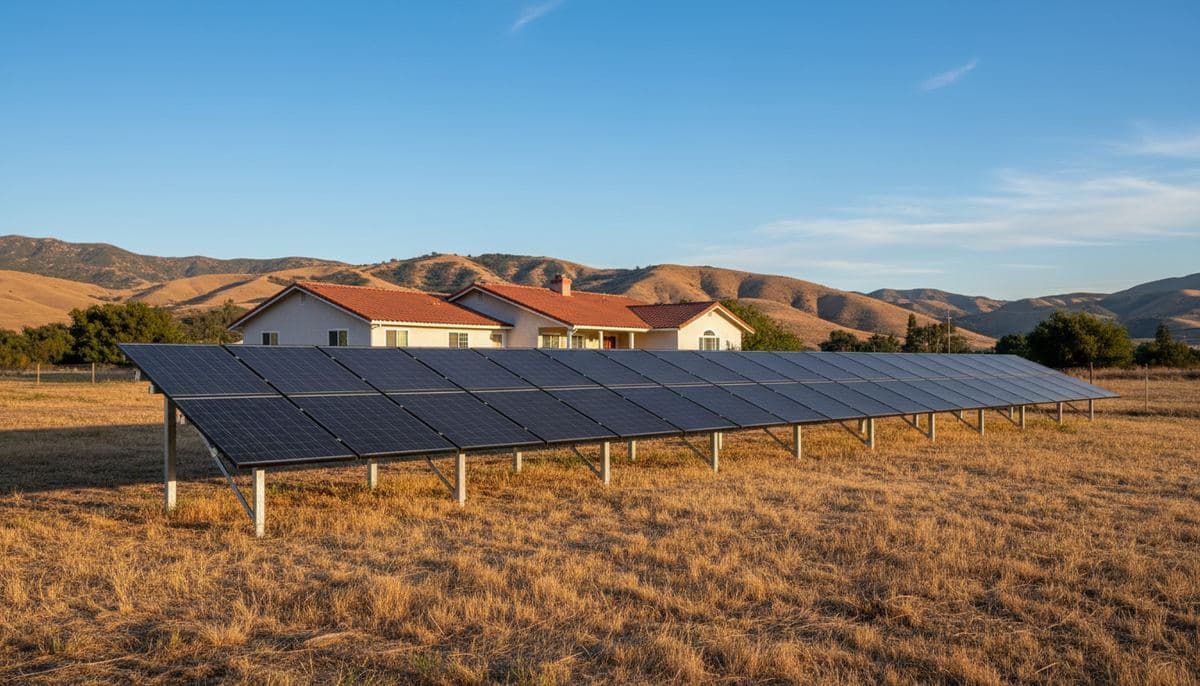
A ground-mounted solar array in California costs about $0.35–$0.75 per watt more than the same panels on your roof, and it makes sense when the roof can't do the job: wrong orientation, heavy shade, an old or tile roof, or not enough usable area. For a 10 kW system that premium is roughly $3,500–$7,500 and you'll need about 600–1,000 sq ft of open ground. Below is the math, the Southern California permitting reality, and a straight answer on when it's worth it.
Last verified: September 2026 by Helios Energy Global.
What a ground-mounted solar system is, and the three racking types
A ground mount is a solar array built on its own steel structure in the yard instead of on the house. Panels, inverters and wiring are the same as a rooftop system; what changes is the racking, the foundation, and the conductor run back to your main panel. Because the array is free-standing it must carry its own wind and seismic loads, which is why it needs footings and engineering that a rooftop array borrows from the house.
- Standard fixed-tilt ground mount. Rows of panels on steel posts set in concrete piers or driven/helical piles, fixed at one tilt (typically 20–30° in Southern California). This is what nearly all residential ground mounts use.
- Pole mount. A cluster of panels on a single heavy pole with one deep footing. Useful on sloped or rocky lots, but each pole carries a limited number of modules, so it scales poorly beyond a few kW.
- Trackers. Single-axis trackers follow the sun east to west; dual-axis units also adjust for season. EnergySage cites gains of "25% or more" over fixed tilt, but moving parts, controls and maintenance make them rare on homes. Panels are cheap enough that adding a few fixed modules almost always beats a tracker.
Cost of ground mount vs roof mount
Rooftop solar in California typically runs about $2.50–$3.50 per watt before incentives; see our solar panel cost page and the California installation cost guide for what drives the range. As a national reference, the U.S. Department of Energy's cost benchmark page (updated May 15, 2026) lists the 2024 residential rooftop benchmark at $2.74/W (minimum sustainable price) to $3.15/W (modeled market price) for an 8 kW system.
Ground mounts cost more because you are building a structure, not bolting to one. EnergySage's ground-mount analysis (updated July 9, 2026) reports a national average of $2.96/W for ground mount against about $2.60/W for rooftop, a $0.36/W gap. The same page says ground-mount systems cost "about 41% more" in total, but that is mostly because ground-mount buyers install bigger systems (14.7 kW vs 12 kW in their sample), not because each watt costs 41% more.
In Southern California the per-watt premium lands above the national gap when the array sits far from the house, so a defensible planning range is $0.35–$0.75 per watt added, or $3,500–$7,500 on a 10 kW system. Where the money goes:
| Item | Roof mount | Ground mount |
|---|---|---|
| Racking | Rails and flashed attachments into rafters | Steel posts, cross-members, rails; heavier gauge for wind and seismic |
| Foundation | None (the house is the structure) | Concrete piers or driven/helical piles, one per post |
| Engineering | Standard rooftop calcs | Site-specific structural calcs, usually PE-stamped; soil classification may be required |
| Wiring run | Short, in the attic or along the eave | Trench (typically 18–24 in deep), conduit and conductor to the main panel; long runs need larger wire for voltage drop |
| Permit path | SolarAPP+ or over-the-counter in many SoCal cities | Standard plan check, multiple inspections |
| Labor | One crew, one to two days | Excavation, concrete cure, then array build; usually two mobilizations |
| 10 kW premium | Baseline | +$3,500 to +$7,500 |
Two incentive notes. The 30% federal Residential Clean Energy Credit is gone for owned systems: the IRS page (last reviewed July 4, 2026) states the credit "is not available for any property placed in service after December 31, 2025." Roughly 30% off the top is still available through a prepaid lease, where the financier owns the system for five years and claims the commercial credit, then ownership transfers to you at the start of year six at essentially no cost. California's SGIP battery rebate remains waitlisted for most residential customers.
When ground mount is the right call, and when it isn't
Go ground mount when:
- Your roof faces the wrong way. A north-facing or heavily east/west roof can leave 10–20% of production on the table; see best direction for solar panels in California. On the ground you pick the azimuth.
- The roof is old. With under 10 years of shingle life left, you'd otherwise pay to remove and reinstall the array mid-life. Our guide on how old a roof can be for solar covers the decision.
- Shade you can't remove. Mature trees or a two-story neighbor can cost more than the ground-mount premium over 25 years.
- Tile, slate or clay roofs. Attachments are doable but slower and more fragile; a ground mount avoids breakage and flashing risk.
- You have land. Ranch lots in Ventura County, the Antelope Valley, inland Riverside and San Bernardino, and the Central Valley routinely have a spare 1,000 sq ft of level ground with clear southern exposure.
Stay on the roof when:
- Lot size. A typical 6,000–7,000 sq ft city lot in Los Angeles or Orange County has no 600 sq ft of unshaded, non-setback yard left after the house, driveway and pool.
- HOA rules. California's Solar Rights Act limits HOA restrictions, but ground arrays are visible from the street, and CC&Rs often still control placement and screening.
- Setbacks and easements. Many jurisdictions treat the array as an accessory structure with side and rear setbacks; septic leach fields, utility easements and well clearances are common deal-breakers.
- A flat roof works. See solar panels on a flat roof in California; ballasted racking gets you optimal tilt without a foundation.
Footprint math: how much land you need
A current residential module such as the Qcells Q.TRON BLK M-G2+ measures 67.8 × 44.6 inches, which is 3,024 sq in or about 21 sq ft per module, at 415–440 W. Call it 430 W, so panel area is about 49 sq ft per kW.
Ground footprint is bigger than panel area because of tilt and row spacing:
- Single row, 25–30° tilt: the panels project onto about 0.9× their area, but you need walk-around and post clearance, so plan on roughly 1.2× panel area.
- Two or more rows: each row shades the one behind it in winter, so rows sit about 1.5–2× their height apart. Multi-row arrays land around 1.8–2.0× panel area.
| System size | Modules (430 W) | Panel area | Ground footprint (single row to multi-row) | Roughly |
|---|---|---|---|---|
| 5 kW | 12 | ~250 sq ft | 300–500 sq ft | 15 × 20 ft to 20 × 25 ft |
| 8 kW | 19 | ~400 sq ft | 480–800 sq ft | 20 × 24 ft to 25 × 32 ft |
| 10 kW | 24 | ~500 sq ft | 600–1,000 sq ft | 20 × 30 ft to 25 × 40 ft |
| 15 kW | 35 | ~735 sq ft | 880–1,470 sq ft | 22 × 40 ft to 30 × 50 ft |
Add the required brush-free clearance (10 ft in the City of Los Angeles, more in fire zones) and any setback, and a 10 kW array realistically claims a 30 × 50 ft patch of yard. A long single row on an east–west axis is the most land-efficient layout because there is no inter-row shading.
Permitting a ground mount in Southern California
This is where ground mounts differ most from rooftop, and it varies by AHJ:
- No instant permit. The SolarAPP+ eligibility page (updated August 13, 2026) lists ground-mounted systems as "currently not within the scope of SolarAPP+"; the platform covers roof-mounted PV and storage on one- and two-family homes and townhomes. The City of Los Angeles (LADBS Information Bulletin P/GI 2023-027) states ground-mounted systems do not qualify for online or counter permits and require standard plan check. San Diego County's PV page says the same: standard review, not over-the-counter, plus Environmental Health and Public Works sign-off.
- Footings and engineering. Expect site-specific structural calculations for wind and seismic loads, usually PE-stamped, with pier depth and rebar called out. Riverside County's solar permit page lists a first inspection for "set-backs, footings and forms," steel and conduit before the array goes up, and a final that requires a protective barrier (solar scrim) under the array.
- Setbacks and height. The Los Angeles bulletin says fire-code setback requirements "shall not apply to ground mounted, free-standing photovoltaic arrays," but requires a 10-ft brush-free area and caps height under the fence and wall rules in LAMC 12.22.C.20(f). Most other SoCal cities treat the array as an accessory structure with side and rear setbacks of 5 ft or more and a height limit in the 8–15 ft range; check the specific code.
- Fire zones and defensible space. Many ground-mount lots sit in a CPUC High Fire-Threat District (Tier 2 "higher risk" or Tier 3 "extreme risk" for utility-caused wildfire) or a CAL FIRE Very High Fire Hazard Severity Zone. Check your address on our High Fire Threat District map. Defensible space law requires 100 ft of managed vegetation around structures, and the Board of Forestry was scheduled to consider adopting final Zone 0 (0–5 ft ember-resistant zone) regulations at its August 19, 2026 meeting for the State Responsibility Area and Very High zones. Keep the array outside the Zone 0 band around the house, maintain clearance under and around it, and expect fire-authority review of access.
- Timeline. Plan on 4–10 weeks for plan check plus two or three inspections, versus days for a SolarAPP+ rooftop permit.
Agricultural parcels under Williamson Act contracts have their own rules and are outside the scope of this guide.
Production advantages of a ground mount
Ground mounts can outproduce the same panels on a roof for three reasons, and the size of the gain depends on how bad the roof was:
- Optimal tilt and azimuth. A fixed array in Southern California does best facing true south at roughly 20–30° tilt. If your roof already faces south at a 4:12 to 6:12 pitch (18–27°), a ground mount gains essentially nothing. If the alternative was a west-facing roof at low pitch, the ground mount typically gains 10–15%; a north-facing roof, more. That is why the honest range is 0–15%.
- Cooling. Panels lose output as they heat up; the Qcells module above is rated at −0.29% per °C. Open air under a ground mount typically keeps cells 5–10°C cooler than a roof-hugging array on a hot afternoon, worth roughly 1.5–3% in those hours, less over a year.
- Cleaning and access. Dust soiling in the inland valleys and high desert can cost several percent; a ground array is rinsed with a hose, and inspections or a future panel swap are cheaper.
Net: for a well-oriented roof, expect 1–3% from cooling and cleaning alone; for a badly oriented one, 10–18% combined. Our design and savings page shows how we model both options on your actual roof and lot.
Batteries with a ground-mounted system
The battery and inverter stay at the house, typically on the garage wall next to the main panel, because they need fire clearances and short runs to critical loads. The array is AC-coupled (microinverters) or DC-coupled through a hybrid inverter at the house, with only the array conductors making the long trip through the trench. A 150–300 ft run means upsizing wire; we size for under 2% voltage drop, which is part of the cost premium above.
Under NEM 3.0 for SCE, PG&E and SDG&E customers, the CPUC's Net Billing Tariff (effective April 15, 2023) pays exports at avoided-cost values that are usually well below retail, so a battery that shifts solar into the 4–9 PM peak is what makes a large ground array pencil. SCE's average rate is around 34–35¢/kWh with peak pricing far higher. LADWP customers still get retail-rate net metering (about 28¢/kWh effective), so the battery case there is outage backup, not rate arbitrage. See our home battery page for the systems we install.
Frequently asked questions about ground-mounted solar
How much more does ground-mounted solar cost than roof-mounted?
Nationally, EnergySage's July 2026 data shows $2.96/W for ground mount versus about $2.60/W for rooftop, a $0.36/W gap. In Southern California we plan for $0.35–$0.75/W more depending on trench length, soil and engineering, which is $3,500–$7,500 on a 10 kW system.
How much land do I need for a 10 kW ground mount?
About 500 sq ft of panels (24 modules at roughly 21 sq ft each), which becomes 600–1,000 sq ft of ground once you add tilt and row spacing. With setbacks and a brush-free perimeter, budget a 30 × 50 ft area.
Can I get an instant permit for a ground mount through SolarAPP+?
No. As of the SolarAPP+ eligibility page updated August 13, 2026, the platform covers roof-mounted systems only and lists ground mounts as outside its scope. Expect standard plan check, engineered footings and at least two inspections in Los Angeles, Riverside and San Diego counties.
Do ground-mounted panels produce more electricity?
Only relative to a compromised roof. If your roof already faces south at a moderate pitch, the gain is 1–3% from cooling and easy cleaning. If the alternative was a north-, east- or west-facing roof, optimal tilt and azimuth add another 10–15%.
Is a solar tracker worth it for a home?
Rarely. Trackers can add 25% or more output per panel, but they cost more, have moving parts, and draw height scrutiny from residential jurisdictions. Adding four more fixed modules usually costs less than tracking the rest.
Do the federal tax credit and NEM rules differ for ground mounts?
No. The 25D residential credit ended for systems placed in service after December 31, 2025 regardless of mount type; a prepaid solar lease still captures roughly 30% through the financier's commercial credit. NEM 3.0 applies to SCE, PG&E and SDG&E customers whether the panels are on the roof or in the yard; LADWP customers stay on retail net metering.
What about wildfire and defensible space rules?
If you are in a CPUC High Fire-Threat District or a CAL FIRE Very High Fire Hazard Severity Zone, keep the array outside the 0–5 ft Zone 0 band around any structure, maintain 100 ft of defensible space, and expect the fire authority to review access and clearance. The City of Los Angeles requires a 10-ft brush-free area around a ground array.
Next steps
- Book a free consultation and custom design. We model your roof and your yard side by side so you see the production and cost difference before committing.
- Check your address on the High Fire Threat District map if your lot is rural or foothill.
- Review our solar overview and home battery options for the full system picture.
Sources
- Solar Photovoltaic System Cost Benchmarks (U.S. DOE / NREL) — May 15, 2026
- Ground-Mounted Solar Panels (EnergySage) — July 9, 2026
- What types of systems are eligible for SolarAPP+ review? (SolarAPP+ Knowledge Base) — August 13, 2026
- Guidelines for Plan Check and Permit Requirements for Solar Energy Systems, P/GI 2023-027 (LADBS) — January 1, 2023
- Residential Clean Energy Credit (IRS) — July 4, 2026
- Defensible Space Zones 0, 1 and 2 (California Board of Forestry and Fire Protection) — August 19, 2026
More guides
How many watts does a pool pump use in 2026?
A single-speed pool pump draws 1,100–2,500 watts; a variable-speed pump runs as low as 150–400 watts at low speed, cutting annual pool-pump electricity costs from roughly $800–$1,400 down to $200–$450 for SCE customers.
ReadHow much does solar panel cleaning cost in 2026?
Professional solar panel cleaning in Southern California typically runs $100–$300 per visit, depending on system size and roof access.
ReadBurbank Water & Power Solar Program Explained (2026)
BWP's Solar Net Billing program credits new solar exports at 6.66–11.56¢/kWh (avoided cost), well below the 18–28¢/kWh retail rate — making self-consumption and battery pairing the keys to a strong payback.
ReadGet a free consultation and custom design.
No pressure, no obligation — the owner reviews every design we send.