What direction should solar panels face in California in 2026?
South-facing panels produce roughly 10-20% more annual energy than west-facing, but west-facing arrays can cut more off your bill under NEM 3.0 and SCE's 4-9 PM peak rates.
By Taylor Crouse — Founder, Helios Energy GlobalPublished
Quick answer
- South-facing panels produce roughly 10–20% more annual kWh than west-facing panels on a typical Southern California roof.
- West-facing panels generate peak power from roughly 2–7 PM, overlapping directly with SCE's 4–9 PM TOU peak at ~34–35¢/kWh — and with the highest-value NEM 3.0 export windows.
- Southwest (200–240° azimuth) is often the best single-plane compromise: within ~5% of true-south production while capturing meaningful afternoon value.
- LADWP customers on retail-rate net metering still benefit most from maximum production (south), while SCE customers on NEM 3.0 increasingly favor west or southwest orientation.
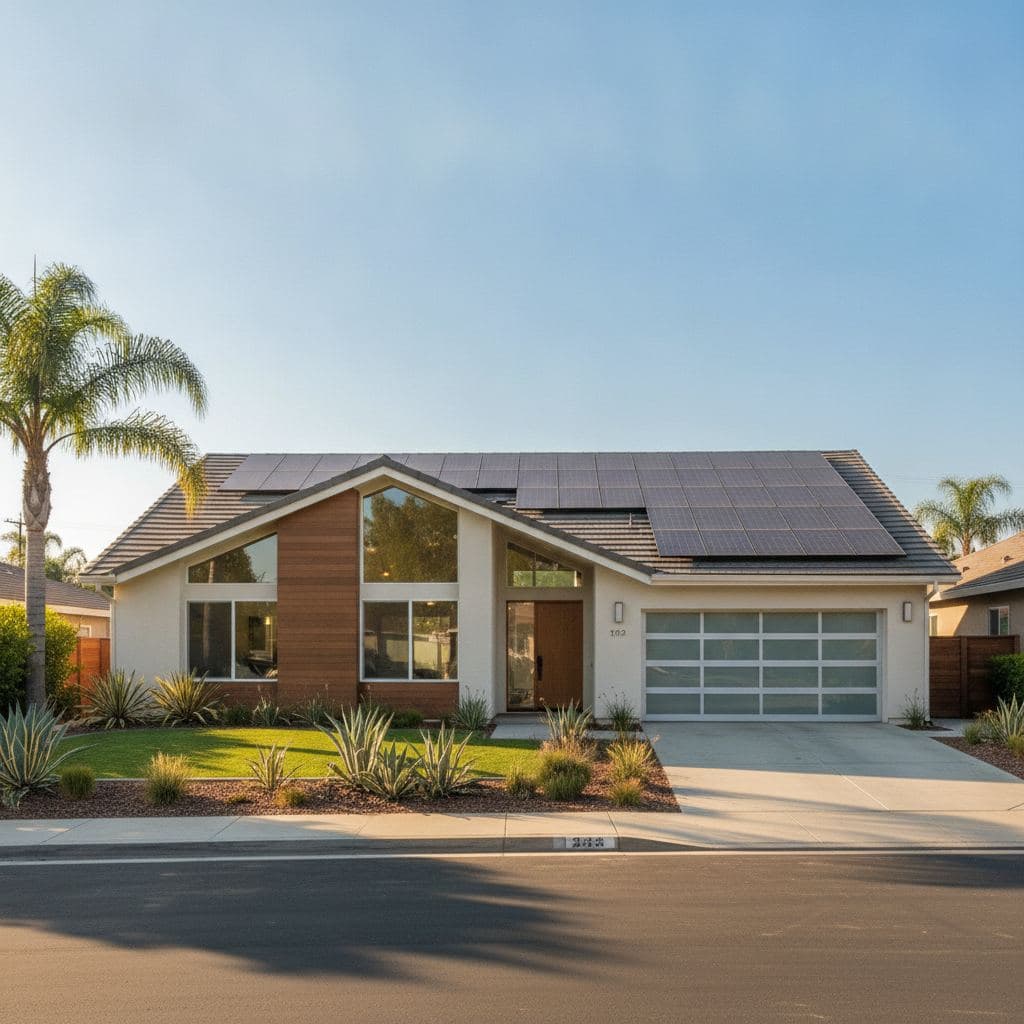
South-facing panels at a 20–30° tilt produce the highest raw kilowatt-hour output in California — typically 10–20% more annual energy than a due-west array of the same size, according to NREL's PVWatts modeling for the Los Angeles area. However, under SCE's Time-of-Use rates and the NEM 3.0 Net Billing Tariff, a west-facing array that generates power during the 4–9 PM peak window (when grid electricity costs ~34–35¢/kWh and export credits are at their highest) can reduce your bill by nearly as much — or more — despite producing fewer total kilowatt-hours.
Last verified: August 2026 by Helios Energy Global.
The right answer for your home depends on your utility, your roof geometry, and whether you're pairing solar with a battery. Here's how to think through it.
Why direction matters more in California than most states
California's electricity rates are among the highest in the country, and they're time-differentiated — meaning when your panels produce matters almost as much as how much they produce. A south-facing array peaks around solar noon (roughly 12–1 PM), which is fine for raw output but increasingly misaligned with the hours when electricity is most expensive or most valuable to keep off the grid.
West-facing panels shift their production curve later in the day, peaking around 2–4 PM and staying productive through 6–7 PM — a much closer match to the afternoon demand surge that drives California's TOU pricing.
The orientation options, ranked
True South (180° azimuth)
The classic recommendation. At a 22–28° tilt, a south-facing array in Southern California captures the most sunlight over the course of a year. This is still the right choice if:
- You're an LADWP customer on retail-rate net metering (every kWh you export earns the same credit regardless of time of day)
- You have limited roof space and need maximum production per panel
- You're sizing a system specifically to zero out a flat-rate or tiered bill
Southwest (200–240° azimuth)
The best compromise for most SCE customers in 2026. Production drops only about 3–7% compared to true south, but the generation curve shifts noticeably into the afternoon. You capture more of the 4–9 PM peak while sacrificing minimal annual output. If your roof has a southwest face, use it.
West (270° azimuth)
Produces roughly 10–20% fewer annual kWh than south, but those kilowatt-hours land in the highest-value window of the day. For SCE customers on NEM 3.0, this can translate to bill savings that rival or exceed a larger south-facing system — especially if you don't have a battery to shift production anyway. West is also the correct orientation if your utility offers a West-Facing Incentive or if your only usable roof plane is west-facing.
East (90° azimuth)
East-facing panels peak in the morning (7–10 AM), which is the lowest-value window under SCE TOU pricing. East-only arrays are generally the weakest financial performers in Southern California. If east is your only option, pair it with a battery — or reconsider your system design.
Flat roofs
Flat commercial and residential roofs can be racked at any azimuth. Installers typically tilt panels south at 10–15° to maximize production while minimizing wind loading and inter-row shading. On flat roofs, true south is almost always correct unless your utility situation specifically favors west.
How NEM 3.0 changes the math for SCE customers
Under the old NEM 2.0 rules, every kilowatt-hour you exported to the grid earned you a full retail-rate credit. Direction was mostly about maximizing total production, so south won easily.
Under NEM 3.0 (the CPUC Net Billing Tariff), export credits vary by time of day and are significantly lower than retail during midday hours — when a south-facing array is at peak output. The highest export credit windows align with late afternoon and early evening, which is exactly when west-facing panels are producing.
The practical result: an SCE customer with a west-facing array may export fewer kilowatt-hours but earn more per kilowatt-hour exported, closing much of the production gap. Pair a west-facing array with a home battery that charges from solar midday and discharges during the 4–9 PM peak, and you can capture the best of both worlds.
For a deeper look at how NEM 3.0 export pricing works, see our guide: NEM 3.0 explained for Southern California homeowners.
LADWP customers: south still wins
LADWP is a municipal utility and not subject to NEM 3.0. LADWP's net metering program credits solar exports at the retail rate regardless of time of day, so there's no financial premium for afternoon generation. For LADWP customers, the goal is simply maximum annual production — which means south-facing at the optimal tilt wins, full stop.
LADWP's effective residential rate runs approximately 28¢/kWh (in the 26–31¢ range depending on tier and usage). Every kilowatt-hour your panels produce is worth the same whether it's generated at noon or 4 PM. Maximize total output; direction is straightforward.
Other Southern California municipal utilities — Pasadena PWP, Burbank Water & Power, Glendale Water & Power, Anaheim Public Utilities, Riverside RPU — also run their own net metering programs independent of NEM 3.0. If you're served by one of these utilities, check your specific tariff before assuming west-facing is advantageous. In most muni cases, south or southwest is still optimal.
Key numbers by orientation: Southern California estimate
| Orientation | Azimuth | Annual production vs. south | Best for | Notes |
|---|---|---|---|---|
| True South | 180° | Baseline (100%) | LADWP, flat-rate bills | Highest kWh/year |
| Southwest | 200–240° | ~93–97% | SCE NEM 3.0, most roofs | Best overall compromise |
| West | 270° | ~80–90% | SCE NEM 3.0, no battery | Highest-value export window |
| Southeast | 120–160° | ~93–97% | Morning-heavy usage | Less valuable under TOU |
| East | 90° | ~75–85% | Last resort | Poorest TOU alignment |
| Flat (south rack) | 180° | ~95–100% | Flat roofs | Low tilt, minimal shading |
Production estimates based on NREL PVWatts modeling for Los Angeles County at 22–28° tilt. Actual output varies by shading, panel efficiency, and microclimate. All figures are approximate.
Tilt angle: the other half of the equation
Azimuth (compass direction) gets most of the attention, but tilt angle matters too. In Southern California (latitude ~34°N):
- Optimal annual tilt: roughly 20–28° for maximum annual production
- Summer tilt: shallower (15–20°) captures more when the sun is high
- Winter tilt: steeper (30–35°) captures more when the sun is low
- Most residential roofs: 18–26° pitch, which is close enough to optimal that re-racking isn't worth the cost
If your roof pitch is very shallow (under 10°) or very steep (over 35°), discuss racking options with your installer. Flat roofs give you full control; steep roofs may benefit from flush-mount acceptance rather than fighting the geometry.
What about split arrays (south + west)?
If your roof has both a south-facing and a west-facing plane, a split array is often the smartest design:
- Put 60–70% of panels south to maximize base production
- Put 30–40% of panels west to extend afternoon generation into the TOU peak
- The result: a flatter, longer production curve that self-consumes better and exports during higher-value hours
This is increasingly the design we recommend for SCE customers with suitable roof geometry. See how this interacts with battery storage in our guide: Solar vs. battery strategy under NEM 3.0.
Shading matters more than direction
A perfectly south-facing array with significant shading from a chimney, tree, or neighboring structure will underperform a slightly west-facing array with a clean exposure. Shading analysis always takes priority over azimuth optimization. Modern panel-level optimizers and microinverters reduce (but don't eliminate) shading losses — ask your installer for a shade report before finalizing placement.
Your roof type and condition also affects where panels can physically go, which may constrain your azimuth options regardless of what's theoretically ideal.
Frequently asked questions about solar panel direction in California
Does west-facing solar really work as well as south in California?
West-facing panels produce roughly 10–20% fewer annual kilowatt-hours than south-facing, but under SCE's NEM 3.0 and 4–9 PM TOU peak pricing, the kilowatt-hours they do produce are worth more. For many SCE customers, the bill savings difference between south and west is smaller than the raw production gap suggests — and in some cases, west-facing performs better financially.
What azimuth is "true south" in Southern California?
True south is 180° on a compass. In Southern California, magnetic declination is roughly 11–12° east, meaning your compass south reads about 168–169° when you're actually pointing at true south. Your installer's design software (and satellite-based tools like PVWatts) use true south automatically, so this only matters if you're doing rough manual estimates.
Should LADWP customers face panels west?
Generally no. LADWP's net metering credits solar exports at the full retail rate regardless of time of day, so there's no financial premium for afternoon generation. LADWP customers should prioritize maximum annual production, which means south-facing at the optimal tilt.
Does panel direction affect how fast solar pays back?
Yes. Orientation affects both total production and — under NEM 3.0 — the value of what you export. A well-oriented system for your specific utility can meaningfully shorten payback. Typical installed costs run approximately $2.50–$3.50 per watt before any incentives; getting the orientation right squeezes more value out of that investment without adding cost. See our solar panel cost guide for full payback context.
Can I put panels on a north-facing roof in California?
North-facing panels are rarely worth installing in Southern California. They produce substantially less energy than any other orientation — often 30–40% less than south — and there's no time-of-use premium that compensates. If north is your only roof plane, a ground mount or carport installation is usually a better option.
How does a battery change the optimal panel direction?
A battery largely decouples production timing from consumption timing. If you have a battery, you can charge it from a south-facing array at midday and discharge during the 4–9 PM peak — capturing both maximum production and peak-hour value. Without a battery, west-facing panels do some of that work passively. With a battery, south-facing is often the better choice again because you want the most total energy to fill the battery.
Does the direction recommendation change if I add panels later?
Yes — plan for expansion at design time. If you're starting with a south-facing array and plan to add panels later, reserving your west-facing roof plane for a future array gives you a natural split-array upgrade path that improves your TOU alignment without changing what's already installed.
Next steps
- Book a free consultation and custom design — we'll run a site-specific shading analysis and model your roof's best orientation for your utility and usage
- See how NEM 3.0 affects solar value for SCE customers
- Explore solar + battery combinations for peak-hour coverage
- Learn about home battery options that pair with any panel direction
- Get a detailed solar cost and payback estimate for Southern California
- See our Southern California service locations
More guides
Best Solar Companies in Thousand Oaks, CA (2026): Honest Rankings for Homeowners
A straight-talking, numbers-first guide to the best solar installers serving Thousand Oaks in 2026 — covering SCE net billing, local roof types, battery storage, and how to compare quotes without getting burned.
ReadTesla Solar Panel Removal and Reinstallation in California: Who Does It and What It Costs in 2026
Helios charges $250–$350 per panel to remove and reinstall Tesla solar panels in California, with the roofing quoted separately. Tesla's own R&R process takes 4–12+ weeks, and a Powerwall system needs a certified installer if you want to keep the battery warranty intact.
ReadHow to clean solar panels (and when to hire a pro) in 2026
DIY cleaning with deionized water and a soft brush takes 20–30 minutes and can recover 5–25% of lost production in Southern California's dusty and ash-prone areas.
ReadGet a free consultation and custom design.
No pressure, no obligation — the owner reviews every design we send.