Can you put solar panels on a flat roof? (2026 California guide)
Yes, flat roofs work well for solar — tilt racks set panels at 10–15° and add roughly $0.15–$0.40/watt to installed cost compared to a standard pitched roof.
By Taylor Crouse — Founder, Helios Energy GlobalUpdated
Quick answer
- Yes — flat roofs are fully compatible with solar; tilt racks angle panels at 10–15° to drain water and capture sun.
- Flat-roof installs cost roughly $0.15–$0.40 per watt more than a standard pitched-roof job, mainly for racking hardware and row-spacing engineering.
- Ballasted (weight-held) systems avoid most roof penetrations; mechanically attached systems are required in high-wind zones or on roofs that can't handle ballast weight.
- Row spacing must be engineered to prevent self-shading — in Southern California (latitude ~34°N), expect 1.5–2.5 feet of setback per foot of panel height depending on tilt angle.
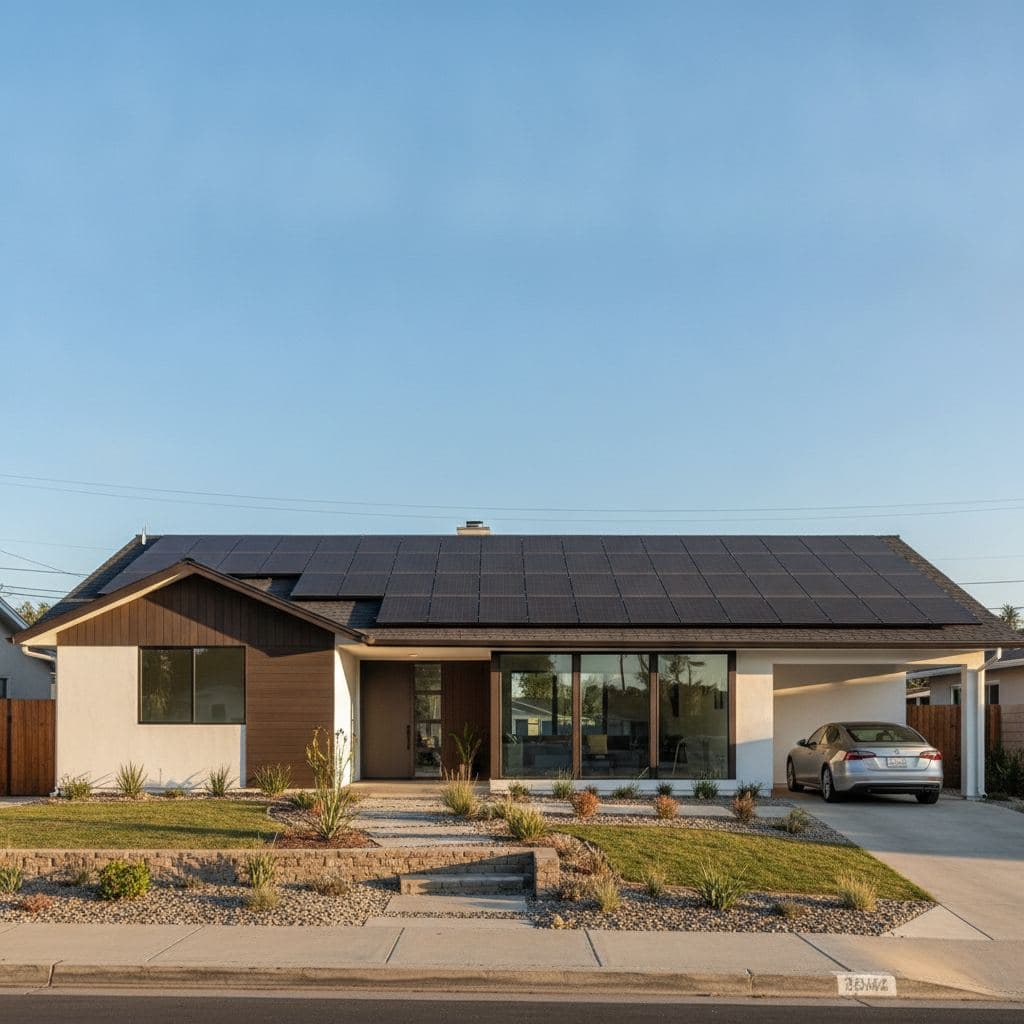
Flat roofs in Southern California are among the best candidates for solar — installers can orient and tilt panels in any direction, and the Los Angeles basin's near-year-round sun means a well-designed 8–12 kW system on a flat commercial-style residential roof can produce 11,000–17,000 kWh per year (estimate, varies by shading and array size). The cost premium over a pitched-roof install is real but modest: budget an extra $1,200–$4,000 on a typical residential system for tilt hardware and engineering.
Last verified: September 2026 by Helios Energy Global.
How flat-roof solar actually works
On a pitched roof, installers bolt rails directly to rafters and panels lie flush at whatever angle the roof already sits — typically 15–30°, which is close to ideal for Southern California. On a flat roof (defined in the California Building Code as a slope of less than 2:12), panels laid flat would collect standing water, lose roughly 10–15% production versus an optimal tilt, and void most panel warranties. So installers use tilt-rack systems that prop each panel row up at 10–15°, facing south (or slightly southwest to hit SCE's 4–9 PM peak demand window).
The result is a system that often outperforms a poorly oriented pitched roof, because you're not stuck with whatever direction the ridge happens to run.
Ballasted vs. mechanically attached racking
This is the biggest design decision on a flat roof, and it has cost and permit implications.
Ballasted (weighted) systems
Ballasted racking uses concrete blocks or pavers — typically 3–8 lbs of ballast per square foot of array — to hold the structure down without drilling through the membrane. Advantages:
- Fewer or zero roof penetrations, which matters enormously on TPO, EPDM, or torch-down modified bitumen membranes (the most common flat-roof coverings in Southern California).
- Faster installation, lower labor cost.
- Easier to remove or reconfigure if the roof needs replacing in 10–15 years.
Limitations:
- Your roof structure must support the added dead load. Most residential flat roofs in LA are engineered for 20–30 psf live load; ballasted arrays can add 5–15 psf depending on tilt and wind zone. A structural engineer must sign off — this is a permit requirement in LA County and the City of LA.
- ASCE 7 wind uplift rules govern how much ballast is needed. Coastal Santa Monica, Malibu, and the beach cities sit in higher wind-exposure categories (Exposure C or D in some zones), which can push ballast requirements up significantly or force a hybrid approach.
Mechanically attached systems
Bolted directly into the roof deck or structural members, with penetrations sealed using manufacturer-approved flashing. Required when:
- Wind loads exceed what ballast alone can safely resist.
- The roof structure can't take the extra ballast weight.
- The roof membrane is torch-down modified bitumen bonded to a wood deck (penetrations are straightforward to flash and seal here).
Mechanically attached systems cost slightly more in labor but use less ballast material, so the total cost difference between the two approaches is often under $500–$1,500 on a residential system.
Roof membrane: what's under those panels matters
| Membrane type | Common in SoCal? | Solar-friendly? | Key consideration |
|---|---|---|---|
| TPO (thermoplastic polyolefin) | Very common, newer builds | Yes — excellent | Heat-welded penetration boots; ballasted preferred to minimize holes |
| EPDM (rubber) | Older builds, some commercial | Yes | Lap sealants required at penetrations; check age/condition first |
| Torch-down modified bitumen | Very common, 1970s–2000s homes | Yes | Penetrations easy to flash; watch for existing cracks or blisters |
| Built-up (gravel/tar) | Older homes, fading | Caution | Gravel must be cleared under array; inspect for delamination |
| PVC membrane | Less common residential | Yes | Similar to TPO; heat-welded boots work well |
Bottom line: any membrane in good condition can host solar. If your flat roof is more than 15–18 years old, Helios will recommend a roof inspection — and often a re-roof — before installation. Replacing the membrane after panels are installed is expensive and disruptive.
See our roof types guide for more detail on membrane compatibility and what a pre-solar roof inspection covers.
Row spacing and self-shading: the math that matters
Tilt racks create shadows. If rows are too close together, the back row shades the front of the next row during morning and afternoon hours, cutting production significantly. The rule of thumb at ~34°N latitude (Los Angeles):
- At 10° tilt: space rows roughly 1.5× the panel height apart (front-to-front). For a standard 1.7m tall panel, that's about 2.5 feet of clear gap between rows.
- At 15° tilt: space rows roughly 2.0–2.5× the panel height apart — closer to 4–5 feet of gap.
More tilt = more production per panel, but fewer rows fit on the roof. The design sweet spot for most SoCal flat roofs is 10–12°, which balances production, row count, and ballast weight. Your system designer will model this in software (PVWatts or equivalent) using your specific roof dimensions.
Practical implication: a flat roof that looks like it fits 30 panels may only fit 18–22 once row spacing is accounted for. This is why an accurate custom design matters before you commit to a system size.
Cost comparison: flat roof vs. pitched roof
| Cost item | Standard pitched roof | Flat roof (ballasted) | Flat roof (mech. attached) |
|---|---|---|---|
| Base install cost (est., 2026) | $2.50–$3.50/watt | $2.50–$3.50/watt | $2.50–$3.50/watt |
| Tilt rack hardware | Included in base | +$0.10–$0.25/watt | +$0.10–$0.20/watt |
| Structural engineering (if required) | Rarely needed | Often required | Often required |
| Structural engineering fee (est.) | — | $400–$1,200 | $400–$1,200 |
| Roof penetration flashing | Standard | Minimal | Standard |
| Typical 10 kW system total (est.) | $25,000–$35,000 | ~$26,500–$38,500 | ~$26,500–$38,000 |
All figures are 2026 estimates before any applicable incentives. The 30% federal residential solar tax credit expired December 31, 2025 and does not apply to 2026 purchases.
Permits and inspections for flat-roof solar in Southern California
Flat-roof solar permits in LA County, the City of LA, Santa Monica, and most SoCal jurisdictions follow the same basic path as pitched-roof permits — but with two additional requirements that can add 2–4 weeks to the timeline:
- Structural calculation package: Because ballasted arrays add dead load, the city will require stamped structural engineering drawings showing the roof can handle it. Mechanically attached systems need rafter/deck pull-out calculations.
- Wind uplift analysis: Required under CBC/ASCE 7. Coastal cities (Santa Monica, Hermosa Beach, Manhattan Beach) may require a site-specific wind study.
Some jurisdictions — including the City of LA — have streamlined solar permit pathways that can cut approval time for standard systems. Your installer handles all of this; just know that flat-roof projects sometimes take a few weeks longer to permit than a simple pitched-roof flush-mount.
Utility rates and payback: SCE vs. LADWP on a flat roof
Flat-roof production is slightly lower per panel than an optimally tilted pitched roof (roughly 5–10% less at a 10° tilt vs. a 20° pitched south-facing roof). But the bigger variable in Southern California is which utility you're on.
SCE customers (most of the South Bay, San Gabriel Valley, Orange County fringe): average residential rate ~34–35¢/kWh with a 4–9 PM peak tier. SCE is on NEM 3.0 (the CPUC Net Billing Tariff), which pays export credits at avoided-cost rates — roughly 8–12¢/kWh for most export hours. This makes pairing a battery with your flat-roof solar much more valuable: store midday production, discharge during the 4–9 PM peak instead of exporting cheap. See our NEM 3.0 explainer and solar vs. battery under NEM 3.0.
LADWP customers (City of LA, including most of Hollywood, Downtown, the Valley): average rate ~28¢/kWh. LADWP is a municipal utility and is not on NEM 3.0 — it still offers retail-rate net metering, meaning your exported kWh earns close to what you'd pay to import. Payback periods are longer than SCE due to the lower rate, but the export math is far more favorable.
See location-specific details for your area.
Frequently asked questions about solar panels on flat roofs
Does a flat roof produce less solar energy than a pitched roof?
At a 10–15° tilt (the typical flat-roof rack angle), production is roughly 5–12% lower than an ideal 20–25° south-facing pitched roof in Southern California — but it's still substantial. A well-designed flat-roof system will outperform a poorly oriented or partially shaded pitched roof.
Will the tilt racks void my roof warranty?
Ballasted systems with no penetrations generally don't affect membrane warranties. Mechanically attached systems require manufacturer-approved flashing boots; when installed correctly, most TPO and EPDM warranties remain intact. Get confirmation in writing from your roofing manufacturer before installation.
How much extra does a flat-roof solar install cost?
Expect to add roughly $0.15–$0.40 per watt over a standard pitched-roof install — mostly for tilt racking hardware and any required structural engineering. On a 10 kW system, that's approximately $1,500–$4,000 extra. Get a custom design to see numbers specific to your roof.
Can I install solar on a flat roof with a TPO membrane?
Yes — TPO is one of the most solar-friendly membranes. Ballasted systems are preferred to minimize penetrations. If mechanical attachment is needed, heat-welded TPO boots create a watertight seal. Confirm your membrane is in good condition first; our roof assessment process covers this.
Is SGIP battery rebate available for flat-roof solar + storage in 2026?
The California SGIP residential battery rebate program is waitlisted as of 2026 — not actively accepting new residential applications with funded incentives. We'll flag it if your project qualifies for a waitlist position, but don't count on it in your payback math. Learn more about battery options and costs.
Do flat-roof solar permits take longer in Los Angeles?
Sometimes — typically 2–4 weeks longer than a standard pitched-roof permit, due to required structural engineering calculations and wind uplift analysis. Coastal cities may add a site-specific wind study. Your installer manages the permitting process end to end.
What's the minimum flat-roof size needed for a useful solar array?
With row-spacing requirements, you need roughly 100–150 square feet of usable roof area per kW of flat-roof solar (more than a pitched roof's ~65–80 sq ft/kW). A 600–800 sq ft flat roof can typically support a 4–7 kW system — enough to offset a significant portion of an average Southern California home's bill.
Next steps
- Book a free consultation and custom design — we'll measure your flat roof remotely and model row spacing, production, and payback before you commit to anything.
- See estimated system costs and savings for Southern California in 2026.
- Learn how NEM 3.0 affects your export credits if you're on SCE.
- Compare solar-only vs. solar + battery under NEM 3.0 — especially relevant for flat-roof SCE customers.
- Explore battery storage options and installed costs.
- Check your roof type compatibility before scheduling.
- Find your local Helios service area in Southern California.
More guides
Best Solar Companies in Murrieta, CA (2026): An Honest Homeowner's Guide
A no-hype, numbers-first look at the top solar installers serving Murrieta, CA in 2026 — covering SCE net billing, real price ranges, battery logic, and how to pick the right company for your roof.
ReadThe 10 Best Solar Companies in Moreno Valley, CA (2026): SCE, MVU, and the Inland Empire Heat Equation
Moreno Valley is one of Southern California's most compelling solar markets — 5.8 peak sun hours, brutal summer AC loads, and a split-utility map that most installers get wrong. Here's how to find a company that gets it right.
Read8 kW Solar System Cost in California 2026
An 8 kW solar system costs roughly $20,000–$28,000 installed in California in 2026, before any incentives.
ReadGet a free consultation and custom design.
No pressure, no obligation — the owner reviews every design we send.