Do ADUs Need Solar Panels in California? Title 24 Rules, Sizing and Exceptions (2026)
Newly built detached ADUs generally require a solar PV system sized by Equation 150.1-C under California's 2025 Energy Code — typically 1.8–4 kW for most Southern California backyard units — while garage conversions, attached additions, and JADUs are exempt.
By Taylor Crouse — Founder, Helios Energy GlobalPublished
Quick answer
- New detached ADUs built from the ground up generally require solar PV under California's 2025 Energy Code (Title 24, Part 6, Section 150.1(c)14), effective January 1, 2026.
- Conversions, attached ADUs, and JADUs are treated as alterations or additions — no solar mandate applies.
- System size is calculated by Equation 150.1-C using conditioned floor area, climate zone, and number of dwelling units; most Southern California ADUs land in the 1.8–4 kW range.
- No solar required if the calculated size is under 1.8 kW, available unshaded roof area is under 80 contiguous sq ft, or the ADU is prefabricated/modular.
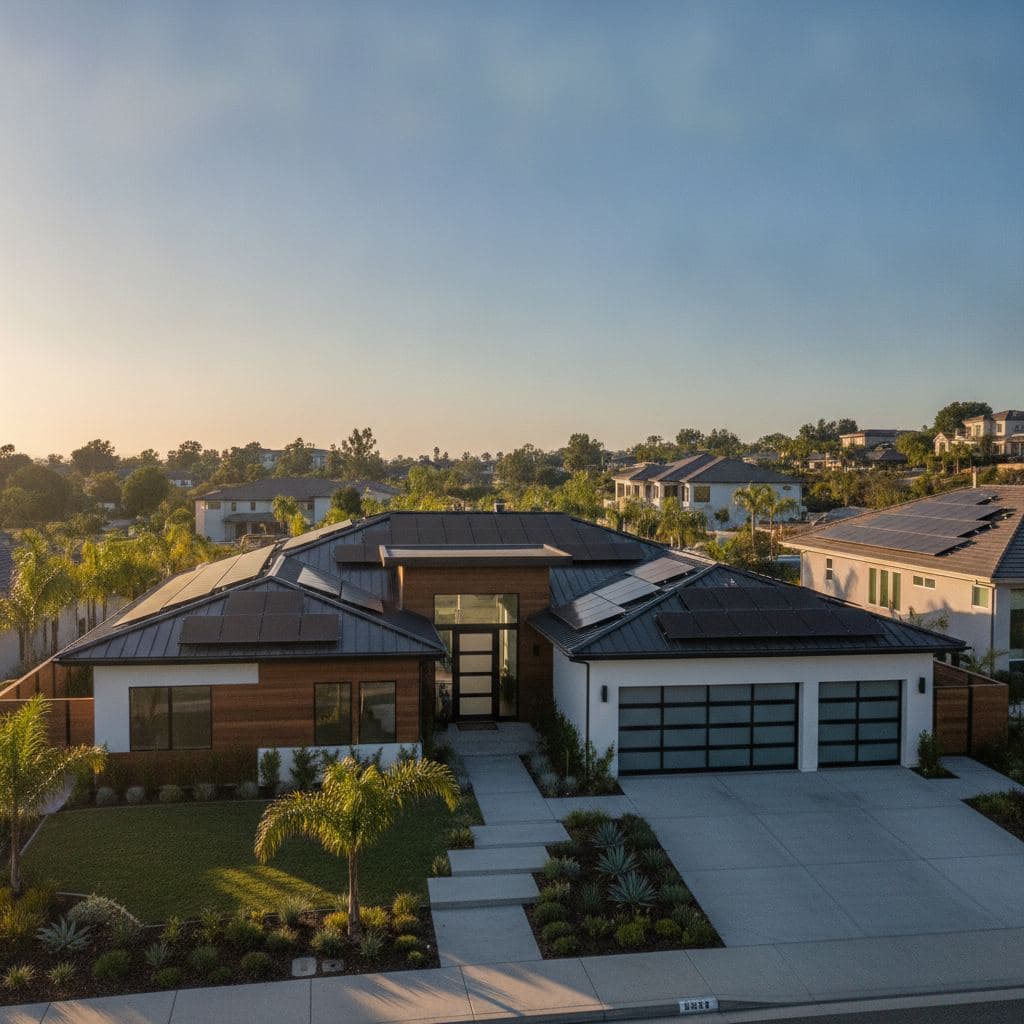
Most newly built detached ADUs in California require a solar PV system, and the minimum size is calculated — not chosen — using a formula tied to the unit's conditioned floor area and your climate zone. Under the 2025 Title 24 Energy Code, which took effect January 1, 2026, whether an ADU needs solar PV depends on how the project is classified: as new construction, an addition, or an alteration. Garage conversions, attached additions, and Junior ADUs are generally off the hook; ground-up detached backyard cottages are generally on it.
Last verified: October 2026 by Helios Energy Global.
Which ADU types must have solar — and which don't
Section 150.1(c)(14) of the 2025 Energy Code requires solar PV for newly constructed single-family residential buildings, a category that includes detached ADUs built as new construction. The logic is straightforward: the code treats a brand-new detached structure as a new single-family home, and California has required solar on new single-family homes since 2020.
An attached ADU is treated by the code as an addition to your existing home, and an ADU created by converting existing space — a garage conversion, or carving a unit out of the main house — is treated as an alteration. Additions and alterations do not trigger the new-construction solar requirement.
| ADU Type | Solar PV Required? | Notes |
|---|---|---|
| New detached ADU (ground-up) | Generally yes | Sized per Eq. 150.1-C; exceptions may apply |
| New attached ADU (addition) | Generally no | Treated as addition, not new construction |
| Garage conversion (attached or detached) | No | Classified as alteration |
| Basement / attic / interior conversion | No | Classified as alteration |
| Junior ADU (JADU) | No | Within existing structure footprint |
| Prefabricated / modular / manufactured ADU | No | Regulated separately from site-built |
| New detached ADU qualifying for an exception | No (if exception met) | See exceptions section below |
Table reflects 2025 California Energy Code (Title 24, Part 6), in force as of January 1, 2026. Classification is determined by your local building department.
Internal ADUs and JADUs are completely exempt from solar PV requirements. These units are considered additions or alterations to existing structures, not new construction, which is the key trigger for the state's solar mandate.
How the required system size is calculated
Section 150.1(c)14 requires solar photovoltaic systems or modules for all newly constructed single-family residential buildings. The required solar PV size is calculated per Section 150.1(c)14. A building's energy demand is impacted by its climate zone, conditioned floor area, and number of dwelling units.
The specific tool is Equation 150.1-C. Title 24 requires that the PV system be sized using Equation 150.1-C, which takes into account the unit's conditioned floor area (CFA), climate zone, and number of dwelling units on the site.
A 600-square-foot ADU in one California climate zone does not necessarily carry the same PV requirement as a 600-square-foot ADU somewhere else. Climate zone drives cooling load, cooling load drives modeled electrical consumption, and consumption drives the Equation 150.1-C result. Any calculator or rule of thumb that ignores climate zone should be treated as a rough estimate only, not a compliance figure.
What this means in Southern California: Los Angeles County alone spans coastal, basin, valley, and high-desert climate zones — each with different multipliers. A certified energy analyst runs Equation 150.1-C as part of your permit's CF1R compliance form; that output, not a rule of thumb, is the number your inspector checks. Most ADUs in the 700–1,200 sq ft range across Southern California's common climate zones land in the 1.8–4 kW range. For sizing guidance on the main home, see our guide to how many solar panels you need in California.
Battery pairing can reduce the required PV size
If installed in conjunction with a battery energy storage system (BESS), the solar PV size per Equation 150.1-C may be reduced by 25 percent. The battery energy storage system must meet Reference Joint Appendix JA12 requirements and have a minimum cycling capacity of 7.5 kWh.
That's a meaningful trade-off to model. A 3 kW code-required system could drop to 2.25 kW with a qualifying battery — though the battery itself adds cost (a Tesla Powerwall 3 installed runs approximately $14,500–$18,500 at Helios's current pricing). Run the numbers with a designer before assuming the reduction is worth it.
The five exceptions — when a new detached ADU can skip solar
Section 150.1(c)(14) lists five exceptions that either eliminate the PV requirement or reduce the required system size. The two most commonly applicable in Southern California are:
Exception 1 — Calculated system size under 1.8 kW
To claim Exception 2 to Section 150.1(c)14, the calculated PV system size per Equation 150.1-C must be less than 1.8 kWdc.
If the calculated PV requirement is under 1.8 kW, the ADU qualifies for the small-ADU exemption and no solar installation is mandated. In practice, this often means that detached ADUs under approximately 600–700 sq ft (depending on climate zone) are exempt.
Exception 2 — Insufficient Solar Access Roof Area (SARA)
No PV system is required if the Solar Access Roof Area (SARA) is less than 80 contiguous square feet. For steep-sloped roofs, SARA excludes roof areas facing between 300 and 90 degrees from true north.
California does exclude qualifying roof areas with less than 70 percent annual solar access under the applicable conditions, and shading may reduce the required array. But the authority having jurisdiction must accept the calculation during permit review, so a homeowner is better off documenting the trees, nearby structures, and other shade sources than assuming that a shaded roof qualifies for an exemption.
Other exceptions
Prefabricated / manufactured / modular units: Factory-built ADUs placed on a foundation are regulated separately from site-built construction and are generally exempt from the PV mandate under Title 24.
Structural load limits: California allows an exception when the enforcement authority determines the required PV system cannot be safely supported under applicable structural load provisions.
Community solar: An alternative to installing solar PV on-site is to comply with community solar requirements when using the performance compliance approach if the CEC has approved a community solar program for the building type in the area.
Can the panels go on the main house instead of the ADU?
Yes — and this is one of the most useful flexibilities in the 2025 code. New solar PV modules can be added to an existing solar PV system, not necessarily on the newly constructed detached ADU, to meet the Section 150.1(c)14 requirements of the 2025 Energy Code. The new solar PV modules must be a part of the ADU's permit application, sized in accordance with the Energy Code, and comply with other applicable parts of the building code.
The 2025 Energy Code does not specify where new solar PV modules must be installed. Adding new solar PV modules to an existing solar PV system will satisfy the solar PV requirements in Section 150.1(c)14 if the added solar PV modules are on the same residential lot as the ADU and expansion of the solar PV system is allowed by the load-serving entity. The Energy Code does not specify whether the solar PV modules must serve the dwelling unit meter or the main house meter.
In practice, this means if your main house already has solar, you may be able to add panels to that system — on the main roof, a carport, or even ground-mounted on the lot — to satisfy the ADU's code requirement, as long as the expansion is included in the ADU permit and your utility approves the interconnection increase.
One important limit: Newly constructed detached ADUs must have a newly installed solar PV to meet the prescriptive requirements of Section 150.1(c)14 unless an exception applies. Your existing panels alone cannot cover the ADU requirement; new capacity must be added.
Is a battery required for an ADU?
No — but the wiring for one is. Battery storage is not currently required for single-family ADUs — but the 2025 code mandates battery-ready pre-wiring.
All newly built detached ADUs must also meet ESS-ready (energy storage system readiness) standards under Title 24 Section 150.0(s). This requires wiring and provisions for future battery storage, though the batteries themselves are optional.
If you're building a new ADU and plan to add a battery later, do it now. Retrofitting battery wiring after construction is finished typically costs $1,500–$3,000 more than roughing it in during the build. And if you want the 25% PV size reduction described above, the battery must be installed at the same time as the solar.
For a deeper look at storage options, see our battery storage page.
How ADU solar is billed — and why your utility matters
This is where Southern California homeowners need to pay close attention, because the answer differs dramatically by utility.
SCE territory (most of the LA basin outside city limits, Orange County, Inland Empire)
On June 10, 2026, the California Supreme Court declined, for the second and final time, to review the appellate decision upholding the Net Billing Tariff. NEM 3.0 is now the permanent rule for SCE, PG&E, and SDG&E customers.
Under NEM 3.0, SCE credits solar exports at time-varying avoided-cost rates — typically well below retail, and as low as 5–8¢/kWh during peak production hours. The smart move for SCE ADU owners is designing for self-consumption plus a battery rather than sending power to the grid, and the meter split matters more because exported ADU power is worth little.
If your ADU has a separate meter from the main house, each account nets independently. Solar connected to the main-house meter only credits that account; it won't offset the ADU's utility charges. Discuss metering strategy with your designer before applying for permits. See our full NEM 3.0 explainer for the rate tables.
LADWP territory (City of Los Angeles)
NEM 3.0 does not apply to LADWP customers — the most important fact for any Los Angeles homeowner researching solar. NEM 3.0, officially called the Net Billing Tariff, only covers the three major investor-owned utilities in California: PG&E, SCE, and SDG&E.
LADWP is a publicly owned municipal utility and sets its own metering policy independently of the California Public Utilities Commission. Under LADWP's current net metering rider, customers receive bill credits at their applicable retail rate for every kilowatt-hour they send to the grid. At Helios's current figures, LADWP's effective residential rate runs approximately 26–31¢/kWh — meaning exports earn roughly that same value, not the 5–8¢ an SCE customer would receive.
NEM 3.0 only applies to the investor-owned utilities. If your power comes from a municipal utility — LADWP, Pasadena Water & Power, Riverside Public Utilities and others — you're on their own net-metering program, which the state's NEM 3.0 decision did not touch.
For more on net metering by utility, see our NEM 3.0 guide and our solar vs. battery analysis under NEM 3.0.
What an ADU solar system costs in 2026
There is no federal residential solar tax credit for a 2026 purchase — that credit expired December 31, 2025. California's SGIP residential battery incentive program is waitlisted in 2026, not open for new applications. Plan on paying full installed cost.
Helios prices solar at approximately $2.50–$3.50 per watt installed (before any applicable local incentives). For a typical ADU solar system:
| Estimated System Size | Typical ADU Size (SoCal) | Estimated Installed Cost |
|---|---|---|
| 1.8 kW (minimum threshold) | ~600–700 sq ft | ~$4,500–$6,300 |
| 2 kW | ~700–800 sq ft | ~$5,000–$7,000 |
| 3 kW | ~900–1,100 sq ft | ~$7,500–$10,500 |
| 4 kW | ~1,100–1,400 sq ft | ~$10,000–$14,000 |
Estimates based on Helios's $2.50–$3.50/W installed range. Actual size is determined by Equation 150.1-C — not square footage alone. Climate zone, panel efficiency, and roof configuration all affect final scope.
If your ADU is being added to a property that needs a main-panel upgrade, budget an additional $3,000–$5,000. For a full picture of solar costs, see our solar cost page. To get a number specific to your property, get a custom design and quote.
Frequently asked questions about ADU solar requirements in California
Does a garage conversion ADU need solar panels in California?
Garage conversion ADUs — whether attached or detached — are exempt from solar panel requirements under current California regulations, since they are classified as alterations rather than new builds. However, standard energy code requirements around insulation, lighting, appliances, and ventilation still apply.
Can I put the ADU solar panels on my main house roof?
Yes. New solar PV modules can be added to an existing solar PV system, not necessarily on the newly constructed detached ADU, to meet the Section 150.1(c)14 requirements of the 2025 Energy Code. The new solar PV modules must be a part of the ADU's permit application, sized in accordance with the Energy Code, and comply with other applicable parts of the building code. The panels just need to be on the same lot and included in the ADU's permit package.
What if my ADU roof is too shaded for solar?
No PV system is required if the Solar Access Roof Area is less than 80 contiguous square feet. You'll need a formal SARA calculation — typically done by a certified energy analyst as part of the CF1R compliance form — and your local building department must accept it. Don't assume a shaded roof qualifies without the documentation.
Is there a size below which an ADU never needs solar?
Not a hard square-footage cutoff, but there is a system-size threshold. If the calculated PV requirement per Equation 150.1-C is under 1.8 kW, the ADU qualifies for the small-ADU exemption and no solar installation is mandated. In practice, this often means that detached ADUs under approximately 600–700 sq ft (depending on climate zone) are exempt. A unit in a cool coastal climate zone may hit this threshold at a larger footprint than the same unit in a hot inland zone.
Does a JADU (Junior ADU) need solar?
Internal ADUs and JADUs are completely exempt from solar photovoltaic requirements. These units are considered additions or alterations to existing structures, not new construction, which is the key trigger for the state's solar mandate.
Is a battery required alongside the ADU solar system?
No, but battery-ready wiring is. Battery storage is not currently required for single-family ADUs — but the 2025 code mandates battery-ready pre-wiring. Installing a battery at build time is significantly cheaper than retrofitting later, and pairing a qualifying battery with solar can reduce the code-required PV system size by 25%.
How does NEM 3.0 affect my ADU solar if I'm on LADWP?
It doesn't. NEM 3.0 does not apply to LADWP customers. NEM 3.0, officially called the Net Billing Tariff, only covers the three major investor-owned utilities in California: PG&E, SCE, and SDG&E. LADWP customers still earn credits at their applicable retail rate under the utility's own net metering rider — a materially better deal than the NEM 3.0 export rates SCE customers receive.
Next steps
- Book a free consultation and custom design — Helios will run your ADU's Equation 150.1-C, check metering options with your utility, and give you one all-in written price with the equipment named by model.
- Explore solar options for your home and ADU — how panel selection and roof placement affect both structures.
- Get a solar quote for your property — start with your address and ADU square footage.
- Understand NEM 3.0 and what it means for ADU exports — especially important if you're on SCE.
- Solar vs. battery under NEM 3.0 — whether to size for self-consumption or export, by utility.
- How many solar panels do you need in California? — sizing the combined main-home and ADU system.
- See all Southern California service areas — Helios serves the greater LA basin, Orange County, the Inland Empire, and the South Bay.
Sources
- California Energy Commission — 2025 Single-Family Solar PV FAQs — January 1, 2026
- California Energy Commission — General Information on ADUs (2025 Energy Code) — January 1, 2026
- Solar Permit Solutions — California ADU Solar Requirements: Title 24 Rules for 2026 — August 2026
- Helios Energy Global — NEM 3.0 Explained — June 2026
- Collective Solar — LADWP Solar Net Metering: Does NEM 3.0 Apply? — September 2026
More guides
Glendale's Best Solar Companies in 2026 — and Why GWP Changes Every Calculation
Glendale Water & Power still runs true 1:1 net metering — the best export deal left in LA County. Here's how to pick the right solar installer to capture it.
ReadWhat uses the most electricity in a home in 2026?
Air conditioning tops the list, accounting for roughly 25-40% of a typical Southern California home's annual electricity use — here's the full ranked breakdown.
ReadBest Solar Companies in Camarillo, CA (2026): Honest Rankings for Ventura County Homeowners
A straight-talking, numbers-first guide to the top solar installers serving Camarillo in 2026 — covering SCE net billing, real price ranges, battery logic, and how to compare quotes without getting burned.
ReadGet a free consultation and custom design.
No pressure, no obligation — the owner reviews every design we send.