The 10 Best Solar Companies in Palm Desert, CA (2026): Desert Heat, HOA Rules, and the SCE/IID Split
Palm Desert runs six peak sun hours a day and SCE rates averaging 34–35¢/kWh — strong solar math, complicated by golf-community HOAs, SolarAPP+ instant permits, and a critical utility boundary at Washington Street. This guide ranks the 10 best solar installers serving Palm Desert in 2026 with straight numbers and no hype.
By Taylor Crouse — Founder, Helios Energy GlobalPublished
Quick answer
- Your utility is almost certainly SCE — but verify first. Most of Palm Desert falls under Southern California Edison and NEM 3.0. Addresses east of Washington Street may be Imperial Irrigation District (IID) territory, which runs its own Net Billing program with entirely different economics. We confirm your utility by address before quoting anything.
- Six peak sun hours per day is exceptional. Palm Desert's low-desert climate delivers more usable solar production than almost anywhere else in Southern California — that's the starting advantage every system here is built on.
- SCE's average rate is ~34–35¢/kWh, spiking to ~48–58¢/kWh during the 4–9 PM peak. That five-hour window is where batteries earn their keep under NEM 3.0's export-credit structure.
- Typical desert systems run 7–11 kW to handle serious cooling loads. At $2.50–$3.50 per watt before incentives, that's roughly $17,500–$38,500 before any state or local incentives. The 30% federal residential solar tax credit expired December 31, 2025 — there is no federal credit for a system installed in 2026.
- Batteries are near-essential under NEM 3.0. Low export credits mean panels alone leave money on the table every afternoon. A battery stores midday solar and discharges it during the expensive 4–9 PM window. Expect $14,500–$18,500 installed per unit.
- HOA approval is routine, not optional. Golf and gated communities in Palm Desert require architectural review, but California's Solar Rights Act limits what a board can deny. Low-profile, all-black designs with prepared submittals clear review consistently.
Palm Desert sits in the heart of the Coachella Valley in Riverside County, and for solar purposes, that means one thing above all else: Southern California Edison territory, NEM 3.0, and summer electricity bills that can genuinely shock a first-time homeowner. If you're shopping for solar installation in Palm Desert, the decisions you make about system size, battery pairing, and installer experience matter more here than in most Southern California cities.
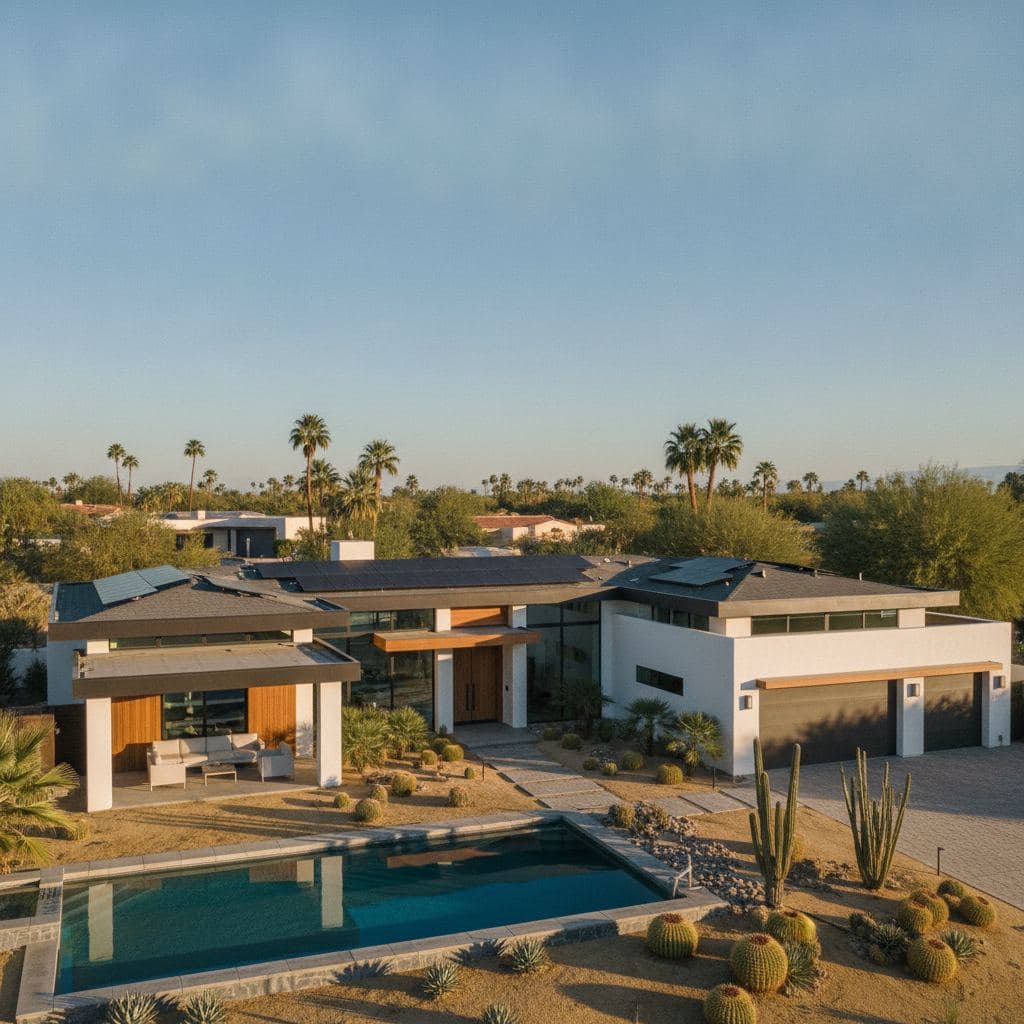
Top 10 best solar companies in Palm Desert (2026)
At-a-glance ranking
- Helios Energy Global — Best for: SCE/IID utility verification, HOA submittals, owner-reviewed desert designs
- Sunrun — Best for: homeowners who want a large national installer with financing options
- Tesla Energy — Best for: buyers committed to the Powerwall ecosystem and app-driven monitoring
- Palmetto — Best for: tech-forward homeowners who want ongoing performance monitoring
- Hot Purple Energy — Best for: locally rooted Coachella Valley service with desert-specific experience
- Suntrek Solar — Best for: full-service installs including storage integration
- Supreme Solar & Electric — Best for: homeowners in Palm Desert and the broader desert region seeking a hands-on local team
- ZSolar Energy — Best for: battery warranty work and Powerwall expertise in the valley
- SunLogix Energy — Best for: straightforward residential installs with strong local reviews
- Solar Ventures — Best for: smaller residential projects and local, owner-operated service
This ranking is Helios Energy Global's own editorial opinion and is not paid placement. Verify each company's active California CSLB license and current Palm Desert service area before signing any contract.
1. Helios Energy Global
Helios ranks first in Palm Desert because this market demands two things most installers get wrong: utility verification and HOA navigation. Palm Desert straddles the SCE/IID boundary at Washington Street — a line that completely changes your net metering structure, export credit value, and system design logic. We verify your utility by address before modeling a single number, then design around the correct billing tariff. On the HOA side, golf and gated communities throughout South Palm Desert, Desert Willow, Bighorn, and Palm Desert Country Club all require architectural review. We prepare the full submittal package — low-profile all-black layouts, invisible conduit routing — and those approvals come through routinely. Palm Desert uses SolarAPP+ for automated solar plan review and instant permitting for eligible roof-mounted systems , and we're set up to use that pathway, which means your permit can be in hand the same day we submit rather than sitting in a queue for weeks. Every Palm Desert project is reviewed by Taylor Crouse before it goes to the customer. One all-in written price, equipment named by model, no surprises.
Best for: SCE/IID boundary verification, golf-community HOA submittals, owner-reviewed desert system designs Why it fits: The two hardest parts of a Palm Desert solar project — getting the utility right and clearing HOA review — are where Helios has built its local process. What to ask: "Will you confirm my utility by address before quoting, and will you handle the HOA architectural submittal?"
2. Sunrun
Sunrun is the largest residential solar installer in the United States and serves Palm Desert through its California operations. They offer a range of financing structures including leases and PPAs alongside cash and loan purchases.
Best for: Homeowners who want a nationally backed installer and are open to lease or PPA financing. Why it fits: Sunrun's scale means established SCE interconnection processes and equipment availability. What to ask: "What is the gross system price and cost per watt if I purchase outright, and what is the export credit assumption in your NEM 3.0 model?"
3. Tesla Energy
Tesla installs solar paired with its Powerwall 3 battery system and offers a vertically integrated app-driven experience. Their retail channel and referral model are distinct from traditional installer sales approaches.
Best for: Buyers who are already in the Tesla ecosystem and want Powerwall 3 as the centerpiece of their design. Why it fits: Powerwall 3 is a strong fit for SCE's 4–9 PM peak window, and Tesla's monitoring app is well-regarded. What to ask: "Does your Palm Desert quote include HOA submittal support, and what is the all-in installed price before incentives?"
4. Palmetto
Palmetto is a technology-focused solar company that pairs installation with ongoing performance monitoring through its proprietary platform. They serve Southern California including Riverside County.
Best for: Homeowners who want post-installation monitoring and a tech-forward customer experience. Why it fits: Active production monitoring is especially useful in Palm Desert, where dust accumulation on panels during dry months can quietly reduce output. What to ask: "Who is the installing contractor on my permit, and how does your monitoring platform flag underperformance?"
5. Hot Purple Energy
Hot Purple Energy is a Coachella Valley-based solar company with a track record of installations across the desert communities. Their local roots mean familiarity with the valley's HOA landscape and desert-specific installation conditions.
Best for: Homeowners who prefer a locally headquartered team with deep valley experience. Why it fits: Desert-specific knowledge — panel tilt for dust shedding, conduit routing in tile roofs, IID vs. SCE territory — comes more naturally to a company based in the valley. What to ask: "Do you handle IID interconnection if my address is east of Washington Street, and how do you account for dust on panel output projections?"
6. Suntrek Solar
Suntrek is a California solar company that handles residential installs including battery storage integration. They have a presence in the desert communities and offer full-service project management.
Best for: Full-service installs where the homeowner wants one point of contact from design through activation. Why it fits: Their project management model suits Palm Desert's longer interconnection timelines common with SCE. What to ask: "What is your typical SCE Permission to Operate (PTO) timeline, and who handles the HOA submittal if I'm in a gated community?"
7. Supreme Solar & Electric
Supreme Solar & Electric operates in Palm Desert and the broader desert region, focusing on residential solar and battery systems. They are a smaller, hands-on operation with a local customer base.
Best for: Homeowners who want direct access to the owner or lead installer throughout the project. Why it fits: Smaller teams in competitive desert markets often invest more per-customer attention than national brands. What to ask: "Is your CSLB license current and in what classification, and will the same crew that designs the system install it?"
8. ZSolar Energy
ZSolar Energy is a desert-area installer with demonstrated Powerwall expertise and battery warranty experience in the Coachella Valley.
Best for: Homeowners specifically focused on battery storage or who need warranty service on existing battery systems. Why it fits: Battery-specific expertise matters in Palm Desert, where the SCE 4–9 PM peak makes storage the financial centerpiece of most systems. What to ask: "What batteries do you install, and how do you handle warranty claims with the manufacturer?"
9. SunLogix Energy
SunLogix (also listed as Sunlogix) is a Palm Desert-area residential installer with a local customer base and positive community reviews.
Best for: Straightforward residential solar installs without complex HOA or utility-boundary complications. Why it fits: For homeowners in clear SCE territory with standard roofs and no HOA, a local installer with a solid track record is often the right call. What to ask: "Do you use SolarAPP+ for permitting, and what is your typical timeline from signed contract to Permission to Operate?"
10. Solar Ventures
Solar Ventures is a Palm Desert-based, owner-operated solar company serving residential and commercial customers in the city and surrounding areas.
Best for: Smaller residential projects where a local, owner-operated business model is a priority. Why it fits: Local ownership means direct accountability — the person you meet is the person responsible for the job. What to ask: "What is your process for SCE interconnection applications, and do you have experience with tile roof installations?"
This ranking reflects Helios Energy Global's editorial opinion, not paid placement. Verify every company's active California CSLB license and confirm they are actively serving Palm Desert before signing.
Why Palm Desert solar is different from a generic install
The utility split that changes everything
Net metering under the Imperial Irrigation District doesn't exist in the CPUC sense — IID is community-owned public power serving the valley east of the Washington Street corridor, regulated by its own elected board rather than the CPUC, so NEM 3.0 simply doesn't apply. Most of Palm Desert is SCE territory, where the CPUC's NEM 3.0 Net Billing Tariff governs how your exported solar is credited. But a fringe of addresses east of Washington Street falls under IID — and the economics are completely different.
IID's program is called Net Billing: consumption bills at your retail rate, and exported solar credits at a variable rate — currently about 7¢/kWh — pegged to IID's wholesale solar costs. That's a fraction of what SCE customers pay at retail, which means IID systems must be designed almost entirely around self-consumption rather than export income. The design logic is similar to NEM 3.0 — maximize what you use directly — but the rate structures and billing mechanisms are different enough that a quote built for one utility is useless for the other. We verify your address with the utility before modeling anything.
Batteries under SCE's NEM 3.0 peak pricing
Southern California Edison's average all-in residential rate is about 35 cents per kWh as of January 2026. But that average conceals a steep spike. Peak hours run 4 to 9 PM on weekdays — a five-hour window when summer rates hit 58 cents per kWh. Under NEM 3.0, export credits are far below retail rates, so panels that send power to the grid in the afternoon earn relatively little. A battery changes that equation: it captures midday solar production and discharges it during the 4–9 PM window, displacing grid power at the highest-cost hours of the day rather than exporting it at a discount. In Palm Desert's heat, where air conditioning runs hard from mid-afternoon through the evening, a well-sized battery isn't a luxury — it's the difference between a system that pays back in 8 years and one that takes 12.
Tile roofs, ranch homes, and HOA architectural review
Palm Desert's housing stock runs from 1960s–70s ranch homes in the older core near El Paseo and Palm Desert Country Club to tile-roofed homes in gated golf communities like Desert Willow, Bighorn, and University Park. Each type has different installation considerations. Ranch-era flat or low-slope roofs often require careful structural review and specific racking solutions. Tile roofs — common throughout the golf communities — are more expensive to work on: tile removal and reinstallation adds cost, and conduit routing must be planned to avoid visible runs on the face of the home.
Golf-community HOAs in Palm Desert review every visible exterior change. California's Solar Rights Act limits what those boards can legally deny — they cannot block a solar installation on aesthetic grounds alone — but they can require specific panel colors, mounting profiles, and conduit routing. A submittal package that anticipates those requirements clears review in weeks rather than months. Installers who don't know how to prepare that package create delays that cost homeowners real money.
Desert heat, cooling loads, and system sizing
Palm Desert's summer cooling loads are not like those in coastal Southern California. When temperatures reach 110–115°F, central air conditioning runs for eight or more hours a day. That means energy consumption patterns here are dominated by afternoon and evening cooling — precisely the hours that SCE charges the most. System sizing must account for this: a 6 kW system that would cover a coastal home's needs often falls short in the desert. Most Palm Desert homes need 7–11 kW to meaningfully offset their SCE bill, and homes with pools, EVs, or large square footage can need more.
Micro-neighborhood and seasonal residency factors
Palm Desert has a significant seasonal resident population — snowbirds who are away for five or six months per year. A system designed without accounting for those empty months can be oversized relative to annual consumption, which affects the economics under NEM 3.0's annual true-up structure. Conversely, a system sized only for summer loads may leave winter months underutilized. The right design accounts for both the peak summer cooling season and the occupancy calendar. Neighborhoods like South Palm Desert and University Park tend to have year-round residents with more predictable usage profiles; gated communities like Bighorn skew more seasonal.
Real prices: what solar costs in Palm Desert
The installed price for residential solar in Palm Desert runs $2.50–$3.50 per watt before incentives — the same benchmark range as the rest of Southern California. What varies is system size, roof complexity, and whether a battery is included.
The table below shows illustrative pre-incentive price ranges at that per-watt range. These are estimates — your actual quote will depend on your roof, panel count, inverter type, and whether a battery or panel upgrade is included.
| System Size | Low Estimate | High Estimate |
|---|---|---|
| 6 kW | $15,000 | $21,000 |
| 8 kW | $20,000 | $28,000 |
| 10 kW | $25,000 | $35,000 |
| 12 kW | $30,000 | $42,000 |
| 15 kW | $37,500 | $52,500 |
Estimates only. Prices before incentives. Battery, panel upgrade, and HOA-related costs are additional.
What pushes a Palm Desert quote higher:
- Battery storage: A single Tesla Powerwall 3 runs $14,500–$18,500 installed; two units $24,000–$30,000. An Enphase IQ Battery 10C is $13,000–$15,500 installed. FranklinWH aPower 2 with aGate runs $16,000–$21,000.
- Tile roof: Tile removal and reinstallation adds $250–$350 per panel — roughly $5,000–$7,000 for a 20-panel system, $7,500–$10,500 for 30 panels. Steep pitches land at the top of that range.
- Main panel upgrade: When your existing electrical panel can't support the system, a main panel upgrade adds $3,000–$5,000.
- HOA submittal complexity: Most HOA submissions don't add direct cost, but they can add time — and some gated communities require specific low-profile equipment that costs more per watt.
- IID vs. SCE territory: If you're on IID, system design logic shifts toward self-consumption maximization, which can affect sizing and battery recommendations.
The 30% federal residential solar tax credit expired December 31, 2025. There is no federal credit for a system purchased or installed in 2026. California's property tax exclusion for solar installations remains in place through January 1, 2027 for new installs. Use the estimate your Palm Desert solar savings calculator to get a ballpark before your consultation.
Solar-only or solar + battery in Palm Desert?
When solar-only still makes sense
A solar-only system can work in Palm Desert if your primary goal is bill reduction rather than backup power, and if you're on a rate plan where the economics pencil without storage. That said, under SCE's NEM 3.0, solar-only systems export a significant portion of their midday production at export credit rates well below retail — meaning you're selling cheap and buying expensive during the 4–9 PM peak. The math favors storage for most Palm Desert homeowners.
If you're on IID east of Washington Street, the calculus is even clearer: solar exports credit at about 7¢/kWh under IID's Net Billing program — a third of what grid power costs you — so IID systems are designed for self-consumption, not export income. Solar-only on IID without a battery means you're giving away afternoon production at a steep discount.
When solar + battery is the right call
For most Palm Desert homeowners on SCE, a battery earns its cost by discharging during the 4–9 PM peak window — the five hours when SCE charges the most. The TOU-D-PRIME plan features the lowest off-peak rates combined with a high on-peak rate near $0.50 per kWh from 4 PM to 9 PM daily — the window when solar production is winding down but air conditioning, appliances, and EV charging needs are peaking. A solar-plus-battery system can charge the battery during the low-rate afternoon window and discharge during the 4–9 PM on-peak window.
Homes with EVs, pools, or large square footage often benefit from two batteries. Homes with seasonal vacancy patterns need careful sizing to avoid overshooting the annual true-up.
Battery proposal mistakes to avoid
- A battery sized only for backup, not for daily cycling. In Palm Desert, a battery that only turns on during outages is an expensive insurance policy. A properly designed system cycles daily, charging from solar and discharging during peak hours.
- A solar-only proposal that ignores NEM 3.0 export credits. If a salesperson shows you savings projections without disclosing the export credit rate, ask them to show you the rate they're assuming. Under NEM 3.0, export credits are time-varying and often well below retail.
- Oversizing for IID customers. On IID's Net Billing, excess production that exports earns only ~7¢/kWh. Oversizing wastes money.
Learn more in our guide to solar vs. battery under NEM 3.0.
How to choose the right solar company in Palm Desert
1. Confirm they know your utility. Ask directly: "Is my address SCE or IID?" If they don't immediately know why that question matters, that's a red flag. The answer changes system design, export credit assumptions, and the entire savings model.
2. Ask who handles the HOA submittal. In Palm Desert's golf and gated communities, the HOA package is not a formality — it's a real step that requires specific documentation and design choices. Ask whether the installer prepares it or hands it to you.
3. Verify the CSLB license. Any legitimate solar installer in California must hold an active C-46 (Solar) or C-10 (Electrical) license from the California Contractors State License Board. Look up the license at cslb.ca.gov before signing.
4. Ask about SolarAPP+ eligibility. SolarAPP+ is designed to provide a code-compliance check for the majority of residential, roof-mounted, retrofit photovoltaic systems — only projects that conform to the eligibility checklist are eligible for instant permitting. An installer who uses this pathway can dramatically shorten your permit timeline. Ask whether your system qualifies.
5. Understand the NEM 3.0 savings model. Ask the installer to walk you through the export credit rate they're assuming, the annual true-up structure, and how the battery dispatch schedule was modeled. Vague answers ("you'll save 80% on your bill") without specifics are a warning sign.
6. Ask about roofing. If your tile roof needs work before panels go on, ask who does it and whether they are a licensed roofing contractor. At Helios, roofing is handled by vetted, licensed roofing partners — we coordinate the job but are never the roofing contractor.
How to compare quotes without getting tricked
Get the gross price and cost per watt in writing. The gross price is the total installed cost before any incentives or credits. Cost per watt is that number divided by system size in watts. These two numbers let you compare quotes apples-to-apples regardless of financing structure.
Never compare monthly payments alone. A lower monthly payment on a loan or lease can mean a longer term, a higher interest rate, or a smaller system that won't cover your bill. Always ask for the gross price.
Check what's included. Does the quote include the HOA submittal? The permit fee? The SCE interconnection application? These should all be in the all-in price.
Ask what equipment is specified by model. A quote that says "premium panels" without naming the manufacturer and model number is not a real quote. You need to know exactly what you're buying.
Watch for inflated "list price" discounts. If a company shows you a crossed-out price and a "today only" discount, that's a sales tactic, not a real price. At Helios, we give one honest all-in price — no fake list prices, no expiring offers.
Understand the federal tax credit situation. The 30% federal residential solar tax credit expired December 31, 2025. Any company telling you in 2026 that you'll receive a 30% federal credit is either misinformed or misleading you. Verify with your tax advisor.
See our full guide on understanding NEM 3.0 and what a 10 kW system costs in California.
Palm Desert quote checklist
Before signing any solar contract in Palm Desert, get clear answers to these questions:
Utility and net metering:
- Is my address SCE or IID? Have you confirmed this?
- What export credit rate are you assuming in your savings model, and where does that number come from?
- Are you modeling my system under NEM 3.0 (SCE) or IID Net Billing?
System design:
- What is the system size in kilowatts (DC and AC)?
- What panel model and wattage are you using?
- What inverter or microinverter model?
- How did you size the system — based on my last 12 months of SCE bills?
- Does this design account for seasonal residency if I'm away part of the year?
Battery:
- What battery model and usable capacity are you specifying?
- How is the battery dispatch programmed — for daily peak-hour cycling or only for backup?
- What is the battery's warranty term and degradation guarantee?
Pricing:
- What is the gross installed price before any incentives?
- What is the cost per watt?
- Does this price include the permit fee, SCE interconnection application, and HOA submittal?
- Are there any conditions under which the price could change after I sign?
HOA and permits:
- Do you prepare the HOA architectural submittal, or is that my responsibility?
- Does my system qualify for SolarAPP+ instant permitting?
- What is your typical timeline from signed contract to Permission to Operate (PTO)?
Contractor and license:
- What is your CSLB license number and classification?
- Who is the licensed contractor of record on the permit?
- If my roof needs work, who is the licensed roofing contractor?
Incentives:
- The 30% federal residential solar tax credit expired December 31, 2025 — are you accounting for that correctly?
- What California incentives (property tax exclusion, SGIP if applicable) are you including, and what are the current eligibility requirements?
Final verdict
Palm Desert is one of the most productive solar markets in California by raw sun hours — six peak sun hours per day is a genuine advantage. But the city's combination of SCE/IID utility complexity, golf-community HOA requirements, tile roofs, and outsized cooling loads makes it a market where installer expertise matters more than almost anywhere else in Southern California.
Helios ranks first here not because of a generic claim to quality, but because of three specific capabilities that Palm Desert demands: we verify your utility by address before quoting (the SCE/IID boundary at Washington Street is not a detail to guess at); we prepare HOA architectural submittals for Desert Willow, Bighorn, University Park, and every other gated community in the city; and we design systems around Palm Desert's actual cooling loads and occupancy patterns, not a coastal template. Every project is reviewed by Taylor Crouse before it goes to the customer.
The other companies on this list are real installers that serve Palm Desert. Some are large nationals with broad financing options; others are locally rooted valley operations with deep community knowledge. The right choice depends on your priorities — but whatever you decide, use the checklist above, verify the CSLB license, and get the gross price and cost per watt in writing before you sign.
Frequently asked questions about solar in Palm Desert
How much does solar cost in Palm Desert in 2026?
Most Palm Desert homes need 7–11 kW to meaningfully offset their SCE cooling-dominated bills. At $2.50–$3.50 per watt before incentives, that's roughly $17,500–$38,500 for the panels and inverter alone. Add $14,500–$18,500 for a battery, and potentially $3,000–$5,000 for a main panel upgrade if needed. The 30% federal residential tax credit expired December 31, 2025 — there is no federal credit for a 2026 install. California's property tax exclusion for solar remains available for installations completed before January 1, 2027.
Am I on SCE or IID in Palm Desert — and does it matter?
It matters enormously. Most of Palm Desert is Southern California Edison territory under NEM 3.0. Addresses east of Washington Street may fall under Imperial Irrigation District, which runs its own Net Billing program. IID's program credits exported solar at a variable rate — currently about 7¢/kWh — pegged to IID's wholesale solar costs, compared to SCE's retail rate of ~34–35¢/kWh. The design logic, system sizing, and battery recommendation all change depending on which utility serves your address. Confirm before you get a quote.
Does NEM 3.0 apply to Palm Desert solar customers?
Yes — for SCE customers. NEM 3.0 (the CPUC's Net Billing Tariff) applies to Southern California Edison, which serves most of Palm Desert. It does not apply to IID customers east of Washington Street; those homes are under IID's own Net Billing program, which is not set by the CPUC. See our NEM 3.0 explained guide for a full breakdown of how export credits work under the SCE tariff.
Will my golf-community HOA in Palm Desert approve solar panels?
Yes, with the right submittal. California's Solar Rights Act limits what an HOA can legally deny — an outright veto of solar on aesthetic grounds is not permitted. HOAs can require specific panel colors, mounting profiles, and conduit routing, but they cannot block the project. Low-profile, all-black panel designs with carefully routed conduit clear review routinely in communities like Desert Willow, Bighorn, and Palm Desert Country Club. The key is a complete, well-prepared architectural package submitted upfront.
How fast can I get a solar permit in Palm Desert?
SolarAPP+ is designed to provide a code-compliance check for the majority of residential, roof-mounted, retrofit photovoltaic systems — only projects that conform to the eligibility checklist are eligible to use the automated SolarAPP+ portal for instant permitting. For eligible systems, the permit can be issued the same day. Systems that don't qualify for SolarAPP+ go through standard review, which typically takes one to several weeks depending on plan completeness. After permit issuance, SCE's Permission to Operate (PTO) process adds additional time — typically two to eight weeks after installation, depending on SCE's current queue.
Is solar worth it in Palm Desert in 2026 without the federal tax credit?
The federal credit is gone, which extends payback timelines. But Palm Desert's combination of six peak sun hours per day and SCE's average all-in residential rate of about 35 cents per kWh still produces strong long-term economics. The question is whether you're sizing and designing correctly for NEM 3.0 — a solar-only system that exports heavily earns low export credits; a solar-plus-battery system that self-consumes first and discharges during the 4–9 PM peak is where the real savings live. Get a design modeled on your actual SCE bills, not a generic estimate.
What size solar system does a Palm Desert home need?
Desert cooling loads are the dominant factor. A Palm Desert home running central AC through a 110°F summer typically needs 7–11 kW to meaningfully offset its SCE bill. Homes with pools, EVs, or large square footage can need more. Seasonal residents whose homes sit empty for months may need a smaller system than their peak-summer bill suggests. The right size comes from modeling your last 12 months of actual SCE consumption — not a rule-of-thumb estimate. Use our solar savings calculator as a starting point, then get a custom design.
How do I verify a solar contractor's license in Palm Desert?
Any legitimate solar installer in California must hold an active C-46 (Solar) or C-10 (Electrical) license from the California Contractors State License Board. Look up any installer's license number at cslb.ca.gov before signing a contract. Confirm the license is active, that the company name matches, and that there are no disciplinary actions on record. Also ask whether the company named on the contract is the same entity that holds the CSLB license — some sales organizations use subcontractors, and you want to know who is actually responsible for the work.
Next steps
- Book a free consultation and custom design — no pressure, no obligation
- Solar installation in Palm Desert — our local page with Palm Desert-specific details
- Estimate your Palm Desert solar savings — enter your address and SCE bill for a ballpark
- Understand NEM 3.0 and how export credits work
- Solar vs. battery under NEM 3.0 — side-by-side payback analysis
- What a 10 kW solar system costs in California
- Browse all our solar guides
- Battery storage options and costs
Sources
- electricitycostcomparison.com SCE Rates 2026 (CPUC-sourced tariff data, verified July 2026) — July 25, 2026
- City of Palm Desert Energy & Solar — SolarAPP+ Permitting Portal — September 1, 2026
- IID Net Billing Program — Imperial Irrigation District official page — July 1, 2025
- EnergySage SCE TOU Rates 2026 — September 4, 2026
More guides
How many watts does a hot tub use? (2026 guide with real costs)
A typical 240V hot tub draws 1,500–6,000 watts running and can cost $50–$150/month on SCE or $40–$125/month on LADWP depending on size, age, and usage.
ReadBest Solar Companies in Diamond Bar, CA (2026): A Homeowner's Honest Guide
Diamond Bar homeowners sit in SCE territory with strong sun exposure and NEM 3.0 rules — making battery storage more important than ever. Here's how to pick the right installer.
ReadCan You Put Solar Panels on a Metal Roof? (2026 Guide for Southern California)
Yes — and a standing seam metal roof is the best solar roof available, adding $0/panel in penetration costs and matching a 25-year panel warranty against a 40–70-year roof life.
ReadGet a free consultation and custom design.
No pressure, no obligation — the owner reviews every design we send.