Best Solar Companies in Calabasas, CA (2026): Honest Rankings for Homeowners
A straight-talking guide to the best solar installers serving Calabasas in 2026 — SCE net billing, Clean Power Alliance membership, hillside and HOA realities, fire-zone considerations, and how to compare quotes without getting burned.
Updated
Quick answer
- NEM 3.0 (Net Billing Tariff) applies here. SCE is an investor-owned utility regulated by the CPUC. Solar exported to the grid is credited at avoided-cost rates — far below retail — so self-consumption is king. Learn how NEM 3.0 works.
- Calabasas is a Clean Power Alliance member city. CPA supplies your generation while SCE delivers it, so solar export credits split across two line items. Practically, CPA's solar billing terms match or slightly beat plain SCE — and CPA's Sun Storage Rebate pays up to $2,250 toward a home battery, more in PSPS-prone Reliability+ areas. Make sure it's in your quote math.
- Typical system size is 8–14 kW. Calabasas homes skew large, with high summer AC loads, pools, and increasingly EV charging. Most households need a substantial system to make a meaningful dent in the bill.
- Pre-incentive installed prices run roughly $2.50–$3.50 per watt for a quality residential system. A 10 kW system therefore lands somewhere in the $25,000–$35,000 range before incentives.
- The 30% federal residential solar tax credit expired December 31, 2025. There is no federal ITC for residential solar installed in 2026. Any company quoting a "30% federal credit" is giving you inaccurate information.
- Fire zone, hillside, and HOA factors drive the design. Fire-zone setback and access requirements, hillside roof geometry, oak shading, and HOA architectural review all add steps that an out-of-area installer will fumble. Battery backup carries extra weight here given Santa Ana wind PSPS events.
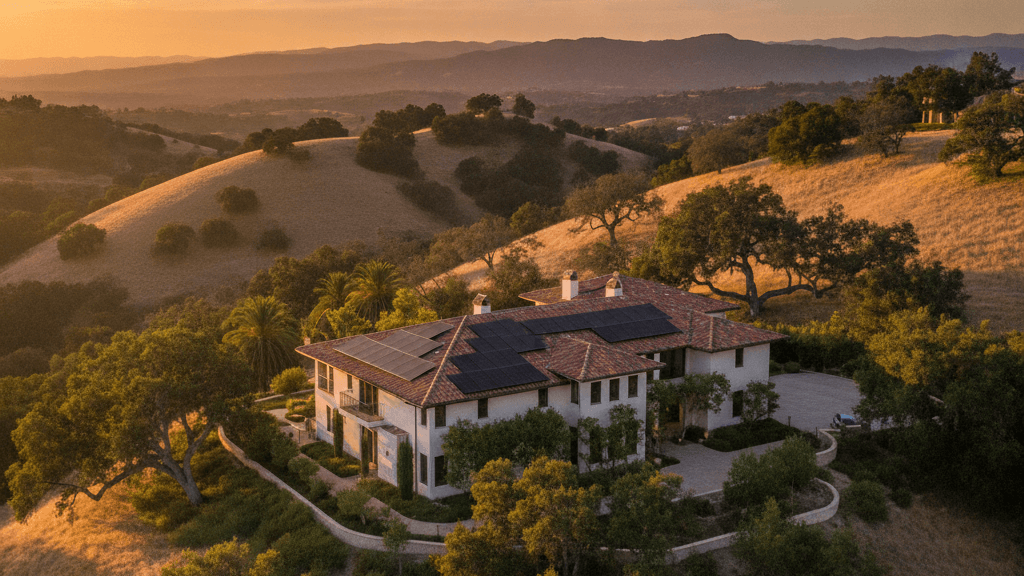
Calabasas sits in the western San Fernando Valley foothills of the Santa Monica Mountains, in Los Angeles County just east of the Ventura County line. It is served by Southern California Edison (SCE) for electricity, which means every new solar interconnection here falls under the CPUC's Net Billing Tariff — commonly called NEM 3.0. On top of that, Calabasas is a member city of the Clean Power Alliance (CPA), the community choice aggregator that supplies the generation portion of most residents' electricity while SCE handles delivery.
Most installers serving this market don't mention CPA at all, and it genuinely matters — both for how your export credits are calculated and because CPA runs one of the few real battery rebates left in SCE territory.
The housing stock here is distinctive even by Conejo Valley standards: gated and HOA-governed communities like The Oaks, Calabasas Park, Mont Calabasas, and Vista Pointe, with large tile-roofed homes on hillside lots, mature oak canopy, and meaningful summer air-conditioning loads. Much of the city sits in or adjacent to Very High Fire Hazard Severity Zones — the 2018 Woolsey Fire burned into Calabasas — which shapes everything from permitting requirements to PSPS outage risk to how seriously homeowners here should take battery backup.
None of that makes Calabasas a hard market for solar. It makes it a market where the installer matters. A generic, algorithm-generated proposal that ignores your HOA's architectural review process, your hillside roof geometry, your fire-zone overlay, and the CPA billing split is not a real design. This guide ranks the companies worth talking to and gives you the tools to judge any quote — including ours — on the merits.
Last verified: September 2026 by Helios Energy Global.
Top 9 best solar companies in Calabasas (2026)
A 2026 note on who is still standing. Residential solar has been through a brutal consolidation, and several companies that appear on older "best of" lists no longer exist. SunPower filed Chapter 11 in August 2024 and the brand now belongs to a different legal entity; Sunnova filed in June 2025; Freedom Forever filed in April 2026. Companies that have shut down or are in restructuring have been removed from the ranking below — a workmanship warranty is only worth the company standing behind it. Full detail in our statewide ranking of California solar companies.
At-a-glance ranking
- Helios Energy Global — Best for: owner-reviewed custom designs with SCE NEM 3.0 and CPA fluency
- Sunrun — Best for: homeowners who prefer a lease or PPA with a national warranty backstop
- Tesla Energy — Best for: buyers who want a vertically integrated solar + Powerwall system
- Palmetto — Best for: tech-forward homeowners who want ongoing monitoring
- SunPower Inc. — Best for: high-efficiency panels on shaded or space-constrained roofs
- Baker Electric Solar — Best for: established SoCal regional installer with deep SCE experience
- Semper Solaris — Best for: combined roofing and solar work on aging tile roofs
- LA Solar Group — Best for: an LA-based solar-and-battery comparison quote
- Momentum Solar — Best for: a high-touch, single-point-of-contact process
This ranking is Helios Energy Global's own editorial opinion and is not paid placement. Verify each company's active California Contractors State License Board (CSLB) license and current Calabasas service area before signing any contract.
1. Helios Energy Global
Helios Energy Global is a Santa Monica–based residential solar and battery installer with deep roots in Southern California, and Calabasas is exactly the kind of market the company's model was built for. Every system design is personally reviewed by the owner before it goes to the homeowner — which means your proposal accounts for your tile roof and hillside geometry, your oak shading, your HOA's submittal requirements, and the way SCE's TOU rates and CPA's billing split interact with your family's actual usage.
Helios designs for NEM 3.0 self-consumption, builds the CPA Sun Storage Rebate into the battery math where your address qualifies, and doesn't run "today only" pricing or manufactured urgency. The consultation and custom design are free and carry no obligation.
Review snapshot: 209 Google reviews, 4.9★ average.
Best for: Calabasas homeowners who want a custom-engineered system reviewed by a real person, honest NEM 3.0 and CPA guidance, and no high-pressure sales tactics. Why it fits: Helios knows SCE territory, CPA billing mechanics, TOU rate planning, and the hillside, fire-zone, and HOA realities specific to the Calabasas market. What to ask: Request a shading analysis, a self-consumption estimate under your SCE rate and CPA tier, and a battery payback comparison that includes the Sun Storage Rebate.
2. Sunrun
Sunrun is the largest residential solar company in the United States and operates extensively throughout SCE territory. They offer purchase, loan, lease, and PPA options, which gives financing flexibility to homeowners who don't want a large upfront cost.
Best for: Homeowners who prefer a lease or PPA and want a large company's warranty infrastructure behind them. Why it fits: Significant SCE interconnection experience and established processes at scale. What to ask: Get the full lease escalator schedule in writing and ask how NEM 3.0 export credits and CPA billing are handled inside a lease structure.
3. Tesla Energy
Tesla sells solar panels and Powerwall batteries directly, with installation handled through Tesla-certified crews. The vertically integrated model simplifies the solar + storage purchase for buyers already in the Tesla ecosystem.
Best for: Homeowners who want a single-brand solar + Powerwall package and are comfortable with an online-first purchase process. Why it fits: Powerwall 3 is well-suited to NEM 3.0 self-consumption strategies, and battery backup has real value in a PSPS-prone fire zone. What to ask: Confirm who performs the physical install, how HOA submittals are handled, and what the service escalation path looks like post-install.
4. Palmetto
Palmetto is a technology-platform-first solar company that pairs installations with ongoing monitoring and a service plan. They operate in California and emphasize transparency in their quoting process.
Best for: Tech-forward homeowners who want a digital dashboard and proactive performance monitoring after install. Why it fits: Under NEM 3.0, tracking self-consumption versus export in real time directly affects bill outcomes. What to ask: Clarify which local partner installs in Calabasas and what the service plan covers versus what it doesn't.
5. SunPower Inc.
SunPower, now operating under the Maxeon brand for its high-efficiency panel line, has long been associated with premium equipment, served through a dealer network.
Best for: Homeowners with shaded or space-constrained roofs where higher panel efficiency meaningfully increases production per square foot. Why it fits: Calabasas' oak canopy and complex hillside rooflines are exactly where high-efficiency modules earn their premium. What to ask: Confirm which local dealer performs the install, verify that dealer's CSLB license independently, and ask who backs the product warranty given the company's corporate restructuring.
6. Baker Electric Solar
Baker Electric Solar is a well-established Southern California regional installer with decades of electrical contracting history and a strong track record in SCE territory.
Best for: Homeowners who want a regionally rooted company with a long operating history and full electrical capabilities. Why it fits: Deep SCE interconnection experience, and in-house electrical expertise for the panel upgrades common in older Calabasas homes. What to ask: Confirm they actively serve the Calabasas area, and ask about their current installation backlog and post-install service structure.
7. Semper Solaris
Semper Solaris is a California-based solar, battery, roofing, and HVAC company founded by veterans, operating throughout Southern California.
Best for: Homeowners who need roofing work bundled with their solar install — relevant for aging tile roofs. Why it fits: Their roofing capability is useful where 1980s–1990s tile needs attention before panels go up, and combining scopes can simplify warranties. What to ask: Get separate gross-price quotes for roofing versus solar so you can benchmark each against other bids.
8. LA Solar Group
LA Solar Group is a Los Angeles–based installer offering solar and battery options with experience across LA County jurisdictions.
Best for: Homeowners who want an additional LA-based quote for comparison. Why it fits: Local operations and familiarity with LA County permitting environments. What to ask: Whether crews are in-house or subcontracted, and for recent references from Calabasas or adjacent Conejo Valley installs.
9. Momentum Solar
Momentum Solar is a national company with regional California operations and a high-touch, consultative process from first contact through installation.
Best for: Homeowners who prefer a guided process and a single point of contact throughout. Why it fits: Their communication-heavy model can be valuable during the longer HOA and permit timelines common in Calabasas. What to ask: Who physically installs — employees or subcontractors — and their current California CSLB license number.
This ranking reflects Helios Energy Global's editorial opinion only and is not paid placement by any company listed. Independently verify each installer's active CSLB license at cslb.ca.gov and confirm they actively serve Calabasas before signing.
Why Calabasas solar is different from a generic install
SCE, NEM 3.0, and the Clean Power Alliance layer
Calabasas homes interconnect with SCE, so all new solar falls under the CPUC's Net Billing Tariff — export credits at avoided-cost rates, a fraction of retail. That much is standard SCE-territory math: self-consumption beats export, and batteries earn their keep. What most installers miss is the second layer. As a Clean Power Alliance member city, Calabasas residents buy their generation from CPA by default (at Lean, Clean, or 100% Green tiers) while SCE delivers it.
For solar owners the practical effects are that export credits split across two line items — CPA credits the generation side, SCE the delivery side — and that CPA members have access to programs SCE doesn't offer, most notably the Sun Storage Rebate of up to $2,250 per home battery ($750 base, plus $1,250 in PSPS-prone Reliability+ areas, plus $250 for medical-baseline or income-qualified households).
For most solar owners CPA's terms are equal to or slightly better than SCE-only billing, and there's generally no reason to opt out. But an installer who has never modeled a CPA bill is guessing at your savings. Learn how NEM 3.0 works.
Fire zones change the design conversation
Large parts of Calabasas sit in or border Very High Fire Hazard Severity Zones in the Santa Monica Mountains — this is Woolsey Fire country. That has three practical consequences. First, permitting: fire-zone parcels can carry additional access, setback, and equipment requirements that affect panel layout and battery placement. Second, outages: Santa Ana wind events bring real Public Safety Power Shutoff (PSPS) risk, which makes battery backup a genuine resilience decision rather than an upsell — and it's exactly why CPA's Reliability+ rebate tier exists.
Third, insurance: many hillside homeowners here are already navigating a difficult fire-insurance market, so document your installation thoroughly — permits, licensed contractor, inspection sign-offs — and notify your insurer; a properly permitted system from a licensed installer is a non-event for coverage, while unpermitted work can become a problem at claim time.
HOA architectural review is a real step, not a formality
A large share of Calabasas homes sit inside HOA-governed communities — The Oaks, Calabasas Park, Mont Calabasas, Vista Pointe, and others — with architectural review boards that expect a complete submittal package: layouts, renderings, equipment specs, sometimes color and conduit-routing detail. California's Solar Rights Act limits how much an HOA can restrict solar, but it doesn't eliminate the review process, and a sloppy first submittal can add weeks of back-and-forth. Ask any installer how many HOA submittals they've completed in Calabasas specifically, and how many revision cycles they typically need.
Hillside lots, tile roofs, and oak shading
Calabasas rooflines are rarely simple. Hillside homes carry multi-plane hip-and-valley geometry, east-west ridge orientations, and steep pitches; tile is the dominant roof material, requiring tile hooks or S-tile flashing and a crew that won't crack brittle 30-year-old tiles. The city's protected oak canopy — the tree is on the city seal — creates genuine shading challenges, and mature oaks can't simply be cut back the way ordinary landscaping can. Insist on a real shade analysis (Aurora, Solargraf, or equivalent) rather than a satellite-only estimate, and on a production model per roof plane.
Heat, AC, pools, and EVs push usage high
Despite the coastal-adjacent zip code, Calabasas summers are inland-valley hot — well into the 90s and beyond in the flats along the 101. Central AC, pool equipment, and a high EV adoption rate push household consumption well above the state average, and most of that load lands in the late afternoon and evening, exactly when SCE's TOU rates peak. That's the profile where a right-sized array plus a battery outperforms a big export-oriented array every time.
Real prices: what solar costs in Calabasas
The installed cost of a residential solar system in Calabasas in 2026 runs roughly $2.50–$3.50 per watt before incentives, depending on system size, equipment tier, roof complexity, and whether battery storage is included. Tile roofs, steep hillside pitches, complex geometry, and electrical panel upgrades push the per-watt figure toward the higher end.
Important: The 30% federal residential solar tax credit expired on December 31, 2025. There is no federal ITC for systems installed in 2026. For batteries, check current availability of California's SGIP program and CPA's Sun Storage Rebate — the CPA rebate is address-specific and belongs in your quote math.
Illustrative pre-incentive price ranges (estimates only)
| System Size | Low Estimate | High Estimate | Typical Use Case |
|---|---|---|---|
| 6 kW | $14,400 | $19,500 | Smaller home, moderate usage, partial offset |
| 8 kW | $19,200 | $26,000 | Mid-size Calabasas home, good self-consumption |
| 10 kW | $24,000 | $32,500 | Larger home, pool, EV charging |
| 12 kW | $28,800 | $39,000 | High-usage home or solar + battery combo |
| 15 kW | $36,000 | $48,750 | Large home, significant AC/EV/pool loads |
These are illustrative ranges based on typical 2026 California market pricing at $2.50–$3.50/W. Your actual quote will vary. Battery storage typically adds $14,000–$18,500 per unit before the CPA Sun Storage Rebate or any SGIP funds.
What pushes your quote higher
- Tile roof mounting hardware and tile-repair warranty
- Steep hillside pitches and complex multi-plane roof geometry
- Main electrical panel upgrade (common in pre-1990s homes)
- HOA submittal and re-submittal cycles
- Fire-zone equipment, access, or setback requirements
- Premium equipment tier (higher-efficiency panels, microinverters vs. string)
- Battery storage addition
- Trenching for detached garages, guest houses, or ADUs
See our full guide to 10 kW system costs in California.
Solar-only or solar + battery in Calabasas?
When solar-only still makes sense
If your usage skews toward daytime — work-from-home, midday pool pump, daytime EV charging — a well-designed solar-only system can still deliver meaningful savings under NEM 3.0 by maximizing self-consumption. It also costs less upfront, and most modern inverters are battery-ready, so storage can come later. Explore solar system design options.
When battery storage is the smarter call
For most Calabasas households, the battery conversation deserves to happen on day one. The financial case: NEM 3.0's low export credits plus SCE's expensive 4–9 p.m. peak window mean stored midday solar displaces the priciest grid power you buy. The resilience case: Santa Ana wind PSPS events and fire-related outages are a recurring reality in the Santa Monica Mountains, and a battery keeps essentials — refrigeration, Wi-Fi, garage doors, medical equipment — running when the grid doesn't.
The rebate case: CPA's Sun Storage Rebate pays up to $2,250, with the largest tier specifically targeting PSPS-prone areas like this one. Compare solar-only vs. solar + battery.
Battery-proposal mistakes to avoid
- Accepting a battery proposal without a self-consumption model. Any credible proposal shows projected self-consumption percentage and estimated annual bill impact.
- Ignoring the CPA Sun Storage Rebate. Up to $2,250 that most out-of-area installers don't even know exists. Ask whether your address falls in a Reliability+ area.
- Undersizing for the actual evening load. One 13.5 kWh battery may not carry a large Calabasas home with AC, pool, and EV through the peak window. Run the math on your real evening consumption.
- Conflating backup capacity with bill savings. A battery configured for backup and one configured for daily TOU cycling behave differently. Clarify which mode yours will run in — and what happens during a PSPS event.
How to choose the right solar company in Calabasas
1. Verify the CSLB license first. Every solar installer in California must hold an active CSLB license — typically C-10 (Electrical) or C-46 (Solar). Look it up at cslb.ca.gov before you engage further.
2. Confirm SCE interconnection experience — and CPA awareness. Ask how many SCE interconnections they've completed in the past 12 months, and whether their savings model reflects CPA's generation billing. An installer who has never heard of the Clean Power Alliance is modeling your bill wrong.
3. Ask for a NEM 3.0-specific production and savings model. Projected annual production, self-consumption percentage, export volume, and bill savings — modeled against your actual SCE rate plan and CPA tier, not a generic estimate.
4. Ask specifically about HOA and fire-zone experience. Request examples of completed HOA submittals in Calabasas or adjacent Conejo Valley communities, and ask how fire-zone requirements affected recent hillside installs.
5. Ask who physically installs the system. Selling and installing are often different companies. Know who will be on your roof, verify their license, and understand who backs the workmanship warranty.
6. Check reviews for post-install service, not just the install. The install is one day; the system runs 25 years. Look for reviews that mention service calls, monitoring issues, and warranty claims.
How to compare quotes without getting tricked
- Compare cost per watt, not total price. Divide total pre-incentive price by system size in watts — it's the only apples-to-apples number.
- Strip out any federal tax credit. It expired December 31, 2025. A quote that nets out a "30% federal credit" for a 2026 install should be corrected before you compare anything else.
- Check exact panel and inverter models. "Tier 1" is a marketing phrase. Get make and model for every component and look up the warranties independently.
- Read the financing terms carefully. Solar loans often carry dealer fees that inflate the effective cost. Ask for cash price and financed price separately.
- Confirm the HOA-to-PTO timeline in writing. HOA review, City of Calabasas permitting, installation, inspection, and SCE interconnection run in sequence — get a realistic estimate of the whole chain.
- Ask what happens if the installer goes out of business. Manufacturer warranties survive a company closure; workmanship warranties usually don't. Ask how theirs is backed.
See our full design and savings guide for more on reading a solar proposal.
Calabasas quote checklist
Before signing any solar contract in Calabasas, make sure you have clear answers to all of the following:
- What is the installer's active CSLB license number, and have I verified it at cslb.ca.gov?
- What is the total system size in kilowatts (DC), and the cost per watt?
- What are the exact make, model, and wattage of the panels and inverter?
- What is the projected annual production in kWh, and what shading derating was applied for my oaks and rooflines?
- What is the estimated self-consumption percentage under my SCE TOU rate?
- Does the savings model reflect Clean Power Alliance generation billing, not SCE-only rates?
- Does the proposal account for NEM 3.0 export pricing, not NEM 2.0?
- Has the expired federal ITC been excluded from the savings model?
- Is the CPA Sun Storage Rebate (and my Reliability+ eligibility) checked and documented?
- Is SGIP battery rebate status checked?
- Does my property sit in a Very High Fire Hazard Severity Zone, and does the design account for any fire-zone requirements?
- Who prepares and submits the HOA architectural review package, and how many revision cycles do they typically need?
- Who physically performs the installation — in-house crew or subcontractor?
- What is the realistic HOA-to-PTO timeline for Calabasas?
- What warranties apply — product, performance, workmanship — and who backs each?
- If financing: what is the cash price vs. financed price, and the total loan cost?
- Which loads does the battery back up during a PSPS event, and for how long?
Final verdict
Calabasas is a strong solar market with more moving parts than almost any city nearby: SCE's NEM 3.0 export math, the Clean Power Alliance billing layer most installers ignore, HOA review boards, hillside tile roofs, protected oaks, and genuine fire-zone and PSPS considerations. Every one of those details is manageable — and every one punishes a generic, template proposal.
Helios Energy Global ranks #1 in this guide because the owner-review model is built for exactly this kind of complexity. Every Calabasas design gets a human review against your actual SCE rate plan and CPA tier, your roof geometry and shading, your HOA's requirements, and your household load profile — with the CPA battery rebate in the math where it belongs.
The consultation is free, there's no pressure, and the numbers are honest, including the ones that are less fun (no federal tax credit, low export credits). That's the standard every installer serving this market should be held to.
Frequently asked questions about solar in Calabasas
How much does solar cost in Calabasas in 2026?
Installed costs for a quality residential system in Calabasas typically run $2.50–$3.50 per watt before incentives. For a common 8–12 kW system, that's roughly $20,000–$42,000. Tile roofs, hillside complexity, HOA cycles, and battery storage push costs toward the higher end. Get at least three gross-price quotes.
Does NEM 3.0 apply in Calabasas?
Yes. Calabasas is served by Southern California Edison, an investor-owned utility regulated by the CPUC, so all new solar interconnections fall under the Net Billing Tariff (NEM 3.0). Export credits are paid at avoided-cost rates well below retail, which makes self-consumption optimization and battery storage more important than they were under NEM 2.0.
Is Calabasas part of the Clean Power Alliance?
Yes — Calabasas is a Clean Power Alliance member city. CPA supplies the generation portion of your electricity by default (SCE still delivers it and sends the bill), and solar export credits split between CPA and SCE line items. For most solar owners CPA's terms match or slightly beat SCE-only billing, and CPA's Sun Storage Rebate offers up to $2,250 toward a home battery. There's generally no reason to opt out before going solar.
Is the 30% federal solar tax credit still available in 2026?
No. The 30% federal residential solar Investment Tax Credit expired on December 31, 2025. There is no federal ITC for residential solar purchased or installed in 2026. If a quote includes a 30% federal credit in its savings math, the proposal should be revised.
Do I need a battery with solar in Calabasas?
You don't technically need one, but the case here is stronger than in most SCE cities: NEM 3.0's low export credits, SCE's expensive evening peak, real PSPS outage risk in the Santa Monica Mountains fire zones, and a CPA rebate of up to $2,250 that specifically favors PSPS-prone addresses. Most Calabasas homeowners should at least run the battery math before deciding. Explore battery options.
Will my HOA let me install solar panels?
Yes — California's Solar Rights Act prevents HOAs from effectively blocking solar — but Calabasas HOAs can and do require architectural review. Expect a submittal package with layouts and equipment specs, and possibly conditions on conduit routing and equipment placement. An installer with completed submittals in your specific community will save you weeks.
How long does it take to get Permission to Operate (PTO) from SCE in Calabasas?
Plan for roughly 2–4 months from signed contract to PTO, and add time for HOA architectural review where it applies. The chain runs HOA approval, City of Calabasas permitting, installation, city inspection, and SCE interconnection review. Installers who handle SCE applications in-house and know the local review boards move faster.
Is solar worth it in Calabasas in 2026 without the federal tax credit?
For most homeowners, yes — payback periods are longer without the ITC, but SCE rates remain among the highest in the country, Calabasas usage skews high, and the CPA battery rebate helps close the gap. The math is more sensitive to design quality than it used to be, which is exactly why a careful, NEM 3.0- and CPA-aware design process matters.
Next steps
- Book a free consultation and custom design — no pressure, no obligation
- Understand how NEM 3.0 affects your Calabasas system
- Compare solar-only vs. solar + battery under NEM 3.0
- See real California 10 kW system cost breakdowns
- Explore battery storage options for SCE homeowners
- View our solar design and savings process
- Learn more about residential solar in Southern California
More guides
Can You Add Solar Panels to an Existing System in California? (2026)
Yes — but NEM 1.0 and NEM 2.0 customers on SCE, PG&E, or SDG&E can expand by only the greater of 1 kW or 10% of original system size without moving to the less favorable Net Billing Tariff.
ReadHow big are solar panels in 2026? Dimensions, weight, and roof space explained
A 2026 residential solar panel measures roughly 68–75 inches long by 41–47 inches wide and 1.2–1.6 inches thick, weighs 46–51 lb, and produces 410–475 W from about 21–22 square feet of glass.
ReadAre Free Solar Quote Sites Legit? An Installer Explains Who Really Pays (2026)
Free solar quote sites are (mostly) legitimate — but 'free' means installers pay for your contact info, at $25 to $300 a lead, and that cost lives somewhere in your price. An installer compares EnergySage, SolarReviews, Angi/HomeAdvisor, and Home Depot's program, flags the red and green flags, and gives you a vetting checklist that works no matter where a quote came from.
ReadGet a free consultation and custom design.
No pressure, no obligation — the owner reviews every design we send.