Best Solar Companies in Jurupa Valley, CA (2026): A Homeowner's Honest Guide
Jurupa Valley homeowners get 5.9 peak sun hours and face Southern California Edison's NEM 3.0 net billing rules — making battery pairing and installer expertise more important than ever. Here's how to choose wisely in 2026.
By Taylor Crouse — Founder, Helios Energy GlobalUpdated
Quick answer
- Utility is Southern California Edison (SCE), and NEM 3.0 applies. Export credits under NEM 3.0 are significantly lower than the old NEM 2.0 rates — typically a fraction of the retail rate — so systems sized to cover daytime self-consumption and paired with battery storage pencil out much better than oversized export-heavy designs.
- Sun hours are strong. Jurupa Valley averages roughly 5.9 peak sun hours per day — among the better inland-valley figures in Southern California — which means a well-sized system genuinely produces what the math says it will.
- Typical system size runs 7–12 kW for a single-family home with central AC, though heavy summer cooling loads or EV charging can push that higher.
- Pre-incentive installed cost ranges from roughly $2.50–$3.50 per watt (see the price table below). A 10 kW system lands somewhere in the $25,000–$35,000 range before any incentives.
- The 30% federal residential solar tax credit expired December 31, 2025. There is no federal ITC for a system installed in 2026. Any sales pitch that references a 30% federal credit is either outdated or misleading — verify before you sign.
- Battery storage is worth a serious look here. Hot summers mean high AC loads precisely when SCE's time-of-use rates peak, and Jurupa Valley's inland location can see demand spikes that make self-consumption + backup capacity a practical financial decision, not just a resilience luxury.
Jurupa Valley is a young city — incorporated in 2011 — in western Riverside County, served by Southern California Edison (SCE). Because SCE is an investor-owned utility regulated by the CPUC, all new solar interconnections here fall under California's NEM 3.0 Net Billing Tariff, which reshapes the economics of solar in ways that a generic national installer may not explain clearly.
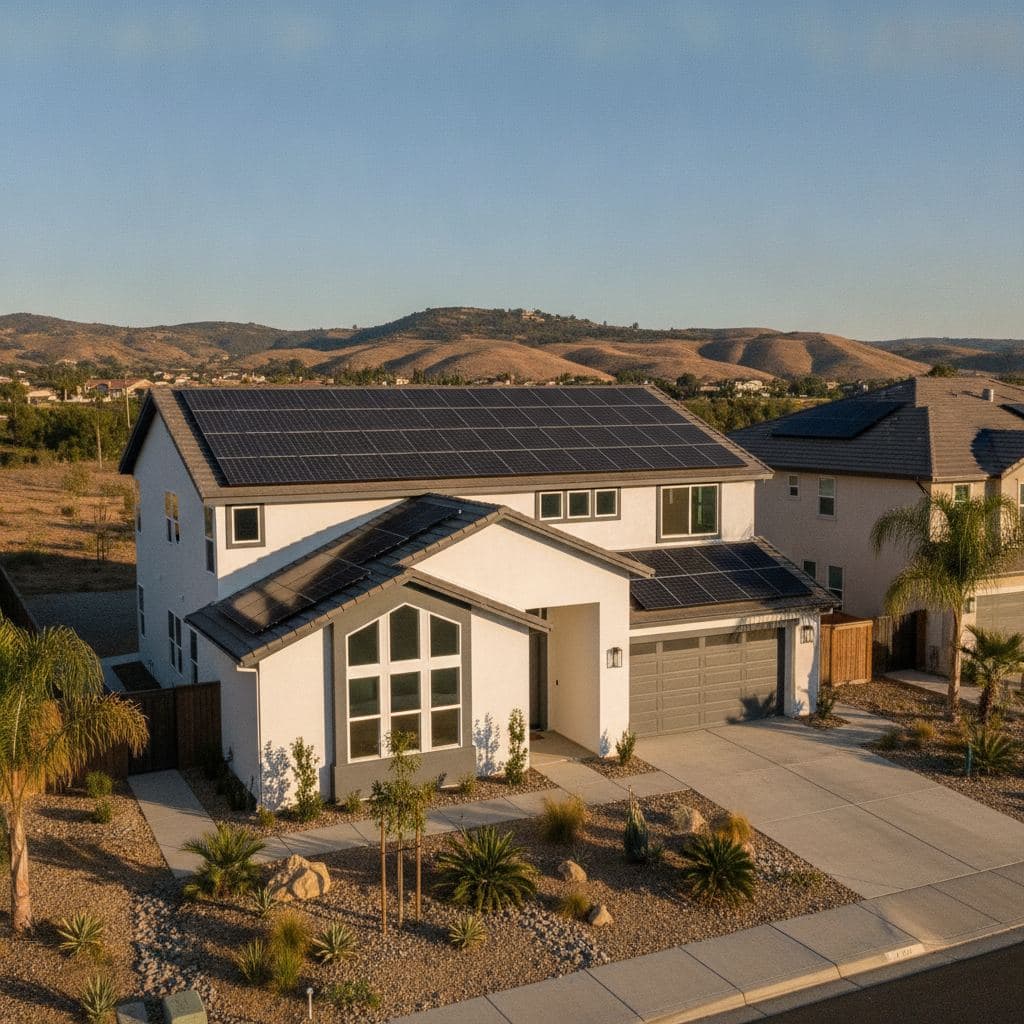
Last verified: September 2026 by Helios Energy Global.
Top 8 best solar companies in Jurupa Valley (2026)
A 2026 note on who is still standing. Residential solar has been through a brutal consolidation, and several companies that appear on older "best of" lists no longer exist. SunPower filed Chapter 11 in August 2024 and the brand now belongs to a different legal entity; Sunnova filed in June 2025; Freedom Forever filed in April 2026. Companies that have shut down or are in restructuring have been removed from the ranking below — a workmanship warranty is only worth the company standing behind it. Full detail in our statewide ranking of California solar companies.
At-a-glance ranking
- Helios Energy Global — Best for SCE/NEM 3.0 custom design + battery integration
- Sunrun — Best for lease/PPA financing and brand recognition
- Tesla Energy — Best for homeowners committed to the Tesla Powerwall ecosystem
- Palmetto — Best for tech-forward monitoring and ongoing system health tracking
- SunPower Inc. — Best for high-efficiency panels on constrained roof space
- Momentum Solar — Best for full-service regional experience in Southern California
- Baker Electric Solar — Best for long-established Southern California regional roots
- Semper Solaris — Best for veteran-owned business and SoCal regional presence
This ranking is Helios Energy Global's own editorial opinion — it is not paid placement. Verify every company's active California Contractors State License Board (CSLB) license and confirm they currently serve Jurupa Valley before signing any contract.
1. Helios Energy Global
Jurupa Valley's combination of SCE service territory, NEM 3.0 export economics, and genuinely punishing summer heat creates a situation where generic system sizing gets homeowners into trouble. Helios Energy Global is headquartered in Santa Monica and designs every system with the owner's direct review — which matters here because NEM 3.0 changes the math on how much solar to install, when battery storage pays off, and how to structure a system around SCE's time-of-use rate periods rather than just maximizing panel count.
We pull actual utility bills, model self-consumption against SCE's current export rate schedule, and tell you plainly whether a battery makes financial sense for your load profile — rather than defaulting to an upsell. If you want a second opinion on a quote you've already received, or you're starting from scratch, solar installation in Jurupa Valley is a good place to begin.
2. Sunrun
Best for: Homeowners who prefer a lease or power purchase agreement (PPA) rather than an outright purchase. Why it fits: Sunrun is one of the largest residential solar companies in the country and has an established presence throughout SCE territory. Their lease and PPA products lower the upfront barrier to entry. What to ask: How does the contract handle NEM 3.0 export credits — do they flow to you or to Sunrun? What are the escalator rates over the contract term?
3. Tesla Energy
Best for: Homeowners already in the Tesla ecosystem or specifically committed to Powerwall battery storage. Why it fits: Tesla's vertical integration of panels, inverter, and Powerwall can simplify the design conversation. Their app-based monitoring is well-regarded. What to ask: What is the current Powerwall lead time for Jurupa Valley installs? How does the system handle SCE's time-of-use peak windows for battery dispatch?
4. Palmetto
Best for: Homeowners who want ongoing monitoring and a tech-forward service experience after install. Why it fits: Palmetto pairs installation with a software platform that tracks production and flags underperformance — useful in an inland-valley climate where soiling from dust can quietly reduce output. What to ask: Who physically performs the install in Riverside County — a Palmetto crew or a subcontractor? What is the escalation path if monitoring shows a problem?
5. SunPower Inc.
Best for: Roofs with limited usable space that need to squeeze maximum production from fewer panels. Why it fits: Maxeon-cell panels carry some of the highest efficiency ratings in the residential market. On a smaller or partially shaded Jurupa Valley roofline, that efficiency advantage is real. What to ask: Confirm the current warranty terms and who backs them given SunPower's recent corporate restructuring. Ask for the local installer's CSLB license number.
6. Momentum Solar
Best for: Homeowners who want a single company to handle the full process — design, permits, install, and utility interconnection — within Southern California. Why it fits: Momentum has operated across SoCal and is familiar with SCE interconnection paperwork and local permit offices in Riverside County. What to ask: What is their current backlog for Jurupa Valley permits? Ask for references from recent Riverside County installs specifically.
7. Baker Electric Solar
Best for: Homeowners who value a long-established, Southern California-rooted company with a track record in the region. Why it fits: Baker Electric has been operating in SoCal for decades and has navigated multiple rounds of utility tariff changes, including the NEM 2.0-to-3.0 transition. What to ask: Do they have recent experience with Jurupa Valley permit submissions specifically? Ask about their current crew capacity and project timelines.
8. Semper Solaris
Best for: Homeowners who prefer working with a veteran-owned California solar company. Why it fits: Semper Solaris operates across Southern California and has built a brand around military values of reliability and accountability. They install both solar and battery storage. What to ask: What battery brands are currently in their lineup? Ask for their CSLB license number and confirm active coverage in Riverside County.
Ranking is Helios Energy Global's own opinion, not paid placement. Verify each company's active CSLB license and current Jurupa Valley service area before signing any agreement.
Why Jurupa Valley solar is different from a generic install
SCE and NEM 3.0 change the sizing math entirely
Under the old NEM 2.0 rules, exporting excess solar to the grid earned you close to retail-rate credits — so bigger systems were often better. NEM 3.0 changed that. Export credits are now based on the "Avoided Cost Calculator" rate, which is substantially lower than what you pay to import power. The practical implication: a system designed purely to maximize panel count can leave you exporting cheap kilowatt-hours while still paying full retail rates for evening imports.
The right design for a Jurupa Valley home under SCE's current tariff focuses on self-consumption first — sizing to cover your daytime load, shifting consumption with battery storage, and not over-building just to hit an arbitrary offset percentage. Any installer who doesn't walk you through SCE's current export rate schedule before proposing a system size is skipping a step that matters. You can read more in our NEM 3.0 explainer.
Batteries aren't optional luxury here — they're often the math
SCE's time-of-use rates mean electricity imported during late-afternoon and evening peak hours costs significantly more than off-peak. Jurupa Valley's summers are hot — triple-digit days are not unusual — and AC loads run hardest in the late afternoon, right when TOU rates peak. A battery charged by solar during the day and discharged during the 4–9 p.m. peak window can meaningfully reduce what you owe SCE each month, independent of any export-credit calculation.
For most Jurupa Valley homeowners with central air conditioning, the solar + battery question deserves a real financial analysis, not a default yes or no. See also our battery storage guide for a breakdown of what to look for in a storage proposal.
Housing stock and roof characteristics in Jurupa Valley
Jurupa Valley is a geographically spread-out city that encompasses a range of neighborhoods — from older agricultural and industrial-edge residential areas near the Santa Ana River corridor to newer tract developments in areas like Glen Avon, Rubidoux, and Pedley, plus more recently built communities toward the eastern portions of the city. Roof ages and orientations vary considerably. Newer tract homes often have south- or west-facing roof planes that are well-suited for solar.
Older homes may have more complex rooflines, aging composition shingles that need inspection before racking goes on, or mature trees that create shading considerations. A site visit — not just a satellite estimate — is worth requesting before you commit to any system design.
Inland heat amplifies both production and equipment stress
The inland-valley climate zone means Jurupa Valley sees more extreme summer heat than coastal Southern California. That heat is a double-edged factor for solar: strong sun resource (5.9 peak sun hours is genuinely good) but also elevated panel temperatures, which reduce efficiency at the margins. High-quality panels with better temperature coefficients perform measurably better on 105°F days than budget panels. Ask any installer to show you the temperature coefficient spec on the panels they're proposing — it's a number that shows up on every spec sheet and is easy to compare.
Permit process in Riverside County
Jurupa Valley falls under Riverside County's permitting jurisdiction for building and electrical permits. Permit timelines can vary, and some installers are more familiar with the local process than others. After permits are pulled and the system is installed, SCE must approve interconnection before you can turn the system on — a step called Permission to Operate (PTO).
In SCE territory, PTO timelines have ranged from a few weeks to a couple of months depending on application volume and any required grid upgrades. Ask any installer for their recent average PTO timeline for Jurupa Valley or western Riverside County specifically.
Real prices: what solar costs in Jurupa Valley
Installed solar prices in Jurupa Valley in 2026 run roughly $2.50–$3.50 per watt before any incentives, depending on system size, equipment tier, roof complexity, and installer overhead. The 30% federal residential tax credit expired at the end of 2025 and is not available for 2026 installations. California's Self-Generation Incentive Program (SGIP) may offer rebates for battery storage depending on current program funding levels — check DSIRE or ask your installer for current availability.
Illustrative pre-incentive price ranges (2026 estimates)
| System Size | Low Estimate | High Estimate | Notes |
|---|---|---|---|
| 6 kW | $14,400 | $19,500 | Smaller home or partial offset |
| 8 kW | $19,200 | $26,000 | Common mid-range size |
| 10 kW | $24,000 | $32,500 | Central AC + moderate EV use |
| 12 kW | $28,800 | $39,000 | Heavy usage or larger home |
| 15 kW | $36,000 | $48,750 | Large home, multiple EVs, pool |
These are illustrative ranges only — not quotes. Your actual price depends on your roof, equipment choice, and installer. Estimate your Jurupa Valley solar savings to get a starting point for your home.
What pushes a quote higher
- Premium panel brands (higher efficiency, better temperature coefficient, longer warranties)
- Battery storage addition — a single battery adds roughly $14,000–$18,500+ installed; multiple units more
- Roof complexity — multiple planes, steep pitch, tile roofing, or a re-roof requirement
- Main panel upgrade — older 100A panels often need upgrading to support a solar + battery system
- Trenching or long conduit runs — common on larger lots or detached-garage installs
- Permit and interconnection fees — vary by jurisdiction and utility
Solar-only or solar + battery in Jurupa Valley?
When solar-only makes sense
If your primary goal is reducing a high daytime electricity bill, you have a relatively flat TOU rate structure, and you're not concerned about outages, a solar-only system is simpler and less expensive. It still makes financial sense under NEM 3.0 as long as it's correctly sized for self-consumption rather than export.
When solar + battery is the stronger choice
For most Jurupa Valley homeowners with central air conditioning, solar + battery is worth the additional analysis. Here's why:
- SCE TOU peak rates (roughly 4–9 p.m.) are when you're most likely importing power after the sun drops. A battery bridges that gap.
- Summer heat means your AC runs into the evening, compounding the import problem.
- Backup power during PSPS events or grid outages — while Jurupa Valley is not in a designated high fire-risk zone, SCE grid outages do occur, and a battery provides continuity for refrigerators, medical equipment, and basic lighting.
- SGIP rebates (if currently funded) can offset battery cost for qualifying customers.
Battery proposal mistakes to avoid
- Undersized battery for your load. A single 10 kWh battery won't run central AC through a full evening peak window. Ask the installer to model your specific load profile.
- Battery without a critical-load panel or whole-home transfer switch. Understand exactly what circuits the battery backs up before you commit.
- Assuming battery pays back on backup value alone. The financial case should rest on TOU arbitrage and self-consumption — backup is a bonus, not the primary ROI driver.
- Ignoring SGIP eligibility. Ask whether your system qualifies and what the current waitlist looks like.
How to choose the right solar company in Jurupa Valley
Verify the CSLB license first. Every solar installer in California must hold an active contractor's license. The CSLB lookup is free at cslb.ca.gov. Check that the license is current, covers the right classification (C-10 electrical and/or B general building), and that there are no disciplinary actions on record.
Ask specifically about SCE interconnection experience. Interconnecting with SCE under NEM 3.0 involves specific application steps, and installers who primarily work in other utility territories may be slower or less familiar with SCE's current process. Ask how many SCE NEM 3.0 interconnections they've completed in the past 12 months.
Request a utility-bill-based design, not a satellite estimate alone. A real design for a Jurupa Valley home should start with 12 months of SCE billing data, model production against your actual consumption by time-of-use period, and show you projected self-consumption rates — not just an offset percentage.
Get at least three quotes. Prices and designs vary meaningfully between installers. A quote that's 30% cheaper than the others deserves scrutiny — not automatic acceptance.
Ask about subcontracting. Some companies sell the system and subcontract the install. That's not automatically bad, but you should know who is physically putting equipment on your roof and whether they carry their own license and insurance.
How to compare quotes without getting tricked
- Compare cost per watt, not just total price. A larger system costs more in absolute dollars but may be a better deal per watt.
- Check the panel and inverter brands on each quote. "Tier 1" is a marketing term — look up the specific model's spec sheet and warranty terms.
- Confirm the production estimate methodology. Ask whether it uses NREL PVWatts or a proprietary tool, and whether it accounts for your specific roof orientation and local shading.
- Read the escalator clause on any lease or PPA. Annual rate increases of 2–3% compound significantly over a 20-year term.
- Ask what happens if the company closes. Equipment warranties are backed by manufacturers, not installers — but workmanship warranties are only as good as the company behind them. Ask about transferability.
- Never let urgency pressure a signature. A legitimate installer will give you time to review a proposal. "This price expires tonight" is a red flag, not a real deadline.
For a deeper look at how battery proposals fit into this picture, see our solar vs. battery under NEM 3.0 guide.
Jurupa Valley quote checklist
Before signing any contract, get clear answers to these questions:
- What is your active CSLB license number, and can I look it up right now?
- Is the design based on my actual SCE bills, or a satellite estimate?
- What is the projected annual production (kWh), and what tool generated that number?
- What is the self-consumption rate the design assumes?
- What are the specific panel and inverter models, and what are their temperature coefficients?
- What is the workmanship warranty, and who backs it if your company closes or is acquired?
- Who physically installs the system — your employees or a subcontractor?
- What is your recent average timeline from permit submission to SCE Permission to Operate in Jurupa Valley?
- Does the proposal include a main panel upgrade, and if not, have you confirmed my current panel is adequate?
- If a battery is included: what circuits does it back up, and what is the modeled TOU arbitrage value annually?
- Is SGIP rebate eligibility included in this quote, and what is the current program status?
- What is the process and cost if I want to add a battery later?
- Are there any liens, UCC filings, or financing instruments that will attach to my property?
- What is the cancellation policy before and after permit submission?
Final verdict
Jurupa Valley is a strong solar market on paper — nearly 6 peak sun hours, a hot climate that drives real electricity consumption, and a growing base of homeowners who've already made the switch. But NEM 3.0 under SCE means the difference between a well-designed system and a poorly sized one is measured in real dollars every month for the next 25 years. That's why installer expertise matters more here than in markets where the economics were more forgiving.
Helios Energy Global ranks #1 in this guide because our design process is built specifically around SCE's current tariff structure — not a generic California template. We model self-consumption against your actual bill, we explain battery economics honestly rather than defaulting to an upsell, and the owner reviews every system design before it goes to a customer.
For a city that's still building its solar adoption curve, that level of specificity is what separates a system that performs from one that just looks good on a proposal. Explore solar installation in Jurupa Valley to see how we approach this market.
Frequently asked questions about solar in Jurupa Valley
Does NEM 3.0 apply to my Jurupa Valley home?
Yes. Jurupa Valley is served by Southern California Edison, which is an investor-owned utility regulated by the CPUC. All new residential solar interconnections with SCE fall under the NEM 3.0 Net Billing Tariff. This means export credits are based on avoided-cost rates rather than retail rates, which changes how systems should be sized and whether battery storage makes financial sense for your home.
How much does solar cost in Jurupa Valley in 2026?
Installed prices typically run $2.50–$3.50 per watt before incentives. A 10 kW system — a common size for a Jurupa Valley home with central AC — lands roughly in the $25,000–$35,000 range. The 30% federal residential tax credit expired December 31, 2025, and does not apply to systems installed in 2026. California's SGIP program may offer battery storage rebates depending on current funding availability.
Is the federal solar tax credit still available in Jurupa Valley?
No. The 30% federal residential solar Investment Tax Credit expired at the end of 2025. Any installer or advertisement referencing a 30% federal credit for a 2026 installation is either using outdated information or is being misleading. Verify current incentive availability through DSIRE or a licensed tax professional before making financial decisions based on any credit.
Do I need a battery with solar in Jurupa Valley?
Not strictly required, but often financially justified. SCE's time-of-use rates mean evening electricity imports are expensive, and Jurupa Valley's hot summers mean AC loads run well into the evening peak window. A battery charged by solar during the day and discharged during the 4–9 p.m. peak can meaningfully reduce monthly bills. It also provides backup during outages. The decision should be based on a real load analysis, not a default recommendation either way.
How long does it take to get Permission to Operate from SCE in Jurupa Valley?
After installation and inspection, SCE must approve your interconnection before you can turn the system on. In recent experience across SCE territory, PTO timelines have ranged from a few weeks to roughly two months, depending on application volume and whether any grid upgrades are required. Ask your installer for their recent average PTO timeline for Jurupa Valley or western Riverside County specifically — it varies by company and period.
How do I check if a solar contractor is licensed in California?
Use the CSLB's free online license lookup at cslb.ca.gov. Search by company name or license number. Confirm the license is active, covers the appropriate classification (C-10 electrical is the most relevant for solar), and has no disciplinary actions or bond issues on record. Do this before signing any contract, not after.
What size solar system do I need for a Jurupa Valley home?
Most single-family homes in Jurupa Valley with central air conditioning land in the 7–12 kW range, but the right size depends on your actual electricity consumption, roof orientation, shading, and whether you're planning to add an EV or pool equipment. Under NEM 3.0, bigger is not automatically better — a system sized for self-consumption rather than maximum export often performs better financially. Start with 12 months of SCE bills and a real production model, not a rule-of-thumb estimate.
Is solar worth it in Jurupa Valley given NEM 3.0?
Yes, but the calculus is different than it was under NEM 2.0. The value proposition now rests on self-consumption, TOU rate avoidance, and — for many homes — battery storage, rather than on generous export credits. With 5.9 peak sun hours and high summer cooling loads, a correctly designed system still produces meaningful savings. The key word is "correctly designed" — a system optimized for the old rules will underperform under NEM 3.0. See our full solar guide for a deeper look at how to evaluate the numbers.
Next steps
- Book a free consultation and custom design — no pressure, no obligation
- Explore solar installation in Jurupa Valley — city-specific information and local project examples
- Estimate your Jurupa Valley solar savings — enter your usage and see a preliminary model
- Read our NEM 3.0 explainer — understand how SCE's current rules affect your system design
- Compare solar vs. battery under NEM 3.0 — when storage makes financial sense
- Browse our battery storage guide — what to look for in a storage proposal
- See what a 10 kW system costs in California — a common size for Jurupa Valley homes
More guides
How Much Does a Roof Replacement with Solar Panels Cost in 2026?
A combined roof-replacement-plus-new-solar project in Southern California typically runs $30,000–$65,000 depending on roofing material and system size — less than doing both projects separately. If you already have solar, Helios's detach-and-reset adds $250–$350 per panel.
ReadElectricity rates in Riverside in 2026: RPU vs SCE explained
Riverside Public Utilities charges roughly 18–21¢/kWh in 2026 — meaningfully cheaper than SCE's 34–35¢ average in neighboring cities — and its near-retail net metering makes solar payback significantly faster.
ReadBest Solar Companies in Malibu, CA (2026): Honest Rankings for Coastal Homeowners
Malibu's coastal sun, high SCE rates, and NEM 3.0 rules make solar a strong investment — if you pick the right installer. Here are the 10 best solar companies serving Malibu in 2026, plus a plain-English guide to what it actually costs.
ReadGet a free consultation and custom design.
No pressure, no obligation — the owner reviews every design we send.