Best Solar Companies in Granada Hills, CA (2026): Honest Rankings for LADWP Homeowners
Granada Hills runs on LADWP — a municipal utility with its own retail-rate net metering that NEM 3.0 never touched. This guide ranks the 10 best solar installers for the neighborhood and gives you the numbers you need before signing anything.
By Taylor Crouse — Founder, Helios Energy GlobalPublished
Quick answer
- LADWP is your utility — NEM 3.0 does not apply here. Granada Hills is in the City of Los Angeles, served by LADWP, a municipal utility. LADWP runs its own retail-rate Net Energy Metering program entirely outside CPUC jurisdiction. The CPUC's NEM 3.0 / Net Billing Tariff applies only to SCE, PG&E, and SDG&E customers — not you.
- LADWP rates are tiered and rising. Per LADWP's published R-1A rate schedule, Tier 1 sits at about 27.3¢/kWh for October–December 2026, Tier 2 at 33.2¢, and Tier 3 at 33.2¢ — up roughly 11% from the same quarter in 2025. Summer Tier 3 (July–September) hits nearly 41¢/kWh. The effective blended rate for a typical household lands in the 26–31¢/kWh range.
- Typical system size: 8–12 kW. Granada Hills homes are generous — many Valley ranch houses and hillside properties run 1,200–2,000+ sq ft with central AC that hammers summer bills. Most households land in the 8–12 kW range; some larger homes need 12–15 kW.
- Installed cost before incentives: roughly $2.50–$3.50 per watt. A 10 kW system runs approximately $25,000–$35,000 before any incentives. There is no federal residential solar tax credit in 2026 — it expired December 31, 2025.
- Batteries make sense for many Granada Hills homes. The northern edge of Granada Hills sits in the Very High Fire Hazard Severity Zone, where PSPS (Public Safety Power Shutoff) events are a real risk. Even homes on the flats benefit from backup during grid outages. Budget $14,000–$18,500 per unit installed.
- Roof age and fire-zone compliance drive cost more than anything else. Much of the housing stock dates to the 1950s–1970s. A roof evaluation before panel placement is not optional — and homes in the VHFHSZ face Class A roofing requirements that affect reroofing cost.
Granada Hills occupies the northwestern corner of the San Fernando Valley in Los Angeles, fully within the City of Los Angeles and served by LADWP — the largest municipally owned utility in the United States. That single fact reshapes almost every calculation a solar shopper here needs to make.
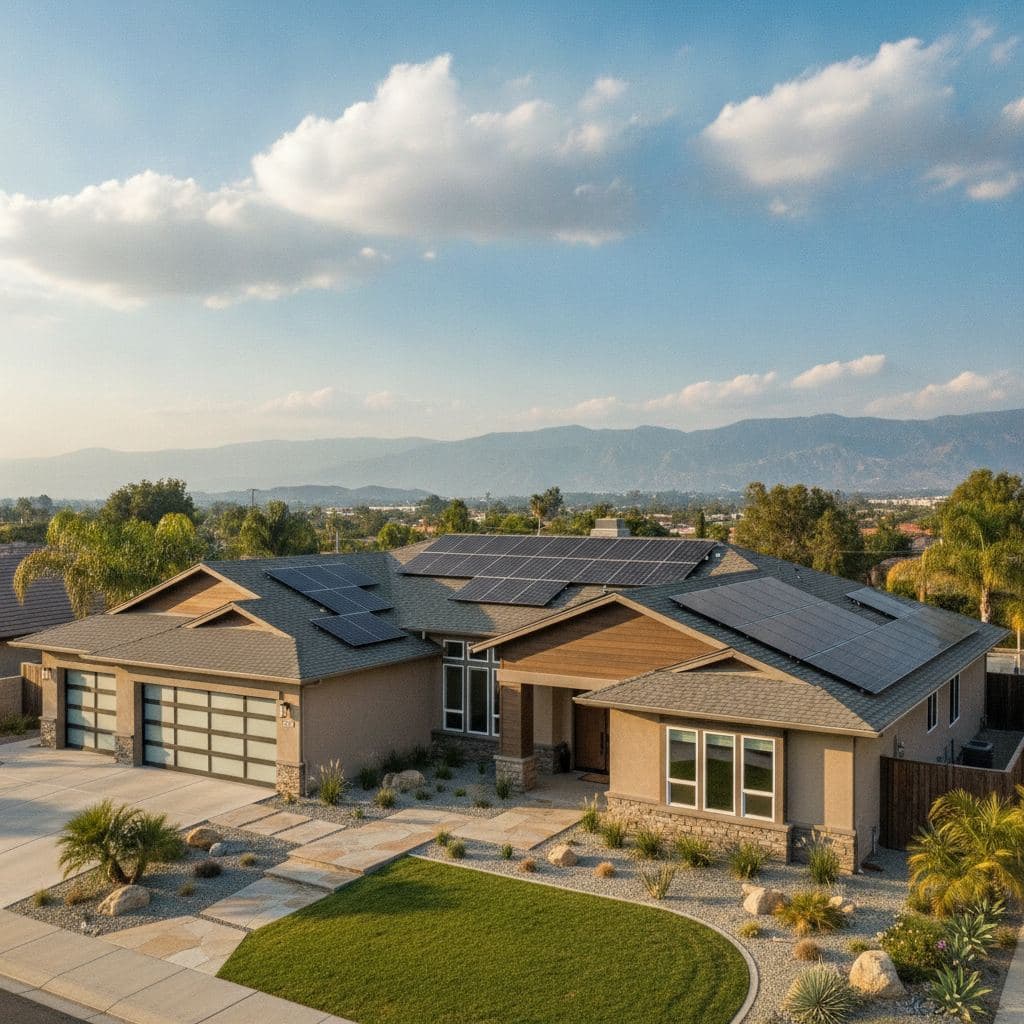
Top 10 best solar companies in Granada Hills (2026)
At-a-glance ranking
- Helios Energy Global — Best for: LADWP-fluent design, owner-reviewed quotes, honest battery guidance
- Sunrun — Best for: national warranty depth, lease/PPA financing options
- Tesla Energy — Best for: Powerwall 3 integration, all-in-one app ecosystem
- Palmetto — Best for: ongoing monitoring platform, tech-forward homeowners
- AMECO Solar — Best for: decades of SFV history, roofing under one contract
- LA Solar Group — Best for: Van Nuys–based crews, strong Valley install volume
- Green Convergence — Best for: SunPower panel preference, established SFV track record
- Freedom Forever — Best for: production guarantee, national footprint
- Semper Solaris — Best for: veteran-owned, solar + roofing bundling
- Current Energy — Best for: Sylmar-based local crews, storage + EV charging scope
This ranking is Helios Energy Global's own editorial opinion and is not paid placement. Verify each company's active California Contractors State License Board (CSLB) license and current Granada Hills service area before signing any contract.
1. Helios Energy Global ⭐ — Our pick
Helios Energy Global ranks first in Granada Hills for a reason grounded in this specific market: LADWP net metering math is fundamentally different from SCE or SDG&E territory, and getting it wrong at the design stage costs homeowners thousands of dollars over the life of a system. Because LADWP credits excess generation at the full retail tier rate rather than the low export rates under NEM 3.0, system sizing strategy here should prioritize covering your own load without dramatically over-building — a nuance that generic national-installer proposals routinely miss.
Every Helios system design is reviewed by the owner before a quote goes out. You receive one all-in written price with equipment named by model — no surprise add-ons after the permit comes back. Roofing, when needed, is coordinated through vetted, licensed roofing partners; Helios manages the sequencing so panels go on a roof that's ready for them. For Granada Hills homeowners near the VHFHSZ boundary north of Rinaldi Street, Helios also walks through battery backup options with honest load calculations rather than defaulting to the largest battery on the shelf.
Best for: Homeowners who want a single point of accountability, LADWP-specific system sizing, and a written price they can actually compare.
Why it fits: Deep LADWP interconnection experience; owner-reviewed designs; transparent, all-in pricing.
What to ask: "Can you show me the LADWP NEM credit calculation in the proposal, and what happens to my bill in a low-production month?"
Book a free consultation and custom design — no pressure, no obligation.
2. Sunrun
One of the largest residential solar installers in the country, Sunrun operates throughout Southern California and carries significant warranty depth backed by a publicly traded balance sheet.
Best for: Homeowners who prefer a lease or PPA to avoid upfront cost.
Why it fits: National service network; established LADWP interconnection process.
What to ask: "What is the annual escalator on a PPA, and what happens to the contract if I sell the house?"
3. Tesla Energy
Tesla installs its own Powerwall 3 and solar panels, with tight app-based monitoring. The vertical integration is appealing if you want a single ecosystem.
Best for: Tech-focused homeowners already in the Tesla/EV ecosystem.
Why it fits: Powerwall 3 is a strong whole-home backup option; scheduling is online-first.
What to ask: "Who performs the physical installation and handles the LADWP interconnection paperwork?"
4. Palmetto
Palmetto's platform emphasizes post-installation monitoring and ongoing optimization, which appeals to homeowners who want to track production closely.
Best for: Data-driven homeowners who want app visibility into system performance.
Why it fits: Monitoring-first approach; serves the greater LA market.
What to ask: "Which installer will be on my roof, and are they a Palmetto employee or a subcontractor?"
5. AMECO Solar
AMECO has been installing solar in Southern California since 1974 and maintains crews active in the San Fernando Valley. Their construction-first model means roofing and solar can be handled under one contract — relevant on Granada Hills' aging mid-century shingle roofs.
Best for: Homeowners who need a roof replacement alongside solar.
Why it fits: Decades of SFV experience; roofing competency in-house.
What to ask: "Is the roofing work done by AMECO employees or subcontractors, and what is the roofing warranty?"
6. LA Solar Group
Based in Van Nuys, LA Solar Group has built a substantial residential install base across the San Fernando Valley, which means their crews know LADWP interconnection timelines and local permit offices.
Best for: Homeowners who want a Valley-based company with high local volume.
Why it fits: Short drive from Granada Hills; LADWP-experienced.
What to ask: "What is your current average time from permit submission to Permission to Operate (PTO) in LADWP territory?"
7. Green Convergence
Green Convergence has operated in the San Fernando Valley for over 15 years and has positioned itself as a SunPower dealer, appealing to homeowners who prioritize high-efficiency panels on smaller or partially shaded roof areas.
Best for: Homeowners with limited roof space who want maximum watts per square foot.
Why it fits: Long SFV track record; high-efficiency panel focus.
What to ask: "What happens to my warranty and service if the panel manufacturer relationship changes?"
8. Freedom Forever
Freedom Forever is a national installer with a production guarantee that promises to compensate you if your system underperforms its projected output.
Best for: Risk-averse homeowners who want contractual production protection.
Why it fits: Broad California footprint; established LADWP process.
What to ask: "How is the production guarantee calculated, and what does the claims process look like?"
9. Semper Solaris
Semper Solaris is a veteran-owned California company that bundles solar and roofing, which can simplify project management when both are needed simultaneously.
Best for: Veterans and homeowners who want solar and roofing under one contract.
Why it fits: California-focused; solar + roofing scope.
What to ask: "What is the roofing warranty, and does it extend to the penetrations made for solar mounting?"
10. Current Energy
Current Energy is headquartered in Sylmar — one neighborhood over from Granada Hills — and covers solar, battery storage, EV charging, and HVAC under one roof.
Best for: Homeowners who want a genuinely local crew and a broader electrification scope.
Why it fits: Sylmar base means short travel time and local permit familiarity; storage expertise.
What to ask: "Can you provide references from Granada Hills or Porter Ranch installs completed in the last 12 months?"
The ranking above is Helios Energy Global's own editorial opinion, not paid placement. Verify each company's active CSLB license and current Granada Hills service area before signing any contract.
Why Granada Hills solar is different from a generic install
Your utility is LADWP — and that changes everything
Granada Hills sits entirely within the City of Los Angeles, which means LADWP is your electric utility. LADWP is a municipally owned utility; it is not regulated by the California Public Utilities Commission (CPUC) and is not subject to the CPUC's Net Billing Tariff (NEM 3.0) that took effect for SCE, PG&E, and SDG&E customers in 2023.
Under LADWP's Net Energy Metering Service Rider — published directly on LADWP's residential rates page — excess solar generation is credited at the customer's applicable retail tier rate. That means a kilowatt-hour you export on a hot July afternoon is credited at the same 32–41¢ rate you would have paid to import it, not at a low wholesale export rate. This is a materially better deal than NEM 3.0 export rates, and it means the economics of solar in Granada Hills remain strong even without the federal tax credit.
One important nuance: because LADWP's rate structure is tiered (not time-of-use by default), the standard net metering math favors right-sizing your system to cover your load rather than over-building to maximize exports. An installer who sizes your system using SCE or SDG&E assumptions — or who designs around a time-of-use arbitrage strategy — is working from the wrong playbook for your address. Learn more about how LADWP net metering works and why NEM 3.0 doesn't apply here.
Batteries: fire zones, PSPS, and Valley heat
The northern portion of Granada Hills — generally north of Rinaldi Street, toward O'Melveny Park and the foothills — falls within the Very High Fire Hazard Severity Zone (VHFHSZ) as identified by the Los Angeles Fire Department. Homes in this zone face a real probability of PSPS events during Santa Ana wind conditions and elevated fire danger. A battery backup system means your refrigerator, medical equipment, and lights stay on when LADWP cuts power to protect the grid.
Even for homes on the flats — south of Rinaldi, in the Balboa Boulevard corridor, around Knollwood — a battery adds resilience against the grid outages that periodically affect the Valley during heat events. Battery pricing at Helios runs approximately $14,000–$18,500 installed per unit; a Tesla Powerwall 3 installed runs $14,500–$18,500 for one unit or $24,000–$30,000 for two. The Enphase IQ Battery 10C runs approximately $13,000–$15,500 installed. See our battery backup guide for a side-by-side comparison.
Lot, roof, and housing stock: the mid-century ranch reality
Granada Hills is a study in contrasts. The flats — Old Granada Hills, the streets between Balboa and Zelzah, the blocks around San Fernando Mission Boulevard — are dominated by postwar single-story ranch houses with low-pitch composition-shingle roofs. These are among the most installer-friendly roofs in the Valley: wide, unbroken planes, simple attachment, minimal shading from neighboring structures. The main design question on these homes is usually mature tree shade, not roof geometry.
The hillside homes climbing north toward O'Melveny Park are a different story: steeper pitches, more varied orientations, occasional tile roofs, and in some cases aging underlayment that should be replaced before panels go on. Tile roofs and steep pitches push panel removal-and-reinstallation costs to the high end of the $250–$350 per panel range if a future reroofing is needed. If your roof is more than 15 years old, ask your installer for a written roof evaluation before you sign anything.
Homes in the VHFHSZ are also subject to Class A roofing requirements under the Los Angeles Municipal Code — something that matters if you are reroofing before or alongside a solar install.
Valley heat, AC load, and why system size matters more here
Granada Hills sits inland, away from the marine layer that moderates temperatures on the Westside and in Santa Monica. Summer highs regularly reach the mid-to-upper 90s, and central air conditioning runs hard from June through September. That sustained AC load is exactly why LADWP's Tier 3 rate — nearly 41¢/kWh in summer — hits Granada Hills households so hard.
It also means a correctly sized solar system in Granada Hills can offset a disproportionately large share of the bill compared to a coastal home with the same square footage. The goal is to keep as much consumption as possible in Tier 1 or Tier 2 by offsetting the high-consumption months when Tier 3 kicks in. Your system design should reflect your actual 12-month LADWP usage history, not a generic square-footage estimate.
Micro-neighborhoods and shading considerations
Not all of Granada Hills gets the same sun exposure. Homes along the north-facing slopes toward the Santa Susana Mountains may have reduced winter production due to low sun angles and hillside shading. The Knollwood Country Club corridor has mature tree canopy that can shade east- and west-facing panels in the afternoon. Microinverters or DC optimizers (rather than a single string inverter) are worth considering on any roof with partial shading — they prevent one shaded panel from dragging down the output of an entire string.
Real prices: what solar costs in Granada Hills
The benchmark for solar installation in California in 2026 is approximately $2.50–$3.50 per watt before incentives. That range applies across Granada Hills regardless of neighborhood — per-watt cost varies by system complexity, roof type, and equipment choice, not by ZIP code.
Illustrative pre-incentive price ranges by system size
| Component | 6 kW | 8 kW | 10 kW | 12 kW | 15 kW |
|---|---|---|---|---|---|
| Solar system (installed) | $15,000–$21,000 | $20,000–$28,000 | $25,000–$35,000 | $30,000–$42,000 | $37,500–$52,500 |
These are estimated ranges at $2.50–$3.50/watt. Actual quotes will vary. Request the gross price and cost per watt in writing from every installer you consider.
What pushes a Granada Hills quote higher
- Tile or steep-pitch roof: more labor, specialized mounting hardware, higher reinstallation cost if the roof needs future work
- Main panel upgrade: when your existing panel can't safely support the solar system's output — budget $3,000–$5,000 when needed
- Battery backup: $14,000–$18,500 per unit installed, depending on brand and configuration
- VHFHSZ compliance: if reroofing is required, Class A materials add cost
- Mature trees requiring shading mitigation: microinverters or DC optimizers add $500–$1,500 versus a basic string inverter setup
- Complex roof geometry: multiple planes, dormers, or skylights increase labor and conduit runs
Important: The federal residential solar Investment Tax Credit (ITC) expired December 31, 2025. There is no 30% federal credit available for systems installed in 2026. Any installer who quotes you a "net price after the 30% federal credit" is working from outdated information. Explore current solar incentives and financing options to understand what is actually available.
Solar-only or solar + battery in Granada Hills?
When solar-only makes sense
A solar-only system is the right starting point if your primary goal is bill reduction, your home is on the flats well south of the VHFHSZ boundary, and you don't have medical equipment or other critical loads that require backup. Under LADWP's retail-rate net metering, a well-sized solar-only system can cut your annual bill by a meaningful amount without the added complexity of battery management.
When adding a battery makes sense
Consider adding a battery if:
- Your home is north of Rinaldi Street or otherwise in or near the VHFHSZ, where PSPS risk is real
- You have medical equipment, a home office, or other critical loads you can't afford to lose during an outage
- You want to charge the battery during LADWP's lower-cost periods and draw from it during Tier 3 hours
- You are installing solar anyway and want to future-proof against potential LADWP rate structure changes
Battery-proposal mistakes to avoid
Mistake 1: Buying more battery than your critical loads need. A single Powerwall 3 (13.5 kWh usable) covers most households' overnight critical loads. Two units are warranted for larger homes or whole-home backup ambitions — but don't let a salesperson upsell you to a second unit without showing you the load calculation.
Mistake 2: Treating the battery as a rate-arbitrage tool without checking LADWP's rate structure. LADWP's standard R-1A rate is tiered, not time-of-use. The arbitrage math that works for SCE TOU customers doesn't apply the same way here. If you're on R-1B (TOU opt-in), the calculation changes — ask your installer to model both scenarios.
Mistake 3: Adding a battery to an undersized solar system. A battery that never gets fully charged by your panels is a poor investment. The solar system should be sized first; the battery should be sized to the loads you want to back up.
Explore solar vs. battery options under LADWP net metering for a deeper breakdown.
How to choose the right solar company in Granada Hills
1. Confirm LADWP interconnection experience. Ask each installer: "How many LADWP interconnection applications have you submitted in the last 12 months, and what is your average time to Permission to Operate?" An installer who mostly works in SCE territory may not know LADWP's specific documentation requirements, which can add weeks to your timeline.
2. Verify the CSLB license. Every solar contractor working in California must hold an active CSLB license — typically a C-46 (Solar) or B (General Building) license. Look up the license number at the CSLB website before you sign. A valid license means the contractor carries workers' comp and liability insurance.
3. Ask who actually does the work. Some companies sell the job and subcontract the installation. There's nothing inherently wrong with that, but you should know who will be on your roof and whether the subcontractor is licensed.
4. Understand the roof question before it becomes a problem. If your installer doesn't ask about your roof age and condition in the first conversation, that's a red flag. Ask for a written roof evaluation as part of the proposal process — especially on homes built before 1985.
5. Get the system design in writing before you sign. The proposal should name the panel model, inverter or microinverter model, system size in kW DC, and estimated annual production in kWh. If a proposal only shows a dollar amount and a monthly savings estimate, it's incomplete.
How to compare quotes without getting tricked
Get the gross price and cost per watt in writing from every installer. That's the all-in price before any incentives, credits, or financing. Comparing gross price per watt is the only apples-to-apples comparison across proposals with different system sizes.
Watch for the federal credit assumption. Any proposal that shows a "net price after 30% federal tax credit" is either outdated or misleading. The federal residential ITC expired at the end of 2025. The gross price is the real price.
Compare equipment, not just price. A 10 kW system with budget panels and a single string inverter is not the same product as a 10 kW system with premium panels and microinverters. Make sure you're comparing the same equipment tier.
Read the production estimate assumptions. Ask what sun-hours figure the installer used, and whether the estimate accounts for your specific roof orientation, tilt, and any shading. A generic estimate based on your ZIP code may be optimistic.
Understand the financing terms completely. Dealer fees on solar loans are often baked into the system price — sometimes adding 15–25% to the gross cost. If a "zero-down" price is significantly higher than a cash price for the same system, the difference is the financing cost. See our solar cost and financing guide for what to watch for.
Check the warranty terms. Panel warranties are typically 25 years from the manufacturer. Workmanship warranties vary from 1 year to 25 years depending on the installer. Ask specifically: "If your company is acquired or goes out of business, who honors the workmanship warranty?"
Granada Hills quote checklist
Before signing any solar contract in Granada Hills, get answers to all of these:
- What is the gross (pre-incentive) system price, and what is the cost per watt?
- What panel model, inverter/microinverter model, and racking system are specified?
- What is the system size in kW DC, and what is the estimated annual production in kWh?
- How was the production estimate calculated — what sun-hours assumption and shading factor?
- Has the installer submitted LADWP interconnection applications recently, and what is their average PTO timeline?
- Who physically installs the system — company employees or subcontractors? Are subcontractors licensed?
- What is the roof age, and has the installer provided a written roof condition assessment?
- If the roof needs replacement, who does the roofing work and what is the roofing warranty?
- Is a main panel upgrade required, and if so, what is the cost? (Budget $3,000–$5,000.)
- What are the workmanship warranty terms, and who honors them if the company is sold or closes?
- Is the CSLB license number on the contract, and is it active?
- If a battery is proposed, what is the usable capacity, and what loads does it cover?
- Does the proposal show LADWP NEM credit calculations, not generic "savings" estimates?
- Is there any annual escalator, lease buyout clause, or lien on the property?
- What permits are pulled, and who is responsible for the inspection sign-off?
Final verdict
Helios Energy Global ranks first in Granada Hills because this market has a specific set of requirements that separate a well-matched installer from a generic one. LADWP's retail-rate net metering is a genuine advantage for homeowners here — but only if the system is sized to your actual LADWP usage history and the NEM credit math is done correctly for a tiered-rate structure, not a time-of-use structure. The VHFHSZ reality in north Granada Hills means battery backup conversations need to be grounded in real load calculations and real PSPS risk, not upsell pressure. And the Valley's mid-century housing stock means roof condition is a legitimate design input, not an afterthought.
Helios brings owner-reviewed system designs, honest all-in pricing with equipment named by model, and LADWP interconnection experience to every Granada Hills project. We coordinate roofing through vetted licensed partners when it's needed, and we don't invent incentives that no longer exist. If you're comparing multiple installers — which you should be — use the checklist above and judge every company by the same standard.
Get a free custom design and quote from Helios — no obligation, no pressure, no expiring offer.
Frequently asked questions about solar in Granada Hills
Does NEM 3.0 apply to Granada Hills homeowners?
No. NEM 3.0 (the CPUC's Net Billing Tariff) applies only to customers of the three investor-owned utilities: SCE, PG&E, and SDG&E. Granada Hills is served by LADWP, a municipal utility that operates entirely outside CPUC jurisdiction. LADWP runs its own Net Energy Metering program, which credits excess generation at the customer's applicable retail tier rate — a significantly more favorable structure than NEM 3.0's low export rates.
How much does solar cost in Granada Hills in 2026?
The installed cost benchmark is approximately $2.50–$3.50 per watt before incentives. A typical 10 kW system runs roughly $25,000–$35,000 gross. There is no federal residential solar tax credit in 2026 — it expired December 31, 2025. California's Self-Generation Incentive Program (SGIP) may apply to battery storage for qualifying customers; ask your installer for current program status. See our solar cost guide for a detailed breakdown.
What size solar system does a Granada Hills home typically need?
Most Granada Hills households land in the 8–12 kW range, driven by central air conditioning that runs hard through the Valley's hot summers. The right size depends on your actual 12-month LADWP usage history — pull your bills or use LADWP's MyAccount portal to see your kWh consumption by month. Avoid any installer who sizes your system without asking for your bills.
Is solar worth it in Granada Hills without the federal tax credit?
Yes, for most households. LADWP's retail-rate net metering means every kWh your system produces is worth the full retail tier rate — up to 41¢/kWh in summer Tier 3. With rates rising roughly 8–11% year-over-year in 2026 and no sign of that trend reversing, a correctly sized system still pencils out for most Granada Hills homeowners. The math is simply more honest now that the 30% federal credit is gone — which makes accurate system sizing and competitive pricing more important than ever.
Do I need a battery if I live in Granada Hills?
It depends on where in Granada Hills you live and what loads matter most to you. Homes north of Rinaldi Street, in or near the Very High Fire Hazard Severity Zone, face a real PSPS risk during Santa Ana wind events and should seriously consider battery backup. Homes on the flats have lower PSPS exposure but may still value backup for medical equipment, home offices, or general resilience during grid outages. A battery is not required to make solar pencil out financially — but for many Granada Hills households, it adds meaningful value. Explore battery backup options to compare models and costs.
How long does LADWP interconnection take for a new solar system?
LADWP interconnection timelines vary, but experienced installers working regularly in LADWP territory typically see Permission to Operate (PTO) issued within 8–14 weeks of a complete application submission, depending on current workload and whether any additional utility review is required. Ask your installer for their recent LADWP PTO timeline — it's a useful proxy for how well they know the process.
How do I verify a solar contractor's California license?
Go to the California Contractors State License Board (CSLB) website and search by license number or company name. Confirm the license is active, that the license type covers solar (C-46 Solar or B General Building), that the bond is current, and that there are no disciplinary actions on record. The license number should appear on your contract — if it doesn't, ask for it before signing.
What should I know about my roof before going solar in Granada Hills?
Granada Hills' housing stock skews heavily toward postwar construction from the 1950s through the 1970s. Composition-shingle roofs from that era may be on their second or third layer and approaching end of life. Installing solar on a roof that needs replacement in five years means paying $250–$350 per panel to remove and reinstall the system — roughly $5,000–$7,000 for a 20-panel system, or $7,500–$10,500 for 30 panels. A written roof evaluation before you sign your solar contract is one of the most valuable steps you can take. Homes in the VHFHSZ also face Class A roofing requirements if reroofing is needed.
Next steps
- Book a free consultation and custom design — no pressure, no obligation
- Understand how LADWP net metering works and why NEM 3.0 doesn't apply
- Compare solar vs. battery options for LADWP customers
- See what a 10 kW system costs in California in 2026
- Explore battery backup options and pricing
- Run your custom savings estimate
- Learn more about residential solar installation
Sources
- LADWP Residential Rates — R-1A & NEM Service Rider (2026) — October 2026
- LAFD Fire Zone History — VHFHSZ Community List — January 2026
- Electricchoice.com — Los Angeles LADWP Rate Schedule R-1A (2026), updated Oct 13 2026 — October 13, 2026
More guides
Solar Tariffs in 2026: What the New Section 232 Tariff Means for Home Solar Prices in California
Two overlapping federal trade actions—a Section 232 proclamation effective December 4, 2026, and AD/CVD orders expected November 2, 2026—affect imported solar panels, but panels are roughly 25–35% of an installed system's price, so the tariff's pass-through to your all-in quote is smaller than the headline rates suggest.
ReadBest Solar Companies in Temecula, CA (2026): Pool Loads, Wine Country PSPS, and NEM 3.0 Reality
Temecula's 5.8 peak sun hours, large two-story tile-roof homes, pool pumps, and SCE's steep TOU-D-PRIME rates make it one of the strongest solar markets in Southern California. Here's how to choose the right installer — and what NEM 3.0 actually means for your payback.
ReadWhat triggers SCE PSPS shutoffs in 2026?
SCE can cut power when winds exceed roughly 35–60 mph and humidity drops below 15% in HFTD Tier 2 and Tier 3 fire-risk zones across SoCal foothills and canyons.
ReadGet a free consultation and custom design.
No pressure, no obligation — the owner reviews every design we send.