The 10 Best Solar Companies in Fallbrook, CA (2026): Fire Country, Acreage Homes, and SDG&E's ~46¢/kWh Rates
Fallbrook's rural acreage, well pumps, ag loads, and serious PSPS fire-shutoff risk make solar + battery a different engineering problem than a tract-home install. Here's how to find the right company for it.
By Taylor Crouse — Founder, Helios Energy GlobalPublished
Quick answer
- SDG&E rates hit ~46¢/kWh in 2026 — per SDG&E's April 2026 rate-change notice, bundled residential rates rose from 45.7¢ to 46.4¢/kWh, the highest of any major investor-owned utility in the continental US. At those rates, every kilowatt-hour your panels produce and you consume directly is worth nearly half a dollar.
- NEM 3.0 (Net Billing Tariff) applies to Fallbrook — Fallbrook is served by San Diego Gas & Electric, one of the three California investor-owned utilities subject to the CPUC's Net Billing Tariff. Export credits average roughly 5–8¢/kWh under NEM 3.0, not the retail rate. Self-consumption and battery storage are how the math works in 2026, not grid exports.
- Typical system sizes run 8–14 kW — rural properties with wells, irrigation pumps, and outbuildings use significantly more electricity than a standard suburban home. A tract-home sizing model will undersize your system.
- Pre-incentive installed costs range roughly $2.50–$3.50/W — for a typical Fallbrook acreage home, that puts a complete system somewhere in the $20,000–$49,000 range before any state incentives. Ground mounts and trenching add cost; ask whether a quote includes them.
- The 30% federal residential solar tax credit expired December 31, 2025 — there is no federal Section 25D credit for a system purchased or installed in 2026. Any installer claiming a 30% federal credit for a 2026 homeowner-owned system is providing inaccurate information.
- Battery backup is the strongest case in San Diego County — Fallbrook is genuine fire country (Rice Canyon, 2007) with documented PSPS exposure on red-flag days. A battery keeps your well pump, refrigeration, and critical circuits running through an SDG&E shutoff. This is a when-not-if scenario for much of North County Inland.
Fallbrook sits in northern San Diego County, about 50 miles north of downtown San Diego in the inland-valley climate zone, and it is served by San Diego Gas & Electric (SDG&E) for electricity. That combination — a rural, agricultural community paired with the most expensive investor-owned utility in the continental US — makes the solar math unusually clear, and the engineering unusually complex.
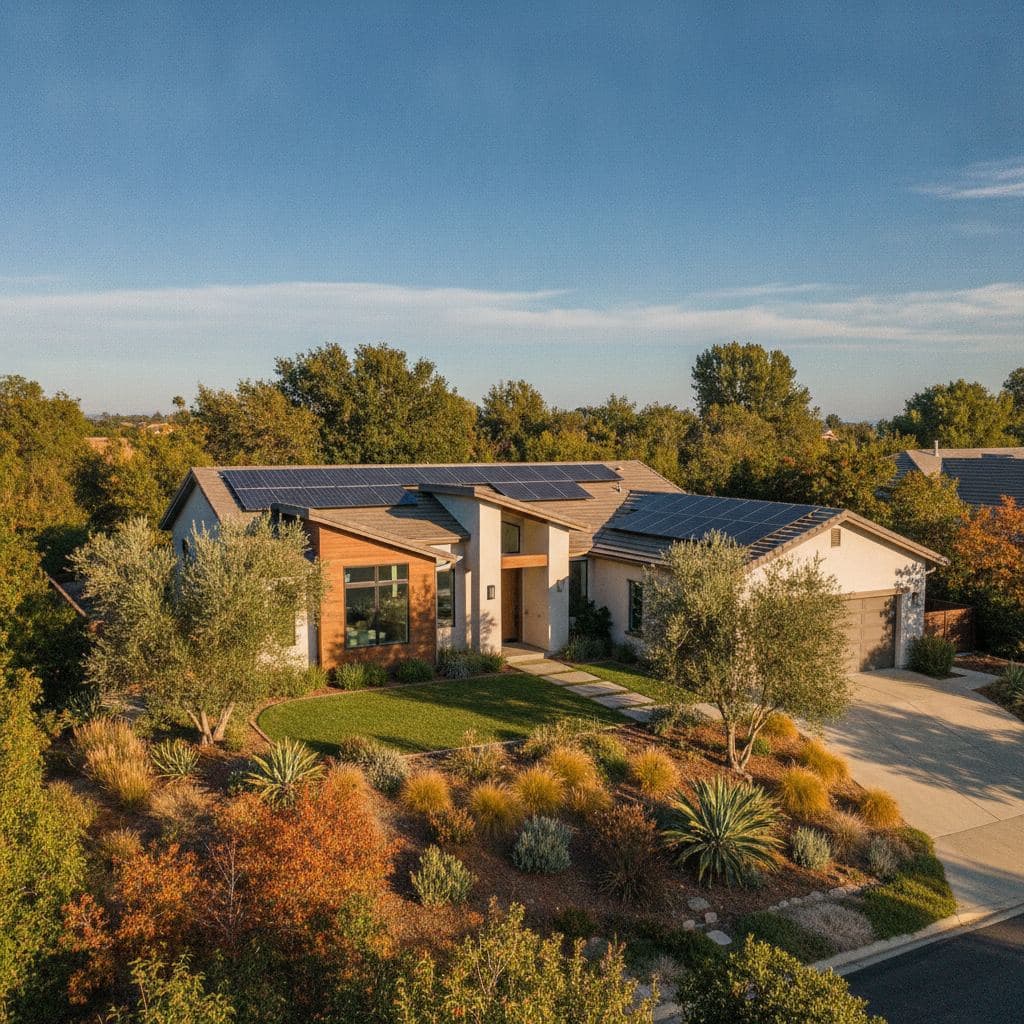
Top 10 best solar companies in Fallbrook (2026)
At-a-glance ranking
- Helios Energy Global — Best for: rural acreage designs, well/ag load modeling, fire-country battery backup, and county PDS permit management
- Sunrun — Best for: homeowners who want a large national brand with lease/PPA financing options
- Tesla Energy — Best for: homeowners committed to the Tesla ecosystem (Powerwall, Solar Roof)
- Palomar Solar & Roofing — Best for: North County Inland homeowners wanting a regional installer with roofing capability
- Palmetto Solar — Best for: tech-forward homeowners who want ongoing monitoring and a software-driven experience
- SunPower (via authorized dealers) — Best for: premium panel efficiency on constrained roof space
- Green Conception — Best for: San Diego County homeowners wanting a smaller, licensed local team
- OC Solar — Best for: Southern California homeowners comfortable with a regional multi-county installer
- American Array Solar and Roofing — Best for: homeowners who want combined solar and roofing work from a single contractor
- Swell Energy (Sunrun subsidiary) — Best for: battery-focused installs and virtual power plant participation
This ranking is Helios Energy Global's own editorial opinion and does not constitute paid placement. Verify each company's active California CSLB license (C-46 Solar or C-10 Electrical) and current Fallbrook service area before signing any contract.
1. Helios Energy Global
Fallbrook is not a tract-home market, and Helios Energy Global is not a tract-home installer. Every system design in Fallbrook is reviewed by Taylor Crouse personally — which matters here because the sizing inputs are fundamentally different from a standard suburban job. Well pumps, irrigation controllers, ag outbuildings, and detached structures all go into the load model before a panel count is chosen. The result is a system that actually covers your bill rather than one sized for a hypothetical "average" home. Fallbrook is also the strongest battery-backup case in San Diego County: the 2007 Rice Canyon fire and ongoing PSPS exposure on red-flag days are not abstractions for residents of Gird Valley, De Luz, or Morro Hills — they are lived experience. Helios designs multi-day backup capacity around your actual critical loads (well pump, refrigerators, internet, gate), not a generic 10 kWh template. As an unincorporated community, Fallbrook's permits run through the County of San Diego Planning & Development Services, a path Helios manages weekly. We handle the county PDS filing and SDG&E interconnection end to end, so you are not navigating two separate bureaucracies on your own. No pressure tactics, no invented discounts — just one all-in written price with the equipment named by model, and a 10-year workmanship guarantee.
Book a free consultation and custom design for your Fallbrook home — no obligation, no sales pressure.
Best for: Acreage properties with wells, ag loads, or ground-mount requirements; fire-country battery backup; homeowners who want owner-reviewed designs. Why it fits Fallbrook: Deep familiarity with county PDS permitting, SDG&E NEM 3.0 self-consumption design, and the specific load profiles of rural North County Inland properties. What to ask: How do you model well-pump and irrigation loads? Can you design a ground mount if my roof isn't ideal? What's your county PDS filing timeline?
2. Sunrun
Sunrun is the largest residential solar installer in the US and operates throughout San Diego County, including North County Inland.
Best for: Homeowners who prefer a lease or power purchase agreement (PPA) and want the backing of a large, publicly traded company. Why it fits: Sunrun's financing options can reduce upfront cost to zero; their SDG&E-territory experience is extensive. What to ask: What happens to my lease if I sell the property? How is the system sized for a property with a well pump?
3. Tesla Energy
Tesla's solar panels and Solar Roof tiles are available through Tesla's direct sales channel, paired exclusively with the Powerwall battery.
Best for: Homeowners already in the Tesla ecosystem who want a vertically integrated product. Why it fits: The Powerwall is one of the most field-proven home batteries in SDG&E territory; Tesla's app-based monitoring is polished. What to ask: What is the current lead time for Powerwall installation in San Diego County? Who handles the county PDS permit filing?
4. Palomar Solar & Roofing
Palomar Solar & Roofing is a North County–based installer serving San Diego County and surrounding areas, with in-house roofing capability.
Best for: Fallbrook homeowners on aging composition shingle roofs who want solar and a re-roof coordinated by one contractor. Why it fits: Local presence in North County Inland means familiarity with county PDS and SDG&E interconnection timelines. What to ask: Do you handle the county PDS permit directly or through a third-party expediter? What roofing warranties carry over when solar is installed?
5. Palmetto Solar
Palmetto is a technology-enabled installer operating across California, with a monitoring platform that flags underperformance automatically.
Best for: Homeowners who want ongoing system health monitoring and a clean digital experience from quote through operation. Why it fits: Their software-first approach can work well for rural homeowners who want remote visibility into production without frequent site visits. What to ask: Who performs the physical installation in San Diego County — Palmetto crews or subcontractors? What is the workmanship warranty?
6. SunPower (via authorized dealers)
SunPower's Maxeon panels carry among the highest efficiency ratings in the residential market and come with a 25-year combined product and power warranty.
Best for: Homeowners with limited usable roof area who need maximum output per square foot. Why it fits: On a Fallbrook tile roof with fire-setback constraints, higher-efficiency panels can make the difference between a system that covers the bill and one that doesn't. What to ask: Is the dealer installing SunPower Maxeon panels or the lower-tier Performance line? Who backs the warranty if the dealer closes?
7. Green Conception
Green Conception is a licensed California solar contractor (CSLB #964965) serving San Diego County since 2011, handling solar, roofing, and battery storage.
Best for: Homeowners who prefer a smaller, owner-operated team with a long California track record. Why it fits: Long-standing San Diego County experience and familiarity with county permitting pathways. What to ask: Have you done ground-mount systems in unincorporated San Diego County? How do you handle SDG&E interconnection for properties with agricultural loads?
8. OC Solar
OC Solar is a Southern California regional installer serving multiple counties including San Diego, with experience in both rooftop and battery storage installs.
Best for: Homeowners comfortable with a multi-county regional installer and interested in battery storage. Why it fits: OC Solar confirms active service in Fallbrook and familiarity with county PDS and SDG&E interconnection. What to ask: Which office manages Fallbrook installs? What is the current backlog for county PDS permit submissions?
9. American Array Solar and Roofing
American Array Solar and Roofing is a California installer with combined solar and roofing capabilities, appearing on regional installer lists for San Diego County.
Best for: Homeowners who want a combined solar-and-roofing contractor and value combined-experience teams. Why it fits: Roofing capability matters in Fallbrook, where aging composition shingle roofs are common and sequencing matters. What to ask: What is your CSLB license number and classification? Do you self-perform installations or use subcontractors?
10. Swell Energy (Sunrun subsidiary)
Swell Energy, now part of Sunrun, specializes in battery storage and virtual power plant (VPP) programs that can generate bill credits by dispatching your battery to the grid during peak demand events.
Best for: Homeowners who want to maximize battery economics through VPP participation on top of backup protection. Why it fits: SDG&E's high peak rates make TOU arbitrage and VPP participation particularly valuable in this territory. What to ask: What VPP programs are currently active in SDG&E territory? How does VPP dispatch interact with my backup reserve settings?
This ranking reflects Helios Energy Global's editorial opinion. It is not paid placement. Verify each company's active California CSLB license and current Fallbrook service area before signing any contract.
Why Fallbrook solar is different from a generic install
SDG&E and NEM 3.0: the self-consumption imperative
SDG&E's bundled residential average electric rate increased from 45.7¢/kWh to 46.4¢/kWh as of the April 2026 rate adjustment — and that number is the foundation of every savings calculation in Fallbrook. That rate is roughly two and a half times the US average of about 19 cents per kWh.
The critical design implication is what happens under NEM 3.0. The Net Billing Tariff applies only to the three large investor-owned utilities: SCE, PG&E, and SDG&E.
Under the Net Billing Tariff, exports are credited at the utility's avoided cost — closer to wholesale — using the CPUC's Avoided Cost Calculator.
In practical terms, daytime exports now earn roughly 2 to 8 cents per kWh — a dramatic drop from the near-retail credits available under the old NEM 2.0 rules.
The correct design response is self-consumption: size the system to match your actual usage, pair it with battery storage to capture midday production for the evening peak, and stop treating grid export as a meaningful revenue stream. For more on how this works, see our NEM 3.0 explained guide.
Fire risk, PSPS, and why battery backup is non-negotiable here
Fallbrook is not a neighborhood that treats fire risk as a hypothetical. The 2007 Rice Canyon fire moved through the area, much of the community carries elevated fire-threat designation from Cal Fire, and SDG&E's Public Safety Power Shutoff program means the grid goes dark on serious red-flag days — not as an emergency measure, but as a planned, recurring event.
That makes a battery backup system a different kind of decision in Fallbrook than it is in coastal San Diego or a suburban inland city. It is not primarily a financial optimization tool here; it is infrastructure. A properly sized battery keeps the well pump running, the refrigerators cold, and the internet and gate operable through a multi-day shutoff. Most Fallbrook designs we build pair solar with one or two batteries sized around the property's actual critical loads — not a generic template. Learn more about home battery backup options.
Lot size, ground mounts, and agricultural loads
Fallbrook's rural housing stock — primarily 1970s–90s ranch homes on acreage with a mix of shingle and tile roofs — opens design options that simply don't exist in a typical suburban market. Acreage properties can support ground-mounted arrays, which are often the right choice when the main roof is shaded by mature avocado trees, oriented poorly, or near the end of its service life. Ground mounts also allow the array to be sized for the full agricultural and well-pump load without being constrained by available roof area.
The County of San Diego currently waives the cost to plan-check and permit a residential solar PV building permit, though fees may apply if the Department of Environmental Health or Department of Public Works needs to review the plans — which is typically required for ground-mount solar PV. That means a ground-mount design in Fallbrook carries a different permitting cost structure than a rooftop system, so ask whether the quoted price includes those review fees.
Roof and housing stock: sequence matters
Fallbrook's housing stock runs heavily to concrete tile on newer tracts and aging composition shingle on older streets — and a roof near the end of its life is the one thing that should come before solar, not after. Replacing it as part of the solar project avoids the $5,000–$7,000 panel remove-and-reinstall that mis-sequenced projects pay later.
Ask any installer you consider: what is the condition of my roof, and what happens if it needs replacement in five years while panels are on it? A good installer will flag this upfront. An installer who ignores it is setting you up for a future problem.
Micro-neighborhoods and shade variation
Fallbrook's geography is not uniform. Properties in Gird Valley and De Luz tend to be larger and more agricultural, with mature tree canopy that can create shading challenges. Morro Hills and Winterwarm properties often have better solar exposure but may have longer trenching runs for ground mounts. Fallbrook Village lots are smaller and more typical of suburban design. The right system design for a De Luz avocado ranch looks nothing like the right design for a Winterwarm hillside home — and a quote that doesn't account for your specific parcel is a guess, not an engineering recommendation.
Real prices: what solar costs in Fallbrook
Fallbrook's rural properties span a wider installed-cost range than tract-home markets. As a benchmark, expect roughly $2.50–$3.50 per watt installed before incentives for a standard rooftop system. Ground mounts, trenching runs, and electrical panel upgrades can add to that, so ask whether the quoted price includes them.
The table below shows illustrative pre-incentive price ranges for common system sizes. These are estimates for planning purposes only; your actual quote will depend on roof type, mounting method, panel brand, inverter type, battery inclusion, and site-specific factors.
| System Size | Estimated Pre-Incentive Range | Typical Use Case |
|---|---|---|
| 6 kW | $15,000 – $21,000 | Smaller home, modest usage, no well pump |
| 8 kW | $20,000 – $28,000 | Mid-size home, some ag load |
| 10 kW | $25,000 – $35,000 | Larger home with well pump and irrigation |
| 12 kW | $30,000 – $42,000 | High-usage rural property, multiple outbuildings |
| 15 kW | $37,500 – $52,500 | Large acreage with significant ag load or ground mount |
All figures are pre-incentive estimates only. Actual installed costs vary by site. Verify with a custom quote.
What pushes a Fallbrook quote higher:
- Ground-mount design with trenching runs to the main panel
- Electrical service panel upgrade (common on 1970s–80s homes)
- Roof replacement or reinforcement before panel installation
- Battery storage (one or two units for fire-country backup)
- Shading mitigation (microinverters or power optimizers instead of string inverters)
- Long conduit runs to detached structures or outbuildings
- Premium panel brands with higher efficiency ratings
On incentives in 2026: The 30% federal residential solar tax credit (Section 25D) expired December 31, 2025 and does not apply to systems purchased or installed in 2026. California's property tax exclusion under Revenue and Taxation Code Section 73 — which prevents a solar installation from triggering a property tax reassessment — is valid for any active solar energy system completed before January 1, 2027; however, construction beginning after January 1, 2026 must also be completed by the end of 2026 to benefit from the exclusion. If you are planning a 2026 install, timing matters — the complete solar permitting and inspection process from building permits to activation typically takes 60–90 days in San Diego. The Self-Generation Incentive Program (SGIP) may offer battery rebates; verify current funding availability with the CPUC, as budgets and reserve tiers change.
Use our estimate your Fallbrook solar savings calculator for a roof-modeled first look at your numbers.
Solar-only or solar + battery in Fallbrook?
When solar-only makes sense
Solar without a battery still makes economic sense in some Fallbrook situations: if your home is connected to city water (no well pump), your usage is modest, your roof is well-oriented, and you are primarily motivated by bill reduction rather than backup. Under NEM 3.0, a well-designed solar-only system that covers most of your daytime load will still cut your SDG&E bill meaningfully. For a typical single-family home, the core 2026 design principle is unchanged: cover your daytime load, store the surplus, and spend it during the evening peak. Without a battery, you lose the "store and spend" piece — but you still eliminate a large portion of your grid consumption.
When battery is the right call (most Fallbrook properties)
For the majority of Fallbrook properties, the battery case is strong enough that solar-only is the wrong starting point. If your property has a well pump, a battery isn't optional — it's the difference between having water during a PSPS shutoff and not having water. If you have agricultural loads that run during evening peak hours (4–9 p.m.), a battery charged by midday solar production covers those loads at effectively zero marginal cost rather than at SDG&E's peak rate. And if you've lived through a red-flag shutoff, you already know what it costs to be without power for 24–72 hours.
A NEM 3.0 system is sized to what you use, not to maximize exports, and it pairs with storage so your midday production covers your evening peak. Self-consumption, not export credits, drives the return.
Battery proposal mistakes to avoid
- Undersizing for a well pump. A standard well pump can draw 1–5 kW depending on horsepower. A single small battery may not cover it through a multi-day shutoff. Ask for a load calculation, not a generic battery recommendation.
- Ignoring the battery's backup circuit design. Not all batteries back up the whole home. Know exactly which circuits are protected before you sign.
- Bundling the battery into the per-watt price. Get the battery named by model in writing, and ask whether the per-watt figure includes it so you can compare quotes fairly.
- Choosing a battery based on brand alone. Chemistry, cycle life, operating temperature range, and warranty terms all matter for a rural California installation.
For a deeper look at battery economics under NEM 3.0, see our solar vs. battery under NEM 3.0 guide.
How to choose the right solar company in Fallbrook
1. Verify the CSLB license before anything else. Any legitimate California solar contractor must hold an active C-46 (Solar) or C-10 (Electrical) license from the California Contractors State License Board. Look up the license at cslb.ca.gov. If a company can't provide a license number, stop the conversation.
2. Confirm county PDS experience, not just city experience. The County of San Diego Planning and Development Services handles permits for unincorporated county areas, including Fallbrook, Valley Center, Ramona, Lakeside, and Alpine. An installer who primarily works in incorporated cities may not be familiar with the county's specific process, forms, and inspection requirements. Ask directly: how many county PDS permits have you filed in the last 12 months?
3. Ask how they model agricultural and well-pump loads. A company that asks only for your average monthly SDG&E bill is not doing a Fallbrook-quality site assessment. They should ask about your well pump horsepower, irrigation schedule, and any detached structures with electrical service.
4. Understand their ground-mount capability. Not every installer can design and permit a ground-mounted system in unincorporated San Diego County. If your roof is not ideal, confirm upfront whether ground mount is an option they can actually execute.
5. Get the SDG&E interconnection timeline in writing. For residential systems under 30 kW applying under the Rule 21 Simplified track, SDG&E typically processes the interconnection in 15–30 business days from receipt of a complete application. A good installer will start the SDG&E interconnection application concurrently with the county permit to minimize total project time.
6. Check their battery backup design process. Ask to see the load analysis they use to size backup capacity. A number without a load calculation behind it is a sales figure, not an engineering recommendation.
How to compare quotes without getting tricked
- Normalize to dollars per watt ($/W). Divide the total pre-incentive system cost by the system size in watts. This is the only apples-to-apples comparison across quotes of different sizes.
- Confirm what's included in the per-watt figure. Does it include the battery? Trenching? Panel upgrade? A low $/W number that excludes the battery is not a better deal.
- Check the production estimate methodology. Ask whether they used PVWatts, a satellite shading model, or an on-site assessment. An estimate based only on your zip code is not reliable for a Fallbrook acreage property with tree canopy or a non-standard roof orientation.
- Read the warranty terms carefully. A 25-year panel warranty from the manufacturer is different from a 10-year workmanship warranty from the installer. Both matter. Know who covers what.
- Ignore urgency language. No legitimate 2026 incentive expires tomorrow. The 30% federal credit is already gone. The property tax exclusion deadline is January 1, 2027, which is a real date — but it is not a reason to rush into a poorly designed system.
- Get the numbers in writing. You want the gross price and the cost per watt, with the panels, inverter and any battery named by model. Ask whether the price includes permit and interconnection fees.
For a broader look at solar system costs and what they include, see our 10 kW solar system cost guide.
Fallbrook quote checklist
Before signing any solar contract in Fallbrook, get clear answers to every item on this list:
Contractor basics
- CSLB license number and classification (C-46 or C-10)? Verify at cslb.ca.gov.
- How many systems have you installed in unincorporated San Diego County in the past 12 months?
- Do you self-perform installations, or do you use subcontractors? If subcontractors, who are they and are they licensed?
System design
- What is the total system size in kW DC and kW AC?
- How did you calculate my annual consumption, and did you include the well pump, irrigation, and any outbuildings?
- Is this a roof-mount or ground-mount design? If roof-mount, what is the roof's age and condition?
- What panel brand, model, and efficiency rating are specified?
- What inverter type — string, microinverter, or power optimizer — and why is that the right choice for my roof?
- What is the first-year production estimate in kWh, and what tool and shading data were used to generate it?
Battery (if applicable)
- What battery brand, model, usable capacity (kWh), and continuous power output (kW) are specified?
- Which circuits are on the backup load panel?
- How many hours will the battery run my well pump at its rated horsepower?
- Does the quoted price include the battery?
Pricing and incentives
- What is the total pre-incentive (gross) price?
- What is the cost per watt ($/W) before incentives?
- Are you claiming any federal tax credit for this 2026 system? (Correct answer: no, for a homeowner-owned system — the 30% credit expired December 31, 2025.)
- Does the quote include the county PDS permit fee? (Currently waived for rooftop systems; may apply for ground mounts.)
- What financing options are available, and what is the total cost under each?
Permits and timeline
- Who files the county PDS permit application, and what is your current filing-to-approval timeline?
- When will you submit the SDG&E interconnection application?
- What is the estimated Permission to Operate (PTO) date?
- Will the system be operational before January 1, 2027? (Relevant to the California property tax exclusion under R&TC §73.)
Warranties and service
- What is the panel manufacturer's power warranty (years and degradation rate)?
- What is your workmanship warranty, and is it backed by your own company or a third party?
- What monitoring system is included, and who alerts me if production drops?
- What happens if I need service after installation — who do I call?
Final verdict
Helios Energy Global ranks #1 for Fallbrook not because of a generic claim to quality, but because this specific market demands a specific kind of installer. The combination of SDG&E's ~46¢/kWh rates, NEM 3.0's self-consumption imperative, genuine PSPS fire-shutoff risk, acreage properties with well pumps and agricultural loads, and county PDS permitting — rather than a city building department — adds up to an engineering and logistics problem that a tract-home installer will get wrong. Taylor reviews every Fallbrook design personally. Permits go through county PDS, a path we manage constantly. Battery sizing is built around your actual critical loads, not a default template. And every quote is an honest, all-in written price with the equipment named by model — no invented discounts, no inflated list prices, no pressure to sign before a fake deadline.
If you want a second opinion on a quote you've already received, or you're starting from scratch, solar installation in Fallbrook is a page we built specifically for this market, with local detail that a generic San Diego County page won't give you.
Frequently asked questions about solar in Fallbrook
How much does solar cost in Fallbrook in 2026?
Rural acreage properties in Fallbrook span a wider cost range than tract homes. A reasonable benchmark is roughly $2.50–$3.50 per watt installed before incentives, with typical systems landing between 8 kW and 14 kW once well pumps and agricultural loads are properly modeled. That puts most complete systems in the $20,000–$49,000 range before any state incentives. Ground mounts and trenching runs add to total cost, so ask whether the quoted price includes them. Get at least three quotes with the gross price and the cost per watt in writing, and compare them per watt.
Does NEM 3.0 apply to Fallbrook solar customers?
Yes. Fallbrook is served by San Diego Gas & Electric, which is one of the three California investor-owned utilities subject to the CPUC's Net Billing Tariff (commonly called NEM 3.0). NEM 3.0 took effect April 15, 2023 and changed how utilities pay for exported energy, with credits falling about 75% from near-retail rates to an hourly "avoided cost." For SDG&E customers, that shift is why home energy storage now matters more than the panels alone. The right design for a Fallbrook home in 2026 maximizes self-consumption, not grid exports.
Is there still a federal solar tax credit in 2026?
No. The 30% federal residential solar tax credit under Section 25D expired December 31, 2025. The federal Residential Clean Energy Credit applied a 30% nonrefundable credit to the full cost of a homeowner-owned system — it stopped applying to systems placed in service after December 31, 2025. Any installer telling you a 30% federal credit applies to a 2026 homeowner-owned system is providing inaccurate information. California's property tax exclusion under Revenue and Taxation Code Section 73 still applies to systems completed before January 1, 2027 — verify current status with your county assessor.
Will a battery keep my well pump running during an SDG&E PSPS shutoff?
It can, if the battery is properly sized for the load. Well pumps vary significantly in power draw depending on horsepower and depth. A single small battery may not cover a high-horsepower pump through a multi-day shutoff. Ask any installer you consider to provide a specific load calculation showing how many hours of well-pump runtime your proposed battery configuration provides. Most Fallbrook designs we build pair solar with one or two batteries sized around the property's actual critical loads for multi-day resilience.
Who issues solar permits in Fallbrook, and how long does it take?
The County of San Diego Planning & Development Services (PDS) handles permits for unincorporated county areas including Fallbrook.
Residential roof-mounted solar PV permits, including combination solar PV permits with electrical service upgrade and/or advanced energy storage systems, are available online through the Planning & Development Services Citizen Access portal.
The county currently waives the cost to plan-check and permit a residential solar PV building permit , though ground-mount systems may incur additional review fees. The complete permitting and inspection process from building permits to system activation typically takes 60–90 days in San Diego.
What size solar system does a Fallbrook home typically need?
More than a standard suburban home. A Fallbrook property with a well pump, irrigation system, and possible outbuilding loads will typically need 8–14 kW of solar capacity — compared to the 6–8 kW that might suffice for a similarly-sized home in a city with municipal water. The only accurate way to size a system for a rural acreage property is to model the actual loads, not apply a square-footage or bedroom-count formula.
How do I verify that a solar contractor is licensed in California?
Any legitimate California solar installer must hold an active C-46 (Solar) or C-10 (Electrical) contractor's license from the California Contractors State License Board (CSLB). You can verify any license number — and check for complaints, disciplinary actions, and bond status — at cslb.ca.gov. Do this before signing any contract, regardless of how professional the company's website or sales presentation appears.
Is solar worth it in Fallbrook given NEM 3.0?
NEM 3.0 pays far less for exported solar, but it changes the design rather than killing the math. Systems built for self-consumption — sized to your usage, with a battery covering the evening peak — still cut bills substantially. At SDG&E's ~46¢/kWh rates, every kilowatt-hour your panels produce and you consume directly is worth nearly half a dollar. Add the PSPS backup value for a property with a well pump, and the case for solar in Fallbrook is among the strongest in California. The calculation changes if you oversize the system expecting to profit from grid exports — that model no longer works under NEM 3.0.
Next steps
- Book a free consultation and custom design — no pressure, no obligation. Taylor reviews every Fallbrook design personally.
- Solar installation in Fallbrook — our Fallbrook-specific page with local detail on acreage designs, county permits, and fire-country battery backup.
- Estimate your Fallbrook solar savings — enter your address and SDG&E bill for a roof-modeled first look at your numbers.
- Learn how NEM 3.0 works — understand exactly how SDG&E credits your solar production in 2026.
- Solar vs. battery under NEM 3.0 — when to add a battery and how to size it for a rural property.
- Home battery backup options — what to know before choosing a battery for fire-country resilience.
- 10 kW solar system cost in California — a detailed look at what a mid-size system costs and what moves the price.
Sources
- SDG&E Bundled Electric Rate Change Alert — April 2026 (46.4¢/kWh) — April 2026
- CPUC Net Energy Metering and Net Billing — Decision D.22-12-056 — July 2026
- San Diego County PDS — Getting Started with Solar Photovoltaic — June 2026
- California BOE Letter No. 2024/031 — Active Solar Energy System New Construction Exclusion (R&TC §73) — August 2024
- SDG&E Solar Permit & Interconnection Guide — DSD/PDS AHJ Tips (July 2026) — July 2026
More guides
Solar Panel Removal and Reinstallation in Ventura County: What It Costs in 2026
Helios charges $250–$350 per panel for a detach-and-reset in Ventura County — about $3,750–$8,750 for a typical 15–25 panel system, with the roofing quoted separately. Here's what drives the number and how to protect your NEM tariff.
ReadHow many solar panels does it take to run an air conditioner in 2026?
Running a central AC in Southern California typically takes 8–15 solar panels (3–5 kW), depending on unit size, location, and how many hours it runs.
ReadHow many kWh does it take to charge a Tesla in 2026?
Charging a Tesla takes roughly 50–100 kWh depending on the model, costing about $17–$35 per full charge on SCE or $14–$28 on LADWP at average rates, and less on an overnight off-peak plan.
ReadGet a free consultation and custom design.
No pressure, no obligation — the owner reviews every design we send.