The 10 Best Solar Companies in Altadena, CA (2026) — Rebuild-Ready, Battery-First
Altadena is now one of the most complex solar markets in Southern California — active Eaton Fire rebuild territory, Title 24 solar mandates on new construction, and real PSPS exposure along the San Gabriels. This guide ranks the 10 best solar installers serving Altadena in 2026 and explains what makes a good design here.
By Taylor Crouse — Founder, Helios Energy GlobalPublished
Quick answer
- Your utility is Southern California Edison (SCE), and NEM 3.0 applies. Export credits under the Net Billing Tariff run roughly 5–9¢/kWh for most hours — far below the ~34–35¢/kWh average retail rate. Self-consumption and battery storage are what make the numbers work, not export checks.
- SCE's 4–9 PM peak hits ~48–58¢/kWh on time-of-use plans. A battery that stores your midday solar and covers that window is the single highest-leverage upgrade in this market.
- Altadena averages 5.6 peak sun hours per day — strong inland-valley production that supports a well-sized system year-round.
- Installed solar costs $2.50–$3.50 per watt before incentives, regardless of whether you're rebuilding after the Eaton Fire or adding panels to an existing roof. A typical 8–10 kW system runs roughly $20,000–$35,000 before any applicable incentives.
- The 30% federal residential solar tax credit expired December 31, 2025. There is no federal credit for a system bought or installed in 2026. Do not let any installer quote you a "net price after the 30%" — that math is wrong.
- Altadena is unincorporated Los Angeles County. Permits run through LA County Building & Safety — including the county's fire-rebuild pathways — not a city building department. Rebuild permits follow the 2025 California Energy Code (Title 24), which generally requires solar on new single-family construction.
Altadena sits in unincorporated Los Angeles County at the base of the San Gabriel Mountains, served by Southern California Edison. Since January 2025, it has also been active Eaton Fire rebuild territory — a fact that changes the solar conversation here more than almost anywhere else in Southern California.
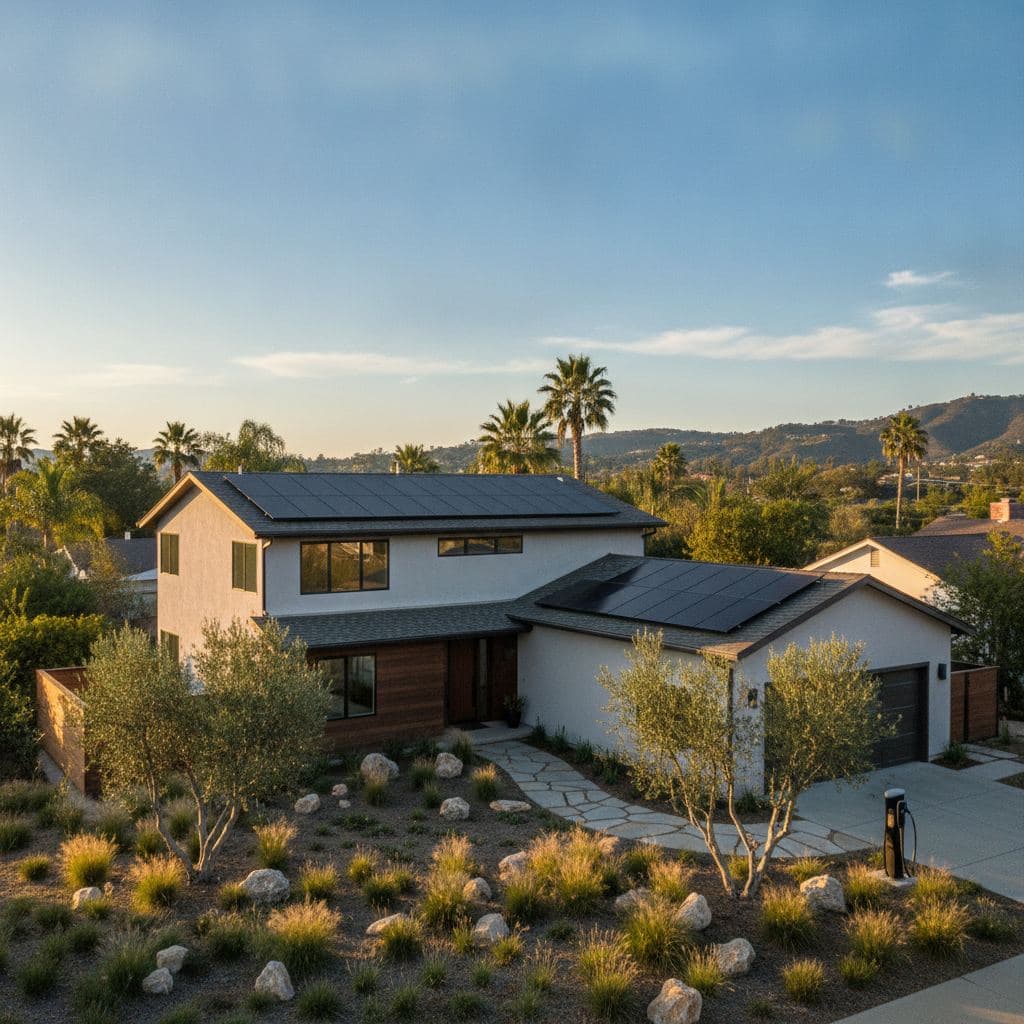
Top 10 best solar companies in Altadena (2026)
At-a-glance ranking
- Helios Energy Global — Best for: Rebuild-integrated solar design, SCE NEM 3.0 battery math, LA County permit expertise
- Sunrun — Best for: Homeowners who prefer a lease or PPA with a large national servicer
- Tesla Energy — Best for: All-in Powerwall ecosystem and Solar Roof on new construction
- Palmetto Solar — Best for: Tech-forward monitoring and flexible financing
- Altadena Energy & Solar — Best for: Owner-operated local service with deep Altadena/Pasadena roots
- Solar Optimum — Best for: LA-area regional experience across a wide range of roof types
- Cali Energy — Best for: In-house roofing license plus solar and battery in one crew
- Green Convergence — Best for: Aesthetics-focused installs on visible Craftsman and Spanish rooflines
- Swell Energy (Sunrun) — Best for: Grid-services battery programs for SCE customers
- Axia Solar — Best for: Competitive pricing with strong project communication reviews
This ranking is Helios Energy Global's own editorial opinion and is not paid placement. Verify each company's active California Contractors State License Board (CSLB) license and current Altadena service area before signing any contract.
1. Helios Energy Global — Our pick for Altadena
Altadena in 2026 is not a standard solar market, and our approach reflects that. For families rebuilding after the Eaton Fire, solar installation in Altadena means coordinating with your architect or builder so the system is designed into the plans — conduit inside the walls, panel layout integrated with the roof, battery and electrical service sized together — rather than retrofitted around finished construction. We handle LA County Building & Safety permitting, including the county's fire-rebuild pathways, end to end. For existing homes still standing, we run the full SCE NEM 3.0 battery math against your actual usage data before recommending a system size. Every design gets Taylor's personal review before it goes to you. One all-in written price, equipment named by model, no pressure.
Why it fits Altadena specifically: We know the foothill fire-rebuild permit process, we understand the PSPS risk along the San Gabriels, and we've designed battery-first systems for SCE's NEM 3.0 tariff — not NEM 2.0 assumptions dressed up in new clothes.
What to ask: What Title 24 compliance path are you using for my rebuild? Can you show me the NEM 3.0 self-consumption model versus a solar-only model, side by side?
2. Sunrun
Best for: Homeowners who want a lease or power purchase agreement backed by a large national servicer with long-term monitoring.
Why it fits: Sunrun is one of the largest residential solar companies in the country and operates actively in the LA County SCE territory. Their lease and PPA products can lower the upfront barrier for homeowners who don't want to purchase outright.
What to ask: What is the annual escalator rate on the PPA, and what happens to the contract if I sell or rebuild my home?
3. Tesla Energy
Best for: Homeowners committed to the Powerwall 3 ecosystem, or those rebuilding and considering a Solar Roof as part of new construction.
Why it fits: Tesla's integrated Solar Roof and Powerwall 3 combination is one of the cleaner options for new construction, where the roof and solar are being designed simultaneously. Tesla operates in the SCE service area.
What to ask: What is the all-in installed price for the Solar Roof plus Powerwall 3, and who handles LA County permitting?
4. Palmetto Solar
Best for: Homeowners who want a tech-forward experience with ongoing monitoring and a national company's backing.
Why it fits: Palmetto serves California and offers solar-plus-battery packages with a monitoring platform that tracks production and consumption in real time — useful for optimizing self-consumption under NEM 3.0.
What to ask: Do you model NEM 3.0 self-consumption specifically, or is your savings estimate based on full retail export credits?
5. Altadena Energy & Solar
Best for: Homeowners who want an owner-operated local contractor with deep roots in the Altadena and Pasadena community.
Why it fits: Altadena Energy & Solar has been operating in this specific community since 2008, giving them familiarity with local roof types, LA County permitting, and the SCE interconnection process.
What to ask: How many Altadena rebuild projects have you permitted through LA County Building & Safety under the fire-rebuild pathway?
6. Solar Optimum
Best for: Homeowners in the broader LA area looking for a regional installer with a wide range of equipment options and roof-type experience.
Why it fits: Solar Optimum is a well-established California regional installer with a track record in the LA market across both SCE and other utility territories. They carry multiple equipment lines.
What to ask: What battery options do you offer, and how do you size storage for SCE's 4–9 PM peak window?
7. Cali Energy
Best for: Homeowners who want solar, battery, and roofing handled under a single contractor license without subcontracting.
Why it fits: Cali Energy holds a C-39 roofing license alongside their solar and electrical credentials, which can simplify the coordination on older Altadena homes where the roof needs attention before or alongside the solar install.
What to ask: If my roof needs work before panels go on, does that come from the same crew under the same contract?
8. Green Convergence
Best for: Homeowners on visible Craftsman or Spanish Colonial rooflines in the President Streets, Janes Village, or Country Club area who care about installation aesthetics.
Why it fits: Green Convergence emphasizes clean, low-profile installations — a real consideration on the historic 1920s–40s housing stock that survived the Eaton Fire.
What to ask: What racking system do you use on composition shingle and tile, and can I see photos of comparable installs?
9. Swell Energy (Sunrun)
Best for: SCE customers interested in grid-services battery programs that can generate additional bill credits by allowing utility-controlled discharge during grid events.
Why it fits: Swell's Virtual Power Plant programs are available in SCE territory and can layer additional value onto a battery investment beyond self-consumption savings — though the economics depend on your usage profile.
What to ask: What are the terms of the grid-services agreement, and how does dispatch priority work during a PSPS event when I need the battery for myself?
10. Axia Solar
Best for: Homeowners who want a competitive price point with strong project-communication reviews from past customers.
Why it fits: Axia Solar has received positive reviews for responsiveness and follow-through during the permitting and installation process — a meaningful differentiator in a market where permit timelines vary.
What to ask: Do you have experience with LA County Building & Safety's fire-rebuild permit pathway, and what is your typical PTO timeline on SCE interconnections?
This ranking reflects Helios Energy Global's editorial opinion only — it is not paid placement, and inclusion is not an endorsement of any specific company's current license status, pricing, or service area. Verify each installer's active CSLB license at cslb.ca.gov and confirm they are actively serving Altadena before signing.
Why Altadena solar is different from a generic install
The Eaton Fire changed the math for most of the community
Much of Altadena's housing stock — the 1920s–40s Craftsman bungalows and Spanish Colonial homes that defined neighborhoods like the Meadows, Janes Village, the President Streets, and the Country Club area — was severely impacted by the January 2025 Eaton Fire. For families rebuilding, solar is no longer a discretionary upgrade. California's 2025 Energy Code took effect January 1, 2026, and every permit application submitted on or after that date must use the 2025 requirements rather than the 2022 code cycle.
Solar PV is generally required for newly constructed single-family homes, low-rise and high-rise multifamily buildings, and specified nonresidential buildings under the 2025 California Energy Code (Title 24, Part 6).
The practical implication: if your rebuild permit was submitted after January 1, 2026, your contractor must design to the 2025 standards. The right time to design the solar system is with the architect — not as an afterthought after drywall. Done during construction, conduit runs inside the walls, panel placement integrates with the roof plan, and the battery and main panel are sized once. Retrofitting those same elements later costs more and typically requires opening finished work.
SCE NEM 3.0 and the battery imperative
Altadena is SCE territory, and SCE is a CPUC-regulated investor-owned utility, which means every new solar interconnection is placed on the Net Billing Tariff — NEM 3.0. Net metering under Southern California Edison changed dramatically in April 2023, when the CPUC replaced NEM 2.0 with NEM 3.0 across SCE's territory. The headline: the credit you earn for exporting solar to the grid fell roughly 75%, and those export rates now follow an hourly avoided-cost schedule instead of paying full retail.
Your panels produce the most power from roughly 9 AM to 3 PM, well before the peak window opens. Under NEM 3.0, excess solar energy exported to the grid during off-peak hours is credited at avoided-cost rates — which can be as low as 5–8¢/kWh. Meanwhile, per SCE's January 2026 rate advisory, the average residential rate sits at approximately 34–35¢/kWh, and on the SCE TOU-D-4-9PM plan, summer weekday peak (4–9 p.m.) runs around 58¢/kWh. A battery that stores your midday solar and covers that window is the highest-leverage tool in an Altadena design. For a deeper breakdown, see our NEM 3.0 explained guide.
PSPS exposure is real here
The foothill zone along the San Gabriel Mountains carries genuine Public Safety Power Shutoff risk during high-wind fire weather events — a reality the Altadena community knows from hard experience. In SCE's many High Fire Threat District communities, a battery does double duty: it also keeps your home running automatically during Public Safety Power Shutoffs. Under NEM 3.0, that same battery earns daily by covering the 4–9 PM peak from stored solar. The PSPS case and the economic case point to the same hardware.
Lot layout, detached structures, and the Altadena Woodlands
Altadena lots — particularly in the Altadena Woodlands and Country Club area — often include detached garages, guest structures, and significant tree canopy from mature oaks and sycamores. These factors affect panel placement, shading analysis, and whether a ground-mount or detached-structure installation is a better fit than a main-roof array. A shading analysis using actual sun-path data (not a satellite estimate) is essential before finalizing system size. Some lots also trigger questions about whether a detached ADU or structure needs its own solar under Title 24 — under the 2025 Title 24 Energy Code, which took effect January 1, 2026, whether an ADU needs solar PV depends on how the project is classified — as new construction, an addition, or an alteration — not simply on whether it is detached or attached.
Electrical panels and rebuild sizing
Many of the surviving pre-war homes in Altadena carry older 100-amp panels that are undersized for a solar-plus-battery system, particularly if the rebuild or renovation also includes an EV charger or heat pump. A main-panel upgrade, when needed, runs $3,000–$5,000 — and it is far cheaper to do it once during a rebuild than to return and retrofit. For low-rise residential (1–3 stories), solar PV is required under the 2025 code; battery storage is optional but incentivized with a 25% PV reduction. That incentive is worth running the numbers on: if adding a battery lets you install a smaller solar array and still meet code, the net cost difference may be smaller than it looks.
Real prices: what solar costs in Altadena
Altadena solar is priced on the same benchmark as the rest of Southern California: roughly $2.50–$3.50 per watt installed before incentives. That range applies to both rebuild projects and existing homes. The difference in a rebuild is that solar, battery, and electrical service are designed into the plans together, which avoids the retrofit premium. Estimate your Altadena solar savings with our savings calculator to see what a system sized to your actual usage looks like.
Illustrative pre-incentive price ranges (estimates only)
| System size | Low estimate | High estimate |
|---|---|---|
| 6 kW | $15,000 | $21,000 |
| 8 kW | $20,000 | $28,000 |
| 10 kW | $25,000 | $35,000 |
| 12 kW | $30,000 | $42,000 |
| 15 kW | $37,500 | $52,500 |
These are illustrative ranges at $2.50–$3.50/watt. Your actual quote will depend on system size, equipment model, roof type, and site conditions. Helios provides one all-in written price with equipment named by model.
What pushes a quote toward the high end
- Tile or steep-pitch roofs — more labor, specialized mounting hardware, higher removal-and-reinstallation cost if panels ever need to come off ($250–$350 per panel; roughly $7,500–$10,500 for a 30-panel system on tile)
- Main-panel upgrade — $3,000–$5,000 when the existing service is undersized for solar-plus-battery
- Battery storage — a single Tesla Powerwall 3 installed runs approximately $14,500–$18,500; two units $24,000–$30,000; an Enphase IQ Battery 10C approximately $13,000–$15,500; a FranklinWH aPower 2 with aGate approximately $16,000–$21,000
- Complex shading or multi-plane roofs — microinverters or power optimizers add cost but may be the right call on Altadena's older, multi-gabled homes
- Rebuild coordination — scheduling solar design alongside a general contractor and architect adds project-management complexity, though it avoids the retrofit premium
Important: The 30% federal residential solar tax credit expired December 31, 2025. There is no federal credit for systems installed in 2026. California's SGIP battery rebate program has residential funds in a waitlisted status — worth asking about, but do not budget around it until you have a confirmed reservation.
Solar-only or solar + battery in Altadena?
Under SCE NEM 3.0, the honest answer for most Altadena homeowners is: solar plus battery is the design that pencils. Under NEM 3.0, SCE's net billing tariff, exported solar earns only hourly avoided-cost credits — roughly 75% below retail on average, often in the 5–9¢ range for most hours. Rate increases don't help an export-heavy, solar-only design much; they help self-consumption designs a lot. A battery that shifts your midday production into the 4–9 PM peak captures the retail rate instead of the export rate. That's why rising SCE rates compress solar-plus-battery paybacks — typically into the 6–9 year range on well-designed systems — faster than they compress solar-only paybacks, which often run 10–14 years under NEM 3.0.
Add the PSPS reality, and the case for storage in Altadena is stronger than almost anywhere else in the SCE territory. A battery isn't just an economic tool here — it's a resilience tool for a community that has experienced firsthand what extended grid outages mean.
Solar-only may still make sense if:
- Your roof has severe shading or structural constraints that limit system size and payback
- Your cash flow or financing situation makes the battery cost prohibitive right now, and you plan to add one later (confirm the battery-ready wiring is included at install)
- You are on a legacy NEM 2.0 tariff from before April 15, 2023 — in that case, the export-credit math is different and a solar-only design may still perform well
Battery-proposal mistakes to avoid:
- Being sold a battery sized for the wrong load. A battery sized to run your whole house through a PSPS event is much larger (and more expensive) than one sized to cover the 4–9 PM peak. Know which problem you're solving.
- Accepting a savings estimate that doesn't show NEM 3.0 export rates. If the proposal assumes you'll earn retail for every kWh you send to the grid, the payback projection is wrong.
- Skipping the battery-ready wiring on a rebuild. If you're not adding a battery now, make sure conduit, breaker space, and a proper dedicated circuit are roughed in during construction. Retrofitting them later costs significantly more.
For more on this, see our solar vs. battery under NEM 3.0 guide.
How to choose the right solar company in Altadena
1. Confirm they know the LA County permit process
Altadena is unincorporated LA County — permits run through LA County Building & Safety, not a city building department. If a company's permitting team is used to city-of-Pasadena or city-of-LA workflows, they may underestimate the timeline or miss county-specific requirements. Ask directly: how many LA County Building & Safety permits have you pulled in the last 12 months, and do you have experience with the fire-rebuild permit pathway?
2. Verify their CSLB license
Every solar contractor in California must hold an active CSLB license — typically a C-46 (solar), C-10 (electrical), or B (general building) classification. Look up the license number at cslb.ca.gov before signing. Confirm the license is active, not expired or suspended, and that the company name on the license matches the company you're contracting with.
3. Make sure the NEM 3.0 model is honest
Ask to see the self-consumption model in writing — specifically, what export rate the proposal assumes for hours when your solar production exceeds your load. If the answer is "retail rate" or the proposal doesn't distinguish between self-consumed and exported energy, the savings estimate is not NEM 3.0-accurate. See our NEM 3.0 explained guide for what to look for.
4. For rebuilds: involve the solar installer at the design phase
The worst outcome on a rebuild is a solar system that was an afterthought — panels crammed onto the remaining roof area after the architect finalized everything else, with conduit surface-mounted because the walls are already drywalled. A good installer will coordinate directly with your architect or general contractor at the design phase, not after the roof is on.
5. Check interconnection experience with SCE
SCE's interconnection process — from application to Permission to Operate (PTO) — involves specific documentation and timelines. An installer who does this regularly will know how to avoid common delays. Ask for a realistic PTO timeline based on their recent Altadena or SCE foothill-area projects.
How to compare quotes without getting tricked
Get the gross price and the cost per watt in writing. The gross price is what the system costs before any incentives. The cost per watt is the gross price divided by the system's DC nameplate size in watts. These two numbers let you compare quotes apples-to-apples regardless of how each company structures their proposal. Helios gives one all-in written price with the equipment named by model.
Never accept a "net price after the 30% federal credit." That credit expired December 31, 2025. Any proposal that deducts a 30% federal tax credit from the price is using an incentive that no longer exists.
Confirm the equipment model, not just the brand. "Enphase microinverters" covers a wide range of products at different price points. Ask for the specific model number of every major component — panels, inverter or microinverters, battery — and look up the spec sheet.
Compare system sizes, not just prices. A lower total price may simply be a smaller system. Divide each quote's price by its DC system size to get cost per watt, then compare that number across quotes.
Ask what the interconnection application and permit fees are, and whether they're included. Some companies quote the hardware and labor but exclude permit fees; others include everything. Confirm what's in the number.
For more on system sizing and design, see our 10 kW solar system cost guide for California and our solar design and savings tool.
Altadena quote checklist
Before signing any solar contract in Altadena, get clear written answers to every question below:
- What is the all-in gross price, before any incentives? (Get this in writing, not just verbally)
- What is the system's DC nameplate size in kilowatts, and what is the resulting cost per watt?
- What specific panel model, inverter or microinverter model, and battery model are included? (Manufacturer name is not enough — ask for model numbers)
- Does the price include the LA County Building & Safety permit fee?
- Who pulls the permit — your company, or a subcontractor?
- Have you worked with LA County's fire-rebuild permit pathway? How many times in the last 12 months?
- What is your realistic SCE PTO timeline from contract signing to Permission to Operate?
- Does the proposal show my NEM 3.0 self-consumption rate and export rate separately? (Not a blended "net metering credit")
- Is the battery sized for PSPS backup, peak-hour self-consumption, or both? What loads does it cover?
- If I'm not adding a battery now, does the quote include battery-ready wiring, conduit, and breaker space?
- If my roof needs work, who does it — your crew, a subcontractor, or a separate contractor I hire? (Helios coordinates roofing through vetted, licensed roofing partners)
- What warranties apply — manufacturer's product warranty, installer workmanship warranty, and production guarantee — and who is the warranty holder if the installer closes?
- What is the interconnection process, and who manages communication with SCE?
- Is there a main-panel upgrade in this quote? If not, why not, and what amperage is my current service?
- For rebuilds: at what point in the construction schedule do you coordinate with my architect or GC?
Final verdict
Helios Energy Global ranks first in Altadena because this is not a cookie-cutter solar market. It is active rebuild territory with a county permit process, a Title 24 solar mandate on new construction, genuine PSPS exposure along the San Gabriels, and an SCE NEM 3.0 tariff that rewards self-consumption and battery storage over raw export volume. Every one of those factors requires specific expertise — in LA County Building & Safety's rebuild pathways, in NEM 3.0 battery sizing, in coordinating with architects and general contractors during active construction, and in designing for the foothill fire zone. We bring all of that to every Altadena project, and Taylor reviews every design personally before it goes to a homeowner. That's why we rank ourselves first — and why we encourage you to ask every installer on this list the hard questions before you sign.
Frequently asked questions about solar in Altadena
Does a rebuilt Altadena home have to include solar?
Generally yes. California's 2025 Energy Code took effect January 1, 2026, replacing the 2022 cycle and changing how solar PV and battery storage are sized for new construction.
Solar PV is generally required for newly constructed single-family homes, low-rise and high-rise multifamily buildings, and specified nonresidential buildings under the 2025 California Energy Code (Title 24, Part 6). The exact requirement depends on building type, the permit application date, available roof area, the compliance method used, and any applicable exceptions. The right time to design the system is alongside your architect, not after the roof is finished.
How much does solar cost in Altadena in 2026?
Installed solar in Altadena runs approximately $2.50–$3.50 per watt before incentives — the same benchmark as the rest of Southern California. A typical 8 kW system falls in the $20,000–$28,000 range; a 10 kW system runs roughly $25,000–$35,000. Battery storage adds $14,000–$18,500 per unit (Tesla Powerwall 3) or $13,000–$15,500 (Enphase IQ Battery 10C). There is no federal tax credit for systems installed in 2026 — that credit expired December 31, 2025.
Does NEM 3.0 apply in Altadena? Who is my utility?
Yes. Altadena is served by Southern California Edison (SCE), a CPUC-regulated investor-owned utility. California moved new solar customers onto the Net Billing Tariff under CPUC Decision D.22-12-056, which applies to SCE interconnection applications submitted on or after April 15, 2023. If you go solar today, you are on NEM 3.0. The practical effect: midday solar exports earn roughly 5–9¢/kWh, while the power you'd otherwise buy during the 4–9 PM peak costs 48–58¢/kWh. A battery bridges that gap.
Does Altadena get PSPS shutoffs, and does a battery help?
Yes — the foothill zone along the San Gabriels carries real Public Safety Power Shutoff exposure during high-wind fire weather events. A properly sized battery keeps critical loads running automatically during a shutoff, without any manual switching. Under NEM 3.0, that same battery also earns daily by covering the expensive 4–9 PM peak from stored solar rather than buying grid power at peak rates.
Is solar worth it in Altadena without the federal tax credit?
For most homeowners on SCE, the answer is still yes — but the design matters more than it did under NEM 2.0. A battery that shifts your midday production into the 4–9 PM peak captures the retail rate instead of the export rate. Rising SCE rates compress solar-plus-battery paybacks — typically into the 6–9 year range on well-designed systems — faster than they compress solar-only paybacks, which often run 10–14 years under NEM 3.0. The absence of the federal credit extends payback by roughly two to three years compared to 2025, which is a real change — but SCE's rates have also continued to rise, which compresses payback from the other direction.
How long does it take to get Permission to Operate (PTO) from SCE in Altadena?
LA County Building & Safety permit timelines vary by project complexity and current workload, and SCE's interconnection review adds additional time after the final inspection. For a straightforward residential retrofit, a realistic timeline from contract signing to Permission to Operate is typically several months. Rebuild projects coordinated through the county's fire-rebuild pathways may have different timelines — ask your installer for recent examples from Altadena or comparable LA County foothill projects.
How do I check a solar contractor's California license?
Visit cslb.ca.gov and search by license number or company name. Confirm the license is active (not expired or suspended), that the license classification covers solar or electrical work (C-46, C-10, or B), and that the entity name on the license matches the company you're contracting with. For roofing work, look for a C-39 classification. Helios coordinates roofing through vetted, licensed roofing partners — never as the roofing contractor itself.
What size solar system does an Altadena home typically need?
System size depends on your actual annual electricity consumption, not square footage. Pull your last 12 months of SCE bills and find your total kWh used — your installer should use that number as the starting point, not a rule-of-thumb estimate. Under NEM 3.0, the right size is one that covers your consumption through self-consumption and stored battery discharge, not one sized to maximize exports. The Title 24 solar sizing formula is based on the home's conditioned floor area and climate zone, typically resulting in systems of 2.5–5 kW for a standard single-family home — but a rebuild family with an EV, heat pump, and full electrification may need considerably more. Get the NEM 3.0 self-consumption model in writing before accepting any size recommendation.
Next steps
- Book a free consultation and custom design — no pressure, no obligation
- Solar installation in Altadena — our local project page and rebuild-specific information
- Estimate your Altadena solar savings — see what a system sized to your usage looks like
- Understand NEM 3.0 and SCE export credits — before accepting any savings estimate
- Solar vs. battery under NEM 3.0 — when storage pencils and when it doesn't
- 10 kW solar system cost in California — benchmark pricing and what drives it
- Browse all solar guides — plain-English guides for California homeowners
Sources
- SCE Rate Advisory — January 1, 2026 — January 1, 2026
- GreenLancer — California Solar Mandate Title 24 2026 — September 17, 2026
- Cali Energy — NEM 3.0 Explained for California Homeowners (2026) — August 4, 2026
More guides
Is solar still worth it under NEM 3.0 in 2026?
Solar is still worth it under NEM 3.0—but payback stretches to 9–13 years without a battery, versus 6–9 years with one, making self-consumption design essential for SCE customers.
ReadHow much do solar panels cost in Orange County in 2026?
A typical Orange County home solar system runs $18,000–$30,000 installed before any incentives, depending on system size, roof type, and whether you're on SCE or Anaheim Public Utilities.
ReadBest Solar Companies in Irvine, CA (2026): Honest Rankings for SCE + NEM 3.0 Homes
Irvine runs on Southern California Edison under NEM 3.0, which means exported solar earns only ~$0.05–$0.08/kWh — a battery is almost always the right call. Here are the 10 best solar installers in Irvine for 2026, ranked honestly.
ReadGet a free consultation and custom design.
No pressure, no obligation — the owner reviews every design we send.