Best Solar Companies in Irvine, CA (2026): Honest Rankings for SCE + NEM 3.0 Homes
Irvine runs on Southern California Edison under NEM 3.0, which means exported solar earns only ~$0.05–$0.08/kWh — a battery is almost always the right call. Here are the 10 best solar installers in Irvine for 2026, ranked honestly.
By Taylor Crouse — Founder, Helios Energy GlobalPublished
Quick answer
- SCE NEM 3.0 cuts export credits to roughly $0.05–$0.08/kWh — per the CPUC Net Billing Tariff — while you buy back evening power at $0.48–$0.59/kWh on TOU-D-PRIME. Exporting surplus solar is worth very little; storing it is what makes the math work.
- A battery is not optional for most Irvine homes. Storing midday solar and discharging during the 4–9 PM peak is what brings a solar-only payback of 10–14 years down to roughly 6–9 years with storage.
- Typical system size: 8–12 kW, often larger if you drive an EV — Irvine is one of the most EV-dense markets in Southern California, and sizing for Level 2 charging up front avoids a costly retrofit later.
- Installed price range: ~$2.50–$3.50/watt before incentives. An 8 kW system runs roughly $20,000–$28,000; a 12 kW system roughly $30,000–$42,000 — before any applicable incentives.
- The 30% federal residential solar tax credit expired December 31, 2025. There is no federal credit for systems purchased or installed in 2026. Your net cost is close to the gross price you're quoted.
- HOA design rules are real here. Irvine's master-planned villages — Woodbridge, Northwood, Turtle Rock, University Park, and the Great Park Neighborhoods — almost universally have HOA architectural review. Low-profile, all-black panel layouts and clean conduit routing are not cosmetic preferences; they are often required for approval.
Irvine sits in Orange County and is served entirely by Southern California Edison (SCE), placing every new solar customer on the NEM 3.0 Net Billing Tariff. That single fact shapes every installation decision in this city, from system size to whether a battery belongs in the design.
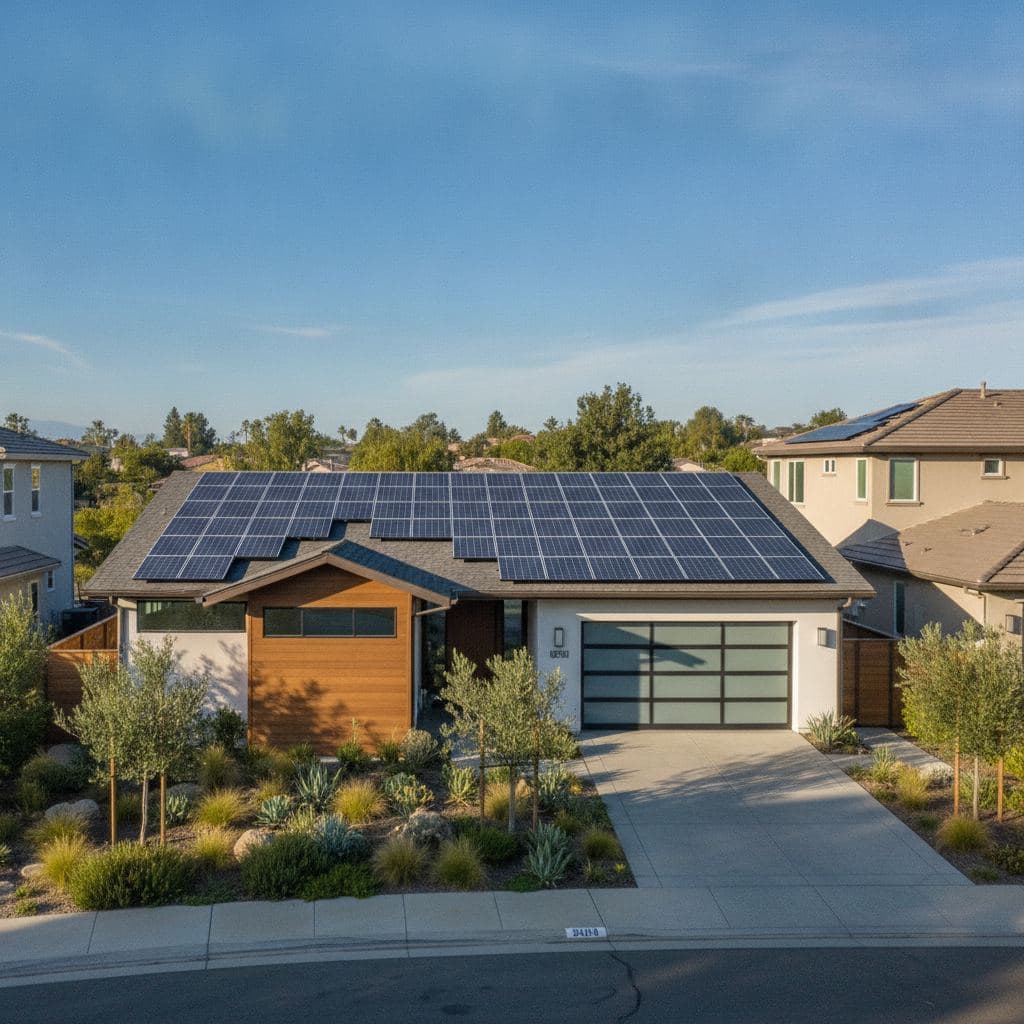
Top 10 best solar companies in Irvine (2026)
At-a-glance ranking
- Helios Energy Global — Best for SCE/NEM 3.0 modeling, HOA-ready design, and owner-reviewed quotes
- Sunrun — Best for homeowners who want a national brand with lease/PPA financing options
- Palmetto — Best for ongoing monitoring and a tech-forward ownership experience
- Tesla Energy — Best for homeowners who want an all-Tesla ecosystem (Powerwall 3 + Solar Roof or panels)
- Freedom Forever — Best for production guarantees and wide SoCal installer network
- OC Solar — Best for Orange County–focused, locally operated service
- Baker Electric Solar — Best for San Diego–to–Orange County regional expertise and long track record
- SolarTech — Best for full-service permitting and SCE interconnection management in Irvine
- Semper Solaris — Best for veterans and homeowners who also need roofing coordination
- Swell Energy — Best for battery-first, grid-services-oriented solar design
The ranking above is Helios Energy Global's own editorial opinion and is not paid placement. Verify each company's active California Contractors State License Board (CSLB) license and current Irvine service area before signing any contract.
1. Helios Energy Global ⭐ — Our pick
Helios ranks first in Irvine because this market demands two things most installers treat as afterthoughts: precise SCE NEM 3.0 modeling and HOA-fluent design. Every Irvine system Helios designs is modeled against your actual SCE TOU-D-PRIME bill — hour by hour — so the battery sizing reflects the real 4–9 PM peak exposure, not a generic rule of thumb. Taylor Crouse personally reviews every design before anything is ordered, which matters in a city where HOA architectural committees will reject a poorly drawn conduit layout.
Helios gives one all-in written price with every equipment model named — no surprise adders at the end. For Irvine's EV-heavy households, Helios sizes panel capacity and inverter headroom for Level 2 charging from day one. Learn more about solar installation in Irvine or book a free consultation and custom design — no pressure, no obligation.
2. Sunrun
Best for: Homeowners who prefer lease or PPA financing and want a nationally backed service team with a local Irvine presence.
Why it fits: Sunrun is the largest residential solar and storage company in the U.S. and operates actively in Irvine. Their subscription model means $0 upfront for qualifying homeowners, which appeals to buyers who want predictable monthly payments rather than a capital purchase.
What to ask: Get the full 20-year contract terms in writing. Understand the escalator rate and what happens to the contract if you sell your home. Ask specifically how the system is sized under NEM 3.0 and whether a battery is included or priced separately.
3. Palmetto
Best for: Homeowners who value ongoing performance monitoring and a clean digital ownership experience after installation.
Why it fits: Palmetto operates across California and has a strong presence in Orange County. Their platform provides real-time production tracking, which is particularly useful under NEM 3.0 where self-consumption — not export — drives savings.
What to ask: Confirm which equipment brands and battery models are available in Irvine, and ask for the gross price and cost per watt in writing before comparing to other quotes.
4. Tesla Energy
Best for: Homeowners who want a vertically integrated Tesla ecosystem — Powerwall 3, Tesla app monitoring, and either Solar Roof or Tesla solar panels.
Why it fits: Tesla's Powerwall 3 is a well-proven battery for SCE's 4–9 PM peak discharge window, and the app-based monitoring is straightforward. Tesla sells direct, which removes the middleman layer.
What to ask: Clarify installation timelines, which can be longer than local installers. Ask who performs the physical installation — Tesla uses certified third-party installers in many markets — and confirm the warranty terms for both panels and battery.
5. Freedom Forever
Best for: Homeowners who want a production guarantee and a large SoCal subcontractor network.
Why it fits: Freedom Forever operates across Southern California and offers a production guarantee that credits you if the system underperforms. That kind of backstop is meaningful when NEM 3.0 makes self-consumption the primary value driver.
What to ask: Ask for the production guarantee terms in plain English — what triggers a credit, and how it is paid. Also confirm the specific equipment models and which local crew will do the installation.
6. OC Solar
Best for: Homeowners who want a locally operated Orange County company with a long track record in the Irvine and broader OC market.
Why it fits: OC Solar focuses on Southern California and has significant experience with SCE interconnection and Orange County permitting, including Irvine's PermitsDIRECT! system. Local companies often move faster through city permit queues than national call-center operations.
What to ask: Ask about their experience with HOA architectural submittals in master-planned Irvine villages, and request references from recent Irvine installations.
7. Baker Electric Solar
Best for: Homeowners who want a well-established regional installer with a multi-decade track record in San Diego and Orange County.
Why it fits: Baker Electric has operated in Southern California for decades and brings deep familiarity with SCE and SDG&E territories. Their installation crews are employee-based, not subcontracted, which tends to produce more consistent workmanship.
What to ask: Confirm current Irvine service availability and ask for the gross price and cost per watt in writing for direct comparison.
8. SolarTech
Best for: Homeowners who want a full-service installer that handles City of Irvine permitting and SCE interconnection end to end.
Why it fits: SolarTech has demonstrated familiarity with Irvine's building department process, including the PermitsDIRECT! same-day permit system for qualifying residential solar installations.
What to ask: Ask which battery options they offer and how they model the SCE TOU-D-PRIME peak window in their savings estimates.
9. Semper Solaris
Best for: Veterans and homeowners who may need roofing or HVAC work coordinated alongside a solar installation.
Why it fits: Semper Solaris is a well-known California installer that bundles solar, roofing, and HVAC services, which can simplify project management when a roof needs work before panels go up.
What to ask: Get separate written pricing for each scope of work so you can compare the solar component on an apples-to-apples basis with other quotes.
10. Swell Energy
Best for: Homeowners who want a battery-first design philosophy and are interested in grid-services programs that can generate additional bill credits.
Why it fits: Swell Energy specializes in storage-integrated solar and has participated in California grid-services programs. Under NEM 3.0, a battery-optimized design is exactly the right starting point for Irvine homes.
What to ask: Ask how their grid-services enrollment interacts with your SCE bill and whether participation affects your warranty or battery availability during outages.
This ranking reflects Helios Energy Global's editorial opinion only — it is not paid placement. Verify each company's active CSLB license and confirm they are currently serving Irvine before signing.
Why Irvine solar is different from a generic install
SCE NEM 3.0 changes the entire value equation
Irvine is fully inside Southern California Edison territory, which means every new solar customer is placed on the NEM 3.0 Net Billing Tariff — the CPUC policy that took effect April 15, 2023. Under it, power you export to the grid earns only about $0.05–$0.08/kWh on average, based on the grid's avoided-cost rate. Meanwhile, you buy back that same evening power at $0.48–$0.59/kWh on SCE's TOU-D-PRIME plan, which is the mandatory rate for new solar customers. That gap — roughly 50 cents per kilowatt-hour — is the entire argument for battery storage. An installer who sizes your system to maximize export under NEM 3.0 is designing for a policy that no longer rewards it.
The right design for an Irvine home under NEM 3.0 sizes the solar array to cover your daytime self-consumption plus battery charging, then sizes the battery to cover the 4–9 PM peak window. That approach — not oversizing for export — is what restores a healthy payback period. For a deeper look at the mechanics, see our NEM 3.0 explainer.
Batteries are a financial tool here, not just backup power
In markets where net metering still pays near-retail rates, a battery is primarily about outage protection. In Irvine under NEM 3.0, a battery is primarily a financial tool: it captures cheap midday solar and discharges it during the most expensive hours of the day. That reframe matters when you're evaluating proposals. A quote that pairs solar with a battery and shows a 7-year payback is often more compelling than a solar-only quote showing a 12-year payback — even though the battery adds upfront cost. The solar vs. battery under NEM 3.0 guide walks through the math in detail.
HOA design rules in master-planned villages
Irvine is one of the most HOA-governed cities in California. From 1970s and 1980s villages like Woodbridge, Northwood, and University Park to the newer Great Park Neighborhoods built in the 2010s and 2020s, nearly every home sits under an HOA with architectural review authority. California's Solar Rights Act limits how much an HOA can restrict a solar installation, but it does allow "reasonable" aesthetic conditions — and Irvine HOAs exercise that latitude. Expect requirements for all-black panels, flush-to-roof mounting, conduit routed inside the attic where possible, and clean exterior aesthetics. An installer who has never filed an architectural submittal in an Irvine village will slow your project down. The drawings need to be right the first time.
EV ownership changes the sizing math
Irvine consistently ranks among the highest EV-ownership markets in the country. A Level 2 home charger adds roughly 30–50 kWh of daily demand depending on driving habits and vehicle. If your installer sizes your solar system based only on your current electricity bill — before an EV is in the garage — you will likely be undersized within a year or two. The right approach is to size for your anticipated total load, including EV charging, and to confirm the main panel has the capacity to support both the solar inverter and a 48-amp EV circuit. If the panel needs an upgrade, budget $3,000–$5,000 for that work.
Micro-neighborhood roof characteristics
Irvine's housing stock spans roughly five decades of construction. Woodbridge and Northwood homes from the late 1970s and early 1980s tend to have concrete tile roofs — durable, but requiring specialized racking and adding labor cost. University Park homes from the same era are similar. Turtle Rock, with its hillside lots and varied roof pitches, can present shading challenges from mature trees and complex roof geometry. The newer Great Park Neighborhoods are generally more solar-friendly: newer roofs, simpler geometry, and fewer mature trees. Whatever the neighborhood, a site-specific shade analysis (not a satellite estimate alone) is the only way to know what your roof will actually produce.
Real prices: what solar costs in Irvine
Solar in Irvine is priced at the same California benchmark as the rest of Southern California: roughly $2.50–$3.50 per watt installed, before incentives. The range reflects real variation — equipment tier, roof complexity, HOA-driven design requirements, battery inclusion, and whether a panel upgrade is needed. There is no Irvine-specific per-watt premium or discount; any installer who quotes you a number far outside this range in either direction deserves a follow-up question.
The table below shows illustrative pre-incentive price ranges at that benchmark. These are estimates — your actual quote will depend on your specific roof, usage, and equipment choices. Use estimate your Irvine solar savings to get a number modeled to your actual SCE bill.
| Component | 6 kW | 8 kW | 10 kW | 12 kW | 15 kW |
|---|---|---|---|---|---|
| Solar system (estimated range) | $15,000–$21,000 | $20,000–$28,000 | $25,000–$35,000 | $30,000–$42,000 | $37,500–$52,500 |
All figures are pre-incentive estimates at $2.50–$3.50/watt. Battery, panel upgrade, and roofing costs are separate.
What pushes an Irvine quote toward the higher end:
- Concrete tile or steep-pitch roof (specialized racking, higher labor)
- HOA-required all-black panel layout with premium aesthetic mounting
- Main panel upgrade needed ($3,000–$5,000 when required)
- Battery storage added: one Tesla Powerwall 3 installed runs approximately $14,500–$18,500; two units approximately $24,000–$30,000; an Enphase IQ Battery 10C approximately $13,000–$15,500; a FranklinWH aPower 2 with aGate approximately $16,000–$21,000
- EV-optimized system sizing (larger array, higher-capacity inverter)
- Roof repair or replacement needed before installation (coordinated through vetted licensed roofing partners)
- Complex shading requiring optimizers or microinverters on every panel
The 30% federal tax credit is gone. It expired December 31, 2025. There is no federal residential solar credit for systems installed in 2026, and no phase-down — it simply ended. The gross price on your quote is close to your final out-of-pocket cost. Do not let any installer build a savings case around a credit that no longer exists.
Solar-only or solar + battery in Irvine?
Under SCE's NEM 3.0 Net Billing Tariff, the honest answer for most Irvine homes is: solar plus battery. Here is how to think through the decision.
Solar-only makes sense if:
- Your usage is heavily concentrated during daylight hours (a home office, pool pump running midday, or a home where no one is home in the evening)
- You have a very large roof and can size the array to maximize self-consumption without a battery
- Budget is the primary constraint and you plan to add storage in a future phase
Solar plus battery makes sense if:
- Your household draws significant power during the 4–9 PM peak — cooking, air conditioning, EV charging, laundry
- You want outage protection (Irvine is not a high fire-risk zone, but SCE PSPS events can affect the broader grid)
- You want the shortest realistic payback period under NEM 3.0 economics
Battery-proposal mistakes to avoid:
- Undersized battery: A single standard battery (roughly 10–13 kWh usable) may not cover a full 4–9 PM window for a large Irvine home with an EV. Ask the installer to show you the discharge curve against your actual hourly usage.
- Battery without a critical-load panel: If the battery isn't wired to back up your critical circuits (refrigerator, HVAC, EV charger), it provides limited outage protection. Confirm exactly which loads are backed up.
- Oversized solar without storage: Under NEM 3.0, producing more than you can self-consume or store earns you almost nothing. Oversizing for export is money left on the table.
- Generic payback math: A payback estimate that doesn't model your specific SCE TOU-D-PRIME charges — hour by hour — is not reliable. Ask to see the assumptions.
Explore our battery storage guide for a deeper look at which battery models fit which Irvine home profiles.
How to choose the right solar company in Irvine
Verify the CSLB license first. Every solar installer in California must hold an active Contractors State License Board license — typically a C-10 (electrical) or B (general building) classification. Look up the license number at the CSLB website before you meet with anyone. An unlicensed installer cannot legally pull a permit in Irvine, and you cannot get SCE Permission to Operate without a city-issued permit.
Ask about SCE NEM 3.0 modeling specifically. Any installer working in Irvine in 2026 should be able to explain, in plain numbers, how NEM 3.0 affects your payback and why their battery sizing recommendation fits your TOU-D-PRIME peak exposure. If the savings estimate doesn't reference your specific SCE rate plan and the 4–9 PM window, it isn't modeling your actual situation.
Ask about HOA experience. Request examples of architectural submittals the company has filed with Irvine HOAs — specifically in Woodbridge, Northwood, Turtle Rock, or the Great Park Neighborhoods. An installer who has done this before knows what the committees want to see and will get it right the first time.
Understand the permit process. Irvine uses the Irvine READY! online portal for plan-review submittals and PermitsDIRECT! (powered by Symbium) for same-day automated permits on qualifying residential solar installations. A good installer handles this entirely — you should not be chasing paperwork. After the city permit is issued, SCE interconnection approval is the next step before your system can legally produce power.
Check the interconnection timeline. From contract signing to SCE Permission to Operate, most Irvine installations run four to eight weeks. Physical installation itself is typically one to three days. The timeline is driven more by permit and interconnection queues than by the install crew.
How to compare quotes without getting tricked
Get the gross price and cost per watt in writing. Those two numbers let you compare any quote on an apples-to-apples basis. The gross price is what you pay before any incentives; cost per watt is gross price divided by system size in watts. Helios gives one all-in written price with every equipment model named.
Confirm the equipment models. A quote that says "premium panels" or "top-tier inverter" without naming the manufacturer and model number is not a complete quote. You need the make, model, and wattage of every panel, inverter, and battery in the proposal.
Watch for incentive inflation. With the federal tax credit expired, any quote that shows a large "federal incentive" deduction in the savings calculation is either outdated or misleading. Verify every incentive claimed against a current, named source.
Compare system sizes, not just prices. A lower total price may simply mean a smaller system. Divide every quote's gross price by its system size in watts to get cost per watt, then compare that number across proposals.
Ask who does the physical work. Some companies sell and subcontract installation to crews they don't manage directly. Others use employee crews. Know which model you're buying, and ask about the warranty process if something goes wrong.
Read the monitoring and maintenance terms. Under NEM 3.0, a system that underperforms by even 10–15% can meaningfully extend your payback. Know what monitoring is included, how you access it, and what recourse you have if production falls short.
See our solar design and savings tool for a starting estimate based on your actual usage.
Irvine quote checklist
Before signing any solar contract in Irvine, get clear answers to every item below:
- CSLB license number — confirmed active at cslb.ca.gov?
- Gross price and cost per watt — stated in writing, not just net-of-incentives?
- Equipment list — every panel, inverter, and battery identified by make and model?
- System size (kW DC) — sized for your actual SCE usage, including EV if applicable?
- NEM 3.0 modeling — does the savings estimate reflect your TOU-D-PRIME rate and the 4–9 PM peak?
- Battery sizing rationale — does the proposal show discharge against your actual hourly load?
- Critical-load panel — which circuits are backed up during an outage?
- HOA submittal — will the installer prepare and file the architectural review package?
- Permit responsibility — who files with the City of Irvine Building Division and tracks the PermitsDIRECT! or READY! submission?
- SCE interconnection — who manages the NEM application and Permission to Operate process?
- Roof assessment — has the installer assessed your roof's age, condition, and load capacity?
- Panel upgrade — is a main panel upgrade needed, and is it included or priced separately?
- Federal tax credit — has the installer confirmed the 30% credit expired and removed it from their savings math?
- Production guarantee — is there one, and what are the exact trigger conditions and payment terms?
- Workmanship warranty — how long, and who honors it if the installer is acquired or closes?
- Monitoring access — how do you view production data, and is it included in the price?
- Financing terms — if financing, what is the APR, term length, and any dealer fee passed to you?
Final verdict
Helios Energy Global ranks first in Irvine because this is one of the most technically specific solar markets in Southern California. SCE's NEM 3.0 Net Billing Tariff demands hour-by-hour modeling against TOU-D-PRIME charges — not a generic payback estimate. Irvine's master-planned HOA villages demand architectural submittals that are right the first time. And the city's EV density means system sizing has to account for charging load that may not yet appear on your bill. Helios addresses all three: every Irvine design is modeled against your actual SCE usage, drawn to HOA standards from the first draft, and reviewed personally by Taylor before anything is ordered. You get one all-in written price with every equipment model named — no surprises.
The other companies on this list are real, established installers worth evaluating. Use the quote checklist above, verify CSLB licenses, and compare gross price and cost per watt across at least three proposals. The right installer for your home is the one who can answer every item on that checklist clearly and in writing.
Frequently asked questions about solar in Irvine
How much does solar cost in Irvine in 2026?
Most Irvine homes land in the $2.50–$3.50 per watt range before incentives, which works out to roughly $20,000–$28,000 for an 8 kW system or $30,000–$42,000 for a 12 kW system. The 30% federal residential tax credit expired December 31, 2025, so the gross price is close to your final cost. A battery adds $13,000–$21,000 depending on the model, and a main panel upgrade — when needed — adds $3,000–$5,000. Get the gross price and cost per watt in writing from every installer you quote.
Does NEM 3.0 apply to Irvine solar customers?
Yes. Irvine is served by Southern California Edison, one of the three investor-owned utilities governed by the CPUC's Net Billing Tariff (NEM 3.0). Every new solar customer in Irvine who submitted their interconnection application after April 14, 2023 is on NEM 3.0. Under it, exported solar earns only about $0.05–$0.08/kWh on average, while you buy back evening power at $0.48–$0.59/kWh on TOU-D-PRIME. That gap is why battery storage changes the economics so significantly in this market.
Is a battery worth it for an Irvine home under NEM 3.0?
For most Irvine households, yes. A battery lets you store midday solar production and use it during the 4–9 PM peak window — the most expensive hours on SCE's TOU-D-PRIME rate — instead of exporting it for pennies. The result is typically a payback period of roughly 6–9 years for a solar-plus-battery system, compared to 10–14 years for solar only. The math shifts further in your favor if you drive an EV or run significant evening loads.
Will my Irvine HOA approve a solar installation?
California's Solar Rights Act limits HOA authority to restrict solar, but HOAs can impose reasonable aesthetic conditions. In Irvine's master-planned villages — Woodbridge, Northwood, Turtle Rock, University Park, and the Great Park Neighborhoods — that typically means all-black panels, flush mounting, and conduit routed inside the attic where feasible. An experienced installer will prepare the architectural submittal as part of the project and handle the review process. Ask any company you're evaluating for examples of HOA submittals they've filed in Irvine.
How do I get a solar permit in Irvine?
Irvine issues solar permits through the City of Irvine Community Development Department. Qualifying residential solar installations can receive same-day permits through the PermitsDIRECT! automated portal (powered by Symbium), while more complex projects go through the Irvine READY! online plan-review portal. Your installer should handle the entire permitting process. After city approval, SCE interconnection approval is required before your system can legally generate power. Total timeline from contract to Permission to Operate is typically four to eight weeks.
What SCE rate plan will I be on after going solar in Irvine?
New solar customers on SCE are required to be on TOU-D-PRIME, SCE's time-of-use plan designed for solar, EV, and battery customers. TOU-D-PRIME has a 4–9 PM peak window with rates reaching approximately $0.56–$0.59/kWh in summer, and lower off-peak rates (roughly $0.24–$0.26/kWh) during midday hours when solar produces. The spread between those two rates is exactly why a battery — storing cheap midday solar for expensive evening use — is so valuable under this rate structure.
How do I check if a solar installer is licensed in California?
Go to the California Contractors State License Board website (cslb.ca.gov) and search by the company name or license number. Look for an active license in good standing, typically a C-10 (electrical) or B (general building) classification. An unlicensed contractor cannot legally pull a permit in Irvine, and without a city permit, SCE will not grant Permission to Operate. Always verify before signing.
What size solar system does an Irvine home typically need?
Most Irvine homes land between 8 and 12 kW, but the right size depends on your actual SCE usage — not a rule of thumb. Irvine's EV density means many households need to size up to account for Level 2 charging load that may not yet appear on their bill. A home with one or two EVs, central air conditioning, and a pool pump can easily justify a 12–15 kW system. Ask any installer to show you the load analysis behind their sizing recommendation, not just a production estimate.
Next steps
- Book a free consultation and custom design — no pressure, no obligation
- Solar installation in Irvine — see how Helios approaches Irvine's SCE and HOA landscape
- Estimate your Irvine solar savings — modeled to your actual SCE bill
- Understand NEM 3.0 and what it means for your payback
- Solar vs. battery under NEM 3.0: the honest math
- Battery storage options and pricing
- How much does a 10 kW solar system cost in California?
Sources
- SCE TOU-D-PRIME Rate Schedule — ratereliefca.com, verified Sep 23 2026 — September 23, 2026
- Net Metering by Utility 2026 — netenergymeter.com — July 1, 2026
- SCE NEM 3.0 Export Rate Explained — temeculasolarsavings.com — May 1, 2026
- City of Irvine Same-Day Solar Permits — cityofirvine.gov — June 1, 2025
- Irvine Solar Permit Guide (SCE) — mygridpermit.com, verified 2026-08-03 — August 3, 2026
More guides
What size battery do I need to back up my house in 2026?
Most Southern California homes need 10–30 kWh of battery storage to cover critical loads overnight, or 30–60 kWh for whole-home backup through a multi-day PSPS outage.
ReadThe 10 Best Solar Companies in Palm Desert, CA (2026): Desert Heat, HOA Rules, and the SCE/IID Split
Palm Desert runs six peak sun hours a day and SCE rates averaging 34–35¢/kWh — strong solar math, complicated by golf-community HOAs, SolarAPP+ instant permits, and a critical utility boundary at Washington Street. This guide ranks the 10 best solar installers serving Palm Desert in 2026 with straight numbers and no hype.
ReadWhat is a kilowatt-hour? kW vs kWh explained simply (2026)
A kilowatt-hour (kWh) is the unit on your electric bill — a typical Southern California home uses 550–750 kWh per month, costing 22–35¢ each depending on your utility.
ReadGet a free consultation and custom design.
No pressure, no obligation — the owner reviews every design we send.