Can You Add a Battery to a Leased Solar System (Sunrun, Tesla, Sunnova) in California?
Yes — a battery you own can be AC-coupled to leased Sunrun, Tesla, or Sunnova panels for roughly $14,500–$18,500 installed (one Powerwall 3), without touching the lease or requiring lessor sign-off.
By Taylor Crouse — Founder, Helios Energy GlobalPublished
Quick answer
- Yes, you can add a battery to leased solar — via AC-coupling, no lessor consent required for a battery you own and install on your own home's electrical panel.
- Cost: roughly $14,500–$18,500 installed for one Tesla Powerwall 3 in Southern California (two units: ~$24,000–$30,000); a main-panel upgrade, if needed, adds $3,000–$5,000.
- You own the battery; the lessor owns the panels. Warranty, maintenance, and replacement are your responsibility on the battery — the lessor's responsibility on the panels.
- NEM 3.0 export rates (~$0.05–$0.08/kWh) make self-consumption the priority for SCE, PG&E, and SDG&E customers — a battery is now the most important upgrade you can make to a leased system. LADWP customers still get retail-rate net metering, which changes the math.
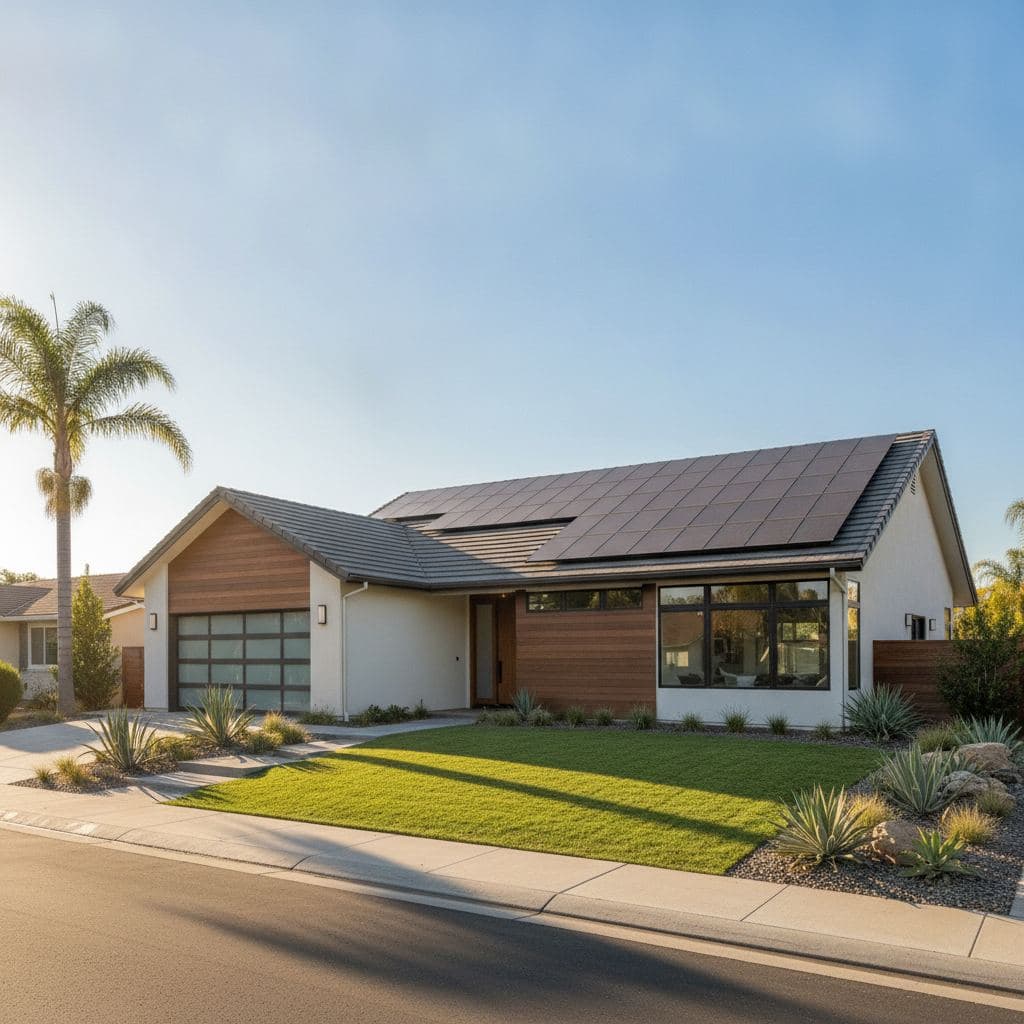
Yes, you can add a battery to a leased solar system — and in most Southern California cases you can do it without asking Sunrun, Tesla, or Sunnova for permission. The battery AC-couples to your home's electrical panel, downstream of where the lease ends, and costs roughly $14,500–$18,500 installed for one Powerwall 3. The lease keeps running exactly as before; you simply own a separate piece of equipment that captures the solar energy the panels are already producing.
Last verified: September 2026 by Helios Energy Global.
How a battery attaches to panels you don't own
The leasing company owns the panels and inverter — but they don't own your house, your main service panel, or a battery you buy. A retrofit battery AC-couples at your main service panel, downstream of where their lease ends.
The battery's own inverter charges from the AC power your solar already produces and discharges back into the house. The panels, the string or micro-inverters, and the monitoring on the roof keep doing exactly what they did before.
That is called AC coupling, and it is why the brand on your panels — and whether the company that installed them still answers the phone — is irrelevant to whether a battery can be added.
Adding a battery to a string inverter system (the most common type in older leased arrays) typically requires an AC-coupled battery — one that has its own built-in inverter, like the Tesla Powerwall 3. It connects to your electrical panel and works alongside your existing setup without replacing anything.
Since August 2026, the Enphase IQ Battery 10C, IQ Combiner 6C, and IQ Meter Collar also support existing non-Enphase solar systems, integrating up to 15.4 kVA of third-party solar with whole-home backup — meaning Enphase microinverter-based leased systems now have a clean native path as well.
Do you need the lessor's permission?
For a third-party battery you own, installed on your own electrical panel: no, in most cases. The lease keeps running. The battery is yours. The leasing company doesn't sign off, approve anything, or get a vote.
That said, read your lease before you proceed. A small number of older agreements include language prohibiting modifications to the "solar energy system" broadly — language that a cautious lessor could try to apply to your panel. In practice we have not seen any major lessor in California successfully block an AC-coupled battery retrofit on those grounds, but you should know what your contract says.
What does require lessor coordination: if you want to expand the solar array at the same time (adding panels), that modifies the leased equipment itself and requires lessor consent and a new interconnection filing.
What the lessors themselves offer — and what it costs
Some lessors will add a battery directly under a new or amended agreement. Here is what each major player offers in California in 2026:
| Lessor | Battery add-on program | Who owns the battery | Your cost structure |
|---|---|---|---|
| Sunrun | Brightbox / Powerwall add-on (available for SCE, PG&E, SDG&E, LADWP customers) | Sunrun (leased) or you (purchased) | Separate monthly bill or purchase price — get a quote |
| Tesla | Powerwall add-on available; lease buyout option after year 5 | Tesla (if leased) or you (if purchased) | Separate agreement; 25-yr lease with 3%/yr escalator |
| Sunnova | Sunnova's portfolio now serviced by SunStrong post-bankruptcy; battery add-ons limited | Sunnova/SunStrong | Contact servicer directly; availability varies |
| Third-party (Helios) | AC-coupled Powerwall 3 or Enphase IQ Battery 10C | You | ~$14,500–$18,500 installed (Powerwall 3, one unit) |
Sunrun's add-on battery program is available for California customers on PG&E, SCE, SDG&E, or LADWP.
Adding a battery through Sunrun does not change the billing for your current solar system — you receive a new, separate bill for the add-on battery reflecting your financing selection.
Tesla's lease agreement includes an estimated buyout price available after year five of the 25-year lease term.
The Section 48E commercial credit remains available to businesses including third-party leased solar systems, which allows Tesla to offer lower monthly lease payments. Payments increase by 3% annually per the lease terms, so future payments are predictable from day one.
The key difference: when you add a battery through the lessor, the lessor typically owns it (under a lease structure) and you pay a monthly fee. When you hire a third-party installer like Helios, you own the battery outright — full equity, no monthly lease payment, no encumbrance on your title beyond the battery's own permit.
NEM 3.0 and why the battery matters even more on a leased system
NEM 3.0 — the Net Billing Tariff covering SCE, SDG&E, and PG&E interconnections after April 15, 2023 — cut what utilities pay for exported solar by roughly 75%. The savings now come from storing daytime solar in a battery and using it during expensive evening hours.
SCE charges about 34 cents per kWh, nearly double the U.S. average, which is what makes solar pay. Its average residential rate is roughly 34 cents per kWh as of July 2026 per SCE rate advisories, against a U.S. average near 18.83 cents per EIA data.
Independent estimates put the blended NEM 3.0 export credit at roughly $0.05–$0.08/kWh versus about $0.25–$0.30/kWh under NEM 2.0 — an average reduction of roughly 75%.
What this means for a leased system: if your lease was signed before April 14, 2023 (NEM 2.0 grandfathered), a battery helps but is not as urgent — you're still earning near-retail for exports. If your lease was signed after April 15, 2023 (NEM 3.0), midday solar your panels export is worth almost nothing, and a battery that captures it for your own 4–9 PM use is the single most impactful upgrade you can make.
Adding a battery to an existing NEM 2.0 system generally does not forfeit that grandfathered status, though a large system upsize can (per CPUC).
Adding storage alone does not change your interconnection tariff on SCE, PG&E, or SDG&E. Adding solar capacity at the same time can. A qualified installer sizes and files the revised interconnection to protect your existing agreement.
LADWP and other municipal utilities
If you're in Los Angeles and get electricity from LADWP, NEM 3.0 does not apply to you. LADWP runs its own net metering program and currently credits solar exports at full retail rates — a significantly better deal.
Municipal utilities have their own rules. That includes LADWP in the City of Los Angeles and Anaheim Public Utilities in Orange County — both set their own solar tariffs, and neither is bound by the CPUC's decision.
For LADWP customers with a leased system, a battery still improves backup resilience and can reduce evening grid draw — but the financial urgency is lower than for SCE customers, because your exports already earn close to retail.
See our NEM 3.0 explainer for a full utility-by-utility breakdown, and solar vs. battery under NEM 3.0 for the self-consumption math.
SGIP battery incentive: can a leased-solar homeowner apply?
SGIP residential general market budgets are waitlisted as of 2026 — new general applications are not being funded.
The Equity and Equity Resiliency tiers remain the only active residential pathways; income-qualified homeowners in high fire-risk or medically baseline areas are the primary candidates.
For the SGIP-eligible tiers, the battery applicant must be the system owner — meaning you, not the lessor, must own the battery. To qualify for the RSSE program, you must install a paired solar + battery system or a battery retrofit on an existing solar system, and be a residential customer of PG&E, SCE, SDG&E, SoCalGas, or LADWP. A third-party-owned battery added through Sunrun or Tesla (where the lessor owns the battery) typically does not qualify you for SGIP — you need to own the battery yourself.
Bottom line: if you are income-qualified and in an SCE or SDG&E territory, owning your own AC-coupled battery gives you the best shot at any SGIP waitlist position that opens. Ask us to check your territory's current queue status before you commit.
Who owns and warranties the battery
This is the most important question to ask before you sign anything:
If the battery is added by the lessor (Sunrun, Tesla) under a new lease or subscription:
- The lessor owns the battery.
- The lessor's warranty and maintenance terms apply — typically 10 years for the battery, bundled into your monthly payment.
- The battery may appear as an additional UCC-1 fixture filing on your title.
If you hire a third-party installer (like Helios) to AC-couple a battery you own:
- You own the battery outright.
- Tesla's 10-year Powerwall warranty (or Enphase's equivalent) runs directly to you.
- No additional encumbrance on your title beyond the battery's own permit.
- The battery's cost is not tied to your lease — if you later buy out the lease, the battery is already yours.
Ownership matters when you sell your home. Most PPA agreements include a buyout option at fixed intervals. Unlike a lease buyout based on remaining payments, a PPA buyout is often calculated at the fair market value of the solar equipment — which depreciates significantly over time. A battery you own outright is a clean asset; a leased battery is another encumbrance to negotiate.
When to wait for the lease buyout instead
Adding a battery to a leased system makes the most sense when:
- You have 10+ years left on the lease and don't want to wait.
- Your SCE or SDG&E bill is high (roughly $200+/month) and NEM 3.0 is eating your export credits.
- You want backup power for outages — regardless of utility or tariff.
It may make more sense to buy out the lease first if:
- You're within 1–3 years of a scheduled buyout option in your contract.
You can request an independent appraisal at your own cost to determine the system's fair market value; the final buyout price will be whichever amount is lower — the estimated price from your contract or the appraised FMV.
- You want to add panels at the same time — which requires owning the system anyway.
- You're planning to sell within 5 years and want a clean title. Many California buyers reject solar leases outright when the annual escalator exceeds 2.5% or when more than 15 years remain on the term.
A note on Sunnova: Sunnova filed bankruptcy after the Trump administration pulled their $3B DOE loan guarantee, and was sold to Solaris Assets/GoodFinch for approximately $118 million. Their lease portfolio is now serviced by SunStrong, which is a servicer, not an installer. If you have a Sunnova lease, battery add-on options through the servicer are limited — a third-party AC-coupled battery is often your most practical path.
For a deeper look at all third-party solar battery retrofits — including compatibility checklists and the NEM 2.0 protection rules — see our sibling guide: Add a Battery to Solar Someone Else Installed.
Key numbers at a glance
| Item | Estimate (Southern California, 2026) |
|---|---|
| Powerwall 3, one unit — installed, third-party owned | ~$14,500–$18,500 |
| Powerwall 3, two units — installed, third-party owned | ~$24,000–$30,000 |
| Main-panel upgrade (if needed) | ~$3,000–$5,000 |
| SCE average residential rate | ~34–35¢/kWh |
| SCE NEM 3.0 export credit (blended) | ~$0.05–$0.08/kWh |
| LADWP effective rate | ~26–31¢/kWh (retail net metering) |
| SGIP General Market residential | Waitlisted — no new funding |
| SGIP Equity / Equity Resiliency | Waitlisted — income-qualified, apply for queue position |
| Federal residential battery tax credit (25D) | Expired Dec 31, 2025 — $0 for homeowners in 2026 |
| Tesla lease buyout option | Available after year 5 of 25-year term |
All installed costs are estimates. Final pricing depends on panel count, panel location, main-panel condition, permit jurisdiction, and system configuration. Ranges, not exact figures.
Frequently asked questions about adding a battery to a leased solar system
Does Sunrun have to approve a battery I add myself?
No — for a battery you own, installed on your own electrical panel by a licensed contractor, Sunrun's approval is not required. The leasing company doesn't own your house, your main service panel, or a battery you buy. A retrofit battery AC-couples at your main service panel, downstream of where their lease ends. Review your specific lease language, but in practice no major California lessor has successfully blocked a third-party AC-coupled battery on a homeowner's own panel.
Will adding a battery change my NEM 2.0 grandfathered status?
Adding a battery to an existing NEM 2.0 system generally does not forfeit that grandfathered status, though a large system upsize can, per the CPUC. Adding storage alone — without expanding the solar array — does not trigger a new interconnection application and does not move you to NEM 3.0. Always confirm with your installer that the permit filing is structured correctly.
Can I get SGIP if my solar panels are leased?
Possibly — but only if you own the battery. SGIP eligibility for the residential tiers requires that the homeowner be the battery owner. SGIP residential general market budgets are waitlisted as of 2026. The Equity and Equity Resiliency tiers remain the only active residential pathways for income-qualified homeowners in high fire-risk or medically baseline areas. A battery added by Sunrun or Tesla under their own lease or subscription would be owned by the lessor, not you, and would not qualify you for SGIP.
Is there a federal tax credit for a battery I add in 2026?
No. The federal residential clean energy credit (Section 25D) covered 30% of battery installation costs through December 31, 2025. On a $12,000 Powerwall install, that was a $3,600 federal credit — gone as of 2026. The 30% credit is no longer available to homeowners purchasing a battery in 2026, regardless of whether their solar is leased or owned.
Does it matter which lessor I have — Sunrun vs. Tesla vs. Sunnova?
For a third-party AC-coupled battery, the lessor brand is largely irrelevant — the battery connects to your panel, not their equipment. The lessor matters most if you want to add a battery through them. Sunrun's add-on battery program is available for California customers on PG&E, SCE, SDG&E, or LADWP. Tesla's program is available through their Energy division. Sunnova's portfolio is now serviced by SunStrong post-bankruptcy, with limited add-on capabilities — a third-party battery is often the most practical path for Sunnova customers.
Will a battery help if I'm on LADWP instead of SCE?
Yes, though the financial urgency is different. LADWP runs its own net metering program and currently credits solar exports at full retail rates — a significantly better deal than NEM 3.0. Because LADWP exports already earn near-retail, the battery's bill-savings case is less dramatic than for SCE customers. However, backup power during outages, wildfire shutoffs, and evening peak reduction are still compelling reasons to add storage.
When does it make more sense to buy out my lease than to add a battery?
If you're within a few years of a scheduled buyout option, buying out the lease first gives you a clean-titled, fully owned system — and you can then add panels, a battery, or both without any lessor coordination. You can request an independent appraisal at your own cost to determine the system's fair market value; the final buyout price will be whichever amount is lower — the estimated price from your contract or the appraised FMV. If you have 10+ years remaining and a high SCE bill today, adding a battery now while continuing the lease is often the better financial move.
Next steps
- Book a free consultation and custom design — we'll review your lease documents, your utility tariff (SCE, LADWP, or other), and your current bill to tell you exactly which battery configuration makes sense and what it will cost.
- See battery options and specifications — Powerwall 3, Enphase IQ Battery 10C, and how we size them for Southern California homes.
- Understand your NEM 3.0 export credits — utility-by-utility breakdown of what your solar is actually earning today.
- Solar vs. battery under NEM 3.0: the self-consumption math — when a battery alone outperforms adding more panels.
- Add a battery to solar someone else installed — the full third-party retrofit guide, including NEM 2.0 protection rules and the Enphase compatibility update.
- See all-in solar installation cost ranges — if you're weighing a lease buyout + new system against staying in the lease.
- Find your Helios service area — we serve Santa Monica, the Westside, the South Bay, the Inland Empire, and surrounding Southern California communities.
Sources
- Tesla Solar Lease Buyout Guide (tesla.com) — September 2026
- EnergyScout — California SGIP Battery Rebate Guide 2026 — April 25, 2026
- Cali-Energy — NEM 3.0 Explained for California Homeowners (2026) — August 4, 2026
- SolarFY — SCE Solar in 2026: NEM 3.0, Rates & Real Payback — August 12, 2026
More guides
Best Solar Companies in Malibu, CA (2026): Honest Rankings for Coastal Homeowners
Malibu's coastal sun, high SCE rates, and NEM 3.0 rules make solar a strong investment — if you pick the right installer. Here are the 10 best solar companies serving Malibu in 2026, plus a plain-English guide to what it actually costs.
ReadBest Solar Companies in San Clemente, CA (2026): Tile-Roof Experts, Honest SCE Numbers
San Clemente's Spanish Colonial tile roofs, SCE's NEM 3.0 export rules, and fire-zone edges in Talega demand a solar installer who actually knows the neighborhood. Here's who does it right in 2026.
ReadCan you put solar panels on a flat roof? (2026 California guide)
Yes, flat roofs work well for solar — tilt racks set panels at 10–15° and add roughly $0.15–$0.40/watt to installed cost compared to a standard pitched roof.
ReadGet a free consultation and custom design.
No pressure, no obligation — the owner reviews every design we send.