Best Solar Companies in Malibu, CA (2026): Honest Rankings for Coastal Homeowners
Malibu's coastal sun, high SCE rates, and NEM 3.0 rules make solar a strong investment — if you pick the right installer. Here are the 10 best solar companies serving Malibu in 2026, plus a plain-English guide to what it actually costs.
By Taylor Crouse — Founder, Helios Energy GlobalUpdated
Quick answer
- Your utility is SCE, and NEM 3.0 applies. Export credits under NEM 3.0 are based on the "avoided cost" rate — typically a fraction of the retail rate — so oversizing your system to dump power onto the grid no longer pays the way it once did. Self-consumption and battery storage are now central to a good Malibu solar design.
- Typical system sizes run 8–15 kW. Malibu homes tend to have above-average electricity use (pools, EV chargers, AC, and large square footage are common), so systems smaller than 8 kW are the exception rather than the rule.
- Pre-incentive installed costs generally fall in the $2.50–$3.50 per watt range. On a 10 kW system that is roughly $25,000–$35,000 before any incentives. Coastal permitting, complex roof work, and battery additions push costs toward the top of that range.
- The 30% federal solar tax credit expired December 31, 2025. There is no federal residential solar credit available for systems installed in 2026. Any installer who quotes you a "30% federal credit" is giving you outdated information — verify before you sign.
- Battery storage is more valuable here than almost anywhere in California. Between NEM 3.0's low export rates, SCE's Time-of-Use pricing, Malibu's wildfire/PSPS risk, and the general remoteness of some hillside properties, a battery is rarely a luxury in this market — it is usually a sound financial and safety decision.
- What drives cost most in Malibu: roof complexity and pitch, coastal setback and permitting requirements, panel and inverter brand selection, whether you add a battery, and the distance from your main panel to the roof.
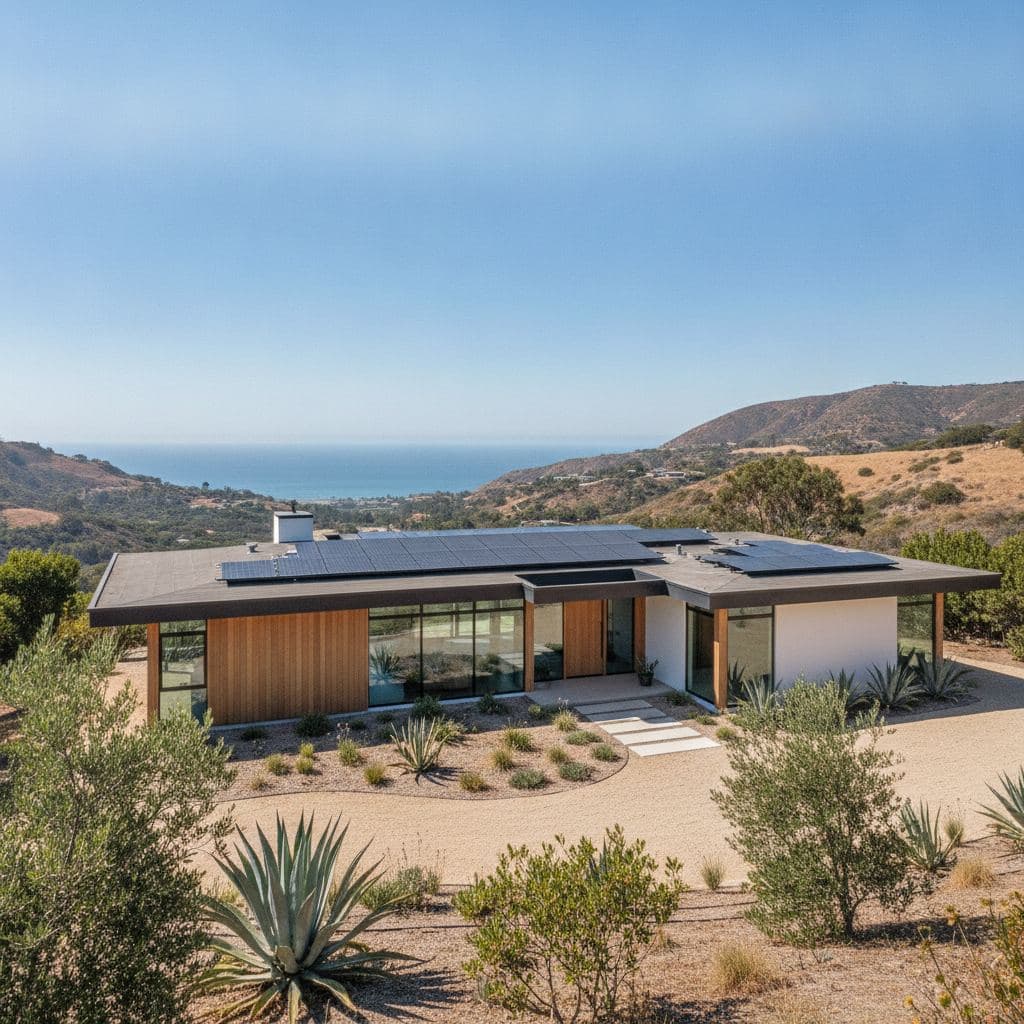
Malibu sits in the western edge of Los Angeles County, stretching roughly 27 miles along the Pacific Coast Highway between the Santa Monica Mountains and the ocean. It is one of the most visually dramatic places in Southern California to install solar — and also one of the most technically demanding. Homes here are served by Southern California Edison (SCE), which means every new solar installation is subject to California's Net Billing Tariff (NEM 3.0), the CPUC-mandated successor to the old net metering program.
That single fact changes the math on solar more than almost anything else a Malibu homeowner needs to understand.
The homes themselves add another layer of complexity. Malibu's housing stock runs from compact beach cottages on narrow PCH lots to sprawling hillside estates in Malibu Park, Latigo Canyon, and Point Dume. Roof pitches vary wildly, many properties have detached garages or ADUs, and coastal exposure brings salt air, marine layer, and occasional shading from mature vegetation.
None of that makes solar a bad idea — SCE's retail rates are among the highest in the country, and Malibu gets solid sun even accounting for morning marine layer. It just means the design details matter enormously, and a generic quote from a national call center is unlikely to serve you well.
If you are shopping for solar panels in Malibu right now, this guide will walk you through the real cost landscape, how NEM 3.0 affects your return, which companies are worth talking to, and what questions to ask before you sign anything.
Last verified: September 2026 by Helios Energy Global.
Top 9 best solar companies in Malibu (2026)
A 2026 note on who is still standing. Residential solar has been through a brutal consolidation, and several companies that appear on older "best of" lists no longer exist. SunPower filed Chapter 11 in August 2024 and the brand now belongs to a different legal entity; Sunnova filed in June 2025; Freedom Forever filed in April 2026. Companies that have shut down or are in restructuring have been removed from the ranking below — a workmanship warranty is only worth the company standing behind it. Full detail in our statewide ranking of California solar companies.
At-a-glance ranking
- Helios Energy Global — Best for custom coastal designs with owner-reviewed engineering
- Sunrun — Best for homeowners who want a large national brand with financing options
- Tesla Energy — Best for homeowners already in the Tesla/Powerwall ecosystem
- Palmetto Solar — Best for transparent online monitoring and long-term service
- SunPower Inc. — Best for maximum efficiency in limited roof space
- Semper Solaris — Best for California veterans and homeowners wanting a local SoCal company
- Baker Electric Solar — Best for San Diego–to–LA corridor homeowners wanting a regional specialist
- Freedom Solar Power — Best for premium equipment and white-glove installation service
- Momentum Solar — Best for homeowners who prefer a consultative, education-first sales process
This ranking is Helios Energy Global's own editorial opinion and does not reflect paid placement. Verify each company's active California Contractors State License Board (CSLB) license and current Malibu service area before signing any agreement.
1. Helios Energy Global
Helios Energy Global is a Santa Monica–based residential solar and battery installer, which means Malibu is genuinely local territory for us — not a distant service area we cover by dispatching a crew from the Inland Empire. Every system design is reviewed by the owner before it goes to a customer, which matters in a market like Malibu where roof geometry, coastal permitting, and NEM 3.0 self-consumption optimization can make or break a project's financial return. We design around your actual SCE usage data and Time-of-Use rate schedule, not a national average load profile.
We are not the cheapest option in every case, and we will tell you that honestly — but we will also show you exactly why a design costs what it costs, and we will not quote you a federal tax credit that no longer exists. If you want a free custom design and no-obligation quote, we will build it around your specific roof, your utility account, and your goals.
Best for: Malibu and coastal LA homeowners who want a locally engineered system, honest NEM 3.0 guidance, and direct access to the people making design decisions.
2. Sunrun
Sunrun is the largest residential solar installer in the United States and operates throughout Southern California, including Malibu.
Best for: Homeowners who want name-brand scale, broad financing options (including lease and PPA structures), and an established service network. Why it fits: Sunrun has experience navigating SCE interconnection and has Brightbox battery storage available. A lease or PPA can reduce upfront cost, though it also reduces long-term ownership benefits. What to ask: Whether the proposed contract is a purchase, lease, or PPA; what the annual escalator rate is; and who handles permitting and SCE interconnection locally.
3. Tesla Energy
Tesla sells and installs solar panels and Powerwall batteries directly, primarily through its own sales channel.
Best for: Homeowners already invested in the Tesla ecosystem (EV, Powerwall) who want integrated energy management. Why it fits: Tesla's Powerwall 3 integrates solar and battery in a single unit, which can simplify installation on some Malibu properties. What to ask: Who physically installs the system locally, what the permitting and interconnection timeline looks like in LA County/City of Malibu, and what post-installation service looks like.
4. Palmetto Solar
Palmetto is a tech-forward solar company that pairs installations with a proprietary monitoring platform and long-term service agreements.
Best for: Homeowners who want ongoing performance monitoring and a company that stays engaged after install day. Why it fits: Their platform gives homeowners visibility into production, consumption, and battery state — useful for optimizing self-consumption under NEM 3.0. What to ask: Which local installer crew they use in the Malibu/LA area and what their service response time is for coastal LA County.
5. SunPower Inc.
SunPower's Maxeon panels carry some of the highest efficiency ratings available in the residential market.
Best for: Malibu homeowners with limited roof space who need to maximize output per square foot — common on beach cottages and smaller PCH lots. Why it fits: Higher efficiency panels mean more kilowatt-hours from a constrained roof area, which can matter significantly when shading or setbacks limit usable space. What to ask: Current warranty terms and service structure following SunPower's recent corporate restructuring; confirm the local dealer's CSLB license.
6. Semper Solaris
Semper Solaris is a California-based solar and roofing company with a strong presence in Southern California.
Best for: Homeowners who want a California-rooted company with roofing capabilities, and veterans who appreciate the company's military-focused culture. Why it fits: If your Malibu roof needs work before or alongside a solar install, a company that handles both can simplify the project. What to ask: Whether they have active projects in coastal LA County and how they handle the City of Malibu's permitting process specifically.
7. Baker Electric Solar
Baker Electric is a well-established Southern California electrical and solar contractor based in Escondido.
Best for: Homeowners who want a regional specialist with deep electrical contracting roots and a track record on complex SoCal installs. Why it fits: Their electrical background is an asset on Malibu properties with older panels, sub-panels, or complex load requirements. What to ask: Their current service radius for Malibu and typical project timelines for coastal LA County permits.
8. Freedom Solar Power
Freedom Solar is a premium installer operating in select California markets with a focus on high-end equipment and installation quality.
Best for: Homeowners prioritizing top-tier equipment brands and a white-glove project experience. Why it fits: Malibu's higher-value homes often warrant premium panel and inverter selections, and Freedom Solar leans into that positioning. What to ask: Confirm active California operations and CSLB licensing, and ask for local references in coastal LA County.
9. Momentum Solar
Momentum Solar operates in California and focuses on a consultative, education-first approach to the sales process.
Best for: Homeowners who feel overwhelmed by solar and want a slower, more educational sales conversation before committing. Why it fits: Their approach can be useful for first-time solar buyers in Malibu who want to understand the NEM 3.0 landscape before making a decision. What to ask: Their current California service area coverage for Malibu specifically, and whether their design team has SCE NEM 3.0 experience.
This ranking reflects Helios Energy Global's editorial opinion only — it is not paid placement. Always verify each company's active CSLB license at cslb.ca.gov and confirm they are actively serving the Malibu area before signing any contract.
Why Malibu solar is different from a generic install
SCE and NEM 3.0: the single biggest factor
Under California's Net Billing Tariff (NEM 3.0), solar energy you export to the SCE grid is credited at the "avoided cost" rate — a wholesale-adjacent figure that is substantially lower than the retail rate you pay when you draw power from the grid. This is a fundamental shift from the old NEM 2.0 rules that made oversized systems financially attractive. Under NEM 3.0, a system designed purely to maximize export will have a much longer payback period than one designed to maximize self-consumption.
A good Malibu solar installer will pull your actual SCE usage data, map it against your Time-of-Use rate schedule, and size your system to cover as much of your on-site consumption as possible — not just to put the biggest number on a proposal. You can read more about how NEM 3.0 works and what it means for your design.
Batteries are not optional for most Malibu properties
Malibu has experienced repeated PSPS (Public Safety Power Shutoff) events as SCE de-energizes lines during high fire-weather conditions in the Santa Monica Mountains. Beyond fire risk, many Malibu hillside properties are at the end of long distribution lines that are simply less reliable than urban grid infrastructure. A battery system — whether a Tesla Powerwall, Enphase IQ Battery, Franklin WH, or similar — provides genuine backup capability during outages and, under NEM 3.0, allows you to store your midday solar production and use it during the expensive evening peak hours instead of exporting it at low credit rates.
The combination of grid unreliability and NEM 3.0 economics makes battery storage more compelling in Malibu than almost anywhere else in Southern California. Explore whether solar + battery makes sense for your situation.
Roof and lot complexity on the Malibu coast
Malibu's housing stock is unusually diverse. A PCH beach house may have a nearly flat roof with limited south-facing exposure and salt-air corrosion concerns. A Malibu Park or Latigo Canyon hillside home may have steep multi-plane roofs with excellent south and west exposure but challenging structural access. Point Dume and Serra Retreat properties often have mature trees, canyon shading, or unusual setbacks.
Detached garages, guesthouses, and ADUs add design options — sometimes a ground-mount or a detached-structure mount is a better choice than the main roof. Any installer who quotes a Malibu system without a detailed site visit or at minimum a thorough satellite/aerial analysis is cutting corners.
High electricity use and the AC/pool factor
Malibu homes tend to use more electricity than the California average. Large square footage, pools and spas, EV charging, and central air conditioning all add up. This is actually good news for solar ROI — the more electricity you use, the more retail-rate power you displace with solar generation, and under NEM 3.0 that self-consumed electricity is worth far more than exported electricity.
A properly sized system for a Malibu home with a pool and two EVs might be 12–15 kW, and that size is often justified. Be skeptical of any proposal that dramatically undersizes your system without a clear explanation of why. Learn more about sizing a solar system for California homes.
Micro-neighborhoods and permitting
The City of Malibu has its own building and planning department, and coastal development in Malibu can involve the California Coastal Commission depending on the location and scope of work. Permitting timelines in Malibu can run longer than in inland LA County jurisdictions. An installer with active Malibu project experience will know how to navigate this — an installer who has never pulled a permit in Malibu may underestimate the timeline and cost. Ask any prospective installer specifically how many Malibu permits they have pulled in the last 12 months.
Real prices: what solar costs in Malibu
Installed solar prices in Malibu generally run in the $2.50–$3.50 per watt range before incentives, based on current market conditions. That range is wide because coastal permitting, roof complexity, and battery additions can push a project significantly higher than a simple inland install. The 30% federal residential solar tax credit expired on December 31, 2025 and is not available for 2026 installations — do not factor it into your payback calculations.
California's Self-Generation Incentive Program (SGIP) may provide a rebate for battery storage in some cases — check current DSIRE listings for availability, as funding is allocated in tranches and availability changes.
Illustrative pre-incentive price ranges for Malibu (2026 estimates)
| System Size | Low Estimate | High Estimate | Typical Annual Output* |
|---|---|---|---|
| 6 kW | $14,400 | $19,500 | ~8,400–9,600 kWh |
| 8 kW | $19,200 | $26,000 | ~11,200–12,800 kWh |
| 10 kW | $24,000 | $32,500 | ~14,000–16,000 kWh |
| 12 kW | $28,800 | $39,000 | ~16,800–19,200 kWh |
| 15 kW | $36,000 | $48,750 | ~21,000–24,000 kWh |
Annual output estimates are approximate and vary with roof orientation, tilt, shading, and equipment. Use NREL's PVWatts calculator for a site-specific estimate. Battery storage adds cost not reflected above.
These are illustrative ranges, not guaranteed quotes. Request a custom design and quote for accurate pricing on your specific property.
What pushes a Malibu quote higher
- Steep or multi-plane roof requiring additional labor and mounting hardware
- Salt-air-rated hardware and corrosion-resistant racking for oceanfront properties
- Older electrical panel requiring an upgrade before interconnection
- Battery storage addition (one battery unit typically adds $14,000–$18,500 installed)
- Trenching or conduit runs on large lots between structures
- California Coastal Commission review or additional local permitting
- Premium panel brands (higher efficiency, longer warranty)
- Permit fees and SCE interconnection application costs
Solar-only or solar + battery in Malibu?
When solar-only makes sense
A solar-only system (no battery) still makes financial sense in Malibu if your primary goal is reducing your SCE bill, you have a relatively simple roof and straightforward interconnection, and you are comfortable without backup power during PSPS events. Under NEM 3.0, a solar-only system still displaces retail-rate electricity during daylight hours, which is the most valuable use of solar generation. Payback periods are longer than they were under NEM 2.0, but the math still works for most Malibu homeowners — especially those with high electricity bills.
When solar + battery is the better choice
For most Malibu homeowners, solar plus battery storage is the stronger recommendation in 2026. Here is why:
- NEM 3.0 economics: Storing midday solar production and using it in the evening peak window (typically 4–9 PM on SCE's TOU rate) is worth dramatically more than exporting that power to the grid at avoided-cost rates.
- PSPS and wildfire risk: Malibu's fire history and SCE's active PSPS program make backup power a genuine quality-of-life and safety issue, not just a financial calculation.
- Grid reliability: Hillside and canyon properties in Malibu are more vulnerable to outages than urban areas.
Battery proposal mistakes to avoid
- Undersized battery for your load: A single battery may not run your whole home overnight. Know what loads you actually want backed up (refrigerator, lights, internet, medical equipment) versus what can wait.
- Battery without solar: A battery charged purely from the grid provides backup but minimal bill savings. The combination is what makes financial sense.
- Ignoring SGIP: California's Self-Generation Incentive Program has historically offered rebates for battery storage. Check current availability through DSIRE before finalizing your budget.
- Conflating backup and bill savings: These are two different benefits. A battery optimized for backup (fully charged at all times) behaves differently from one optimized for TOU arbitrage. A good designer will ask which matters more to you. Read more about battery storage options.
How to choose the right solar company in Malibu
Verify the CSLB license first. Every solar installer in California must hold a valid Contractors State License Board license — typically a C-46 (Solar) or C-10 (Electrical) license. Check it at cslb.ca.gov before you spend time on a proposal. An unlicensed or expired-license contractor is a serious legal and financial risk.
Ask about Malibu-specific experience. How many permits have they pulled in the City of Malibu? Have they worked with the California Coastal Commission? Do they understand SCE's interconnection process for coastal LA County? These are not trick questions — a good installer will answer them confidently.
Get your actual SCE usage data into the conversation. Any serious installer should ask for your 12-month usage history from SCE (available through your online account or a signed release). A proposal built on estimated usage is a proposal built on guesswork.
Understand what the proposal includes. Does it include the permit fees? The SCE interconnection application? The utility meter upgrade if required? Get written confirmation of what the total includes.
Ask about the NEM 3.0 self-consumption design. Under NEM 3.0, the design philosophy matters as much as the equipment. Ask the installer to show you the projected self-consumption percentage and the estimated bill savings year by year, not just total production.
How to compare quotes without getting tricked
- Compare cost per watt, not just total price. A $28,000 quote for an 8 kW system is $3.50/W — above market. A $24,000 quote for a 10 kW system is $2.40/W — at the low end of market. Size and price together tell the real story.
- Check the equipment specs. Panel wattage, efficiency, and warranty terms vary significantly. A proposal using 400W panels is not the same as one using 450W panels, even if both say "solar panels."
- Ask about the inverter type. String inverters, microinverters (Enphase), and power optimizers (SolarEdge) each have different performance profiles for shaded or complex roofs. Malibu's varied roof geometries often favor microinverters.
- Read the production guarantee language carefully. Some companies offer production guarantees; others only guarantee equipment. Know what you are buying.
- Never let a "today only" price push you into a decision. Legitimate solar companies do not run one-day sales. If a salesperson is pressuring you with an expiring offer, that is a red flag.
- Confirm who pulls the permit. The installing company should pull the permit, not the homeowner. If they ask you to pull your own permit, walk away.
Malibu quote checklist
Before signing any solar contract in Malibu, get clear answers to all of these:
- What is the installer's CSLB license number, and is it currently active?
- Have they pulled permits in the City of Malibu in the last 12 months? How many?
- Is the proposal based on my actual SCE 12-month usage data?
- What is the system size in kW DC and kW AC?
- What is the cost per watt (total installed price divided by system size in watts)?
- What panel brand, model, wattage, and efficiency are specified?
- What inverter type and brand are specified (string, microinverter, optimizer)?
- Does the proposal include a battery, and if so, what brand, capacity (kWh), and backup capability?
- What is the projected self-consumption percentage under NEM 3.0?
- What are the estimated annual bill savings in Year 1, Year 5, and Year 10?
- Does the price include permit fees, SCE interconnection application, and any required panel upgrades?
- Is there a production guarantee, and what does it cover?
- What is the workmanship warranty, and who backs it?
- What is the realistic timeline from contract to Permission to Operate (PTO) from SCE?
- Has the installer confirmed whether a California Coastal Commission review applies to my property?
- Is the 30% federal tax credit mentioned anywhere in the proposal? (If yes, flag it — it expired in 2025.)
- What financing options are available, and what is the total cost of financing over the loan term?
Final verdict
Malibu is one of the most compelling solar markets in Southern California — and one of the most technically demanding. SCE's NEM 3.0 tariff, the real risk of PSPS outages, complex coastal rooflines, and the City of Malibu's permitting environment all reward working with an installer who actually knows this market rather than one treating it as just another zip code.
Helios Energy Global ranks first on this list because we are genuinely local — based in Santa Monica, actively working in coastal LA County, and focused exclusively on residential solar and battery design. Every system we propose is reviewed by the owner, built around your actual SCE usage data, and designed with NEM 3.0 self-consumption optimization at the center rather than as an afterthought.
We are not going to tell you the federal tax credit is still available, we are not going to pressure you with a fake deadline, and we are not going to send a crew that has never pulled a Malibu permit.
The other companies on this list are real and worth considering. Use this guide to ask the right questions of any installer you talk to, and you will be in a strong position to make a decision you will not regret.
Frequently asked questions about solar in Malibu
How much does solar cost in Malibu, CA in 2026?
Installed solar prices in Malibu generally run $2.50–$3.50 per watt before incentives, which translates to roughly $25,000–$35,000 for a 10 kW system. Coastal permitting, complex roofs, and battery additions push costs toward the higher end of that range. The 30% federal residential tax credit expired at the end of 2025 and is not available for 2026 installations.
Does NEM 3.0 apply to Malibu solar customers?
Yes. Malibu is served by Southern California Edison (SCE), which is an investor-owned utility regulated by the CPUC. NEM 3.0 — California's Net Billing Tariff — applies to all new SCE solar customers. Export credits under NEM 3.0 are set at the avoided-cost rate, which is much lower than the retail rate, making self-consumption and battery storage central to a financially sound Malibu solar design. Learn more at our NEM 3.0 guide.
Do I need a battery for solar in Malibu?
You do not legally need one, but for most Malibu homeowners it is a strong recommendation. PSPS outages are a real and recurring risk in the Santa Monica Mountains corridor, and under NEM 3.0 a battery lets you store midday solar production and use it during SCE's expensive evening peak hours rather than exporting it at low credit rates. The financial and safety case for battery storage in Malibu is stronger than in most other California markets.
Is solar worth it in Malibu?
For most Malibu homeowners with high SCE bills, yes — though payback periods under NEM 3.0 are longer than they were under the old net metering rules. The key is a design that maximizes self-consumption rather than export. Homes with pools, EV chargers, and high square footage tend to see the strongest returns because there is more on-site load to displace with solar generation. Use our savings estimator to get a ballpark for your property.
How long does it take to get solar turned on in Malibu?
From signed contract to Permission to Operate (PTO) from SCE, Malibu projects typically take longer than inland LA County installs — often 3–6 months or more, depending on permitting complexity, whether a Coastal Commission review is triggered, and SCE's current interconnection queue. Ask any installer for their realistic timeline estimate based on recent Malibu projects specifically.
How do I check if a solar contractor is licensed in California?
Visit the California Contractors State License Board website at cslb.ca.gov and use the license check tool. You want an active license — typically a C-46 Solar license or C-10 Electrical license. Verify the license is current, the name matches the company you are dealing with, and there are no disciplinary actions on record.
What size solar system do I need for my Malibu home?
It depends on your actual electricity usage. Malibu homes with pools, EVs, and large square footage often need 10–15 kW systems. The right starting point is your 12-month SCE usage history — a good installer will use that data to size the system around your real consumption pattern, not a national average. See our guide to solar system sizing for more detail.
What is SGIP and does it apply to Malibu battery storage?
SGIP stands for California's Self-Generation Incentive Program, which has historically provided rebates for battery storage systems. It is administered by the utilities including SCE. Funding is allocated in tranches and availability changes — check the current status through DSIRE or ask your installer. SGIP rebates, when available, can meaningfully reduce the net cost of a battery addition in Malibu.
Next steps
- Book a free consultation and custom design — no pressure, no obligation
- Explore solar + battery options for coastal LA homes
- Understand NEM 3.0 and what it means for your SCE bill
- See what a 10 kW solar system costs in California
- Compare solar-only vs. solar + battery under NEM 3.0
- Get a savings estimate for your Malibu property
More guides
Best Solar Companies in Redondo Beach, CA (2026): Coastal-Smart Installs, SCE NEM 3.0 Math, and Honest Prices
Redondo Beach runs on SCE under NEM 3.0, which makes battery storage the centerpiece of any honest solar design here. This guide ranks the 10 best solar installers serving the South Bay in 2026 — with real prices, coastal hardware considerations, and no hype.
ReadHow do I lower my electric bill in California? (2026 guide)
California homeowners can cut their electric bill by 20–60% through rate-plan switching, load-shifting, and solar+battery — here's exactly how, with SCE and LADWP numbers.
ReadBest Solar Companies in La Crescenta-Montrose, CA (2026): Honest Rankings for Foothill Homeowners
La Crescenta-Montrose sits in the Crescenta Valley foothills under LADWP service — not SCE, not NEM 3.0. This guide ranks the 10 best solar installers for 2026 and explains exactly what that means for your payback.
ReadGet a free consultation and custom design.
No pressure, no obligation — the owner reviews every design we send.